

Simulation of quantum circuits by low-rank stabilizer decompositions
Open accessThe DOI matches its Crossref record; 60 of the 60 references it cites were found in a registry or an index.
Abstract
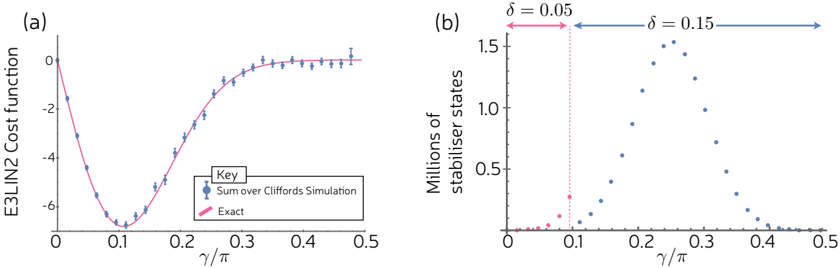
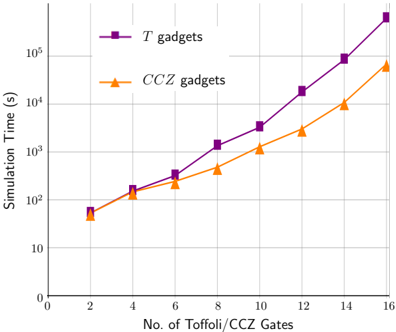
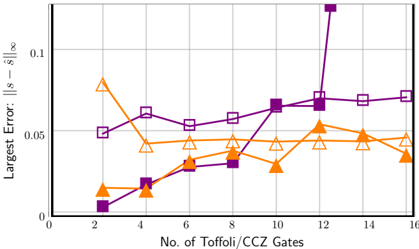
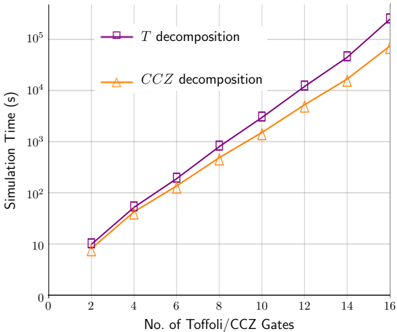
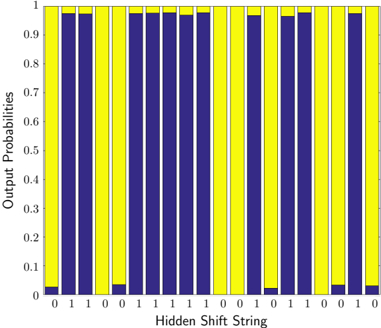
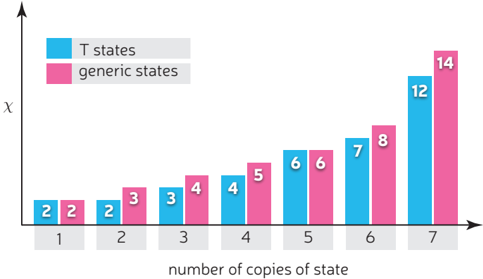
Recent work has explored using the stabilizer formalism to classically simulate quantum circuits containing a few non-Clifford gates. The computational cost of such methods is directly related to the notion of s t a b i l i z e r rank , which for a pure state ψ is defined to be the smallest integer χ such that ψ is a superposition of χ stabilizer states. Here we develop a comprehensive mathematical theory of the stabilizer rank and the related approximate stabilizer rank. We also present a suite of classical simulation algorithms with broader applicability and significantly improved performance over the previous state-of-the-art. A new feature is the capability to simulate circuits composed of Clifford gates and arbitrary diagonal gates, extending the reach of a previous algorithm specialized to the Clifford+T gate set. We implemented the new simulation methods and used them to simulate quantum algorithms with 40-50 qubits and over 60 non-Clifford gates, without resorting to high-performance computers. We report a simulation of the Quantum Approximate Optimization Algorithm in which we process superpositions of χ ∼ 10 6 stabilizer states and sample from the full n -bit output distribution, improving on previous simulations which used ∼ 10 3 stabilizer states and sampled only from single-qubit marginals. We also simulated instances of the Hidden Shift algorithm with circuits including up to 64 T gates or 16 CCZ gates; these simulations showcase the performance gains available by optimizing the decomposition of a circuit's non-Clifford components.
Overview
The claims and statistics of this paper haven’t been checked yet.
Free: it reads the open-access text and checks the first 5 claims that cite a source we can check. Create a free account to check every claim.
Integrity signals
Registry
Cites
Statistics
Figures
Verification
Claims the paper makes
The claims and statistics of this paper haven’t been checked yet.
Free: it reads the open-access text and checks the first 5 claims that cite a source we can check. Create a free account to check every claim.
Claims other papers make about this one
Each is checked against this paper’s own text: does it say what the citing paper says it does?
The cited source says what the claim attributes to it.
In the citing paper
“Simulation of such logical circuits is challenging because of the high connectivity (rendering tensor networks inefficient) and large numbers of non-Cliffords50.”
From Logical quantum processor based on reconfigurable atom arrays (2024) · cites this paper as [50]
The cited source says what the claim attributes to it.
In the citing paper
“state-of-the-art Clifford + T simulators can handle roughly 16 CCZ gates50.”
From Logical quantum processor based on reconfigurable atom arrays (2024) · cites this paper as [50]
Self-check
Percentages, sums and reported differences re-computed from the paper’s own numbers.
The self-check needs the paper’s full text.
Citations
Cites
Boyd, S., & Vandenberghe, L. (2004) · doi:10.1017/cbo9780511804441 · Cited by 56,601
Quantum Computation and Quantum Information
Nielsen, M. A., Chuang, I., & Grover, L. K. (2002) · American Journal of Physics · doi:10.1119/1.1463744 · Cited by 21,895
Quantum Computing in the NISQ era and beyond
Preskill, J. (2018) · Quantum · doi:10.22331/q-2018-08-06-79 · Cited by 8,830 · cited 1×
“As a main application of our simulation algorithms we envision verification of noisy intermediatesize quantum circuits [49] in the regime when a brute-force classical simulation may be impractical [3, 35, 44].”
MethodProbability Inequalities for Sums of Bounded Random Variables
Hoeffding, W. (1963) · Journal of the American Statistical Association · doi:10.1080/01621459.1963.10500830 · Cited by 4,852
Gottesman, D., & Chuang, I. L. (1999) · Nature · doi:10.1038/46503 · Cited by 1,860 · cited 1×
“[28]).”
Universal quantum computation with ideal Clifford gates and noisy ancillas
Bravyi, S., & Kitaev, A. (2005) · Physical Review A · doi:10.1103/physreva.71.022316 · Cited by 1,525 · cited 2×
“It is known that stabilizer operations augmented with preparation of certain single-qubit “magic states” become computationally universal [12].”
BackgroundSelf-citationImproved simulation of stabilizer circuits
Aaronson, S., & Gottesman, D. (2004) · Physical Review A · doi:10.1103/physreva.70.052328 · Cited by 1,515 · cited 4×
“i noise models [27] only requires quantum circuits composed of Cliord gates and Pauli measurements{which can be easily simulated classically for thousands of qubits using the Gottesman-Knill theorem [2,6]. Furthermore, it is known that Cliord circuits can be promoted to universal quantum computation when provided with…”
BackgroundMethodInfluentialQiskit: An Open-source Framework for Quantum Computing
Aleksandrowicz, G., Alexander, T., Barkoutsos, P. K., Bello, L., Ben-Haim, Y., Bucher, D., Cabrera-Hernández, F. J., Carballo-Franquis, J., Chen, A., Chen, C.-F., et al. (2019) · Zenodo (CERN European Organization for Nuclear Research) · doi:10.5281/zenodo.2562110 · Cited by 1,434
Qiskit: An Open-source Framework for Quantum Computing
Aleksandrowicz, G., Alexander, T., Barkoutsos, P. K., et al. (2019) · Zenodo (CERN European Organization for Nuclear Research) · doi:10.5281/zenodo.2562111 · Cited by 1,314
Characterizing quantum supremacy in near-term devices
Boixo, S., Isakov, S. V., Smelyanskiy, V. N., Babbush, R., Ding, N., Jiang, Z., Bremner, M. J., Martinis, J. M., & Neven, H. (2018) · Nature Physics · doi:10.1038/s41567-018-0124-x · Cited by 1,175 · cited 1×
“Several tensor-based simulators have been developed [17, 39, 48] for geometrically local shallow quantum circuits that include only nearest-neighbor gates on a 2D grid of qubits [9].”
Background
Research works printed but not linked: 2
- 3. Dorit Aharonov, Michael Ben-Or, Elad Eban, and Urmila Mahadev. Interactive proofs for quantum computations. arXiv preprint arXiv:1704.04487, 2017. · arXiv
- 29. David Gross, Sepehr Nezami, and Michael Walter. Schur-Weyl duality for the Clifford group with applications: Property testing, a robust Hudson theorem, and de Finetti representations. arXiv preprint arXiv:1712.08628, 2017. · arXiv
Cited by
Items 101–200 of 303
Universal limitations on implementing resourceful unitary evolutions
Takagi, R., & Tajima, H. (2020) · Physical Review A · doi:10.1103/physreva.101.022315 · Cited by 21
“It was shown that the stabilizer extent is multiplicative for tensor products between states supported on up to three qubits [43], and thus R satisfies Property 3’.”
BackgroundInfluentialGleipnir: toward practical error analysis for Quantum programs
Tao, R., Shi, Y., Yao, J., Hui, J., Chong, F. T., & Gu, R. (2021) · ACM SIGPLAN Conference on Programming Language Design and Implementation (PLDI) · doi:10.1145/3453483.3454029 · Cited by 33
“master equation [30]—neither of which scales beyond a few qubits [35]—and (2) approximate methods, based on either Clifford circuit approximation [6, 18, 19, 29] or classical sampling methods with Monte-Carlo simulations [31, 45, 51, 53].”
MethodPseudorandom unitaries are neither real nor sparse nor noise-robust
Haug, T., Bharti, K., & Koh, D. E. (2025) · Quantum · doi:10.22331/q-2025-06-04-1759 · Cited by 72
Equivalence Checking of Dynamic Quantum Circuits
Hong, X., Feng, Y., Li, S., & Ying, M. (2022) · International Conference on Computer Aided Design · doi:10.1145/3508352.3549479 · Cited by 36
“More recently, DQCs have been used in extending the lifetime of qubits [17], resetting qubits [20], realising non-elementary quantum gates [5, 22], generating entanglement [21, 23], and embedding the classical real-time logic into quantum systems [1, 9].”
MethodStair, N. H., & Evangelista, F. A. (2022) · Journal of Chemical Theory and Computation · doi:10.1021/acs.jctc.1c01155 · Cited by 34
Advances in Quantum Computation and Quantum Technologies: A Design Automation Perspective
Micheli, G. D., Jiang, J.-H. R., Rand, R. W., Smith, K. N., & Soeken, M. (2022) · IEEE Journal on Emerging and Selected Topics in Circuits and Systems · doi:10.1109/jetcas.2022.3205174 · Cited by 27
“There are recent efforts [177], [178], [179] that attempt to alleviate the exponential growth through the notion of stabilizer rank [178] by decomposing a state into the superposition of a number of stabilizer states [177].”
BackgroundA Herculean task: classical simulation of quantum computers
Xu, X., Benjamin, S. C., Chen, J., Sun, J., Yuan, X., & Zhang, P. (2025) · Science Bulletin · doi:10.1016/j.scib.2025.10.016 · Cited by 79
“[65], which proposes a sparsification method to obtain an approximation of the target state with a decomposition that contains fewer stabilizer states.”
Chaos and magic in the dissipative quantum kicked top
Passarelli, G., Lucignano, P., Rossini, D., & Russomanno, A. (2025) · Quantum · doi:10.22331/q-2025-03-05-1653 · Cited by 37
Huang, J., Qian, X., & Qin, M. (2025) · Physical Review A · doi:10.1103/gxdn-zwrw · Cited by 45
Quantum Convolutional Neural Network For Image Classification
Chen, G., Chen, Q., Long, S., & Zhu, W. (2020) · International Conference on Digital Home (ICDH) · doi:10.1109/icdh51081.2020.00028 · Cited by 19
Quantifying multiqubit magic channels with completely stabilizer-preserving operations
Saxena, G., & Gour, G. (2022) · Physical Review A · doi:10.1103/physreva.106.042422 · Cited by 32
“We extend the generalized robustness and the min-relative entropy of magic from the state to the channel domain [28, 42].”
BackgroundInfluentialOptimality of T-gate for generating magic resource
Li, X., & Luo, S. (2023) · Communications in Theoretical Physics · doi:10.1088/1572-9494/acaf28 · Cited by 19
“The stabilizer rank, defined as the minimal number of components in the expansion of a state in terms of stabilizer states, was introduced in [13, 18].”
Magic Resource Can Enhance the Quantum Capacity of Channels
Bu, K., & Jaffe, A. M. (2025) · Physical Review Letters · doi:10.1103/physrevlett.134.050202 · Cited by 29
Improved Stabilizer Estimation via Bell Difference Sampling
Grewal, S., Iyer, V., Kretschmer, W., & Liang, D. (2024) · ACM Symposium on Theory of Computing (STOC) · doi:10.1145/3618260.3649738 · Cited by 80
Doped stabilizer states in many-body physics and where to find them
Gu, A., Oliviero, S. F. E., & Leone, L. (2024) · Physical Review A · doi:10.1103/physreva.110.062427 · Cited by 35
“It shows how the vast literature on doped stabilizer state simulation techniques [e.g., 32, 33] can be applied in many-body physics, enabling us to probe previously inaccessible high entanglement regimes.”
Optimal diagonal qutrit gates for creating Wigner negativity
Li, X., & Luo, S. (2023) · Physics Letters A · doi:10.1016/j.physleta.2022.128620 · Cited by 18
Nonequilibrium quantum Monte Carlo algorithm for stabilizer Rényi entropy in spin systems
Liu, Z., & Clark, B. K. (2025) · Physical review. B./Physical review. B · doi:10.1103/physrevb.111.085144 · Cited by 37
“The nonstabilizerness of a state is called quantum magic and characterizes the deviation of a quantum state from a stabilizer state, or alternatively, how many stabilizer states are required for an accurate classical description of this state [15–21].”
Simulating quantum circuit expectation values by Clifford perturbation theory
Begušić, T., Hejazi, K., & Chan, G. K. (2025) · The Journal of Chemical Physics · doi:10.1063/5.0269149 · Cited by 76
Stabilizer rank and higher-order Fourier analysis
Labib, F. (2022) · Quantum · doi:10.22331/q-2022-02-09-645 · Cited by 21
Simulation of quantum optics by coherent state decomposition
Marshall, J., & Anand, N. (2023) · Optica Quantum · doi:10.1364/opticaq.504311 · Cited by 35
“[8], for a stabilizer rank decomposition.”
BackgroundMethodResultInfluentialMagic of random matrix product states
Chen, L., Garcia, R. J., Bu, K., & Jaffe, A. M. (2024) · Physical review. B./Physical review. B · doi:10.1103/physrevb.109.174207 · Cited by 35
Stabilizer Tensor Networks with Magic State Injection
Nakhl, A. C., Harper, B., West, M. T., Dowling, N., Sevior, M. E., Quella, T., & Usman, M. (2025) · Physical Review Letters · doi:10.1103/physrevlett.134.190602 · Cited by 45
“[7], which simulates up to 64 T -gates on 40 qubits using an extended stabilizer simulator that scales exponentially with the number of T -gates, Figure 3(b) shows that our technique is able to simulate 160 T -gates on 40 qubits.”
InfluentialMana and thermalization: Probing the feasibility of near-Clifford Hamiltonian simulation
Sewell, T. J., & White, C. D. (2022) · Physical review. B./Physical review. B · doi:10.1103/physrevb.106.125130 · Cited by 24
One-Shot Yield-Cost Relations in General Quantum Resource Theories
Takagi, R., Regula, B., & Wilde, M. M. (2022) · PRX Quantum · doi:10.1103/prxquantum.3.010348 · Cited by 26
Bridging Magic and Non-Gaussian Resources via Gottesman-Kitaev-Preskill Encoding
Hahn, O., Ferrini, G., & Takagi, R. (2025) · PRX Quantum · doi:10.1103/prxquantum.6.010330 · Cited by 32
Stabilizer Testing and Magic Entropy via Quantum Fourier Analysis
Bu, K.-F., Gu, W.-C., & Jaffe, A. (2023) · Communications in Mathematical Physics · doi:10.1007/s00220-025-05421-3 · Cited by 21
Quantum supremacy and hardness of estimating output probabilities of quantum circuits
Kondo, Y., Mori, R., & Movassagh, R. (2022) · Annual Symposium on Foundations of Computer Science · doi:10.1109/focs52979.2021.00126 · Cited by 46
Clifford recompilation for faster classical simulation of quantum circuits
Qassim, H., Wallman, J. J., & Emerson, J. (2019) · Quantum · doi:10.22331/q-2019-08-05-170 · Cited by 27
“As the exponential scaling of the runtimes in [5] is determined by ‖a‖(2)1, this allows for a significant speed-up in some cases.”
BackgroundMethodInfluentialEfficient witnessing and testing of magic in mixed quantum states
Haug, T., & Tarabunga, P. S. (2026) · npj Quantum Information · doi:10.1038/s41534-026-01189-z · Cited by 54
“Additionally, W α also relates to another magic monotone, namely the stabilizer fidelity for mixed states [52, 53] where we have the Uhlmann fidelity F ( ρ, σ ) = tr( √ ρσ ) 2 [54] and D F ( ρ ) ≤ LR( ρ ) (see Appendix D).”
Quantum circuit compilation and hybrid computation using Pauli-based computation
Peres, F. C. R., & Galvão, E. F. (2023) · Quantum · doi:10.22331/q-2023-10-03-1126 · Cited by 33
“Finally, compared against the weak simulators based on stabilizer-rank techniques proposed in [22] and [23], which allow to approximately sample from the output distribution of the desired”
BackgroundMethodInfluentialOptimal Quantum Circuit Cuts with Application to Clustered Hamiltonian Simulation
Harrow, A. W., & Lowe, A. (2025) · PRX Quantum · doi:10.1103/prxquantum.6.010316 · Cited by 58
Improved simulation of quantum circuits dominated by free fermionic operations
Reardon-Smith, O., Oszmaniec, M., & Korzekwa, K. (2024) · Quantum · doi:10.22331/q-2024-12-04-1549 · Cited by 77
“[19] for phase-sensitive simulation of stabilizer quantum mechanics.”
InfluentialMagic transition in measurement-only circuits
Tarabunga, P. S., & Tirrito, E. (2025) · npj Quantum Information · doi:10.1038/s41534-025-01104-y · Cited by 48
“Such measures exist 33,36 – 40 , including those whose original de fi nitions involve minimization procedures, and are thus generally dif fi cult to compute beyond a few qubits.”
The axiomatic and the operational approaches to resource theories of magic do not coincide
Heimendahl, A., Heinrich, M., & Gross, D. (2022) · Journal of Mathematical Physics · doi:10.1063/5.0085774 · Cited by 35
“A number of such magic monotones have been studied and their values linked to the runtime of classical simulation algorithms [15, 19–21].”
BackgroundNonstabilizerness of a boundary time crystal
Passarelli, G., Russomanno, A., & Lucignano, P. (2025) · Physical Review A · doi:10.1103/d7tm-9hkp · Cited by 22
A nonstabilizerness monotone from stabilizerness asymmetry
Tarabunga, P. S., Frau, M., Haug, T., Tirrito, E., & Piroli, L. (2025) · Quantum Science and Technology · doi:10.1088/2058-9565/adfd0d · Cited by 34
“First, we introduce the min-relative entropy of magic [16, 66], defined by where is the stabilizer fidelity.”
InfluentialRussomanno, A., Passarelli, G., Rossini, D., & Lucignano, P. (2025) · Physical review. B./Physical review. B · doi:10.1103/njgn-fksh · Cited by 34
Simulation of Quantum Computers: Review and Acceleration Opportunities
Cicero, A., Maleki, M. A., Azhar, M. W., Kockum, A. F., & Trancoso, P. (2025) · ACM Transactions on Quantum Computing · doi:10.1145/3762672 · Cited by 44
“The complexity of the tensor network is constrained by the largest tensor involved in the contraction process.”
Quantum Data Compression for Efficient Generation of Control Pulses
Volya, D., & Mishra, P. (2023) · Asia and South Pacific Design Automation Conference (ASP-DAC) · doi:10.1145/3566097.3567927 · Cited by 15
“The circuits are then efficiently simulated on a classical computer to generate a noiseless dataset[20].”
MethodComplexity Phase Transitions Generated by Entanglement
Ghosh, S., Deshpande, A., Hangleiter, D., Gorshkov, A. V., & Fefferman, B. (2023) · Physical Review Letters · doi:10.1103/physrevlett.131.030601 · Cited by 25
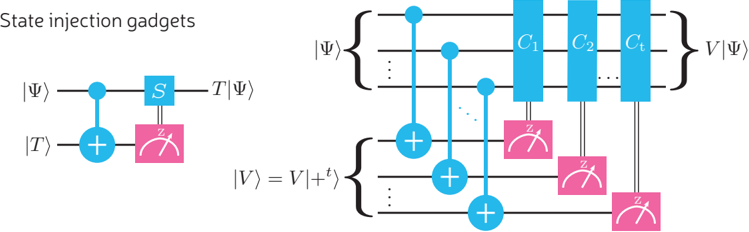
“From [30], any quantum circuit having Clifford gates and t T gates can be implemented by a quantum circuit starting with t magic states, each given by Both the stabilizer and the approximate stabilizer rank of this equivalent circuit are O ( 2 ct ) , for some constant c . factor Due to local…”
BackgroundMethodClassical simulation of non-Gaussian bosonic circuits
Dias, B., & König, R. (2024) · Physical Review A · doi:10.1103/physreva.110.042402 · Cited by 35
“Our work mirrors earlier findings in the context of stabilizer [20, 23, 26], matchgate and fermionic linear optics computations [21, 24].”
MethodResultExtracting randomness from magic quantum states
Vairogs, C., & Yan, B. (2025) · Physical Review Research · doi:10.1103/3ttm-vhdt · Cited by 25
Bridging Entanglement and Magic Resources within Operator Space
Dowling, N., Modi, K. K., & White, G. A. L. (2025) · Physical Review Letters · doi:10.1103/c7k1-xcwy · Cited by 57
Quantum magic in quantum electrodynamics
Liu, Q., Low, I., & Yin, Z. (2026) · Physical review. D/Physical review. D. · doi:10.1103/l8vw-kwhz · Cited by 40
Fermionic Magic Resources of Quantum Many-Body Systems
Sierant, P., Stornati, P., & Turkeshi, X. (2026) · PRX Quantum · doi:10.1103/3yx4-1j27 · Cited by 86
“Measures of non-stabilizerness, such as the stabilizer rank [30, 38], stabilizer fidelity [39], or the magic robustness [31, 40], provide bounds on the increasing complexity of representing quantum states as they deviate further from the set of stabilizer states.”
Optimal Hadamard Gate Count for Clifford+ T Synthesis of Pauli Rotations Sequences
Vandaele, V., Martiel, S., Perdrix, S., & Vuillot, C. (2023) · ACM Transactions on Quantum Computing · doi:10.1145/3639062 · Cited by 20
Zero and Finite Temperature Quantum Simulations Powered by Quantum Magic
Gu, A., Hu, H.-Y., Luo, D., Patti, T. L., Rubin, N. C., & Yelin, S. F. (2024) · Quantum · doi:10.22331/q-2024-07-23-1422 · Cited by 19
“Like entanglement, quantum magic has also been shown to be directly connected with the hardness of classical simulation [5].”
BackgroundRubboli, R., Takagi, R., & Tomamichel, M. (2024) · Quantum · doi:10.22331/q-2024-10-04-1492 · Cited by 28
“Moreover, we used that, for pure states, F 0 is equal to the stabilizer fidelity and the latter is multiplicative for an arbitrary number of pure states [26].”
BackgroundMethodResultInfluentialClassical Simulability of Quantum Circuits with Shallow Magic Depth
Zhang, Y., & Zhang, Y. (2025) · PRX Quantum · doi:10.1103/prxquantum.6.010337 · Cited by 22
Efficient Learning of Quantum States Prepared With Few Non-Clifford Gates
Grewal, S., Iyer, V., Kretschmer, W., & Liang, D. (2025) · Quantum · doi:10.22331/q-2025-11-06-1907 · Cited by 77
Detecting quantum phase transition via magic resource in the XY spin model
Fu, S., Li, X., & Luo, S. (2022) · Physical Review A · doi:10.1103/physreva.106.062405 · Cited by 14
Fast Equivalence Checking of Quantum Circuits of Clifford Gates
Thanos, D., Coopmans, T. J., & Laarman, A. (2023) · Lecture notes in computer science · doi:10.1007/978-3-031-45332-8_10 · Cited by 21
“Possible future work includes extending this method to arbitrary circuits us-ing non-Clifford gates [7,4], following existing classical simulation formalisms of such circuits [13].”
MethodFaster variational quantum algorithms with quantum kernel-based surrogate models
Smith, A. W. R., Paige, A. J., & Kim, M. S. (2023) · Quantum Science and Technology · doi:10.1088/2058-9565/aceb87 · Cited by 17
“This is not at all surprising as an initial stabilizer state with only a few non-Clifford rotations applied can be simulated “efficiently” (i.e. at cost polynomial in the number of qubits n , but exponential in the number of non-Clifford gates) on a classical computer [86].”
BackgroundDeep quantum circuit simulations of low-energy nuclear states
Li, A., Baroni, A., Stetcu, I., & Humble, T. S. (2024) · The European Physical Journal A · doi:10.1140/epja/s10050-024-01286-7 · Cited by 14
“These include state-vector [46, 52], density-matrix [47, 53], tensor-network [49, 54], decision diagrams [55, 56], stabilizer [50, 57], and device-level simulation such as pulse-based simulation [58].”
Lower Bounds on Stabilizer Rank
Peleg, S., Shpilka, A., & Volk, B. L. (2022) · Quantum · doi:10.22331/q-2022-02-15-652 · Cited by 29
“[4] present a different restricted model in which they prove an exponential lower bound.”
BackgroundMethodInfluentialEpsilon measures of state-based quantum resource theory
Luo, Y., Meng, F., & Wang, Y. (2024) · Physical Review A · doi:10.1103/physreva.109.052413 · Cited by 10
Fault-Tolerant Compiling of Classically Hard Instantaneous Quantum Polynomial Circuits on Hypercubes
Hangleiter, D., Kalinowski, M., Bluvstein, D., Cain, M., Maskara, N., Gao, X., Kubica, A., Lukin, M. D., & Gullans, M. J. (2025) · PRX Quantum · doi:10.1103/prxquantum.6.020338 · Cited by 39
“6(a), and find that it is significantly smaller than n by a constant factor for hyperdepth L = 1 but nearly saturating the maximal value of n − 1 at Another family of simulation algorithms are near-Clifford simulators [98,99].”
Magic Monotone for Faithful Detection of Nonstabilizerness in Mixed States
Warmuz, K., Dokudowiec, E., Radhakrishnan, C., & Byrnes, T. (2025) · Physical Review Letters · doi:10.1103/2s3j-t22p · Cited by 24
Sun, J., Cheng, L., & Zhang, S. (2025) · Quantum · doi:10.22331/q-2025-06-24-1782 · Cited by 24
“…states are utilized as important tools in the explorations of quantum information [47, 48], quantum dynamics [49, 50, 51], quantum error correction [52, 53], topological quantum computing [54], quantum circuit simulation [55, 56, 57], and quantum-classical hybrid algorithms [58, 59, 60, 61, 62].”
Universal resources for quantum computing
Wang, D. (2023) · Communications in Theoretical Physics · doi:10.1088/1572-9494/ad07d6 · Cited by 12
Abstraqt: Analysis of Quantum Circuits via Abstract Stabilizer Simulation
Bichsel, B., Paradis, A., Baader, M., & Vechev, M. (2023) · Quantum · doi:10.22331/q-2023-11-20-1185 · Cited by 16
“Overall, we considered two tools based on stabilizer simulation (ESS [5] and QuiZX [4]), one tool based on abstract interpretation (YP21 [20], in two different modes), and one tool based on state vectors (Statevector as implemented by Qiskit [14]).”
BackgroundMethodInfluentialSynthesizing Quantum Circuits via Numerical Optimization
de Brugière, T. G., Baboulin, M., Valiron, B., & Allouche, C. (2019) · Lecture notes in computer science · doi:10.1007/978-3-030-22741-8_1 · Cited by 13
“Obtaining the matrix from the circuit can be done either by running the circuit on a quantum hardware (plus some tomography) or via a simulation on a classical computer [2, 24].”
Classical simulation of quantum circuits using fewer Gaussian eliminations
Kocia, L., & Sarovar, M. (2021) · Physical Review A · doi:10.1103/physreva.103.022603 · Cited by 9
Imperfect quantum networks with tailored resource states
Mor-Ruiz, M. F., Wallnöfer, J., & Dür, W. (2025) · Quantum · doi:10.22331/q-2025-01-21-1605 · Cited by 15
Qudit Shadow Estimation Based on the Clifford Group and the Power of a Single Magic Gate
Mao, C., Yi, C., & Zhu, H. (2025) · Physical Review Letters · doi:10.1103/physrevlett.134.160801 · Cited by 24
“Currently, there are two main approaches for dealing with magic gates: the first one is based on gadgetization [67, 68], and the second one is based on low-rank stabilizer decomposition [56].”
Maximal magic for two-qubit states
Liu, Q., Low, I., & Yin, Z. (2026) · Quantum Science and Technology · doi:10.1088/2058-9565/ae3028 · Cited by 37
Nonstabilizerness of neural quantum states
Sinibaldi, A., Mello, A. F., Collura, M., & Carleo, G. (2025) · Physical Review Research · doi:10.1103/v5tw-yn1f · Cited by 33
Contraction of ZX diagrams with triangles via stabiliser decompositions
Koch, M. E., Yeung, R. W. K., & Wang, Q. (2024) · Physica Scripta · doi:10.1088/1402-4896/ad6fd8 · Cited by 20
“The family of hidden shift circuits for benchmarking stabiliser decomposition based simulators was first introduced in [4] and has since been used for benchmarking in [3, 19, 20, 28].”
MethodStationary Phase Method in Discrete Wigner Functions and Classical Simulation of Quantum Circuits
Kocia, L., & Love, P. J. (2021) · Quantum · doi:10.22331/q-2021-07-05-494 · Cited by 8
“This also seems to have been noticed in the discrete community, which has turned to favor stabilizer state decomposition of magic states [43, 45].”
BackgroundQuantifying magic resource via quantum Jensen–Shannon divergence
Tian, P., & Sun, Y. (2024) · Journal of Physics A Mathematical and Theoretical · doi:10.1088/1751-8121/ad9a28 · Cited by 7
“In particular, when ρ = | ψ ⟩⟨ ψ | is a pure state, where is the stabilizer fidelity introduced in [70].”
Efficient learning for linear properties of bounded-gate quantum circuits
Du, Y., Hsieh, M.-H., & Tao, D. (2025) · Nature Communications · doi:10.1038/s41467-025-59198-z · Cited by 27
Unlocking early fault-tolerant quantum computing with mitigated magic dilution
Luthra, S., Moylett, A. E., Browne, D. E., & Campbell, E. T. (2025) · Quantum Science and Technology · doi:10.1088/2058-9565/ae0aef · Cited by 14
“[30– 34].”
InfluentialSelf-citationClassical simulation and quantum resource theory of non-Gaussian optics
Hahn, O., Takagi, R., Ferrini, G., & Yamasaki, H. (2025) · Quantum · doi:10.22331/q-2025-10-13-1881 · Cited by 41
“In analogy to the resource theory of magic [23, 38, 44], we define the Gaussian rank as and the Gaussian extent as We allow in the definition of the Gaussian rank and the Gaussian extent countably infinitely many terms in the decomposition.”
InfluentialComputing quantum magic of state vectors
Sierant, P., Vallès-Muns, J., & García-Sáez, A. (2026) · Quantum · doi:10.22331/q-2026-04-10-2059 · Cited by 34
Improved graph formalism for quantum circuit simulation
Hu, A. T., & Khesin, A. B. (2022) · Physical Review A · doi:10.1103/physreva.105.022432 · Cited by 20
Optimality of the Howard-Vala T-gate in stabilizer quantum computation
Feng, L., & Luo, S. (2024) · Physica Scripta · doi:10.1088/1402-4896/ad80e7 · Cited by 7
Quantum Ruzsa Divergence to Quantify Magic
Bu, K., Gu, W., & Jaffe, A. (2025) · IEEE Transactions on Information Theory · doi:10.1109/tit.2025.3543276 · Cited by 20
“Later, the extension of the Gottesman-Knill theorem beyond stabilizer circuits was further studied [15], [16], [17], [18], [19], [20], [21], [22], [23], [24].”
Shallow quantum circuits for deeper problems
Pérez-Salinas, A., Draškić, R., Tura, J., & Dunjko, V. (2023) · Physical Review A · doi:10.1103/physreva.108.062423 · Cited by 19
“The idea of CB-rank is also closely related to the stabilizer rank in stabilizer-based methods for simulating circuits [16].”
MethodQuantum Advantage with Noisy Shallow Circuits in 3D
Bravyi, S. B., Gosset, D., König, R., & Tomamichel, M. (2019) · Annual Symposium on Foundations of Computer Science · doi:10.1109/focs.2019.00064 · Cited by 10
“[12] Sergey Bravyi, Dan Browne, Padraic Calpin, Earl Campbell, David Gosset, and Mark Howard.”
BackgroundSelf-citationFast simulation of planar Clifford circuits
Gosset, D., Grier, D., Kerzner, A., & Schaeffer, L. (2024) · Quantum · doi:10.22331/q-2024-02-12-1251 · Cited by 19
Self-citationHarvesting stabilizer entropy and nonlocality from a quantum field
Cepollaro, S., Cusumano, S., Hamma, A., Giudice, G. L., & Odavić, J. (2025) · Physical review. D/Physical review. D. · doi:10.1103/4brj-cl26 · Cited by 18
Anticoncentration and state design of doped real Clifford circuits and tensor networks
Magni, B., Heinrich, M., Leone, L., & Turkeshi, X. (2026) · Physical Review A · doi:10.1103/w6l4-mh6k · Cited by 23
Simulating quantum computations with Tutte polynomials
Mann, R. L. (2021) · npj Quantum Information · doi:10.1038/s41534-021-00477-0 · Cited by 8
“37 .”
New techniques for bounding stabilizer rank
Lovitz, B., & Steffan, V. (2022) · Quantum · doi:10.22331/q-2022-04-20-692 · Cited by 20
“So we may assume A i ⊆ R for all i ∈ [3].”
BackgroundMethodInfluentialFaster Born probability estimation via gate merging and frame optimisation
Koukoulekidis, N., Kwon, H., Jee, H. H., Jennings, D., & Kim, M. S. (2022) · Quantum · doi:10.22331/q-2022-10-13-838 · Cited by 9
Overcoming entropic limitations on asymptotic state transformations through probabilistic protocols
Regula, B., Lami, L., & Wilde, M. M. (2023) · Physical Review A · doi:10.1103/physreva.107.042401 · Cited by 12
“…resourceful one in order to satisfy D max , F ( ψ ) = D min , F ( ψ ) (a counterexample being, e.g., the Clifford magic states discussed in [60] in the resource theory of nonstabilizer quantum computation), but condition 1 is nevertheless a useful assumption to state as it can be satisfied…”
BackgroundApproximate error correction scheme for three-dimensional surface codes based reinforcement learning
Qu, Y., 陈, Z. 钊. C., 王, W.-J. 伟. W., & 马, H.-Y. 鸿. M. (2023) · Chinese Physics B · doi:10.1088/1674-1056/acd8a9 · Cited by 8
Wasserstein complexity of quantum circuits
Li, L., Bu, K., Koh, D. E., Jaffe, A. M., & Lloyd, S. (2025) · Journal of Physics A Mathematical and Theoretical · doi:10.1088/1751-8121/ade381 · Cited by 29
“[26] Sergey Bravyi, Dan Browne, Padraic Calpin, Earl Campbell, David Gosset, and Mark Howard, “Simulation of quantum circuits by low-rank stabilizer decompositions,” Quantum 3, 181 (2019).”
Feynman-path-type simulation using stabilizer projector decomposition of unitaries
Huang, Y., & Love, P. J. (2021) · Physical Review A · doi:10.1103/physreva.103.022428 · Cited by 13
“The method based on Sum-over-Cliffords for unitaries [8]: where K j ’s are all Clifford gates and a j ’s are some complex coefficients.”
MethodQuantifying magic resource for quantum channels via channel-state duality
Li, X., Luo, S., & Zhang, Z. (2025) · Physical Review A · doi:10.1103/physreva.111.052420 · Cited by 5
Displaced fermionic Gaussian states and their classical simulation
Lyu, X., & Bu, K. (2025) · Journal of Physics A Mathematical and Theoretical · doi:10.1088/1751-8121/ade647 · Cited by 11
Accelerating Simulation of Quantum Circuits under Noise via Computational Reuse
Wang, M., Tannu, S., & Nair, P. J. (2025) · Proceedings - International Symposium on Computer Architecture/Proceedings · doi:10.1145/3695053.3730992 · Cited by 12
“Beyond general-purpose simulators, a class of quantum circuit simulators can simulate special quantum circuits efficiently [8, 21, 63].”
Local spreading of stabilizer Rényi entropy in a brickwork random Clifford circuit
Maity, S., & Hamazaki, R. (2026) · Physical Review Research · doi:10.1103/68g7-8pdc · Cited by 10
Role of quantum state texture in probing resource theories and quantum phase transitions
Patra, A., Konar, T. K., Halder, P., & De, A. S. (2026) · Physical Review A · doi:10.1103/y2wz-ypln · Cited by 17
“The stabilizer formalism plays a crucial role in quantum information and computation, as many prototypical quantum error-correcting codes are built upon it [10, 54, 55], and Clifford operations within this framework can be implemented fault-tolerantly [56, 57].”
Stabilizer Bootstrapping: A Recipe for Efficient Agnostic Tomography and Magic Estimation
Chen, S., Gong, W., Ye, Q., & Zhang, Z. H. (2025) · ACM Symposium on Theory of Computing (STOC) · doi:10.1145/3717823.3718191 · Cited by 49
Unitary-invariant method for witnessing nonstabilizerness in quantum processors
Wagner, R., Peres, F. C. R., Cruzeiro, E. Z., & Galvão, E. F. (2025) · Journal of Physics A Mathematical and Theoretical · doi:10.1088/1751-8121/ade9ff · Cited by 20
“The following monotones require complete knowledge of the underlying state and of the STAB polytope: stabilizer fidelity [20], stabilizer extent [20], stabilizer rank [20–22], stabilizer nullity [72].”
Fast Emulation of Fermionic Circuits with Matrix Product States
Provazza, J., Gunst, K., Zhai, H., Chan, G. K., Shiozaki, T., Rubin, N. C., & White, A. F. (2024) · Journal of Chemical Theory and Computation · doi:10.1021/acs.jctc.4c00200 · Cited by 10
“For example, approximate tensor network contraction [1–4], stabilizer simulation [5], or Clifford perturbation theory [6] have been used to classically emulate a quantum computational task at much lower complexity than exact state vector simulation of the quantum circuit.”
MethodKuantum Uyarlamalı Genetik Algoritmalar için Çözüm Kalitesini Artıracak Yeni Bir Yaklaşım
Yetış, H., & Karaköse, M. (2021) · Fırat Üniversitesi Mühendislik Bilimleri Dergisi · doi:10.35234/fumbd.749192 · Cited by 5
“[28] Bravyi S, Browne D, Calpin P, Campbell E, Gosset D, Howard M.”
BackgroundApproximating Hamiltonian dynamics with the Nyström method
Rudi, A., Wossnig, L., Ciliberto, C., Rocchetto, A., Pontil, M., & Severini, S. (2020) · Quantum · doi:10.22331/q-2020-02-20-234 · Cited by 15
Single-Copy Stabilizer Testing
Hinsche, M., & Helsen, J. (2025) · ACM Symposium on Theory of Computing (STOC) · doi:10.1145/3717823.3718169 · Cited by 18
“Definition 2.10 (Stabilizer fidelity, [6]).”
Influential
Metadata
- Authors
- Bravyi, S., Browne, D., Calpin, P., Campbell, E., Gosset, D., & Howard, M.
- Affiliations
- IBM (United States) (US)
- University College London (GB)
- University of Sheffield (GB)
- Venue
- Quantum
- Published
- 2019-09-02
- Volume
- 3
- Pages
- 181
- ISSN
- 2521-327X (ISSN-L)
- OpenAlex
- W2885845431
- Cited by
- 302
- References
- 45
- Citations by year
- 2026: 46 · 2025: 90 · 2024: 47 · 2023: 34 · 2022: 38 · 2021: 24 · 2020: 13 · 2019: 10
- FWCI
- 9.69
- Type
- journal article
- Language
- en
- Open access
- gold
- doi.org
- Locations
- Quantum (publishedVersion, cc-by)
- ARAN (University of Galway Research Repository) (Ollscoil na Gaillimhe – University of Galway) (acceptedVersion, cc-by-nc-nd)
- arXiv (Cornell University) (submittedVersion)
- DOAJ (DOAJ: Directory of Open Access Journals) (submittedVersion)
- ARAN (University of Galway Research Repository) (Ollscoil na Gaillimhe – University of Galway) (submittedVersion, cc-by)
- arXiv (Cornell University) (cc-by)
- Funders
- Engineering and Physical Sciences Research Council (M013243/1, EP/M013243/1, EP/M024261/1, EP/L015242/, EP/L015242/1)
- Topics
- Physical Sciences › Computer Science › Artificial Intelligence › Quantum Computing Algorithms and Architecture
- Physical Sciences › Physics and Astronomy › Atomic and Molecular Physics, and Optics › Quantum many-body systems
- Physical Sciences › Physics and Astronomy › Atomic and Molecular Physics, and Optics › Quantum Mechanics and Applications
- Keywords
- stabilizer states, classical simulation of quantum circuits, non-Clifford gates, Clifford gates, quantum approximate optimization algorithm, T-gate, CCZ gate
About these checks
Registry, retraction, Cites and statistics results are computed, not judged, with one exception: a printed reference that no index lists is read once by a model before it counts as a citation error. Claims are extracted by a model and kept only when their quote appears verbatim in the text; each cited source is then checked, with a model’s help, for whether it says what the claim relies on. Those verdicts can be wrong — read the claim’s quote and the cited source before relying on one.
Statistics and arithmetic are recomputed, not judged.
Confidence bands are shown only for fields calibrated on our annotated test set. None is calibrated yet, so no band is shown.
What counts as a claim ›How we measure confidence ›How we check this ›
Are you an author, or do you see a problem with this page? Request a review
Data sources
Bibliographic data: Semantic Scholar, OpenAlex, Crossref.
Contains information from the Semantic Scholar Academic Graph Datasets, made available under the ODC Attribution License (ODC-BY 1.0).
Semantic Scholar’s data is described in: Kinney, R., et al. (2023). The Semantic Scholar Open Data Platform. arXiv:2301.10140.
