

Simulation of quantum circuits by low-rank stabilizer decompositions
Open accessThe DOI matches its Crossref record; 60 of the 60 references it cites were found in a registry or an index.
Abstract
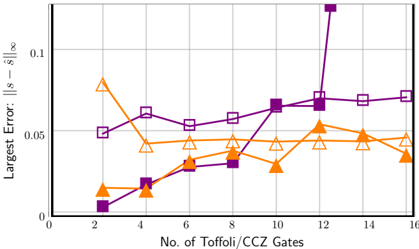
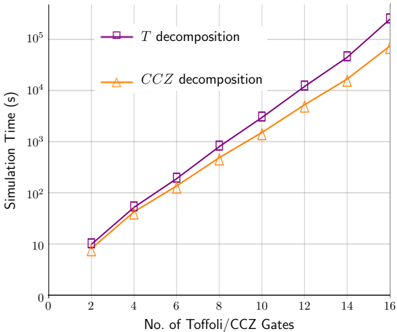
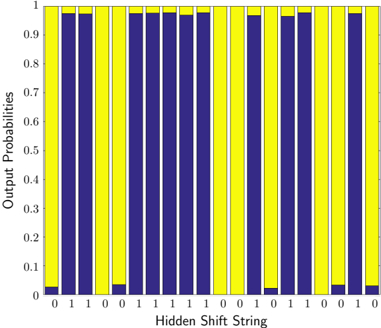
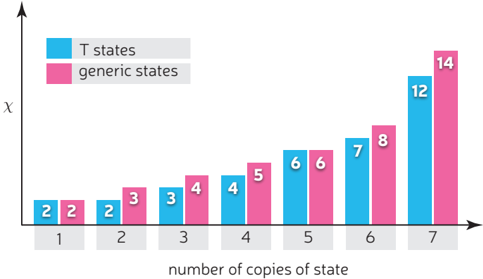
Recent work has explored using the stabilizer formalism to classically simulate quantum circuits containing a few non-Clifford gates. The computational cost of such methods is directly related to the notion of s t a b i l i z e r rank , which for a pure state ψ is defined to be the smallest integer χ such that ψ is a superposition of χ stabilizer states. Here we develop a comprehensive mathematical theory of the stabilizer rank and the related approximate stabilizer rank. We also present a suite of classical simulation algorithms with broader applicability and significantly improved performance over the previous state-of-the-art. A new feature is the capability to simulate circuits composed of Clifford gates and arbitrary diagonal gates, extending the reach of a previous algorithm specialized to the Clifford+T gate set. We implemented the new simulation methods and used them to simulate quantum algorithms with 40-50 qubits and over 60 non-Clifford gates, without resorting to high-performance computers. We report a simulation of the Quantum Approximate Optimization Algorithm in which we process superpositions of χ ∼ 10 6 stabilizer states and sample from the full n -bit output distribution, improving on previous simulations which used ∼ 10 3 stabilizer states and sampled only from single-qubit marginals. We also simulated instances of the Hidden Shift algorithm with circuits including up to 64 T gates or 16 CCZ gates; these simulations showcase the performance gains available by optimizing the decomposition of a circuit's non-Clifford components.
Overview
The claims and statistics of this paper haven’t been checked yet.
Free: it reads the open-access text and checks the first 5 claims that cite a source we can check. Create a free account to check every claim.
Integrity signals
Registry
Cites
Statistics
Figures
Verification
Claims the paper makes
The claims and statistics of this paper haven’t been checked yet.
Free: it reads the open-access text and checks the first 5 claims that cite a source we can check. Create a free account to check every claim.
Claims other papers make about this one
Each is checked against this paper’s own text: does it say what the citing paper says it does?
The cited source says what the claim attributes to it.
In the citing paper
“Simulation of such logical circuits is challenging because of the high connectivity (rendering tensor networks inefficient) and large numbers of non-Cliffords50.”
From Logical quantum processor based on reconfigurable atom arrays (2024) · cites this paper as [50]
The cited source says what the claim attributes to it.
In the citing paper
“state-of-the-art Clifford + T simulators can handle roughly 16 CCZ gates50.”
From Logical quantum processor based on reconfigurable atom arrays (2024) · cites this paper as [50]
Self-check
Percentages, sums and reported differences re-computed from the paper’s own numbers.
The self-check needs the paper’s full text.
Citations
Cites
Boyd, S., & Vandenberghe, L. (2004) · doi:10.1017/cbo9780511804441 · Cited by 56,601
Quantum Computation and Quantum Information
Nielsen, M. A., Chuang, I., & Grover, L. K. (2002) · American Journal of Physics · doi:10.1119/1.1463744 · Cited by 21,895
Quantum Computing in the NISQ era and beyond
Preskill, J. (2018) · Quantum · doi:10.22331/q-2018-08-06-79 · Cited by 8,830 · cited 1×
“As a main application of our simulation algorithms we envision verification of noisy intermediatesize quantum circuits [49] in the regime when a brute-force classical simulation may be impractical [3, 35, 44].”
MethodProbability Inequalities for Sums of Bounded Random Variables
Hoeffding, W. (1963) · Journal of the American Statistical Association · doi:10.1080/01621459.1963.10500830 · Cited by 4,852
Gottesman, D., & Chuang, I. L. (1999) · Nature · doi:10.1038/46503 · Cited by 1,860 · cited 1×
“[28]).”
Universal quantum computation with ideal Clifford gates and noisy ancillas
Bravyi, S., & Kitaev, A. (2005) · Physical Review A · doi:10.1103/physreva.71.022316 · Cited by 1,525 · cited 2×
“It is known that stabilizer operations augmented with preparation of certain single-qubit “magic states” become computationally universal [12].”
BackgroundSelf-citationImproved simulation of stabilizer circuits
Aaronson, S., & Gottesman, D. (2004) · Physical Review A · doi:10.1103/physreva.70.052328 · Cited by 1,515 · cited 4×
“i noise models [27] only requires quantum circuits composed of Cliord gates and Pauli measurements{which can be easily simulated classically for thousands of qubits using the Gottesman-Knill theorem [2,6]. Furthermore, it is known that Cliord circuits can be promoted to universal quantum computation when provided with…”
BackgroundMethodInfluentialQiskit: An Open-source Framework for Quantum Computing
Aleksandrowicz, G., Alexander, T., Barkoutsos, P. K., Bello, L., Ben-Haim, Y., Bucher, D., Cabrera-Hernández, F. J., Carballo-Franquis, J., Chen, A., Chen, C.-F., et al. (2019) · Zenodo (CERN European Organization for Nuclear Research) · doi:10.5281/zenodo.2562110 · Cited by 1,434
Qiskit: An Open-source Framework for Quantum Computing
Aleksandrowicz, G., Alexander, T., Barkoutsos, P. K., et al. (2019) · Zenodo (CERN European Organization for Nuclear Research) · doi:10.5281/zenodo.2562111 · Cited by 1,314
Characterizing quantum supremacy in near-term devices
Boixo, S., Isakov, S. V., Smelyanskiy, V. N., Babbush, R., Ding, N., Jiang, Z., Bremner, M. J., Martinis, J. M., & Neven, H. (2018) · Nature Physics · doi:10.1038/s41567-018-0124-x · Cited by 1,175 · cited 1×
“Several tensor-based simulators have been developed [17, 39, 48] for geometrically local shallow quantum circuits that include only nearest-neighbor gates on a 2D grid of qubits [9].”
Background
Research works printed but not linked: 2
- 3. Dorit Aharonov, Michael Ben-Or, Elad Eban, and Urmila Mahadev. Interactive proofs for quantum computations. arXiv preprint arXiv:1704.04487, 2017. · arXiv
- 29. David Gross, Sepehr Nezami, and Michael Walter. Schur-Weyl duality for the Clifford group with applications: Property testing, a robust Hudson theorem, and de Finetti representations. arXiv preprint arXiv:1712.08628, 2017. · arXiv
Cited by
Items 201–300 of 303
Classical simulability of Clifford + T circuits with Clifford-augmented matrix product states
Liu, Z., & Clark, B. K. (2026) · Physical Review Research · doi:10.1103/ybnf-rjw8 · Cited by 28
“[20], Definition 1 focuses solely on the Clifford operators themselves (allowing for applicability to arbitrary initial states) and also tracks phase factors.”
Rise and fall of nonstabilizerness via random measurements
Scocco, A., Mok, W., Aolita, L., Collura, M., & Haug, T. (2026) · Physical Review Research · doi:10.1103/31sq-k4m3 · Cited by 13
“They constitute the main factor determining the runtime of quantum computers [8] and are exponentially hard to simulate on quantum computers [9–11].”
Unconditional quantum magic advantage in shallow circuit computation
Zhang, X., Pan, Z., & Liu, G. (2024) · Nature Communications · doi:10.1038/s41467-024-54864-0 · Cited by 13
Lower T-count with faster algorithms
Vandaele, V. (2025) · Quantum · doi:10.22331/q-2025-09-16-1860 · Cited by 29
Robustness of nonstabilizerness in the quantum Ising chain via quantum Monte Carlo tomography
Timsina, H., Ding, Y.-M., Tirrito, E., Tarabunga, P. S., Mao, B.-B., Collura, M., Yan, Z., & Dalmonte, M. (2025) · Physical review. B./Physical review. B · doi:10.1103/4hpw-6mq3 · Cited by 18
“The CG method can also be applied to compute other nonstabilizerness measures involving the A n matrix, for example, the stabilizer fidelity and the stabilizer extent [97, 98].”
Possibilistic simulation of quantum circuits by classical circuits
Wang, D. (2022) · Physical Review A · doi:10.1103/physreva.106.062430 · Cited by 5
“Since this property holds for any gate that is diagonal [22] or in the third-level of the Clifford hierarchy [23], Theorem 1 extends to such gates.”
BackgroundOverview of Digital Quantum Simulator: Applications and Comparison with Latest Methods
Tang, H., Simancas-García, J. L., Mai, J., Cheng, M., Iqbal, I., & Por, L. Y. (2024) · SPIN · doi:10.1142/s2010324724400046 · Cited by 4
Automated Reasoning in Quantum Circuit Compilation
Thanos, D., Villoria, A., Brand, S., Quist, A.-J., Mei, J., Coopmans, T. J., & Laarman, A. (2024) · Lecture notes in computer science · doi:10.1007/978-3-031-66149-5_6 · Cited by 14
“Stabilizer-rank-based methods [28] allow (classical) fixed-parameter tractable simulation in the number of T gates in the circuit.”
MethodFast algorithms for classical specifications of stabiliser states and Clifford gates
de Silva, N., Salmon, W., & Yin, M. (2025) · Quantum · doi:10.22331/q-2025-01-08-1586 · Cited by 11
Faster computation of nonstabilizerness
Hamaguchi, H., Hamada, K., Marumo, N., & Yoshioka, N. (2025) · Physical Review Applied · doi:10.1103/physrevapplied.23.014069 · Cited by 5
Computational self-testing for entangled magic states
Mizutani, A., Takeuchi, Y., Hiromasa, R., Aikawa, Y., & Tani, S. (2022) · Physical Review A · doi:10.1103/physreva.106.l010601 · Cited by 8
Minimizing the negativity of quantum circuits in overcomplete quasiprobability representations
Kulikov, D. A., Yashin, V. I., Fedorov, A. K., & Kiktenko, E. O. (2024) · Physical Review A · doi:10.1103/physreva.109.012219 · Cited by 6
Procedurally Optimised ZX-Diagram Cutting for Efficient T-Decomposition in Classical Simulation
Sutcliffe, M., & Kissinger, A. (2024) · Electronic Proceedings in Theoretical Computer Science · doi:10.4204/eptcs.406.3 · Cited by 21
“There are many such decompositions that have been discovered [7, 6, 19, 21], of varying efficiencies, and the conventional strategies [19], perhaps unsurprisingly, tend to opt for the most efficient (i.e. those which translate a set of T-gates into the fewest number of Clifford terms).”
BackgroundCodsi, J., & van de Wetering, J. (2025) · Physical Review A · doi:10.1103/physreva.111.012422 · Cited by 25
“We will show that it is possible to remove a qubit and all its adjacent phase gadgets from a ZX-diagram at the cost of having to solve two (smaller) instances instead of one.”
Methods for classically simulating noisy networked quantum architectures
Vankov, I., Mills, D., Wallden, P., & Kashefi, E. (2019) · Quantum Science and Technology · doi:10.1088/2058-9565/ab54a4 · Cited by 8
“The work of [3] has since been generalised [90] to allow for other gate sets.”
BackgroundEfficient Magic State Cultivation on R P 2
Chen, Z.-H., Chen, M.-C., Lu, C., & Pan, J.-W. (2026) · PRX Quantum · doi:10.1103/9kys-3whh · Cited by 65
Antiflatness and nonlocal nonstabilizerness in two-particle scattering processes
Robin, C., & Savage, M. J. (2026) · Physical review. D/Physical review. D. · doi:10.1103/hvft-hk9p · Cited by 30
“…this interplay is captured by the non-local non-stabilizerness [62] – the non-stabilizerness that cannot be removed from the system via local operations – and thus large non-local non-stabilizerness will be the key feature of quantum systems that drive future quantum advantages [45, 61, 64– 84].”
Renormalization of magic and quantum phase transition in spin models
He, J., & Fu, S. (2023) · Quantum Information Processing · doi:10.1007/s11128-023-03905-6 · Cited by 3
Park, G., Kwon, H., & Jeong, H. (2024) · Physical Review Letters · doi:10.1103/physrevlett.133.220601 · Cited by 9
LeBlond, T., Groszkowski, P., Lietz, J. G., Seck, C. M., & Bennink, R. S. (2025) · Physical Review Research · doi:10.1103/ktb3-gcxr · Cited by 12
“For each shot s , two Clifford circuits are independently simulated in a phase-sensitive fashion [38], and inner products (cid”
InfluentialHybrid Hamiltonian Simulation for Excitation Dynamics
Wan, L., Liu, J., Li, Z., & Yang, J. (2024) · The Journal of Physical Chemistry Letters · doi:10.1021/acs.jpclett.4c02624 · Cited by 6
HybridQ: A Hybrid Simulator for Quantum Circuits
Mandrà, S., Marshall, J., Rieffel, E. G., & Biswas, R. (2021) · IEEE/ACM International Workshop on Quantum Computing Software (QCS) · doi:10.1109/qcs54837.2021.00015 · Cited by 23
“In this case, the complexity grows exponentially with the number of non-Clifford gates [14].”
BackgroundPhysical implementability for reversible magic state manipulation
Chen, Y.-A., Gour, G., Wang, X., Zhang, L., & Zhu, C. (2025) · Communications Physics · doi:10.1038/s42005-024-01914-0 · Cited by 3
“https://doi.org/10.1038/s42005-024-01914-0”
InfluentialPauli spectrum of quantum channels and the related magic-channel distillation bounds
Wang, Y., & Li, Y. (2025) · Physical Review A · doi:10.1103/physreva.111.012405 · Cited by 6
PAC-learning of free-fermionic states is NP-hard
Bittel, L., Mele, A. A., Eisert, J., & Leone, L. (2025) · Quantum · doi:10.22331/q-2025-03-20-1665 · Cited by 9
“Remarkably, Aaronson has demonstrated a surprising result: the entire class of n -qubit quantum states can be PAC-learned using training sets of size O ( n ) , where n is the number of qubits.”
InfluentialHardness of measuring magic resource
Garcia, R. J., Bhole, G., Bu, K., Chen, L., Arthanari, H., & Jaffe, A. (2025) · Physical Review Research · doi:10.1103/qcqv-3ym8 · Cited by 9
Modern Quantum Computing: Languages, Simulators, Architectures and Future Directions
Karhan, D., Çimen, S., & Güllü, M. (2025) · International Conference on Artificial Intelligence, Computer, Data Sciences and Applications (ACDSA) · doi:10.1109/acdsa65407.2025.11165857 · Cited by 2
“Similarly, while the presence of non-Clifford gates pushes simulation back towards exponential difficulty, Hybrid Approaches attempt to keep the computational cost manageable for circuits containing a limited number of T gates [48].”
Analyzing the Free States of one Quantum Resource Theory as Resource States of Another
Deneris, A. E., Braccia, P., Bermejo, P., Diaz, N. L., Mele, A. A., & Cerezo, M. (2026) · Advanced Quantum Technologies · doi:10.1002/qute.202500702 · Cited by 16
“Specifically, the free operations are obtained from the exponentiation of the 𝑑 × 𝑑 generators 𝑆 𝑥 , 𝑆 𝑦 , and 𝑆 𝑧 whose action is given by Then, free states coh are obtained as the orbit of the reference highest-weight spin coherent state | 𝜓 ref coh ⟩ = | 𝑠, 𝑠 ⟩ .”
Leveraging magic resources for quantum channel capacity enhancement under stabilizer convolution
Sun, W., & Jin, Y. (2025) · Physical Review A · doi:10.1103/qnz3-4fsc · Cited by 2
Magic states in the asymmetric quantum Rabi model
Campos-Uscanga, A., Rodríguez, E. B., Martínez, E. P., & Bastarrachea-Magnani, M. A. (2025) · Physical Review A · doi:10.1103/qmw5-2wbf · Cited by 3
Stabilizer Rényi entropy for translation-invariant matrix product states
Liu, L., Yi, S., & Cui, J. (2026) · Physical Review A · doi:10.1103/7hzd-lv9k · Cited by 5
Pauli Propagation: A Computational Framework for Simulating Quantum Systems
Rudolph, M. S., Jones, T., Teng, Y., Angrisani, A., & Holmes, Z. (2026) · PRX Quantum · doi:10.1103/6vd7-l9bn · Cited by 156
“[45, 46].”
Non-stabilizerness and entanglement from cat-state injection
Peres, F. C. R., Wagner, R., & Galvão, E. F. (2024) · New Journal of Physics · doi:10.1088/1367-2630/ad1b80 · Cited by 4
Dynamics of steered quantum coherence and magic resource under sudden quench
Ansari, S., Akbari, A., & Jafari, R. (2024) · Quantum Information Processing · doi:10.1007/s11128-024-04414-w · Cited by 3
Quadratic Lower Bounds on the Approximate Stabilizer Rank: A Probabilistic Approach
Mehraban, S. A., & Tahmasbi, M. (2024) · ACM Symposium on Theory of Computing (STOC) · doi:10.1145/3618260.3649733 · Cited by 17
Chasing shadows with Gottesman-Kitaev-Preskill codes
Conrad, J., Eisert, J., & Flammia, S. T. (2026) · Quantum · doi:10.22331/q-2026-01-19-1973 · Cited by 5
“[45] and references therein.”
Toolchain for faster iterations in quantum software development
Kinanen, O., Muñoz-Moller, A. D., Stirbu, V., Murillo, J. M., & Mikkonen, T. (2025) · Computing · doi:10.1007/s00607-025-01450-x · Cited by 4
“For example, quantum circuits containing few non-Clifford gates can be simulated efficiently up to a higher number of qubits using low-rank stabilizer decompositions [18].”
Resource-efficient shadow tomography using equatorial stabilizer measurements
Park, G., Teo, Y. S., & Jeong, H. (2025) · Physical Review Research · doi:10.1103/9pbp-jzr9 · Cited by 9
“Instead, our proposed schemes employ a smaller stabilizer subset, namely the equatorial stabilizer positive operator-valued measure (ESPOVM) [32] together with the computational basis.”
InfluentialScalable Programming Workflows for Validation of Quantum Computers
Nguyen, T., Oftelie, L. B., Lyakh, D. I., Lotshaw, P. C., McCaskey, A., Bennink, R. S., Leyton‐Ortega, V., Pooser, R. C., Humble, T. S., & de Jong, W. A. (2021) · IEEE/ACM International Workshop on Quantum Computing Software (QCS) · doi:10.1109/qcs54837.2021.00013 · Cited by 5
Characterization of non-adaptive Clifford channels
Yashin, V. I., & Elovenkova, M. A. (2025) · Quantum Information Processing · doi:10.1007/s11128-025-04682-0 · Cited by 6
“The difficulty of the simulation depends on the amount of magic (also called non-stabilizerness) in the circuit [17, 20–23].”
Duality theory for Clifford tensor powers
Montealegre‐Mora, F., & Gross, D. (2025) · Journal of Mathematical Physics · doi:10.1063/5.0244325 · Cited by 2
“…example, lead to efficient protocols for quantum device characterization [1–4], quantum state distinction [5], compressed sensing [6], stabilizerness testing [7], bounding the stabilizer rank of magic states [8], as well as the construction of complex projective [7, 9] and unitary [10] t -designs.”
Combarro, E. F., Nicolás, A. P., Ranilla, J., & Rúa, I. F. (2020) · Computational and Mathematical Methods · doi:10.1002/cmm4.1120 · Cited by 2
BGLS: A Python Package for the Gate-by-Gate Sampling Algorithm to Simulate Quantum Circuits
Shapiro, A., & LaRose, R. (2023) · International Conference for High Performance Computing, Networking, Storage and Analysis (SC) · doi:10.1145/3624062.3624215 · Cited by 1
“𝜔 is a complex scalar, and | 𝑠 ⟩ ∈ { 0 , 1 } [4].”
BackgroundMethodInfluentialAgnostic Tomography of Stabilizer Product States
Grewal, S., Iyer, V., Kretschmer, W., & Liang, D. (2026) · Quantum · doi:10.22331/q-2026-03-13-2027 · Cited by 22
“…for example, [19] suggested that an agnostic tomography algorithm for stabilizer states could be useful as a subroutine for finding low-rank stabilizer decompositions of magic states, which could in turn improve the runtime of certain classical algorithms for simulating quantum circuits [22].”
Bases for optimising stabiliser decompositions of quantum states
de Silva, N., Yin, M., & Strelchuk, S. (2024) · Quantum Science and Technology · doi:10.1088/2058-9565/ad53fc · Cited by 6
“This motivated the authors of [25] to introduce the stabiliser extent : a more computationally feasible quantity that upper bounds the approximate stabiliser rank [25, theorem 1].”
Enhancement of nonstabilizerness within indefinite causal order
Mo, Y., Zhu, C., Liu, Z., Jing, M., & Wang, X. (2024) · Physical Review A · doi:10.1103/physreva.109.062428 · Cited by 6
“To identify such simulation complexity and fully exploit the power of non-stabilizer resources quantitatively in Fault-Tolerant Quantum Computing (FTQC), a resource-theoretic approach known as the quantum resource theory (QRT) of magic states and channels is proposed [20, 21, 23, 30].”
MethodQuantum higher-order Fourier analysis and the Clifford hierarchy
Bu, K., Gu, W., & Jaffe, A. M. (2025) · Proceedings of the National Academy of Sciences · doi:10.1073/pnas.2515667122 · Cited by 13
“Later, many other results on classical simulation have been considered in the literature [5, 6, 4, 3, 42, 14, 13, 34, 19].”
Quantum Advantage via Efficient Postprocessing on Qudit Classical Shadow Tomography
Wang, Y. (2025) · Physical Review Letters · doi:10.1103/92ky-ln8f · Cited by 6
“Following the CH-form transformation technique introduced in [23], each Clifford gate is then translated into CH-form with runtime O ( n ) per S , CZ, and CNOT gate, and O ( n 2 ) per Hadamard gate.”
Resource theory of nonrevivals with applications to quantum many-body scars
Garcia, R. J., Bu, K., Chen, L., & Graf, A. M. (2025) · Physical Review A · doi:10.1103/614s-y4px · Cited by 3
Quantifying magic via quantum ( α , β ) Jensen–Shannon divergence
Wang, L., & Wu, Z. (2026) · Communications in Theoretical Physics · doi:10.1088/1572-9494/ae418d · Cited by 1
“The robustness of magic of ρ is defined as and the min-relative entropy of magic is defined by is the stabilizer fidelity [ 51 ] , which implies that In view of the monotonicity of classical Tsallis α - entropy with respect to α ∈ ( 1, + ∞ ) and the monotonicity of classical unified , ( with…”
Augmenting Density Matrix Renormalization Group with Matchgates and Clifford Circuits
Huang, J., Qian, X., Li, Z., & Qin, M. (2026) · Chinese Physics Letters · doi:10.1088/0256-307x/43/4/040708 · Cited by 13
“36–41] Quantum states described by match-gates are Gaussian states, which exhibit no two-body correlations but can possess large magic.”
Shallow Quantum Circuit for Generating Extremely Low-Entangled Approximate State Designs.
Lee, W., Hhan, M., Cho, G. Y., & Kwon, H. (2025) · Physical Review Letters · doi:10.1103/p966-lcgs
“For shadow tomography of low-rank observables, a typical approach for this is us-ing low-rank stabilizer states [42], neural quantum states (NQS) [43, 44], or matrix product states (MPS) [45] to efficiently represent the observables as their summations.”
Efficient Simulation of Logical Magic State Preparation Protocols
Surti, S., Daguerre, L., & Kim, I. H. (2026) · PRX Quantum · doi:10.1103/fby6-xjbm · Cited by 27
“When applicable, our method yields a computational complexity scaling polynomially with the number of qubits and a quantity that quantifies the nonstabilizerness of the target encoded magic state, e.g., stabilizer rank [48] or Pauli rank [49].”
InfluentialSpectral signatures of nonstabilizerness and criticality in infinite matrix product states
Hallam, A., Smith, R., & Papić, Z. (2026) · Physical review. B./Physical review. B · doi:10.1103/77wh-qv29 · Cited by 11
“However, it can identify mixed stabilizer states and provides a lower bound for other genuine monotones, like the log-free robustness of magic [7, 10] and the mixed-state stabilizer fidelity [100, 101].”
Growth and spreading of quantum resources under random circuit dynamics
Aditya, S., Turkeshi, X., & Sierant, P. (2026) · Physical Review Research · doi:10.1103/79vj-nx6r · Cited by 41
Feng, L., & Luo, S. (2022) · Теоретическая и математическая физика · doi:10.4213/tmf10334 · Cited by 1
Dynamics of atomic magic in the Jaynes–Cummings model
Fu, S., Li, X., & Luo, S. (2022) · Quantum Information Processing · doi:10.1007/s11128-022-03756-7 · Cited by 2
Quantum Computational Complexity of Matrix Functions
Cifuentes, S., Wang, S., Silva, T. D. L., Berta, M., & Aolita, L. (2026) · PRX Quantum · doi:10.1103/g5x4-jcsz · Cited by 9
Dynamic T-decomposition for classical simulation of quantum circuits
Ahmad, W. A., & Sutcliffe, M. (2025) · International Journal of Modern Physics C · doi:10.1142/s0129183125430028 · Cited by 4
Extremality of stabilizer states
Bu, K. (2025) · Physical Review A · doi:10.1103/ln8j-ytcj · Cited by 8
Fast Classical Simulation of Quantum Circuits via Parametric Rewriting in the ZX-Calculus
Sutcliffe, M., & Kissinger, A. (2025) · Electronic Proceedings in Theoretical Computer Science · doi:10.4204/eptcs.426.10 · Cited by 19
“The work of Bravyi, Smith, and Smolin [5], as well as Bravyi et al [4], introduced the sum-over-Cliffords method for classical simulation of universal quantum circuits.”
Dataset for "Unlocking early fault-tolerant quantum computing with mitigated magic dilution"
Luthra, S., Moylett, A. E., Browne, D. E., & Campbell, E. T. (2025) · Zenodo (CERN European Organization for Nuclear Research) · doi:10.5281/zenodo.15427988 · Cited by 1
Self-citationZulehner, A., & Wille, R. (2023) · Springer eBooks · doi:10.1007/978-3-031-36751-9_4
The Quantum Circuit Model is not a Practical Representation of Quantum Software
de Griend, A. M.-V. (2024) · IEEE International Conference on Software Analysis, Evolution and Reengineering - Companion (SANER-C) · doi:10.1109/saner-c62648.2024.00025
“In practice, these equalities are proven by translating the quantum circuit into a different formalism, e.g. tensor networks [23], path-sums [3], ZX-calculus [6], stabilizer decompositions [5], or plain mathematics.”
BackgroundInteractive proofs for verifying (quantum) learning and testing
Caro, M. C., Eisert, J., Hinsche, M., Ioannou, M., Nietner, A., & Sweke, R. (2026) · Quantum · doi:10.22331/q-2026-10-20-2239 · Cited by 6
Noncontextual Pauli Hamiltonians
Ralli, A., Weaving, T., & Love, P. J. (2025) · Journal of Physics A Mathematical and Theoretical · doi:10.1088/1751-8121/adf677 · Cited by 1
Entanglement and Magic Correlations Generated by Discrete Beam‐Splitters
Feng, L., & Luo, S. (2025) · Annalen der Physik · doi:10.1002/andp.202500288 · Cited by 1
Chowdhury, S. R., Naik, S. G., Chakraborty, A., Patra, R. K., Ghosh, S. B., Ghosal, P., Banik, M., & Maity, A. G. (2026) · Physical Review A · doi:10.1103/x741-4kd1 · Cited by 5
“However, inclusion of a single non-stabilizer resource, such as the T-gate, renders the system universal and confers quantum advantage, thereby identifying non-stabilizer resources as element of magic in quantum computation [ 5 – 10 ].”
A Streamlined Demonstration That Stabilizer Circuits Simulation Reduces to Boolean Linear Algebra
Yashin, V. I. (2025) · Lobachevskii Journal of Mathematics · doi:10.1134/s1995080225607842 · Cited by 1
“One drawback of our framework is that it is phase-independent, so it cannot include simulation of close-to-stabilizer magic operations by stabilizer decompositions [13, 45, 46].”
Efficient Classical Simulation of the DQC1 Circuit with Zero Discord
Jose, S., Sairam, A. K., & Shaji, A. (2025) · Quantum · doi:10.22331/q-2025-10-28-1895 · Cited by 2
“Just the presence of large quantities of entanglement is therefore not a sufficient condition for computational speedup and quite a bit of exploration has been done on whether particular quantum circuits can be simulated classically [5, 6, 7, 8].”
QRAMsim: Efficiently Simulating, Analyzing, and Optimizing Large-Scale Quantum Random Access Memory
Tao, C., Ji, Y., Lu, L., Zheng, S., & Yin, J. (2025) · Lecture notes in computer science · doi:10.1007/978-981-95-1021-4_9
Phase-space tableau simulation for quantum computation
Ipek, S., Yücel, A. T., Shahi, F., Ozdemir, C., & Okay, C. (2026) · Physical Review A · doi:10.1103/11f2-nqht · Cited by 6
GCAMPS: A Scalable Classical Simulator for Qudit Systems
Harper, B., Nakhl, A. C., Quella, T., Sevior, M. E., & Usman, M. (2026) · International Conference on High Performance Computing in Asia-Pacific Region (HPC Asia) · doi:10.1145/3773656.3773689 · Cited by 7
“…simulations of interest enabled by such an extension will in general require universality, with universal extended stabilizer simulators scaling strictly exponentially with the number of non-Clifford operations performed, that is regardless of the actual non-stabilizerness of the final state [4].”
Symmetry-Accelerated Classical Simulation of Clifford-Dominated Circuits
Camillo, G., Peres, F. C. R., Heinrich, M., & Bermejo-Vega, J. (2026) · PRX Quantum · doi:10.1103/nnzz-481j · Cited by 2
“An alternative, more general approach is given by the sum-over-Cliffords simulation [13], wherein the non-Clifford unitaries are directly decomposed into a linear combination of Clifford unitaries C , say U = (cid:80) C x C C .”
InfluentialQuantum fidelity estimation in the resource theory of nonstabilizerness
Liu, Z., Wang, K., & Wang, X. (2025) · Physical Review A · doi:10.1103/l8tq-hhxk
Krötz, F., To, X.-T. M., Staudacher, K., & Kranzlmüller, D. A. (2025) · IEEE International Conference on Quantum Computing and Engineering (QCE) · doi:10.1109/qce65121.2025.20531
“In contrast, our course emphasizes building simulators from scratch, helping students internalize core computational models such as statevectors [2], density matrices [2], the stabilizer formalism [3], [14], [15], and matrix product states [16], [17].”
Amy, M., & Stinchcombe, L. S. (2025) · Quantum · doi:10.22331/q-2025-12-02-1926 · Cited by 6
“The same construction of the circuit has since been used to benchmark a variety of simulation methods [7, 11, 20–22, 29, 33], as well as benchmarking quantum hardware [25, 39].”
InfluentialLow-overhead tailoring and learning of noise in graph states
Park, G., Sun, J., & Jeong, H. (2026) · Physical Review A · doi:10.1103/rr8y-yz5m · Cited by 3
“Graph states [5], more generally, the hypergraph states [6] can host rich entanglement and non-stabilizerness [7–9].”
Gradient scalability and Taylor surrogation of quantum cost landscapes
Meyer, S., Scala, F., Tacchino, F., & Lucchi, A. (2026) · Physical Review Research · doi:10.1103/l9bp-dccf · Cited by 5
Lower bounds on the non-Clifford cost of pseudoentanglement
Grewal, S., Iyer, V., Kretschmer, W., & Liang, D. (2025) · Physical Review A · doi:10.1103/v493-8s1q
“…gates include quantum fault tolerance based on magic state distillation [BK05], near-Clifford classical simulation algorithms [AG04, BG16, RLCK19, BBC + 19], and quantum learning algorithms based on the stabilizer formalism [ LC22, GIKL23a, GIKL23b, GIKL23c, GIKL23d, LOLH22, LOH23, HG23, CLL23].”
BackgroundDeep Thermalization and Measurements of Quantum Resources
Varikuti, N. D., Bandyopadhyay, S., & Hauke, P. (2026) · Physical Review Letters · doi:10.1103/91hd-8k7g · Cited by 16
“Other measures like stabilizer fidelity, extent [106], rank [13, 106, 107], mana [5], and Wigner negativity [108] have also been explored in related contexts.”
Geometric and resource-theoretic characterization of nonstabilizerness in quantum algorithms
Krüger, T., & Mauerer, W. (2026) · Physical Review A · doi:10.1103/1f5p-rhy4 · Cited by 1
Quantifying the magic resources of quantum channels via the discrete Wigner functions
Fu, S., & Li, X. (2025) · Chinese Science Bulletin (Chinese Version) · doi:10.1360/csb-2025-5567 · Cited by 1
Advancements in numerical methods for quantum resources
Kožić, S. B., Torre, G., & Giampaolo, S. M. (2026) · Journal of Statistical Mechanics Theory and Experiment · doi:10.1088/1742-5468/ae1ff9 · Cited by 1
“In general, ξ is submultiplicative and not multiplicative [92, 93].”
Kimura, Y., Li, S., Satō, H., Fujita, M., & Wille, R. (2026) · IEEE Transactions on Quantum Engineering · doi:10.1109/tqe.2026.3654543
Malarvel, M., Kaliyamurthie, K. P., & Antonidoss, A. (2025) · IEEE International Conference on Innovations in Engineering and Next-Generation Technologies for Sustainability (ICINVENTS) · doi:10.1109/icinvents64613.2025.11402497
“Though they scale badly in non-Clifford gates, alternative methods such as stabiliser simulations [25, 26] can model many qubits.”
Modified resource measures for quantum resource theory
Ji, Z., Li, L., Wu, J.-R., & Li, M. (2026) · Quantum Information Processing · doi:10.1007/s11128-026-05116-1
“Beyond their foundational role, QRTs have found widespread applications in quantum communication [18], quantum computation [19, 20], and quantum information processing [21], providing insights into resource efficiency, security and scalability.”
Optimal ququint diagonal gates for generating Wigner negativity
Feng, L., & Luo, S. (2026) · Physical Review A · doi:10.1103/d36z-tb7h
Understanding and exploiting non-local effects in quantum spin chains
Catalano, A. G. (2024) · theses.fr (ABES) · doi:10.70675/9af8436az5cfez449az864ez3a3f94c1ceb9 · Cited by 1
Offline recovery of magic and entanglement from noisy Pauli product states
Lloyd, E., Fleury, A., Coons, M. P., Brown, J., & Hernandez, M. (2026) · Physica Scripta · doi:10.1088/1402-4896/ae67b5
“Both of these resources must be present in controllable amounts to go beyond the reach of classical algorithms [6, 7].”
Hou, W., Fu, Z., Li, L., Wang, Y., & Li, Y. W. (2026) · Physics Letters A · doi:10.1016/j.physleta.2026.131793
Beyond Belief Propagation: Cluster-Corrected Tensor Network Contraction with Exponential Convergence
Midha, S., & Zhang, Y. (2026) · PRX Quantum · doi:10.1103/sdlx-d3tn · Cited by 17
“BP has since proven useful in tasks such as decoding classical and quantum low-density parity check (LDPC) codes [27–33], machine learning [34, 35], and optimization [36, 37].”
Limits of Clifford disentangling in tensor network states
Masot-Llima, S., Sierant, P., Stornati, P., & García-Sáez, A. (2026) · Physical review. B./Physical review. B · doi:10.1103/5g5b-5rrz · Cited by 5
“One constructive approach to generate states with controlled amount of nonstabi-lizerness [53] is by forming superpositions of stabilizer states [54–56].”
Taming Trotter Errors with Quantum Resources
Anonymous, Xu, J., Zhao, Q., & Zhou, Y. (2026) · Physical Review Letters · doi:10.1103/qf86-f5jg · Cited by 3
Shin, H., Lee, S., Kwak, M., & Kim, Y. (2026) · International Conference on Supercomputing · doi:10.1145/3797905.3816723
“%) of non-Clifford gates [9, 13, 14, 62].”
Classical simulation of noisy quantum circuits via locally entanglement-optimal unravelings
Cichy, S., Faehrmann, P. K., Bittel, L., Eisert, J., & Pashayan, H. (2026) · Physical Review A · doi:10.1103/jj2r-y777 · Cited by 16
Quokka#: Quantum Computing with #SAT
Mei, J., Zak, D., Osama, M., Coopmans, T. J., & Laarman, A. (2026) · Lecture notes in computer science · doi:10.1007/978-3-032-32537-2_19 · Cited by 1
“Due to the task’s inherent complexity, good solutions are highly non-trivial and have fundamental implications [22,20].”
Classical Algorithms for Estimating Expectation Values in Linear Optical Circuits
Anonymous, & Oh, C. (2026) · Physical Review Letters · doi:10.1103/bl9r-2gyb · Cited by 21
Analytic formulas for nonlocal nonstabilizerness in bipartite systems of qutrits and ququints
Anonymous, Gargalionis, J., Wallace, E. N. V., & White, M. J. (2026) · Physical Review A · doi:10.1103/jh55-rmc6 · Cited by 10
Extremal Magic States from Symmetric Lattices
Ohta, M., & Sakurai, K. (2026) · Quantum Information Processing · doi:10.1007/s11128-026-05337-4 · Cited by 5
Metadata
- Authors
- Bravyi, S., Browne, D., Calpin, P., Campbell, E., Gosset, D., & Howard, M.
- Affiliations
- IBM (United States) (US)
- University College London (GB)
- University of Sheffield (GB)
- Venue
- Quantum
- Published
- 2019-09-02
- Volume
- 3
- Pages
- 181
- ISSN
- 2521-327X (ISSN-L)
- OpenAlex
- W2885845431
- Cited by
- 302
- References
- 45
- Citations by year
- 2026: 46 · 2025: 90 · 2024: 47 · 2023: 34 · 2022: 38 · 2021: 24 · 2020: 13 · 2019: 10
- FWCI
- 9.69
- Type
- journal article
- Language
- en
- Open access
- gold
- doi.org
- Locations
- Quantum (publishedVersion, cc-by)
- ARAN (University of Galway Research Repository) (Ollscoil na Gaillimhe – University of Galway) (acceptedVersion, cc-by-nc-nd)
- arXiv (Cornell University) (submittedVersion)
- DOAJ (DOAJ: Directory of Open Access Journals) (submittedVersion)
- ARAN (University of Galway Research Repository) (Ollscoil na Gaillimhe – University of Galway) (submittedVersion, cc-by)
- arXiv (Cornell University) (cc-by)
- Funders
- Engineering and Physical Sciences Research Council (M013243/1, EP/M013243/1, EP/M024261/1, EP/L015242/, EP/L015242/1)
- Topics
- Physical Sciences › Computer Science › Artificial Intelligence › Quantum Computing Algorithms and Architecture
- Physical Sciences › Physics and Astronomy › Atomic and Molecular Physics, and Optics › Quantum many-body systems
- Physical Sciences › Physics and Astronomy › Atomic and Molecular Physics, and Optics › Quantum Mechanics and Applications
- Keywords
- stabilizer states, classical simulation of quantum circuits, non-Clifford gates, Clifford gates, quantum approximate optimization algorithm, T-gate, CCZ gate
About these checks
Registry, retraction, Cites and statistics results are computed, not judged, with one exception: a printed reference that no index lists is read once by a model before it counts as a citation error. Claims are extracted by a model and kept only when their quote appears verbatim in the text; each cited source is then checked, with a model’s help, for whether it says what the claim relies on. Those verdicts can be wrong — read the claim’s quote and the cited source before relying on one.
Statistics and arithmetic are recomputed, not judged.
Confidence bands are shown only for fields calibrated on our annotated test set. None is calibrated yet, so no band is shown.
What counts as a claim ›How we measure confidence ›How we check this ›
Are you an author, or do you see a problem with this page? Request a review
Data sources
Bibliographic data: Semantic Scholar, OpenAlex, Crossref.
Contains information from the Semantic Scholar Academic Graph Datasets, made available under the ODC Attribution License (ODC-BY 1.0).
Semantic Scholar’s data is described in: Kinney, R., et al. (2023). The Semantic Scholar Open Data Platform. arXiv:2301.10140.
