

The DOI matches its Crossref record; 50 of the 50 references it cites were found in a registry or an index.
Inherited Variation in Vitamin D Genes Is Associated With Predisposition to Autoimmune Disease Type 1 Diabetes
Open accessAbstract
OBJECTIVE: Vitamin D deficiency (25-hydroxyvitamin D [25(OH)D] <50 nmol/L) is commonly reported in both children and adults worldwide, and growing evidence indicates that vitamin D deficiency is associated with many extraskeletal chronic disorders, including the autoimmune diseases type 1 diabetes and multiple sclerosis. RESEARCH DESIGN AND METHODS: We measured 25(OH)D concentrations in 720 case and 2,610 control plasma samples and genotyped single nucleotide polymorphisms from seven vitamin D metabolism genes in 8,517 case, 10,438 control, and 1,933 family samples. We tested genetic variants influencing 25(OH)D metabolism for an association with both circulating 25(OH)D concentrations and disease status. RESULTS: Type 1 diabetic patients have lower circulating levels of 25(OH)D than similarly aged subjects from the British population. Only 4.3 and 18.6% of type 1 diabetic patients reached optimal levels (≥75 nmol/L) of 25(OH)D for bone health in the winter and summer, respectively. We replicated the associations of four vitamin D metabolism genes (GC, DHCR7, CYP2R1, and CYP24A1) with 25(OH)D in control subjects. In addition to the previously reported association between type 1 diabetes and CYP27B1 (P = 1.4 × 10⁻⁴), we obtained consistent evidence of type 1 diabetes being associated with DHCR7 (P = 1.2 × 10⁻³) and CYP2R1 (P = 3.0 × 10⁻³). CONCLUSIONS: Circulating levels of 25(OH)D in children and adolescents with type 1 diabetes vary seasonally and are under the same genetic control as in the general population but are much lower. Three key 25(OH)D metabolism genes show consistent evidence of association with type 1 diabetes risk, indicating a genetic etiological role for vitamin D deficiency in type 1 diabetes.
Overview
The claims and statistics of this paper haven’t been checked yet.
Run the check — free, no account needed. It reads the open-access text and checks the sources it cites.
Integrity signals
Registry
Cites
Statistics
Figures
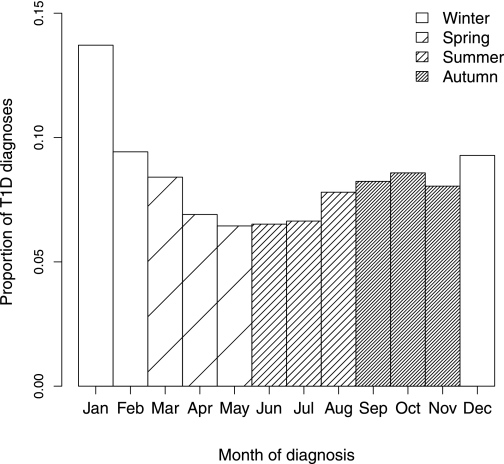
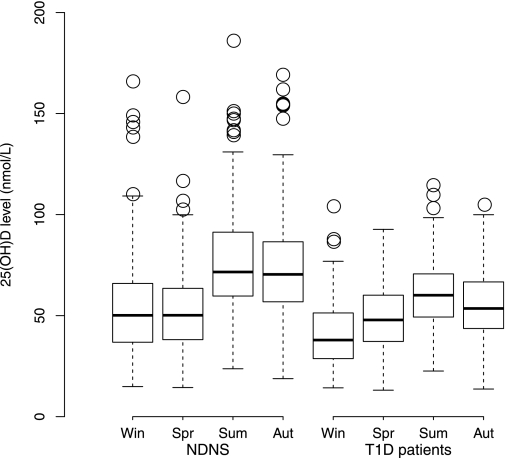
Verification
Claims the paper makes
The claims and statistics of this paper haven’t been checked yet.
Run the check — free, no account needed. It reads the open-access text and checks the sources it cites.
Claims other papers make about this one
Each is checked against this paper’s own text: does it say what the citing paper says it does?
The cited source says what the claim attributes to it.
In the citing paper
“A plethora of environmental influences have been purported to affect the epidemiology of type 1 diabetes,25 with infant and adolescent diets,26 vitamin D and vitamin D pathway constituents,27–29 and viruses receiving the most focus.30,31”
From Type 1 diabetes (2014) · cites this paper as [29]
The cited source says what the claim attributes to it.
In the citing paper
“Genetic susceptibility might also influence responses to environmental stimuli or physiological pathways (eg, vitamin D and interferon induced helicase).29,76”
From Type 1 diabetes (2014) · cites this paper as [29]
Self-check
Percentages, sums and reported differences re-computed from the paper’s own numbers.
The self-check needs the paper’s full text.
Citations
Cites
Holick, M. F. (2007) · New England Journal of Medicine · doi:10.1056/nejmra070553 · Cited by 13,720
Genome-wide association study of 14,000 cases of seven common diseases and 3,000 shared controls
The Wellcome Trust Case Control Consortium, Management Committee, Burton, P. R., Clayton, D. G., Cardon, L. R., Craddock, N., Deloukas, P., Duncanson, A., Kwiatkowski, D. P., McCarthy, M. I., et al. (2007) · Nature · doi:10.1038/nature05911 · Cited by 9,442
Self-citationThe International HapMap Project
†The International HapMap Consortium, Genotyping centres: Baylor College of Medicine and ParAllele BioScience, Gibbs, R. A., Belmont, J. W., Hardenbol, P., Willis, T. D., Yu, F., Chinese HapMap Consortium, Yang, H., Ch'ang, L.-Y., et al. (2003) · Nature · doi:10.1038/nature02168 · Cited by 6,057
Howie, B. N., Donnelly, P., & Marchini, J. (2009) · PLoS Genetics · doi:10.1371/journal.pgen.1000529 · Cited by 3,928
Toll-Like Receptor Triggering of a Vitamin D-Mediated Human Antimicrobial Response
Liu, P. T., Stenger, S., Li, H., Wenzel, L., Tan, B. H., Krutzik, S. R., Ochoa, M. T., Schauber, J., Wu, K., Meinken, C., et al. (2006) · Science · doi:10.1126/science.1123933 · Cited by 3,924
A new multipoint method for genome-wide association studies by imputation of genotypes
Marchini, J., Howie, B., Myers, S., McVean, G., & Donnelly, P. (2007) · Nature Genetics · doi:10.1038/ng2088 · Cited by 2,609
Vitamin D Deficiency and Risk of Cardiovascular Disease
Wang, T. J., Pencina, M. J., Booth, S. L., Jacques, P. F., Ingelsson, E., Lanier, K. J., Benjamin, E. J., D’Agostino, R. B., Wolf, M. S., & Vasan, R. S. (2008) · Circulation · doi:10.1161/circulationaha.107.706127 · Cited by 2,423
Self-citationSerum 25-Hydroxyvitamin D Levels and Risk of Multiple Sclerosis
Munger, K. L., Levin, L. I., Hollis, B. W., Howard, N. S., & Ascherio, A. (2006) · JAMA · doi:10.1001/jama.296.23.2832 · Cited by 1,899
The Type 1 Diabetes Genetics Consortium, Barrett, J. C., Clayton, D. G., Concannon, P., Akolkar, B., Cooper, J. D., Erlich, H. A., Julier, C., Morahan, G., Nerup, J., et al. (2009) · Nature Genetics · doi:10.1038/ng.381 · Cited by 1,746
Self-citationCommon genetic determinants of vitamin D insufficiency: a genome-wide association study
Wang, T. J., Zhang, F., Richards, J. B., Kestenbaum, B. R., van Meurs, J. B. J., Berry, D. J., Kiel, D. P., Streeten, E. A., Ohlsson, C., Koller, D. L., et al. (2010) · The Lancet · doi:10.1016/s0140-6736(10)60588-0 · Cited by 1,562
Self-citation
Cited by
Sorted by citations
Atkinson, M. A., Eisenbarth, G. S., & Michels, A. W. (2014) · The Lancet · doi:10.1016/s0140-6736(13)60591-7 · Cited by 2,931
Skeletal and Extraskeletal Actions of Vitamin D: Current Evidence and Outstanding Questions
Bouillon, R., Marcocci, C., Carmeliet, G., Bikle, D. D., White, J. H., Dawson-Hughes, B. F., Lips, P. T. A. M., Munns, C. F., Lazaretti‐Castro, M., Giustina, A., et al. (2018) · Endocrine Reviews · doi:10.1210/er.2018-00126 · Cited by 1,257
Forouhi, N. G., & Wareham, N. J. (2014) · Medicine · doi:10.1016/j.mpmed.2014.09.007 · Cited by 778
Vitamin D and Risk of Multiple Sclerosis: A Mendelian Randomization Study
Mokry, L. E., Ross, S., Ahmad, O. S., Forgetta, V., Smith, G. D., Leong, A., Greenwood, C. M. T., Thanassoulis, G., & Richards, J. B. (2015) · PLOS Medicine · doi:10.1371/journal.pmed.1001866 · Cited by 445
Vitamin D’s Effect on Immune Function
Martens, P.-J., Gysemans, C. A., Verstuyf, A., & Mathieu, C. (2020) · Nutrients · doi:10.3390/nu12051248 · Cited by 486
Metadata
- Authors
- Cooper, J. D., Smyth, D. J., Walker, N. M., Stevens, H., Burren, O. S., Wallace, C., Greissl, C., Ramos-Lopez, E., Hyppönen, E., Dunger, D. B., Spector, T. D., Ouwehand, W. H., Wang, T. J., Badenhoop, K., & Todd, J. A.
- Affiliations
- University of Cambridge (GB)
- University Hospital Frankfurt (DE)
- Department of Internal Medicine I, Division of Endocrinology, Diabetes, and Metabolism, University Hospital Frankfurt, Frankfurt am Main, Germany
- University College London (GB)
- Department of Twin Research and Genetic Epidemiology, King's College London, London, U.K.
- National Health Service (GB)
- Harvard University (US)
- Corresponding author
- Todd, John A.
- ORCID
- Venue
- Diabetes
- Publisher
- American Diabetes Association
- Published
- 2011-04-23
- Volume
- 60
- Issue
- 5
- Pages
- 1624-1631
- ISSN
- 0012-1797 (ISSN-L)
- 1939-327X
- PMC
- PMC3292339
- OpenAlex
- W2155640444
- Cited by
- 279
- References
- 50
- Citations by year
- 2026: 4 · 2025: 4 · 2024: 2 · 2023: 11 · 2022: 12 · 2021: 14 · 2020: 19 · 2019: 23 · 2018: 19 · 2017: 22 · 2016: 23 · 2015: 20 · 2014: 23 · 2013: 37 · 2012: 34
- FWCI
- 23.63
- Type
- journal article
- Language
- en
- Open access
- hybrid
- doi.org
- Licence
- Locations
- Diabetes (publishedVersion, cc-by-nc-nd)
- PubMed Central (publishedVersion, cc-by-nc-nd)
- PubMed (publishedVersion)
- Digital Access to Scholarship at Harvard (DASH) (Harvard University) (submittedVersion, cc-by)
- UCL Discovery (University College London) (submittedVersion)
- Research Portal (King's College London) (submittedVersion)
- Funders
- Juvenile Diabetes Research Foundation International (068545/Z/02)
- American Heart Association
- Wellcome Trust (068545/Z/02), 091157, G0000934, 061858, 089989, 068545, 079895, 076113, 076113/C/04/Z)
- National Institute for Health and Care Research (PHCS/C4/4/016, NF-SI-0508-10274, NF-SI-0508-10275)
- Food Standards Agency
- University College London
- European Commission (241447, FP7-NAIMIT, 201167)
- Queen's University Belfast
- Queen's University
- Universitetet i Oslo
- National Institutes of Health (G0000934, 068545/Z/02, 079895)
- Medical Research Council (G0601653, 068545/Z/02, G0000934)
- Cambridge Institute for Medical Research, University of Cambridge (079895)
- Norwegian Institute of Public Health
- Topics
- Health Sciences › Medicine › Endocrinology, Diabetes and Metabolism › Vitamin D Research Studies
- Life Sciences › Biochemistry, Genetics and Molecular Biology › Genetics › Diabetes and associated disorders
- Life Sciences › Biochemistry, Genetics and Molecular Biology › Genetics › Genetic Associations and Epidemiology
- Keywords
- type 1 diabetes, vitamin D deficiency, 25-hydroxyvitamin D, vitamin D metabolism genes, genetic susceptibility, DHCR7, CYP2R1, CYP24A1, CYP27B1, GC, seasonal variation, autoimmune disease susceptibility
- MeSH terms
- Cytochrome P450 Family 2, Adolescent, Adult, Aged, Child, Child, Preschool, Diabetes Mellitus, Type 1, Genotype, Humans, Middle Aged, Mutation, Steroid Hydroxylases, Vitamin D, 25-Hydroxyvitamin D3 1-alpha-Hydroxylase, Genetic Predisposition to Disease, Polymorphism, Single Nucleotide, Oxidoreductases Acting on CH-CH Group Donors, Cholestanetriol 26-Monooxygenase, Young Adult, Vitamin D3 24-Hydroxylase
About these checks
Registry, retraction, Cites and statistics results are computed, not judged, with one exception: a printed reference that no index lists is read once by a model before it counts as a citation error. Claims are extracted by a model and kept only when their quote appears verbatim in the text; each cited source is then checked, with a model’s help, for whether it says what the claim relies on. Those verdicts can be wrong — read the claim’s quote and the cited source before relying on one.
Statistics and arithmetic are recomputed, not judged.
Confidence bands are shown only for fields calibrated on our annotated test set. None is calibrated yet, so no band is shown.
What counts as a claim ›How we measure confidence ›How we check this ›
Are you an author, or do you see a problem with this page? Request a review
