

The Oral Minimal Model Method
Open accessThe DOI matches its Crossref record; 48 of the 48 references it cites were found in a registry or an index.
Abstract
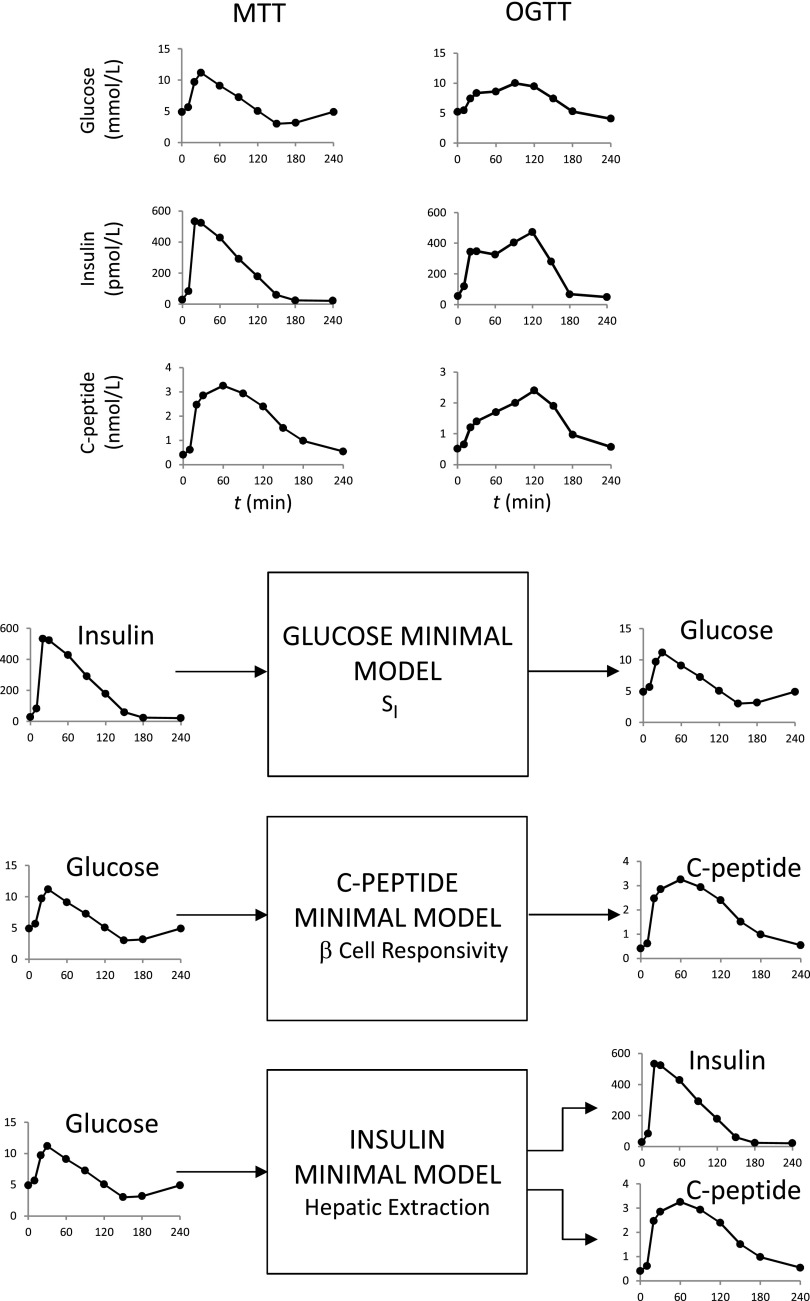
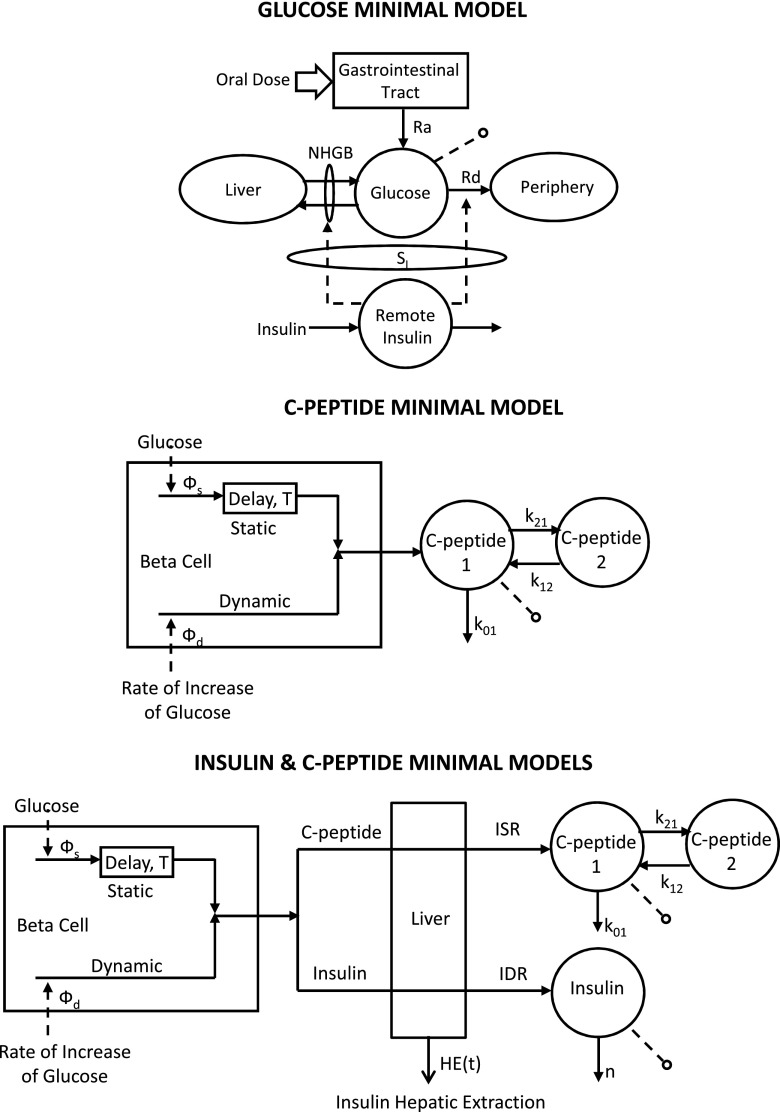
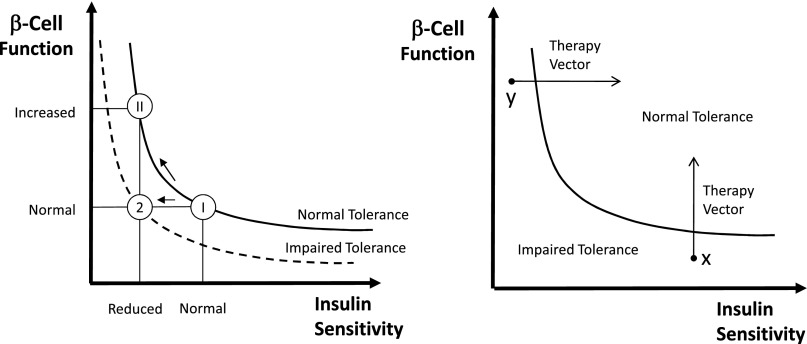
The simultaneous assessment of insulin action, secretion, and hepatic extraction is key to understanding postprandial glucose metabolism in nondiabetic and diabetic humans. We review the oral minimal method (i.e., models that allow the estimation of insulin sensitivity, β-cell responsivity, and hepatic insulin extraction from a mixed-meal or an oral glucose tolerance test). Both of these oral tests are more physiologic and simpler to administer than those based on an intravenous test (e.g., a glucose clamp or an intravenous glucose tolerance test). The focus of this review is on indices provided by physiological-based models and their validation against the glucose clamp technique. We discuss first the oral minimal model method rationale, data, and protocols. Then we present the three minimal models and the indices they provide. The disposition index paradigm, a widely used β-cell function metric, is revisited in the context of individual versus population modeling. Adding a glucose tracer to the oral dose significantly enhances the assessment of insulin action by segregating insulin sensitivity into its glucose disposal and hepatic components. The oral minimal model method, by quantitatively portraying the complex relationships between the major players of glucose metabolism, is able to provide novel insights regarding the regulation of postprandial metabolism.
Overview
The claims and statistics of this paper haven’t been checked yet.
Free: it reads the open-access text and checks the first 5 claims that cite a source we can check. Create a free account to check every claim.
Integrity signals
Registry
Cites
Statistics
Figures



Verification
Claims the paper makes
The claims and statistics of this paper haven’t been checked yet.
Free: it reads the open-access text and checks the first 5 claims that cite a source we can check. Create a free account to check every claim.
Claims other papers make about this one
Each is checked against this paper’s own text: does it say what the citing paper says it does?
The source backs part of the claim, not all of it — or backs it for a different population, condition or comparison.
In the citing paper
“Indeed, SI measured during an OGTT is highly correlated with glucose disposal measured during the euglycemic-hyperinsulinemic clamp technique (r = 0.70) [51].”
From Insulin sensitivity and pancreatic β-cell function in patients with primary aldosteronism (2021) · cites this paper as [51]
Experimental — accuracy not yet measured
Self-check
Percentages, sums and reported differences re-computed from the paper’s own numbers.
The self-check needs the paper’s full text.
Citations
Cites
Quantitative estimation of insulin sensitivity.
Bergman, R. N., Ider, Y. Z., Bowden, C. R., & Cobelli, C. (1979) · American Journal of Physiology-Endocrinology and Metabolism · doi:10.1152/ajpendo.1979.236.6.e667 · Cited by 1,874 · cited 2×
“(5), one obtains the following (14): (8)>>>< >>>: _ QðtÞ 1⁄4 2 1⁄2SG þ XðtÞ $QðtÞ þ SG$Qb þ Raða; tÞ Qð0Þ 1⁄4 Qb”
MethodSelf-citationBergman, R. N., Phillips, L. S., & Cobelli, C. (1981) · Journal of Clinical Investigation · doi:10.1172/jci110398 · Cited by 1,640 · cited 1×
“One possibility is to resort to a normalization of b-cell function based on the disposition index (DI) paradigm, first introduced in 1981 (28), and recently revisited first in Cobelli et al.”
MethodSelf-citationCauter, E. V., Mestrez, F., Sturis, J., & Polonsky, K. S. (1992) · Diabetes · doi:10.2337/diab.41.3.368 · Cited by 890
Cauter, E. V., Mestrez, F., Sturis, J., et al. (1992) · Diabetes · doi:10.2337/diabetes.41.3.368 · Cited by 643
DHEA in elderly women and DHEA or testosterone in elderly men.
Nair, K. S., Rizza, R. A., O'Brien, P., Dhatariya, K., Short, K. R., Nehra, A., Vittone, J. L., Klee, G. G., Basu, A., Basu, R., et al. (2006) · New England Journal of Medicine · doi:10.1056/nejmoa054629 · Cited by 566 · cited 1×
“For instance, the battery of oral glucose, C-peptide, and insulin models has been used to study the effect of age and sex on glucose metabolism (8), the effect of antiaging drugs (35), the influence of ethnicity (36), SI and b-cell function in nondiabetic (37) and obese (38) adolescents and children (39), the pathogen…”
MethodSelf-citationIncreased prevalence of insulin resistance and nonalcoholic fatty liver disease in Asian-Indian men
Petersen, K. F., Dufour, S., Feng, J., Befroy, D., Dziura, J., Man, C. D., Cobelli, C., & Shulman, G. I. (2006) · Proceedings of the National Academy of Sciences · doi:10.1073/pnas.0608537103 · Cited by 403 · cited 1×
“For instance, the battery of oral glucose, C-peptide, and insulin models has been used to study the effect of age and sex on glucose metabolism (8), the effect of antiaging drugs (35), the influence of ethnicity (36), SI and b-cell function in nondiabetic (37) and obese (38) adolescents and children (39), the pathogen…”
MethodSelf-citationEffects of Age and Sex on Postprandial Glucose Metabolism
Basu, R., Dalla Man, C., Campioni, M., Basu, A., Klee, G., Toffolo, G., Cobelli, C., & Rizza, R. A. (2006) · Diabetes · doi:10.2337/db05-1692 · Cited by 334
Self-citationOral Glucose Tolerance Test Minimal Model Indexes of β-Cell Function and Insulin Sensitivity
Breda, E., Cavaghan, M. K., Toffolo, G., Polonsky, K. S., & Cobelli, C. (2001) · Diabetes · doi:10.2337/diabetes.50.1.150 · Cited by 320
Self-citationCobelli, C., Toffolo, G. M., Man, C. D., Campioni, M., Denti, P., Caumo, A., Butler, P., & Rizza, R. (2007) · American Journal of Physiology-Endocrinology and Metabolism · doi:10.1152/ajpendo.00421.2006 · Cited by 311
Self-citationMeal and oral glucose tests for assessment of β-cell function: modeling analysis in normal subjects
Mari, A., Schmitz, O., Gastaldelli, A., Oestergaard, T., Nyholm, B., & Ferrannini, E. (2002) · American Journal of Physiology-Endocrinology and Metabolism · doi:10.1152/ajpendo.00093.2002 · Cited by 303
Research works printed but not linked: 1
- Cobelli, 1999, Minimal model SG overestimation and SI underestimation: improved accuracy by a Bayesian two-compartment model, Am J Physiol, 277, E481
Cited by
Items 201–216 of 216
Ridout, S. A., Vellanki, P., & Nemenman, I. M. (2025) · eLife · doi:10.1101/2024.06.04.597343
“Short-39 1 of 16 timescale models describe the dynamics of insulin and glucose over minutes or hours ( Bergman et al., 1979 ; Cobelli et al., 2014 ; Toffolo et al., 1995 , 2001 ; Stefanovski et al., 2020 ).”
Ridout, S. A., Vellanki, P., & Nemenman, I. M. (2024) · eLife · doi:10.7554/elife.100193.1
Ridout, S. A., Vellanki, P., & Nemenman, I. M. (2025) · eLife · doi:10.7554/elife.100193.2 · Cited by 1
Perazzolo, S., Galderisi, A., Carr, A. L. J., Dayan, C. M., & Cobelli, C. (2025) · Journal of Diabetes Science and Technology · doi:10.1177/19322968251365274
“1 Second, the built-in batch processor is made more flexible for AOMM.”
Self-citationA control-theoretic law of human glucose homeostasisPreprint
Sugimoto, H., Hironaka, K., Yamada, T., Sakaguchi, K., Ogawa, W., & Kuroda, S. (2025) · medRxiv · doi:10.1101/2025.09.30.25337012
Automatic computation of the glycemic index:Data driven analysis of the glucose standard
Credali, F., Venuti, M. T., Boffi, D., & Rossi, P. (2026) · Journal of Theoretical Biology · doi:10.1016/j.jtbi.2026.112447
“The main features of several minimal and maximal models are summarized in [15, 14].”
Reconstructing a physiological state space via chronic jugular microdialysis in freely moving micePreprint
Nardin, M., Wang, N., Elziny, S., Boyer, C., Pjanovic, V., Schuster, L., Boklund, P., Lindo, S. E., Morris, K., Ilanges, A., et al. (2025) · bioRxiv (Cold Spring Harbor Laboratory) · doi:10.64898/2025.12.08.692974
Gadgil, M. D., STROEBEL, B. M., King, S. M., Bergeron, N., Chiu, S., & Krauss, R. M. (2026) · Journal of Nutrition · doi:10.1016/j.tjnut.2026.101458
Usui, R., Hamamoto, Y., Omori, Y., Tatsuoka, H., Hayakawa, T., Shimomura, K., Murotani, K., Kuwata, H., Yamada, Y., & Seino, Y. (2026) · Diabetes Obesity and Metabolism · doi:10.1111/dom.70693
“…components of the insulin response to glucose; the basal insulin secretion (φb), the static component (φs) reflecting sustained insulin secretion at steady state; and the dynamic component (φd), representing early-phase insulin secretion in response to the rate of increase in glucose [10–12].”
Liu, H., Zhang, Y., Feng, L., Zhang, J., Sun, Y., Zhao, Y., Jiang, M., Liu, X., Tracey, G. J., Chen, L., et al. (2026) · Nature Communications · doi:10.1038/s41467-026-71798-x
“The evaluation of BCF is divided into four parts: basal, dynamic-phase, static-phase, and total BCF ( φ b , φ d , φ s , φ tot ) 34 .”
InfluentialTime-fractional optimal control in the Bergman model for type 1 diabetes
Amina, E., Karim, M., Ferjouchia, H., Youssef, M. Z., & Zaky, M. A. (2026) · AIMS Mathematics · doi:10.3934/math.2026546
Garrish, J., Chan, C. L., Nychka, D. W., & Behn, C. D. (2026) · SIAM Journal on Applied Mathematics · doi:10.1137/25m1733410
Tsvetkova, V. V., & Todorova, K. N. (2026) · International Journal of Molecular Sciences · doi:10.3390/ijms27167083
Sherman, A., Sala, N., Sumner, A. E., Ha, J., & Chung, S. T. (2026) · American Journal of Physiology-Endocrinology and Metabolism · doi:10.1152/ajpendo.00397.2025
Wang, C., Kanaley, J. A., Chen, J., & Tan, J. (2026) · Frontiers in Physiology · doi:10.3389/fphys.2026.1907805
“…from minimal models that focus only on insulin-glucose dynamics (Bergman et al., 1979) to more comprehensive models incorporating multiple tissues and metabolic pathways (Dalla Man et al., 2006; Li et al., 2006; Maas et al., 2006; Man et al., 2007; Cobelli et al., 2014; Alkhateeb et al., 2021).”
Marchiori, H., Schiavon, M., TICHY, E. M., ALGUARD, M. D., Desousa, M., Favero, S. D., Gaglia, J. L., Sherr, J. L., Man, C. D., & Galderisi, A. (2026) · Diabetologia · doi:10.1007/s00125-026-06895-z
Metadata
- Authors
- Cobelli, C., Dalla Man, C., Toffolo, G., Basu, R., Vella, A., & Rizza, R.
- Affiliations
- University of Padua (IT)
- Department of Information Engineering, University of Padova, Padova, Italy
- Mayo Clinic (US)
- Corresponding author
- Cobelli, Claudio
- Venue
- Diabetes
- Publisher
- American Diabetes Association
- Published
- 2014-03-13
- Volume
- 63
- Issue
- 4
- Pages
- 1203-1213
- ISSN
- 0012-1797 (ISSN-L)
- 1939-327X
- PMC
- PMC4179313
- OpenAlex
- W2123229781
- Semantic Scholar
- 11546915ff6d99236372831822dc553c6adef873
- Cited by
- 216
- References
- 47
- Citations by year
- 2026: 12 · 2025: 15 · 2024: 16 · 2023: 23 · 2022: 16 · 2021: 18 · 2020: 19 · 2019: 19 · 2018: 22 · 2017: 17 · 2016: 18 · 2015: 13 · 2014: 8
- FWCI
- 3.52
- Type
- journal article
- Language
- en
- Open access
- hybrid
- doi.org
- Licence
- Locations
- Diabetes (publishedVersion, cc-by-nc-nd)
- PubMed Central (publishedVersion, cc-by-nc-nd)
- PubMed (publishedVersion)
- Padua Research Archive (University of Padova) (submittedVersion, cc-by-nc-nd)
- Funders
- National Institutes of Health (UL1TR000135)
- National Institute of Diabetes and Digestive and Kidney Diseases (R01DK029953, P30DK050456, DK 29953, R37DK029953)
- National Center for Advancing Translational Sciences
- Topics
- Health Sciences › Medicine › Endocrinology, Diabetes and Metabolism › Pancreatic function and diabetes
- Health Sciences › Medicine › Endocrinology, Diabetes and Metabolism › Diabetes, Cardiovascular Risks, and Lipoproteins
- Health Sciences › Medicine › Endocrinology, Diabetes and Metabolism › Diabetes Management and Research
- Keywords
- insulin sensitivity, beta-cell function, hepatic insulin extraction, postprandial glucose metabolism, oral glucose tolerance test, mixed meal tolerance test, disposition index, glucose tracer, glucose disposal
- MeSH terms
- Adolescent, Blood Glucose, C-Peptide, Child, Food, Glucose, Glucose Tolerance Test, Humans, Insulin, Insulin Resistance, Liver, Models, Biological, Glucose Clamp Technique, Postprandial Period, Insulin-Secreting Cells
About these checks
Registry, retraction, Cites and statistics results are computed, not judged, with one exception: a printed reference that no index lists is read once by a model before it counts as a citation error. Claims are extracted by a model and kept only when their quote appears verbatim in the text; each cited source is then checked, with a model’s help, for whether it says what the claim relies on. Those verdicts can be wrong — read the claim’s quote and the cited source before relying on one.
Statistics and arithmetic are recomputed, not judged.
Confidence bands are shown only for fields calibrated on our annotated test set. None is calibrated yet, so no band is shown.
What counts as a claim ›How we measure confidence ›How we check this ›
Are you an author, or do you see a problem with this page? Request a review
Data sources
Bibliographic data: Semantic Scholar, OpenAlex, Crossref.
Contains information from the Semantic Scholar Academic Graph Datasets, made available under the ODC Attribution License (ODC-BY 1.0).
Semantic Scholar’s data is described in: Kinney, R., et al. (2023). The Semantic Scholar Open Data Platform. arXiv:2301.10140.
