

Declining β-Cell Function Relative to Insulin Sensitivity With Increasing Fasting Glucose Levels in the Nondiabetic Range in Children
Open accessThe DOI matches its Crossref record; 30 of the 30 references it cites were found in a registry or an index.
Abstract
OBJECTIVE: In adults, higher fasting plasma glucose (FPG) levels, even within the normoglycemic range, are associated with increased diabetes risk. This investigation tested the hypothesis that β-cell function relative to insulin sensitivity decreases with increasing FPG in youth. RESEARCH DESIGN AND METHODS: A total of 223 youth with FPG <126 mg/dl underwent evaluation of first- and second-phase insulin secretion during a 2-h hyperglycemic (∼225 mg/dl) clamp, insulin sensitivity during a 3-h hyperinsulinemic-euglycemic clamp, body composition, and abdominal adiposity with dual-energy X-ray absorptiometry and computed tomographic scan. β-Cell function relative to insulin sensitivity was calculated as the product of first-phase insulin and insulin sensitivity, i.e., glucose disposition index (GDI). The subjects were divided into three FPG categories: ≤90, >90–<100, and ≥100–<126 mg/dl. RESULTS: GDI decreased significantly across the three categories as FPG increased (1,086 ± 192 vs. 814 ± 67 and 454 ± 57 mg/kg/min, P = 0.002). This decline remained significant after adjustment for race, sex, BMI, and percent body fat or visceral fat. Within each FPG category, GDI declined with increasing BMI percentiles. CONCLUSIONS: The impairment in β-cell function relative to insulin sensitivity is apparent even within the nondiabetic FPG range in children. At the current cutoff of 100 mg/dl for impaired fasting glucose (IFG), there is an ∼49% decline in the GDI independent of obesity and race. This observation may reflect a heightened risk of β-cell dysfunction and progression to diabetes in these children. Considering the near doubling of IFG prevalence among youth between National Health and Nutrition Examination Survey 1999–2000 and 2005–2006, our findings have important public health implications.
Overview
The claims and statistics of this paper haven’t been checked yet.
Free: it reads the open-access text and checks the first 5 claims that cite a source we can check. Create a free account to check every claim.
Integrity signals
Registry
Cites
Statistics
Figures
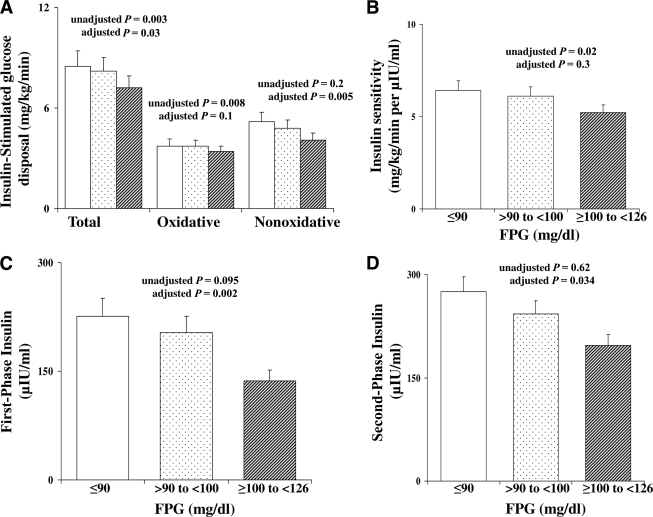
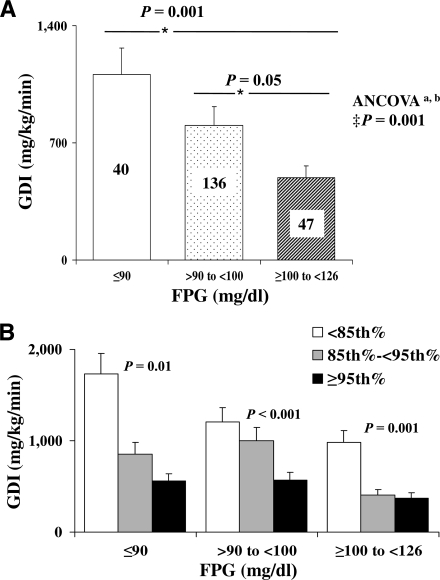
Verification
Claims the paper makes
The claims and statistics of this paper haven’t been checked yet.
Free: it reads the open-access text and checks the first 5 claims that cite a source we can check. Create a free account to check every claim.
Claims other papers make about this one
Each is checked against this paper’s own text: does it say what the citing paper says it does?
In the citing paper
“The children with high fasting blood glucose have 49% lower glucose deposition index”
From Lack of Exercise Is a Major Cause of Chronic Diseases (2012) · cites this paper as [504]
Self-check
Percentages, sums and reported differences re-computed from the paper’s own numbers.
The self-check needs the paper’s full text.
Citations
Cites
Diagnosis and Classification of Diabetes Mellitus
American Diabetes Association (2011) · Diabetes Care · doi:10.2337/dc11-s062 · Cited by 13,988
Report of the Expert Committee on the Diagnosis and Classification of Diabetes Mellitus
The Expert Committee on the Diagnosis and Classification of Diabetes Mellitus* (2002) · Diabetes Care · doi:10.2337/diacare.25.2007.s5 · Cited by 10,338
The metabolic phenotype in obesity: Fat mass, body fat distribution, and adipose tissue function
Goossens, G. H. (2017) · Obesity Facts · doi:10.1159/000471488 · Cited by 8,481
Report of the Expert Committee on the Diagnosis and Classification of Diabetes Mellitus
The Expert Committee on the Diagnosis and Classification of Diabetes Mellitus (1997) · Diabetes Care · doi:10.2337/diacare.20.7.1183 · Cited by 6,220
Follow-up report on the diagnosis of diabetes mellitus
The Expert Committee on the Diagnosis and Classification of Diabetes Mellitus* (2003) · Diabetes Care · doi:10.2337/diacare.26.11.3160 · Cited by 3,784 · cited 1×
“The American Diabetes Association classifies this intermediate state of FPG as impaired fasting glucose (IFG) (4) and initially defined it as fasting glucose of 110–125 mg/dl (8), which was lowered to 100 mg/dl in 2003 to better identify subjects at risk of diabetes development (9).”
BackgroundCalculation of substrate oxidation rates in vivo from gaseous exchange.
Frayn, K. N. (1983) · Journal of Applied Physiology · doi:10.1152/jappl.1983.55.2.628 · Cited by 2,365 · cited 1×
“Insulin-stimulated carbohydrate and fat oxidation rates were calculated according to the formulas of Frayn (18) from the indirect calorimetry data.”
MethodKahn, S. E. (2003) · Diabetologia · doi:10.1007/s00125-002-1009-0 · Cited by 2,166 · cited 1×
“This tight regulation is maintained by a delicate balance between insulin sensitivity and secretion (19).”
BackgroundHigh body mass index for age among US children and adolescents, 2003-2006.
Ogden, C. L. (2008) · JAMA · doi:10.1001/jama.299.20.2401 · Cited by 1,850 · cited 1×
“3% (24), which translates to 5 million children in the overweight category.”
BackgroundDiagnosis and classification of diabetes mellitus
American Diabetes Association (2009) · Diabetes Care · doi:10.2337/dc09-s062 · Cited by 1,817
Coutinho, M., Gerstein, H. C., Wang, Y., & Yusuf, S. (1999) · Diabetes Care · doi:10.2337/diacare.22.2.233 · Cited by 1,685 · cited 1×
“In addition, a meta-analysis of prospective studies showed a continuous relationship between baseline fasting glucose and subsequent cardiovascular risk (10).”
Background
Cited by
Lack of Exercise Is a Major Cause of Chronic Diseases
Booth, F. W., Roberts, C. K., & Laye, M. J. (2012) · Comprehensive Physiology · doi:10.1002/cphy.c110025 · Cited by 2,575
Arslanian, S., Bacha, F., Grey, M., Marcus, M. D., White, N. H., & Zeitler, P. (2018) · Diabetes Care · doi:10.2337/dci18-0052 · Cited by 349
Self-citationISPAD Clinical Practice Consensus Guidelines 2018: Type 2 diabetes mellitus in youth
Zeitler, P., Arslanian, S., Fu, J., Pinhas-Hamiel, O., Reinehr, T., Tandon, N., Urakami, T., Wong, J., & Maahs, D. M. (2018) · Pediatric Diabetes · doi:10.1111/pedi.12719 · Cited by 221
“However, data in youth demonstrate that β-cell function relative to insulin sensitivity is impaired even below the typically accepted cut points for fasting and the 2-hour glucose concentrations diagnostic of IFG and IGT.60,61 • In obese adolescents, pre-diabetes is often transient, with as many as 60% of individuals…”
BackgroundInfluentialSelf-citationEsser, N., Utzschneider, K. M., & Kahn, S. E. (2020) · Diabetologia · doi:10.1007/s00125-020-05245-x · Cited by 192
The changing face of diabetes in youth: lessons learned from studies of type 2 diabetes
Hannon, T. S., & Arslanian, S. A. (2015) · Annals of the New York Academy of Sciences · doi:10.1111/nyas.12939 · Cited by 137
Self-citationKim, J. Y., Bacha, F. F., Tfayli, H. M., Michaliszyn, S. F., Yousuf, S., & Arslanian, S. A. (2018) · Diabetes Care · doi:10.2337/dc18-1178 · Cited by 119
“The presence of impaired adipose tissue insulin sensitivity in obese youth with NGT, before any alteration in glucose homeostasis, is concordant with our previous research demonstrating that abnormalities in insulin sensitivity of glucose metabolism and b-cell dysfunction are also present in obese youth with NGT (19,2…”
ResultSelf-citationKim, J. Y., Michaliszyn, S. F., Nasr, A., Lee, S., Tfayli, H. M., Hannon, T. S., Hughan, K. S., Bacha, F. F., & Arslanian, S. A. (2016) · Diabetes Care · doi:10.2337/dc16-0352 · Cited by 111
“Among these are the fasting (11), 1-h (12), and 2-h glucose concentrations during an OGTT, which signal b-cell failure, measured by the clamp-derived disposition index (DI), and presage progression to type 2 diabetes (8,13).”
BackgroundSelf-citationMetabolomic Profiling of Amino Acids and β-Cell Function Relative to Insulin Sensitivity in Youth
Michaliszyn, S. F., Sjaarda, L. A., Mihalik, S. J., Lee, S., Bacha, F. F., Chace, D. H., Jesús, V. R. D., Vockley, J., & Arslanian, S. A. (2012) · The Journal of Clinical Endocrinology & Metabolism · doi:10.1210/jc.2012-2170 · Cited by 87
“In vivo IS was evaluated during a 3-h hyperinsulinemiceuglycemic clamp as previously reported (14, 18).”
MethodSelf-citationBurns, S. F., Bacha, F. F., Lee, S., Tfayli, H. M., Gungor, N., & Arslanian, S. A. (2011) · Diabetes Care · doi:10.2337/dc11-0423 · Cited by 79
“90 to ,100 mg/dL) had evidence of impaired b-cell function relative to insulin sensitivity compared with children whose fasting glucose concentrations were#90 mg/dL (9).”
BackgroundInfluentialSelf-citationTG: HDL-C Ratio as Insulin Resistance Marker for Metabolic Syndrome in Children With Obesity
Iwani, A. K. N. Z., Jalaludin, M. Y., Yahya, A., Mansor, F., Zain, F. M., Hong, J. Y. H., Zin, R. M. W. M., & Mokhtar, A. H. (2022) · Frontiers in Endocrinology · doi:10.3389/fendo.2022.852290 · Cited by 72
“Additionally, another study also reported that impaired insulin sensitivity was not present among youth in the prediabetic range (47, 48), hence signifying that IFG among children with obesity may be a less important driver of morbidity and mortality than that in adults.”
BackgroundKim, J. Y., Nasr, A., Tfayli, H. M., Bacha, F. F., Michaliszyn, S. F., & Arslanian, S. A. (2017) · Diabetes · doi:10.2337/db17-0551 · Cited by 63
“In brief, all participants underwent a hyperinsulinemic-euglycemic clamp combined with stable isotopes and continuous indirect calorimetry and a hyperglycemic clamp after 10–12 h of fasting within a 1–4-week period in random order (2,3).”
BackgroundSelf-citationHu, T., Jacobs, D. R., Sinaiko, A. R., Bazzano, L., Burns, T. L., Daniels, S. R., Dwyer, T., Hutri‐Kähönen, N., Juonala, M., Murdy, K. A., et al. (2020) · Diabetes Care · doi:10.2337/dc20-0822 · Cited by 55
“mg/dL were associated with a lower b-cell function and thus lower insulin sensitivity (29).”
BackgroundKelsey, M. M., Pyle, L. L., Hilkin, A. M., Severn, C., Utzschneider, K. M., Pelt, R. E. V., Nadeau, K. J., & Zeitler, P. S. (2020) · The Journal of Clinical Endocrinology & Metabolism · doi:10.1210/clinem/dgaa043 · Cited by 52
Tfayli, H. M., Lee, S., Bacha, F. F., & Arslanian, S. A. (2011) · Pediatric Diabetes · doi:10.1111/j.1399-5448.2011.00745.x · Cited by 223
Self-citationRajakumar, K., Heras, J. D. L., Lee, S., Holick, M. F., & Arslanian, S. A. (2012) · Diabetes Care · doi:10.2337/dc11-1825 · Cited by 47
“DI was calculated as the product of insulin sensitivity and firstphase insulin concentration (15).”
MethodSelf-citationKim, J. Y., Goran, M. I., Toledo‐Corral, C. M., Weigensberg, M. J., Choi, M., & Shaibi, G. Q. (2013) · Diabetes Care · doi:10.2337/dc12-1861 · Cited by 46
“, fasting glucose between 90 and 100 mg/dL and 2-h glucose between 120 and 140 mg/dL) exhibited lower b-cell function compared with youth whose fasting and 2-h glucose concentrations are ,90 mg/dL and 120 mg/dL, respectively (31,32).”
BackgroundSİVA, Z. O., Uludüz, D., Keskin, F. E., Erenler, F., Balcı, H., Uygunoğlu, U., Saip, S., Göksan, B., & Sıva, A. (2017) · Cephalalgia · doi:10.1177/0333102417748928 · Cited by 46
Heras, J. D. L., Rajakumar, K., Lee, S., Bacha, F. F., Holick, M. F., & Arslanian, S. A. (2013) · Diabetes Care · doi:10.2337/dc12-1288 · Cited by 45
“Clamp studies A 3-h hyperinsulinemic-euglycemic clamp (14,15) and a 2-h hyperglycemic clamp (15,16) were performed in a random sequence within a 1–4-week period at the PCTRC in all participants (n = 175) after 10–12 h of overnight fasting as described previously.”
BackgroundMethodInfluentialSelf-citationRapid Deterioration of Insulin Secretion in Obese Adolescents Preceding the Onset of Type 2 Diabetes
Elder, D. A., Hornung, L. N., Herbers, P. M., Prigeon, R. L., Woo, J. G., & D’Alessio, D. A. (2014) · The Journal of Pediatrics · doi:10.1016/j.jpeds.2014.11.029 · Cited by 44
“Elevations of fasting glucose, within the nondiabetic range, have been reported to predict the development of T2DM in adults(30) and adolescents.(17) Increased fasting and poststimulus PI secretion is a common finding in adults with T2DM and is commonly used as a surrogate for failed or failing b cells.”
BackgroundMetabolic Basis of Ethnic Differences in Diabetes Risk in Overweight and Obese Youth
Alderete, T. L., Toledo‐Corral, C. M., & Goran, M. I. (2014) · Current Diabetes Reports · doi:10.1007/s11892-013-0455-z · Cited by 43
Zheng, S., Zhou, H., Tingting, H., Li, Y., Zhang, Y., Liu, W., & Hu, Y. (2015) · BMC Endocrine Disorders · doi:10.1186/s12902-015-0018-1 · Cited by 42
“A previous study [30] involving young adults (n = 223) with FPG < 126 mg/ dL who underwent an evaluation of first and second phase insulin secretion during a 2 h hyperglycemic clamp found that the impairment in β cell function relative to insulin sensitivity was apparent even within the FPG range of those without diab…”
MethodPrevalence of Type 2 diabetes and pre‐diabetes among overweight or obese children in Tianjin, China
Zhu, H., Zhang, X., Li, M., Xie, J., & Yang, X. (2013) · Diabetic Medicine · doi:10.1111/dme.12269 · Cited by 38
Measuring β-Cell Function Relative to Insulin Sensitivity in Youth
Sjaarda, L. A., Lee, S., Tfayli, H. M., Bacha, F. F., Bertolet, M. H., & Arslanian, S. A. (2012) · Diabetes Care · doi:10.2337/dc12-1508 · Cited by 37
“This method was used to calculate the slope of the regression line for each of the NW, OB-NGT, OB-IGT, and OB-T2DM groups.”
BackgroundInfluentialSelf-citationGaronzi, C., Maguolo, A., & Maffeis, C. (2022) · Hormone Research in Paediatrics · doi:10.1159/000528342 · Cited by 29
Harnois‐Leblanc, S., Sylvestre, M., Hulst, A. V., Barnett, T. A., Mathieu, M.-E., Mésidor, M., McGrath, J. J., Tremblay, A., Drapeau, V., Paradis, G., et al. (2022) · The Lancet Child & Adolescent Health · doi:10.1016/s2352-4642(22)00278-4 · Cited by 27
Zeng, L., Lu, H., Deng, H., Mu, P., Li, X., & Wang, M. (2011) · Diabetes Technology & Therapeutics · doi:10.1089/dia.2011.0123 · Cited by 27
Hebbar, P., Abu‐Farha, M., Alkayal, F., Nizam, R., Elkum, N. B., Melhem, M., John, S. E., Channanath, A. M., Abubaker, J. A., Bennakhi, A., et al. (2020) · Scientific Reports · doi:10.1038/s41598-019-57072-9 · Cited by 26
Wang, S., Deng, Y., Xie, X., Ma, J., Xu, M., Zhao, X., Gu, W., Hong, J., Wang, W., Xu, G., et al. (2018) · Journal of Diabetes · doi:10.1111/1753-0407.12771 · Cited by 26
Rafalson, L. B., Pham, T., Willi, S. M., Marcus, M. D., Jessup, A., & Baranowski, T. (2013) · Obesity · doi:10.1002/oby.20129 · Cited by 26
Calcaterra, V., Verduci, E., Pascuzzi, M. C., Magenes, V. C., Fiore, G., Profio, E. D., Tenuta, E., Bosetti, A., Todisco, C. F., D’Auria, E., et al. (2021) · Nutrients · doi:10.3390/nu13082805 · Cited by 24
“Furthermore, overweight children and adolescents have impaired insulin sensitivity, coupled with a declining beta cell function, below the thresholds that are used to define prediabetes states [56,57].”
BackgroundIslet function in obese adolescents
Giannini, C., & Caprio, S. (2012) · Diabetes Obesity and Metabolism · doi:10.1111/j.1463-1326.2012.01643.x · Cited by 24
“glucose disposition index (given by the product of first-phase insulin and insulin sensitivity) decreased significantly across the three categories as fasting plasma glucose increased [21].”
BackgroundKim, J. Y., Tfayli, H. M., Bacha, F. F., Lee, S., Michaliszyn, S. F., Yousuf, S., Gebara, N. Y., & Arslanian, S. A. (2019) · Pediatric Diabetes · doi:10.1111/pedi.12940 · Cited by 22
“β-cell function relative to insulin sensitivity, that is, the disposition index (DI), was calculated as the product of insulin sensitivity, measured by the hyperinsulinemic-euglycemic clamp, and first-phase insulin secretion measured during the hyperglycemic clamp.(22,23,25,29)”
MethodSelf-citationLiu, J., Liu, J., Fang, D., Liu, L., Huang, Z., Wan, X., Cao, X., & Li, Y. (2013) · Endocrine Journal · doi:10.1507/endocrj.ej12-0315 · Cited by 22
Oral glucose effectiveness and metabolic risk in obese children and adolescents
Spreghini, N., Cianfarani, S., Spreghini, M. R., Brufani, C., Morino, G. S., Inzaghi, E., Convertino, A., Fintini, D., & Manco, M. (2019) · Acta Diabetologica · doi:10.1007/s00592-019-01303-y · Cited by 18
Rivera-Vega, M., Flint, A., Winger, D. G., Libman, I. M., & Arslanian, S. A. (2014) · Pediatric Diabetes · doi:10.1111/pedi.12249 · Cited by 18
Self-citationChildhood-Adolescent Obesity in the Cardiorenal Syndrome: Lessons from Animal Models
Hayden, M. R., & Sowers, J. R. (2011) · Cardiorenal Medicine · doi:10.1159/000327022 · Cited by 16
“The International Obesity Task Force has estimated that 22 million children younger than 5 years of age are overweight or obese. They also estimated that 1 in 10 children (approximately 155 million) are overweight. This emerging pandemic is largely thought to be triggered by the same sociologic/environmental factors t…”
BackgroundProgression of β-Cell Dysfunction in Obese Youth
Giannini, C., & Caprio, S. (2012) · Current Diabetes Reports · doi:10.1007/s11892-012-0347-7 · Cited by 15
“Of note, abnormalities in β-cell function relative to insulin sensitivity is apparent even across the non-diabetic fasting plasma glucose range [33] and, more importantly, across the OGTT derived 2 hour glucose categories [31••].”
BackgroundMethodDonahue, R. P., Stranges, S., Rafalson, L. B., Dmochowski, J., Dorn, J. M., & Trevisan, M. (2013) · Nutrition Metabolism and Cardiovascular Diseases · doi:10.1016/j.numecd.2013.06.006 · Cited by 15
Wang, H., Zheng, X., Bai, Z.-H., Lv, J., Sun, J., Shi, Y., & Pei, H. (2020) · Medical Science Monitor · doi:10.12659/msm.920880 · Cited by 14
The Early Diabetes Intervention Program – is early actually late?
Bergman, M. (2014) · Diabetes/Metabolism Research and Reviews · doi:10.1002/dmrr.2563 · Cited by 14
“fasting glucose levels in the non-diabetic range were observed in children [29].”
BackgroundVidmar, A. P., Durazo-Arvizú, R., Weigensberg, M. J., Alderete, T. L., & Goran, M. I. (2023) · Diabetes · doi:10.2337/db22-1034 · Cited by 13
Liu, L., Yang, S., Liu, J., Li, H., Liu, J., Cao, X., Xiao, H., & Li, Y. (2018) · Journal of Diabetes Research · doi:10.1155/2018/9423965 · Cited by 12
“Elevations of FPG from the normal range to diabetic threshold are associated with a progressive decline in β cell function [26, 27]; in an autopsy study, FPG showed a curvilinear relationship with relative β cell volume [28].”
Insulin function in obese children within the low and high ranges of impaired fasting glycemia
Hagman, E., Ek, A. E., & Marcus, C. (2018) · Pediatric Diabetes · doi:10.1111/pedi.12804 · Cited by 12
“Furthermore, first-phase insulin secretion has been shown to be impaired in adolescents and adults with IFG, corresponding to a 49% decline in β-cell function relative to insulin sensititvity.(15) Second-phase insulin secretion and peripheral insulin”
BackgroundHosking, J., Metcalf, B. S., Jeffery, A., Streeter, A., Voss, L. D., & Wilkin, T. J. (2013) · Pediatric Diabetes · doi:10.1111/pedi.12049 · Cited by 12
Brar, P. C., Mehta, S., Brar, A., Pierce, K. A., Albano, A., & Bergman, M. (2023) · Clinical Medicine Insights Endocrinology and Diabetes · doi:10.1177/11795514231177206 · Cited by 10
Brar, P. C., Koren, D., Gallagher, P. R., Pendurthi, B., & Katz, L. E. L. (2013) · Clinical Pediatrics · doi:10.1177/0009922812472251 · Cited by 8
Li, W., Ma, L., & Li, Q. (2012) · Gynecological Endocrinology · doi:10.3109/09513590.2011.650757 · Cited by 8
“DI, including measurements of both insulin action and secretion, allows the analysis of the β-cell function according to the ambient insulin resistance [21,22].”
BackgroundCho, W., Bacha, F. F., Tfayli, H. M., Lee, S., Michaliszyn, S. F., Kim, J. Y., & Arslanian, S. A. (2025) · Obesity · doi:10.1002/oby.24317 · Cited by 6
“Disposition index (DI), which represents insulin secretion relative to insulin sensitivity, was calculated as the product of PIS and first-phase insulin secretion [3, 11, 12].”
Self-citationElmajnoun, H. K., Faris, M. E., Uday, S., Gorman, S., Greening, J. E., Haris, P. I., & Abu-Median, A.-B. (2021) · Frontiers in Nutrition · doi:10.3389/fnut.2021.756413 · Cited by 6
“Moreover, it has been observed that the pathogenesis of T2D among adolescents and/or young adults (< 20 years old) who are obese is somewhat similar to the pathological changes in adults, in terms of the reduction of β-cell function about a significant decline in insulin sensitivity (131).”
BackgroundKim, J. Y., Tfayli, H. M., Bacha, F. F., Lee, S., Gebara, N. Y., & Arslanian, S. A. (2020) · Metabolism · doi:10.1016/j.metabol.2020.154346 · Cited by 4
Self-citationGebara, N. Y., Kim, J. Y., Bacha, F. F., Lee, S., & Arslanian, S. A. (2021) · Clinical Obesity · doi:10.1111/cob.12501 · Cited by 4
Self-citationVitamin D status and glucose metabolism in youth
Giudici, K. V., de Souza, W. N., & Martini, L. A. (2015) · Critical Reviews in Food Science and Nutrition · doi:10.1080/10408398.2013.866069 · Cited by 4
“In a study with children and adolescents from 8- to 18-years old, Tfayli et al. (2010) found that insulin sensitivity decreased as fasting plasma glucose increased even within the normal reference range, but insulin secretion did not increase sufficiently to maintain the glucose disposition index,…”
BackgroundSanctis, V. D., Saki, F., Karimi, M., Faranoush, M., El-Hakim, I., Soliman, A. T., Daar, S., & Tzoulis, P. (2025) · Mediterranean Journal of Hematology and Infectious Diseases · doi:10.4084/mjhid.2025.072 · Cited by 3
“%) of β-cell function has been reported compared to those with FPG below 90 mg/ dL. 31 Subgroup linear correlation analysis revealed important nuances.”
Pathophysiology of Insulin Resistance and Type 2 Diabetes
Weiss, R. (2018) · Elsevier eBooks · doi:10.1016/b978-0-323-55138-0.00001-2 · Cited by 3
Liu, Z., Sun, L., Sun, F., Cui, S. F., Zhang, Y., Wang, J., Zhang, Z., Sun, L., Yang, R., Yao, G., et al. (2024) · Scientific Reports · doi:10.1038/s41598-024-76183-6 · Cited by 2
Type II Diabetes Mellitus and Obesity in Youths
Giannini, C., & Caprio, S. (2013) · Humana Press eBooks · doi:10.1007/978-1-60761-395-4_29 · Cited by 1
Novel Biomarkers and Genetic Variants for Type 2 Diabetes in Latinos
Kim, J. (2015) · Cited by 1
Harnois‐Leblanc, S. (2022) · Papyrus : Institutional Repository (Université de Montréal) · doi:10.71781/1396 · Cited by 1
Early origins of diabetes: an update from the EarlyBird study
Jeffery, A. (2014) · European Diabetes Nursing · doi:10.1002/edn.251
Giudici, K. V. (2016) · Digital Library of Theses and Dissertations (Universidade de São Paulo) · doi:10.11606/t.6.2016.tde-02122015-102149
Pinhas‐Hamiel, O., Zeitler, P. S., & Kelsey, M. M. (2017) · Contemporary Endocrinology · doi:10.1007/978-3-319-68192-4_24
Yang, C.-H. (2017) · Minerva Access (University of Melbourne)
Olmstead, B. D. (2019) · OhioLink ETD Center (Ohio Library and Information Network)
Çetin, S. K., Büyükyılmaz, G., Keleştemur, E., Demirtaş, Ş., Sengil, H. N., & Gürbüz, F. (2026) · Turkish Journal of Pediatric Disease · doi:10.12956/tjpd.2026.1360
“The 1-hour OGTT glucose threshold of ≥155 mg/dL may serve as a useful clinical tool for risk stratification, identifying adolescents with obesity who are at higher risk for progression to T2DM and who may warrant more intensive monitoring and intervention (25,36).”
Influential
Metadata
- Authors
- Tfayli, H., Lee, S., & Arslanian, S.
- Affiliations
- Children's Hospital of Pittsburgh (US)
- Corresponding author
- Arslanian, Silva
- Venue
- Diabetes Care
- Publisher
- American Diabetes Association
- Published
- 2010-09-01
- Volume
- 33
- Issue
- 9
- Pages
- 2024-2030
- ISSN
- 0149-5992 (ISSN-L)
- 1935-5548
- PMC
- PMC2928357
- OpenAlex
- W2123147152
- Cited by
- 57
- References
- 30
- Citations by year
- 2025: 1 · 2024: 1 · 2023: 2 · 2022: 3 · 2021: 3 · 2020: 5 · 2019: 2 · 2018: 6 · 2017: 3 · 2016: 1 · 2015: 4 · 2014: 5 · 2013: 9 · 2012: 8
- FWCI
- 7.08
- Type
- journal article
- Language
- en
- Open access
- hybrid
- doi.org
- Licence
- Locations
- Diabetes Care (publishedVersion, cc-by-nc-nd)
- Europe PMC (PubMed Central) (publishedVersion, cc-by-nc-nd)
- PubMed Central (publishedVersion, cc-by-nc-nd)
- PubMed (publishedVersion)
- Funders
- American Diabetes Association
- Rural and Environment Science and Analytical Services Division
- National Institutes of Health (UL1TR000005)
- U.S. Public Health Service
- Center for Clinical and Translational Sciences, University of Texas Health Science Center at Houston
- National Institute of Diabetes and Digestive and Kidney Diseases (R21DK083654)
- National Center for Research Resources (M01-RR-00084, UL1RR024153, M01RR000084)
- NIH Clinical Center
- National Center for Advancing Translational Sciences
- Eunice Kennedy Shriver National Institute of Child Health and Human Development (R01‐HD27503, R01HD027503, K24HD001357, K24 HD 01357)
- Topics
- Health Sciences › Medicine › Endocrinology, Diabetes and Metabolism › Pancreatic function and diabetes
- Health Sciences › Medicine › Endocrinology, Diabetes and Metabolism › Diabetes, Cardiovascular Risks, and Lipoproteins
- Health Sciences › Medicine › Endocrinology, Diabetes and Metabolism › Diabetes Management and Research
- Keywords
- beta-cell function, insulin sensitivity, fasting blood glucose, impaired fasting glucose, children, youth, prediabetes, type 2 diabetes risk, hyperinsulinemic-euglycemic clamp, hyperglycemic clamp, body mass index, visceral fat, first-phase insulin secretion
- MeSH terms
- Adolescent, Adult, Blood Glucose, Body Composition, Child, Fasting, Female, Humans, Insulin Resistance, Male, Glucose Clamp Technique, Absorptiometry, Photon, Adiposity, Insulin-Secreting Cells, Young Adult
About these checks
Registry, retraction, Cites and statistics results are computed, not judged, with one exception: a printed reference that no index lists is read once by a model before it counts as a citation error. Claims are extracted by a model and kept only when their quote appears verbatim in the text; each cited source is then checked, with a model’s help, for whether it says what the claim relies on. Those verdicts can be wrong — read the claim’s quote and the cited source before relying on one.
Statistics and arithmetic are recomputed, not judged.
Confidence bands are shown only for fields calibrated on our annotated test set. None is calibrated yet, so no band is shown.
What counts as a claim ›How we measure confidence ›How we check this ›
Are you an author, or do you see a problem with this page? Request a review
Data sources
Bibliographic data: Semantic Scholar, OpenAlex, Crossref.
Contains information from the Semantic Scholar Academic Graph Datasets, made available under the ODC Attribution License (ODC-BY 1.0).
Semantic Scholar’s data is described in: Kinney, R., et al. (2023). The Semantic Scholar Open Data Platform. arXiv:2301.10140.
