

First Use of Model Predictive Control in Outpatient Wearable Artificial Pancreas
Open accessThe DOI matches its Crossref record; 13 of the 13 references it cites were found in a registry or an index.
Abstract
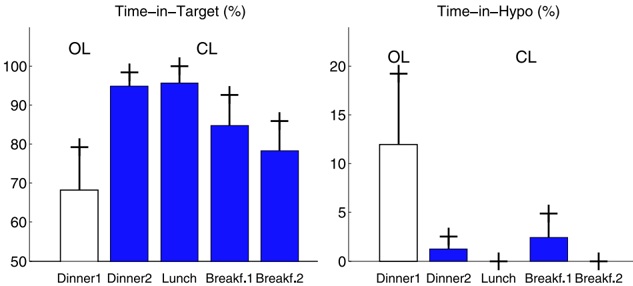
OBJECTIVE: Inpatient studies suggest that model predictive control (MPC) is one of the most promising algorithms for artificial pancreas (AP). So far, outpatient trials have used hypo/hyperglycemia-mitigation or medical-expert systems. In this study, we report the first wearable AP outpatient study based on MPC and investigate specifically its ability to control postprandial glucose, one of the major challenges in glucose control. RESEARCH DESIGN AND METHODS: A new modular MPC algorithm has been designed focusing on meal control. Six type 1 diabetes mellitus patients underwent 42-h experiments: sensor-augmented pump therapy in the first 14 h (open-loop) and closed-loop in the remaining 28 h. RESULTS: MPC showed satisfactory dinner control versus open-loop: time-in-target (70-180 mg/dL) 94.83 vs. 68.2% and time-in-hypo 1.25 vs. 11.9%. Overnight control was also satisfactory: time-in-target 89.4 vs. 85.0% and time-in-hypo: 0.00 vs. 8.19%. CONCLUSIONS: This outpatient study confirms inpatient evidence of suitability of MPC-based strategies for AP. These encouraging results pave the way to randomized crossover outpatient studies.
Overview
The claims and statistics of this paper haven’t been checked yet.
Free: it reads the open-access text and checks the first 5 claims that cite a source we can check. Create a free account to check every claim.
Integrity signals
Registry
Cites
Statistics
Figures
Verification
Claims the paper makes
The claims and statistics of this paper haven’t been checked yet.
Free: it reads the open-access text and checks the first 5 claims that cite a source we can check. Create a free account to check every claim.
Self-check
Percentages, sums and reported differences re-computed from the paper’s own numbers.
The self-check needs the paper’s full text.
Citations
Cites
Artificial Pancreas: Past, Present, Future
Cobelli, C., Renard, E., & Kovatchev, B. (2011) · Diabetes · doi:10.2337/db11-0654 · Cited by 600
Self-citationNocturnal Glucose Control with an Artificial Pancreas at a Diabetes Camp
Phillip, M., Battelino, T., Atlas, E., Kordonouri, O., Bratina, N., Miller, S., Biester, T., Avbelj Stefanija, M., Muller, I., Nimri, R., et al. (2013) · New England Journal of Medicine · doi:10.1056/nejmoa1206881 · Cited by 435 · cited 1×
“Three successful outpatient studies with an AP have recently been reported, using either a heuristic algorithm (hypo/hyperglycemia-mitigation system) (2,3) or a medical-based expert system (4).”
MethodModel Predictive Control of Type 1 Diabetes: An in Silico Trial
Magni, L., Raimondo, D. M., Bossi, L., Dalla Man, C., De Nicolao, G., Kovatchev, B., & Cobelli, C. (2007) · Journal of Diabetes Science and Technology · doi:10.1177/193229680700100603 · Cited by 317 · cited 1×
“(9), used in an inpatient study, as described in Breton et al.”
MethodSelf-citationFully Integrated Artificial Pancreas in Type 1 Diabetes
Breton, M., Farret, A., Bruttomesso, D., Anderson, S., Magni, L., Patek, S., Dalla Man, C., Place, J., Demartini, S., Del Favero, S., et al. (2012) · Diabetes · doi:10.2337/db11-1445 · Cited by 315
Self-citationKovatchev, B. P., Cox, D. J., Gonder-Frederick, L. A., Young-Hyman, D., Schlundt, D., & Clarke, W. (1998) · Diabetes Care · doi:10.2337/diacare.21.11.1870 · Cited by 310
Self-citationModular Closed-Loop Control of Diabetes
Patek, S. D., Magni, L., Dassau, E., Hughes-Karvetski, C., Toffanin, C., De Nicolao, G., Del Favero, S., Breton, M., Man, C. D., Renard, E., et al. (2012) · IEEE Transactions on Biomedical Engineering · doi:10.1109/tbme.2012.2192930 · Cited by 180
Self-citationFeasibility of Outpatient Fully Integrated Closed-Loop Control
Kovatchev, B. P., Renard, E., Cobelli, C., Zisser, H. C., Keith-Hynes, P., Anderson, S. M., Brown, S. A., Chernavvsky, D. R., Breton, M. D., Farret, A., et al. (2013) · Diabetes Care · doi:10.2337/dc12-1965 · Cited by 177 · cited 2×
“Three successful outpatient studies with an AP have recently been reported, using either a heuristic algorithm (hypo/hyperglycemia-mitigation system) (2,3) or a medical-based expert system (4).”
BackgroundMethodSelf-citationMPC based Artificial Pancreas: Strategies for individualization and meal compensation
Soru, P., Nicolao, G. D., Toffanin, C., Man, C. D., Cobelli, C., & Magni, L. (2012) · Annual Reviews in Control · doi:10.1016/j.arcontrol.2012.03.009 · Cited by 130
Self-citationPilot Studies of Wearable Outpatient Artificial Pancreas in Type 1 Diabetes
Cobelli, C., Renard, E., Kovatchev, B. P., Keith-Hynes, P., Ben Brahim, N., Place, J., Del Favero, S., Breton, M., Farret, A., Bruttomesso, D., et al. (2012) · Diabetes Care · doi:10.2337/dc12-0660 · Cited by 120 · cited 1×
“Three successful outpatient studies with an AP have recently been reported, using either a heuristic algorithm (hypo/hyperglycemia-mitigation system) (2,3) or a medical-based expert system (4).”
MethodSelf-citationDiAs User Interface: A Patient-Centric Interface for Mobile Artificial Pancreas Systems
Keith-Hynes, P., Guerlain, S., Mize, B., Hughes-Karvetski, C., Khan, M., McElwee-Malloy, M., & Kovatchev, B. P. (2013) · Journal of Diabetes Science and Technology · doi:10.1177/193229681300700602 · Cited by 85
Self-citation
Cited by
Weisman, A., Bai, J.-W., Cardinez, M., Kramer, C. K., & Perkins, B. A. (2017) · The Lancet Diabetes & Endocrinology · doi:10.1016/s2213-8587(17)30167-5 · Cited by 463
In silico clinical trials: how computer simulation will transform the biomedical industry
Viceconti, M., Henney, A., & Morley-Fletcher, E. (2016) · International Journal of Clinical Trials · doi:10.18203/2349-3259.ijct20161408 · Cited by 289
A review of personalized blood glucose prediction strategies for T1DM patients
Oviedo, S., Vehí, J., Calm, R., & Armengol, J. (2017) · International Journal for Numerical Methods in Biomedical Engineering · doi:10.1002/cnm.2833 · Cited by 279
Coming of age: the artificial pancreas for type 1 diabetes
Thabit, H., & Hovorka, R. (2016) · Diabetologia · doi:10.1007/s00125-016-4022-4 · Cited by 223
Kropff, J., Del Favero, S., Place, J., Toffanin, C., Visentin, R., Monaro, M., Messori, M., Di Palma, F., Lanzola, G., Farret, A., et al. (2015) · The Lancet Diabetes & Endocrinology · doi:10.1016/s2213-8587(15)00335-6 · Cited by 201
Self-citation
Metadata
- Authors
- Del Favero, S., Bruttomesso, D., Di Palma, F., Lanzola, G., Visentin, R., Filippi, A., Scotton, R., Toffanin, C., Messori, M., Scarpellini, S., Keith-Hynes, P., Kovatchev, B. P., DeVries, J. H., Renard, E., Magni, L., Avogaro, A., Cobelli, C., & on behalf of the AP@home Consortium
- Affiliations
- Department of Information Engineering, University of Padova, Padova, Italy
- University of Padua (IT)
- Department of Civil Engineering and Architecture, University of Pavia, Pavia, Italy
- University of Pavia (IT)
- Amsterdam UMC Location University of Amsterdam (NL)
- University of Virginia (US)
- Department of Endocrinology, Diabetes, and Nutrition, Montpellier University Hospital, Montpellier, France
- Corresponding author
- Cobelli, Claudio
- ORCID
- Venue
- Diabetes Care
- Publisher
- American Diabetes Association
- Published
- 2014-04-10
- Volume
- 37
- Issue
- 5
- Pages
- 1212-1215
- ISSN
- 0149-5992 (ISSN-L)
- 1935-5548
- OpenAlex
- W2025988694
- Cited by
- 103
- References
- 13
- Citations by year
- 2026: 1 · 2024: 4 · 2023: 5 · 2022: 5 · 2021: 6 · 2020: 3 · 2019: 15 · 2018: 10 · 2017: 14 · 2016: 11 · 2015: 18 · 2014: 11
- FWCI
- 14.48
- Type
- journal article
- Language
- en
- Open access
- hybrid
- doi.org
- Licence
- cc-by-nc-nd
- Locations
- Diabetes Care (publishedVersion, cc-by-nc-nd)
- PubMed (publishedVersion)
- Data Archiving and Networked Services (DANS) (submittedVersion)
- Pure Amsterdam UMC (submittedVersion)
- Padua Research Archive (University of Padova) (submittedVersion)
- INFM-OAR (INFN Catania) (submittedVersion, other-oa)
- Topics
- Health Sciences › Medicine › Endocrinology, Diabetes and Metabolism › Diabetes Management and Research
- Physical Sciences › Engineering › Control and Systems Engineering › Advanced Control Systems Optimization
- Health Sciences › Medicine › Endocrinology, Diabetes and Metabolism › Diabetes Management and Education
- Keywords
- model predictive control, artificial pancreas, type 1 diabetes, postprandial glucose control, sensor-augmented pump therapy, time in target, hypoglycemia
- MeSH terms
- Adult, Algorithms, Blood Glucose, Diabetes Mellitus, Type 1, Female, Humans, Hyperglycemia, Hypoglycemia, Hypoglycemic Agents, Insulin, Insulin Infusion Systems, Male, Treatment Outcome, Pancreas, Artificial, Postprandial Period
About these checks
Registry, retraction, Cites and statistics results are computed, not judged, with one exception: a printed reference that no index lists is read once by a model before it counts as a citation error. Claims are extracted by a model and kept only when their quote appears verbatim in the text; each cited source is then checked, with a model’s help, for whether it says what the claim relies on. Those verdicts can be wrong — read the claim’s quote and the cited source before relying on one.
Statistics and arithmetic are recomputed, not judged.
Confidence bands are shown only for fields calibrated on our annotated test set. None is calibrated yet, so no band is shown.
What counts as a claim ›How we measure confidence ›How we check this ›
Are you an author, or do you see a problem with this page? Request a review
How to cite
Cite CoChat for the checks on this page, and the paper for its own findings.
- This page
- CoChat. (2026). Citation check: First Use of Model Predictive Control in Outpatient Wearable Artificial Pancreas. https://app.cochat.ai/papers/10.2337/dc13-1631
- The paper
- Del Favero, S., Bruttomesso, D., Di Palma, F., Lanzola, G., Visentin, R., Filippi, A., Scotton, R., Toffanin, C., Messori, M., Scarpellini, S., Keith-Hynes, P., Kovatchev, B. P., DeVries, J. H., Renard, E., Magni, L., Avogaro, A., Cobelli, C., & on behalf of the AP@home Consortium. (2014). First Use of Model Predictive Control in Outpatient Wearable Artificial Pancreas. Diabetes Care. https://doi.org/10.2337/dc13-1631
Data sources
Bibliographic data: Semantic Scholar, OpenAlex, Crossref.
Contains information from the Semantic Scholar Academic Graph Datasets, made available under the ODC Attribution License (ODC-BY 1.0).
Semantic Scholar’s data is described in: Kinney, R., et al. (2023). The Semantic Scholar Open Data Platform. arXiv:2301.10140.
