

Assessing carnivore diet by faecal samples and stomach contents: a case study with Alpine red foxes
Open accessThe DOI matches its Crossref record; 39 of the 39 references it cites were found in a registry or an index.
Abstract
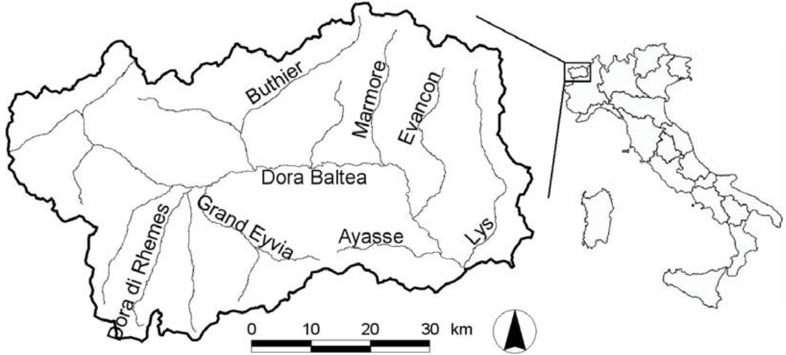
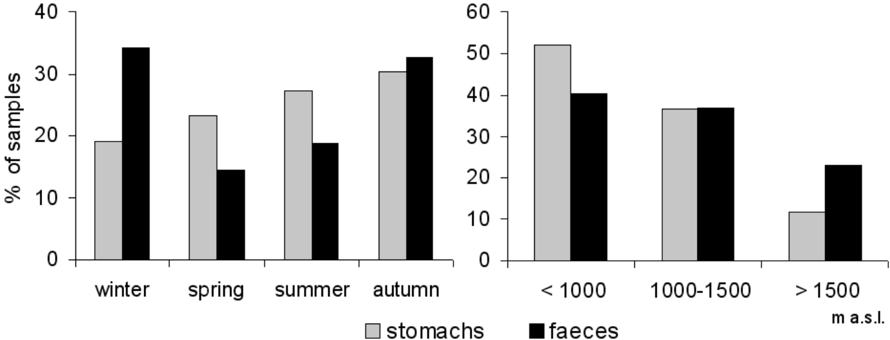
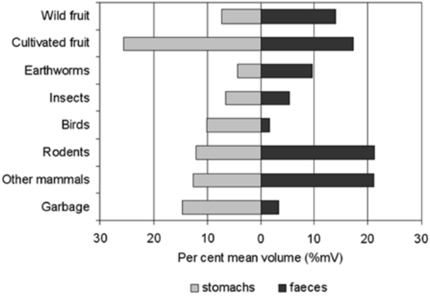
Research on the feeding habits of mammalian carnivores relies mainly on the analysis of stomach contents and faecal samples, but the outcomes of these two methods have only been compared in a few studies, with contrasting conclusions. In an Alpine area of NW Italy, we analysed both fox faeces collected along standardised transects, and the stomach contents of road-killed individuals. Faecal analysis involved the identification of macroscopic fragments, the identification of earthworm chaetae, and the assessment of relative volumes using Kruuk and Parish’s technique. Use of both methods indicated that the diet of the red fox included mainly fruit and mammals, but quantitative differences emerged. Garbage, birds, and cultivated fruit were overrepresented in the stomach contents, while earthworms, mammals, and wild fruit prevailed in the faecal samples. Logistic Regression Analysis suggested that the method of analysis was the main factor in determining the occurrence of food items in fox diet. Nonetheless, evidence suggests that road-killed foxes may include a disproportionately high percentage of synanthropic individuals and therefore be biased towards anthropogenic food. Results suggest that by using Kruuk and Parish’s technique, the main limitation of faecal analysis, i.e. the inaccurate estimation of the relative volume of each food item, can be overcome.
Overview
The claims and statistics of this paper haven’t been checked yet.
Free: it reads the open-access text and checks the first 5 claims that cite a source we can check. Create a free account to check every claim.
Integrity signals
Registry
Cites
Statistics
Figures
Verification
Claims the paper makes
The claims and statistics of this paper haven’t been checked yet.
Free: it reads the open-access text and checks the first 5 claims that cite a source we can check. Create a free account to check every claim.
Claims other papers make about this one
Each is checked against this paper’s own text: does it say what the citing paper says it does?
The source backs part of the claim, not all of it — or backs it for a different population, condition or comparison.
In the citing paper
“Another alternative for diet assessment is the analysis of stomach contents, a more invasive method since it requires deceased individuals; however, it allows for a more accurate evaluation of consumed items compared to fecal analyses, given that the items can be better identified since they have been exposed to much less digestive action, and easily-digestible foods may not be present in feces (B”
From Digestive anatomy and diet of free-ranging maned wolf (Chrysocyon brachyurus) (2025) · cites this paper as Balestrieri et al. 2011
Experimental — accuracy not yet measuredThe cited source says what the claim attributes to it.
In the citing paper
“The relative volume (%V) of each food item “as ingested” was assessed following Kruuk and Parish’s method60, which has been widely used for assessing carnivore diets and provides volume estimates as accurate as those obtained by the analysis of stomach contents40.”
From Nutritional ecology of a prototypical generalist predator, the red fox (Vulpes vulpes) (2024) · cites this paper as [40]
The cited source says what the claim attributes to it.
In the citing paper
“In our study areas, fox diet was poor in fruit (average Vm% = 8.5) respect to previous studies carried out in the western Italian Alps (Vm% = 15–32%)40–42.”
From Nutritional ecology of a prototypical generalist predator, the red fox (Vulpes vulpes) (2024) · cites this paper as [40]
Self-check
Percentages, sums and reported differences re-computed from the paper’s own numbers.
The self-check needs the paper’s full text.
Citations
Cites
ANALYZING TABLES OF STATISTICAL TESTS
Rice, W. R. (1989) · Evolution · doi:10.1111/j.1558-5646.1989.tb04220.x · Cited by 14,547
Schoener, T. W. (1974) · Science · doi:10.1126/science.185.4145.27 · Cited by 4,129
Mitchell-Jones, A. J., Amori, G., Kryštufek, B., Marnell, F., Miteva, S., Sallay, A., Schley, L., Thissen, J., & Vohralík, V. (2000) · CRC Press eBooks · doi:10.1201/9780429197611 · Cited by 1,250
REYNOLDS, J. C., & AEBISCHER, N. J. (1991) · Mammal Review · doi:10.1111/j.1365-2907.1991.tb00113.x · Cited by 426
Identification of hair and feather remains in the gut and faeces of stoats and weasels
Day, M. G. (1966) · Journal of Zoology · doi:10.1111/j.1469-7998.1966.tb02948.x · Cited by 424
Martens, Sables and Fishers' Biology and Conservation
McErlain-Ward, P., Buskirk, S. W., Harestad, A. S., Raphael, M. G., & Powell, R. A. (1996) · The Journal of Animal Ecology · doi:10.2307/5708 · Cited by 391
Contesse, P., Hegglin, D., Gloor, S., Bontadina, F., & Deplazes, P. (2004) · Mammalian Biology · doi:10.1078/1616-5047-00123 · Cited by 337
Relating Wolf Scat Content to Prey Consumed
Floyd, T. J., Mech, L. D., & Jordan, P. A. (1978) · The Journal of Wildlife Management · doi:10.2307/3800814 · Cited by 315
Feeding Specialization of the European Badger Meles meles in Scotland
Kruuk, H., & Parish, T. (1981) · The Journal of Animal Ecology · doi:10.2307/4136 · Cited by 313
Hair of West-European mammals : atlas and identification key
Teerink, B. J. (2003) · Cambridge University Press eBooks · Cited by 302
Research works printed but not linked: 7
- Schoener T.W., Resource partitioning in ecological communities, Science, 1974, 185, 27-39
- Hales A.L., Belant J.L., Bird J., Potential for sampling bias in diet studies of American Marten Martes americana, Small Carnivore Conservation, 2007, 37, 18-20
- Leinati L., Mandelli G., Videsott R., Grimaldi E., Indagini sulle abitudini alimentari della Volpe (Vulpes vulpes L.) del Parco Nazionale del Gran Paradiso, La Clinica Veterinaria, 1960, 83, 305- 311, (in Italian)
- Debrot S., Fival G., Mermod C., Weber J.M., Atlas des poils des mammifères d'Europe, Institut de Zoologie, Université de Neuchâtel Press, Neuchâtel, 1982, (in French)
- Di Palma M.G., Massa B., Contributo metodologico per lo studio dell'alimentazione dei rapaci, Proceedings of the first Italian Congress of Ornithology (Aulla, Italy), La Spezia Ambrosiana, 1981, 69-76, (in Italian)
- Kelly B.T., Carnivore scat analysis: an evaluation of existing techniques and the development of predictive models of prey consumed, M.Sc. Thesis, University of Idaho, Moscow, Idaho, USA, 1991
- Cumberland R.E., Dempsey J.A., Forbes G.J., Should diet be based on biomass? Importance of larger prey to the American marten, Wildlife Soc. B., 2001, 29, 1125-1130
Cited by
Soe, E., Davison, J., Süld, K., Valdmann, H., Laurimaa, L., & Saarma, U. (2017) · Mammal Review · doi:10.1111/mam.12092 · Cited by 121
“Since analyses based on stomach contents and on scats may differ systematically in their representation of different food items (Balestrieri et al. 2011), we repeated the analyses after excluding the relatively small number of studies based on stomach contents (Appendix S5).”
Dietary characterization of terrestrial mammals
Pineda-Munoz, S., & Alroy, J. (2014) · Proceedings of the Royal Society B: Biological Sciences · doi:10.1098/rspb.2014.1173 · Cited by 117
“Faeces contents are easier to evaluate because less time is required and there is no direct interaction with the animals [22,23].”
BackgroundMethodPlumer, L., Davison, J., & Saarma, U. (2014) · PLoS ONE · doi:10.1371/journal.pone.0115124 · Cited by 96
Mammalian Mycophagy: a Global Review of Ecosystem Interactions Between Mammals and Fungi
Elliott, T. F., Truong, C., Jackson, S., Zúñiga, C. L., Trappe, J. M., & Vernes, K. (2022) · Fungal Systematics and Evolution · doi:10.3114/fuse.2022.09.07 · Cited by 110
Contrasting evidence of phylogenetic trophic niche conservatism in mammals worldwide
Olalla‐Tárraga, M. Á., González‐Suárez, M., Bernardo‐Madrid, R., Revilla, E., & Villalobos, F. (2016) · Journal of Biogeography · doi:10.1111/jbi.12823 · Cited by 69
Balestrieri, A., Remonti, L., Ruiz‐González, A., Vergara, M., Capelli, E., Gómez‐Moliner, B. J., & Prigioni, C. (2010) · ACTA THERIOLOGICA · doi:10.1007/s13364-010-0015-8 · Cited by 60
Self-citationVariation in red fox Vulpes vulpes diet in five continents
Castañeda, I., Doherty, T. S., Fleming, P. A., Stobo‐Wilson, A. M., Woinarski, J. C. Z., & Newsome, T. M. (2022) · Mammal Review · doi:10.1111/mam.12292 · Cited by 59
Wolf diet and prey selection in Croatia
Octenjak, D., Pađen, L., Šilić, V., Reljić, S., Vukičević, T. T., & Kusak, J. (2020) · Mammal Research · doi:10.1007/s13364-020-00517-8 · Cited by 35
Distinctive diets of eutherian predators in Australia
Fleming, P. A., Stobo‐Wilson, A. M., Crawford, H. M., Dawson, S. J., Dickman, C. R., Doherty, T. S., Fleming, P. J. S., Newsome, T. M., Palmer, R., Thompson, J. A., et al. (2022) · Royal Society Open Science · doi:10.1098/rsos.220792 · Cited by 36
“Although there has been suggestion of underreporting of birds in carnivore diet interpreted from scats analysis [215,216,218], this was not apparent in the present investigation by comparison between studies using different methods.”
BackgroundResultDo non‐native fish as prey favour the conservation of the threatened indigenous Eurasian otter?
Balestrieri, A., Remonti, L., Vezza, P., Prigioni, C., & Copp, G. H. (2013) · Freshwater Biology · doi:10.1111/fwb.12102 · Cited by 34
Self-citationDoes the presence of large predators affect the diet of a mesopredator?
Brassine, M. C., & Parker, D. M. (2011) · African Journal of Ecology · doi:10.1111/j.1365-2028.2011.01308.x · Cited by 31
Highways associated with expansion of boreal scavengers into the alpine tundra of Fennoscandia
Rød‐Eriksen, L., Skrutvold, J., Herfindal, I., Jensen, H., & Eide, N. E. (2020) · Journal of Applied Ecology · doi:10.1111/1365-2664.13668 · Cited by 33
Twining, J. P., Montgomery, I. W., Fitzpatrick, V., Marks, N. J., Scantlebury, D. M., & Tosh, D. G. (2019) · European Journal of Wildlife Research · doi:10.1007/s10344-019-1289-z · Cited by 29
Danckwerts, D. K., McQuaid, C. D., Connan, M., Smale, M. J., Corre, M. L., Humeau, L., Kaehler, S., Juhasz, C., Orlowski, S., Tourmetz, J., et al. (2016) · Marine Biology · doi:10.1007/s00227-015-2810-x · Cited by 26
“Thus, the RPO method was used to give an indication of the breadth of the diet by signifying how often a food type is encountered relative to all other food types (Hyslop 1980; Balestrieri et al. 2011).”
BackgroundMethodSmiroldo, G., Villa, A., Tremolada, P., Gariano, P., Balestrieri, A., & Delfino, M. (2019) · Mammal Review · doi:10.1111/mam.12155 · Cited by 26
Self-citationBrown bear feeding habits in a poor mast year where supplemental feeding occurs
Pereira, J., Viličić, L., Rosalino, L. M., Reljić, S., Habazin, M., & Huber, Đ. (2021) · Ursus · doi:10.2192/ursus-d-19-00023.3 · Cited by 22
Bandeira, V., Virgós, E., Carvalho, J., Barros, T., Cunha, M. V., & Fonseca, C. M. D. (2017) · Mammalian Biology · doi:10.1016/j.mambio.2017.11.004 · Cited by 22
Lazzaroni, M., Brogi, R., Napolitano, V., Apollonio, M., Range, F., & Marshall‐Pescini, S. (2024) · Current Zoology · doi:10.1093/cz/zoae023 · Cited by 20
“Foxes’ behavioral plasticity together with their high diet diversity (Contesse et al. 2004; Hartová-Nentvichová et al. 2010; Balestrieri et al. 2011; Bassi et al. 2012; Castañeda et al. 2022), are likely important factors in their success in the human-altered environment.”
BackgroundResultTop-down control of ecosystems and the case for rewilding: does it all add up?
Hayward, M. W., Edwards, S., Fancourt, B. A., Linnell, J. D. C., & Nilsen, E. B. (2019) · Cambridge University Press eBooks · doi:10.1017/9781108560962.016 · Cited by 18
Jacquot, M. (2013) · theses.fr (ABES) · doi:10.70675/e567841az4185z45f1z8897z05400f1f2740 · Cited by 17
Lino, S., Rossa, M., Fernandes, J. M., Barros, T., Lino, A., Hipólito, D., Ferreira, E., Aliácar, S. C., Cadete, D., Fonseca, C. M. D., et al. (2023) · European Journal of Wildlife Research · doi:10.1007/s10344-023-01740-9 · Cited by 16
“This metric is commonly used as an estimate of the importance of the different prey in the canids’ diets (Balestrieri et al. 2010).”
Top‐predator carrion is scary: Fight‐and‐flight responses of wild boars to wolf carcasses
Redondo‐Gómez, D., Rossi, L., Cardello, M., Pasquale, S. D., Martínez‐Carrasco, C., Sánchez‐Zapata, J. A., & Moleón, M. (2023) · Ecology and Evolution · doi:10.1002/ece3.9911 · Cited by 16
O’Connor, J. M., Srivastava, S. K., Tindale, N. W., & Burnett, S. E. (2020) · Australian Journal of Zoology · doi:10.1071/zo19059 · Cited by 16
“International studies also confirm the presence of insects in the fox diet, albeit with seasonal fluctuation and variable importance (Lanszki 2005; Sidorovich et al. 2006; Helldin and Danielsson 2007; Delibes-Mateos et al. 2008; Balestrieri et al. 2011).”
BackgroundInfluentialFletcher, J. W. J., Tollington, S., Cox, R., Tolhurst, B. A., Newton, J., McGill, R. A. R., Cropper, P., Berry, N., Illa, K., & Scott, D. M. (2025) · Ecology and Evolution · doi:10.1002/ece3.70844 · Cited by 14
“Some forms of anthropogenic food (e.g., food waste such as scavenged meat, bread and other processed foods) are highly digestible and therefore more easily identified in fox stomach contents than in faecal samples (Balestrieri, Remonti, and Prigioni 2011).”
Long-term game species dynamic as indicator for changing landscape quality
Tasser, E., Unterthurner, B., Agreiter, A., Aukenthaler, H., Gerstgrasser, L., Giardino, M. J., Tappeiner, U., & Rüdisser, J. (2023) · The Science of The Total Environment · doi:10.1016/j.scitotenv.2023.162375 · Cited by 12
Reed, P. M., Dwyer, J. F., & Stankowich, T. (2023) · Wildlife Biology · doi:10.1002/wlb3.01095 · Cited by 13
Lanszki, J., Bende, Z., Nagyapáti, N., Lanszki, Z., & Pongrácz, P. (2023) · Ecology and Evolution · doi:10.1002/ece3.10033 · Cited by 11
“…changes), for example, in prey abundance, are usually well reflected in the diet composition of vertebrate predators and community dynamics (Balestrieri et al., 2011; DíazRuiz et al., 2013; Jędrzejewski & Jędrzejewska, 1992; Kjellander & Nordström, 2003; Panzacchi et al., 2008; Soe et al.,…”
BackgroundRagadozó emlősök táplálkozási kapcsolatai
Lanszki, J. (2012) · Natura Somogyiensis · doi:10.24394/natsom.2012.21.2 · Cited by 9
Harriott, L. (2018) · The University of Queensland · doi:10.14264/uql.2018.223 · Cited by 9
“bread, domestic dog food), these may be masked from scat studies and therefore give a biased representation of diet composition (Balestrieri et al., 2011).”
BackgroundNutritional ecology of a prototypical generalist predator, the red fox (Vulpes vulpes)
Balestrieri, A., Gigliotti, S., Caniglia, R., Velli, E., Zambuto, F., De Giorgi, E., Mucci, N., Tremolada, P., & Gazzola, A. (2024) · Scientific Reports · doi:10.1038/s41598-024-58711-6 · Cited by 8
“The relative volume (%V) of each food item “as ingested” was assessed following Kruuk and Parish’s method 60 , which has been widely used for assessing carnivore diets and provides volume estimates as accurate as those obtained by the analysis of stomach contents 40 .”
MethodSelf-citationLingle, S., Breiter, C.-J. C., Schowalter, D. B., & Wilmshurst, J. (2022) · Wildlife Biology · doi:10.1002/wlb3.01048 · Cited by 8
Pollard, M. D., & Puckett, E. E. (2021) · bioRxiv (Cold Spring Harbor Laboratory) · doi:10.1101/2021.09.15.460515 · Cited by 8
Encarnação, J., Dias, E., Engelen, A. H., Serrão, E. Á., Morais, P., & Teodósio, M. A. (2024) · Biological Invasions · doi:10.1007/s10530-024-03515-y · Cited by 7
The influence of an apex predator introduction on an already established subordinate predator
Parker, D. M., van de Vyver, D., & Bissett, C. (2020) · Journal of Zoology · doi:10.1111/jzo.12852 · Cited by 7
Boukhdoud, L., Saliba, C., Parker, L. D., McInerney, N. R., Kahale, R., Saliba, I., Maldonado, J. E., & Kharrat, M. B. D. (2021) · Metabarcoding and Metagenomics · doi:10.3897/mbmg.5.70107 · Cited by 8
“Traditional techniques such as direct visualization, camera traps and visual analyses of stomach, gut, and scat content (Balestrieri et al. 2011; D’hondt et al. 2011; González-Varo et al. 2014; Norouzzadeh et al. 2018), are still widely used, but they present multiple obstacles (Davidson et al.…”
MethodWilliams, N. F., Porteus, T. A., Hardouin, E. A., Case, J., Rivers, E., Andreou, D., Hoodless, A. N., Stillman, R. A., & Short, M. J. (2024) · Mammal Research · doi:10.1007/s13364-024-00769-8 · Cited by 7
Drivers of spatio-temporal population dynamics of game species in a mountain landscape
Tasser, E., Unterthurner, B., Agreiter, A., Gerstgrasser, L., Giardino, M. J., Tappeiner, U., Walde, J. F., & Rüdisser, J. (2024) · Scientific Reports · doi:10.1038/s41598-024-53019-x · Cited by 7
Molecular versus morphological approaches to diet analysis of the caracal (Caracal caracal)
Momeni, S., Malekian, M., & Hemami, M. (2019) · Mammalia · doi:10.1515/mammalia-2017-0161 · Cited by 6
Using stomach contents for diet analysis of carnivores through DNA barcoding
Santos, T. L., Fonseca, C. M. D., Barros, T., Godinho, R., Bastos‐Silveira, C., Bandeira, V., & Rocha, R. G. (2015) · Wildlife Biology in Practice · doi:10.2461/wbp.2015.11.4 · Cited by 6
Temu, S. E., Nahonyo, C. L., East, M. L., & Moehlman, P. D. (2022) · Tanzania Journal of Science · doi:10.4314/tjs.v48i4.5 · Cited by 5
Detection of earthworm chaetae in mammal faeces: methodological implications
Battisti, A., Giuliano, D., & Balestrieri, A. (2019) · Folia Zoologica · doi:10.25225/fozo.075.2019 · Cited by 5
“This kind of research mainly relies on the examination of stomach contents and faecal samples, the second being a non-invasive technique which does not imply the death of target individuals (Balestrieri et al. 2011).”
BackgroundSelf-citationYoungmann, J. L., Lance, S. L., Kilgo, J. C., Ruth, C. R., Cantrell, J. R., & D’Angelo, G. J. (2023) · PLoS ONE · doi:10.1371/journal.pone.0293270 · Cited by 5
Comparative analysis of the diet of members of the families Mustelidae and Canidae
Martsiv, M., & Dykyy, I. V. (2021) · Theriologia Ukrainica · doi:10.15407/tu2112 · Cited by 4
Diet composition of the golden jackal (Canis aureus) in the Ngorongoro Crater, Tanzania
Temu, S. E., Nahonyo, C. L., & Moehlman, P. D. (2018) · Tanzania Journal of Science · doi:10.65085/2507-7961.1771 · Cited by 4
“Diet assessment is also important in mammalian ecology as food availability influences population size, social organization and interspecific relationships and thus has significant implications in conservation (Balestrieri et al.2011).”
BackgroundThe association between diet of periurban wild dogs and zoonotic pathogen carriage
Harriott, L., Gentle, M., Traub, R. J., Magalhães, R. J. S., & Cobbold, R. N. (2019) · Australian Mammalogy · doi:10.1071/am18042 · Cited by 4
“While scats are relatively easy to collect and allow for repeated consistent sampling across different habitats, there are some limitations with their use for assessing diet composition that only stomach sampling can overcome (Balestrieri et al. 2011; Klare et al. 2011).”
BackgroundLyngen, J. (2016) · NVA (Nasjonalt vitenarkiv) · Cited by 4
Digestive anatomy and diet of free-ranging maned wolf (Chrysocyon brachyurus)
Silva, B. C., de Oliveira, L. A., Clauss, M., Costa, C. G., de Oliveira Marques Alexandre, L., & Duque-Correa, M. J. (2025) · Mammalian Biology · doi:10.1007/s42991-025-00493-z · Cited by 3
“…for a more accurate evaluation of consumed items compared to fecal analyses, given that the items can be better identified since they have been exposed to much less digestive action, and easily-digestible foods may not be present in feces (Balestrieri et al. 2011; Pineda-Munoz and Alroy 2014).”
Coprolite Multimodal Analysis: A Tool for Hyaenid Predator Identification
Dauphin, Y., & Brugal, J. (2025) · Animals · doi:10.3390/ani15081145 · Cited by 3
Jean-Pierre, A., Loranger‐Merciris, G., Saint-Louis, L. J., & Cézilly, F. (2023) · European Journal of Wildlife Research · doi:10.1007/s10344-023-01698-8 · Cited by 3
“We also suggest to further investigate the potential impact of exotic mammal predators on FT and other ground-dwelling forest birds, possibly through collecting faeces in the wild (Carrión and Valle 2018) or from direct analysis of stomach content (Balestrieri et al. 2011) following control operations.”
BackgroundFood Habits of the Wolf in a Low-Density Territory in the Northeast of Trás-os-Montes (Portugal)
Lemos, S., Llaneza, L., Pereira, A., & Monzón, A. (2025) · Animals · doi:10.3390/ani15060873 · Cited by 2
“This study’s method for determining the Iberian wolf’s diet was scat analysis because it is a non-invasive technique that is very effective for collecting information on carnivores’ diet [16] and allows homogeneous sampling, with an accuracy of 80–90% [28,29].”
Kukreti, M., Arya, S., & Singh, S. K. (2013) · Journal of Applied and Natural Science · doi:10.31018/jans.v5i2.351 · Cited by 2
“Some other workers examined the faeces of mammals to identify the contents in it (Katona and Altbacker, 2002; Balestrieri et al., 2011; Ndawula et al., 2011; Bergstron, 2013).”
BackgroundCafiero, S. A., Cenni, L., Rossi, C., Pascoe, E. L., Obber, F., Rold, G. D., Citterio, C. V., Adriano, C., Hauffe, H. C., & Massolo, A. (2025) · International Journal for Parasitology Parasites and Wildlife · doi:10.1016/j.ijppaw.2025.101095 · Cited by 2
“The stomach contents were washed, filtered and macroscopically analysed with minor modifications of a well-established protocol (Kruuk and Parish, 1981; Balestrieri et al., 2011).”
Patterns of reproduction and body condition in Red fox (Vulpes vulpes)
Halvorsrud, E. (2014) · NVA (Nasjonalt vitenarkiv) · Cited by 2
Encarnação, J. P. D. S. (2024) · Universidade do Algarve · Cited by 2
Diet of the invasive red fox (Vulpes vulpes) in the Pilbara, Western Australia
Grassi, N. (n.d.) · Murdoch University Research Portal · Cited by 2
Park, J., Park, I., Kim, J., & Park, D. (2024) · Food Webs · doi:10.1016/j.fooweb.2024.e00365 · Cited by 1
Conservancy, T. S. L., Hacker, C., & Sonoma, C. (2023) · Science Reviews Biology · doi:10.57098/scirevs.biology.2.3.1 · Cited by 1
Smiroldo, G. (2019) · Archivio Istituzionale della Ricerca (Universita Degli Studi Di Milano) · doi:10.13130/smiroldo-giorgio_phd2019-01-30 · Cited by 1
Etude du régime alimentaire des carnivores par des techniques moléculaires
Shehzad, W. (2011) · theses.fr (ABES) · doi:10.70675/99ed65dazb6edz43c6za310z73ce6011180f · Cited by 1
“Some studies have also focused the diet of large endangered carnivores by examining stomach contents from dead carcasses (e.g. otter from England; Britton et al. 2006 and red fox from Italy; Balestrieri et al. 2011).”
BackgroundInfluentialZanvo, S. (2022) · theses.fr (ABES) · doi:10.70675/686dc4e0z4cb5z4875z9a8dz7221c56de889 · Cited by 1
Storihle, M. (2013) · NVA (Nasjonalt vitenarkiv)
Dingo diet in a modified landscape
Duncan, T. A. (2020) · Murdoch University Research Portal
Siziba, V. I. (2024) · ResearchSpace (University of KwaZulu-Natal)
Cui, Y., Wang, D., Huang, F., Cao, Z., Liu, Y., Pingcuo, A., Qiong, D., Hu, X., & Xu, Y. (2026) · Ecology and Evolution · doi:10.1002/ece3.73361
“Prior studies have indicated that red foxes may obtain food subsidies from human activities along roads, such as edible waste discarded by drivers and the carcasses of road-killed animals (Forman and Alexander 1998; Balestrieri et al. 2011).”
Autumn–winter diet of the raccoon (Procyon lotor) in the Czech Republic: a preliminary diet analysis
Mikulka, O., Cukor, J., Musálková, E., Drimaj, J., Brynychová, K., & Matějů, Z. (2026) · Mammal Research · doi:10.1007/s13364-026-00899-1
“Compared with scat analysis, it also has the advantage that food remains are less extensively digested, which may facilitate their identifi - cation (Balestrieri et al. 2011).”
You are what you eat: evolutionary analysis of the diet of Carnivora (Mammalia)
Tarquini, S. D., Chemisquy, M. A., Ladevèze, S., & Prevosti, F. J. (2026) · Mammal Research · doi:10.1007/s13364-026-00904-7
“Likewise, bird remains have been reported to be underestimated in faecal analysis (Balestrieri et al. 2011 ).”
Dietary ecology of introduced predators in a fragmented biodiversity hotspot
Grassi, N., Comer, S. J., Hall, M. L., Standish, R. J., Shephard, J. M., & Fleming, P. A. (2026) · Australian Mammalogy · doi:10.1071/am26017
Metadata
- Authors
- Balestrieri, A., Remonti, L., & Prigioni, C.
- Affiliations
- University of Pavia (IT)
- Venue
- Open Life Sciences
- Publisher
- Walter de Gruyter GmbH
- Published
- 2011-02-04
- Volume
- 6
- Issue
- 2
- Pages
- 283-292
- ISSN
- 1895-104X (ISSN-L)
- 2391-5412
- OpenAlex
- W2073273905
- Cited by
- 56
- References
- 39
- Citations by year
- 2026: 2 · 2025: 5 · 2024: 6 · 2023: 8 · 2022: 5 · 2021: 4 · 2020: 4 · 2019: 6 · 2018: 2 · 2017: 2 · 2016: 1 · 2015: 1 · 2014: 3 · 2013: 3 · 2012: 1
- FWCI
- 2.03
- Type
- journal article
- Language
- en
- Open access
- gold
- doi.org
- Licence
- Locations
- Open Life Sciences (publishedVersion, cc-by-nc-nd)
- DOAJ (DOAJ: Directory of Open Access Journals) (submittedVersion, cc-by-sa)
- INFM-OAR (INFN Catania) (submittedVersion, cc-by-nc-nd)
- Topics
- Physical Sciences › Environmental Science › Ecology › Wildlife Ecology and Conservation
- Physical Sciences › Environmental Science › Ecology › Animal Ecology and Behavior Studies
- Life Sciences › Agricultural and Biological Sciences › Ecology, Evolution, Behavior and Systematics › Plant and animal studies
- Keywords
- red fox, Vulpia vulpes, carnivore diet, fecal analysis, stomach contents, road-killed animals, anthropogenic food, fruit consumption, Alpine region
About these checks
Registry, retraction, Cites and statistics results are computed, not judged, with one exception: a printed reference that no index lists is read once by a model before it counts as a citation error. Claims are extracted by a model and kept only when their quote appears verbatim in the text; each cited source is then checked, with a model’s help, for whether it says what the claim relies on. Those verdicts can be wrong — read the claim’s quote and the cited source before relying on one.
Statistics and arithmetic are recomputed, not judged.
Confidence bands are shown only for fields calibrated on our annotated test set. None is calibrated yet, so no band is shown.
What counts as a claim ›How we measure confidence ›How we check this ›
Are you an author, or do you see a problem with this page? Request a review
Data sources
Bibliographic data: Semantic Scholar, OpenAlex, Crossref.
Contains information from the Semantic Scholar Academic Graph Datasets, made available under the ODC Attribution License (ODC-BY 1.0).
Semantic Scholar’s data is described in: Kinney, R., et al. (2023). The Semantic Scholar Open Data Platform. arXiv:2301.10140.
