

Assessing carnivore diet by faecal samples and stomach contents: a case study with Alpine red foxes
Open accessThe DOI matches its Crossref record; 39 of the 39 references it cites were found in a registry or an index.
Abstract
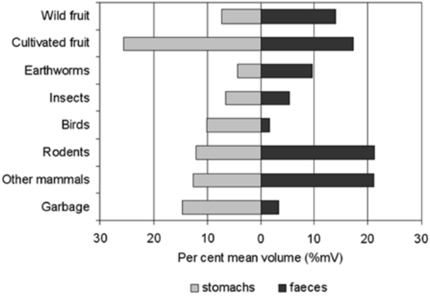
Research on the feeding habits of mammalian carnivores relies mainly on the analysis of stomach contents and faecal samples, but the outcomes of these two methods have only been compared in a few studies, with contrasting conclusions. In an Alpine area of NW Italy, we analysed both fox faeces collected along standardised transects, and the stomach contents of road-killed individuals. Faecal analysis involved the identification of macroscopic fragments, the identification of earthworm chaetae, and the assessment of relative volumes using Kruuk and Parish’s technique. Use of both methods indicated that the diet of the red fox included mainly fruit and mammals, but quantitative differences emerged. Garbage, birds, and cultivated fruit were overrepresented in the stomach contents, while earthworms, mammals, and wild fruit prevailed in the faecal samples. Logistic Regression Analysis suggested that the method of analysis was the main factor in determining the occurrence of food items in fox diet. Nonetheless, evidence suggests that road-killed foxes may include a disproportionately high percentage of synanthropic individuals and therefore be biased towards anthropogenic food. Results suggest that by using Kruuk and Parish’s technique, the main limitation of faecal analysis, i.e. the inaccurate estimation of the relative volume of each food item, can be overcome.
Overview
The claims and statistics of this paper haven’t been checked yet.
Free: it reads the open-access text and checks the first 5 claims that cite a source we can check. Create a free account to check every claim.
Integrity signals
Registry
Cites
Statistics
Figures
Verification
Claims the paper makes
The claims and statistics of this paper haven’t been checked yet.
Free: it reads the open-access text and checks the first 5 claims that cite a source we can check. Create a free account to check every claim.
Claims other papers make about this one
Each is checked against this paper’s own text: does it say what the citing paper says it does?
The source backs part of the claim, not all of it — or backs it for a different population, condition or comparison.
In the citing paper
“Another alternative for diet assessment is the analysis of stomach contents, a more invasive method since it requires deceased individuals; however, it allows for a more accurate evaluation of consumed items compared to fecal analyses, given that the items can be better identified since they have been exposed to much less digestive action, and easily-digestible foods may not be present in feces (B”
From Digestive anatomy and diet of free-ranging maned wolf (Chrysocyon brachyurus) (2025) · cites this paper as Balestrieri et al. 2011
Experimental — accuracy not yet measuredThe cited source says what the claim attributes to it.
In the citing paper
“The relative volume (%V) of each food item “as ingested” was assessed following Kruuk and Parish’s method60, which has been widely used for assessing carnivore diets and provides volume estimates as accurate as those obtained by the analysis of stomach contents40.”
From Nutritional ecology of a prototypical generalist predator, the red fox (Vulpes vulpes) (2024) · cites this paper as [40]
The cited source says what the claim attributes to it.
In the citing paper
“In our study areas, fox diet was poor in fruit (average Vm% = 8.5) respect to previous studies carried out in the western Italian Alps (Vm% = 15–32%)40–42.”
From Nutritional ecology of a prototypical generalist predator, the red fox (Vulpes vulpes) (2024) · cites this paper as [40]
Self-check
Percentages, sums and reported differences re-computed from the paper’s own numbers.
The self-check needs the paper’s full text.
Citations
Cites
ANALYZING TABLES OF STATISTICAL TESTS
Rice, W. R. (1989) · Evolution · doi:10.1111/j.1558-5646.1989.tb04220.x · Cited by 14,547
Schoener, T. W. (1974) · Science · doi:10.1126/science.185.4145.27 · Cited by 4,129
Mitchell-Jones, A. J., Amori, G., Kryštufek, B., Marnell, F., Miteva, S., Sallay, A., Schley, L., Thissen, J., & Vohralík, V. (2000) · CRC Press eBooks · doi:10.1201/9780429197611 · Cited by 1,250
REYNOLDS, J. C., & AEBISCHER, N. J. (1991) · Mammal Review · doi:10.1111/j.1365-2907.1991.tb00113.x · Cited by 426
Identification of hair and feather remains in the gut and faeces of stoats and weasels
Day, M. G. (1966) · Journal of Zoology · doi:10.1111/j.1469-7998.1966.tb02948.x · Cited by 424
Martens, Sables and Fishers' Biology and Conservation
McErlain-Ward, P., Buskirk, S. W., Harestad, A. S., Raphael, M. G., & Powell, R. A. (1996) · The Journal of Animal Ecology · doi:10.2307/5708 · Cited by 391
Contesse, P., Hegglin, D., Gloor, S., Bontadina, F., & Deplazes, P. (2004) · Mammalian Biology · doi:10.1078/1616-5047-00123 · Cited by 337
Relating Wolf Scat Content to Prey Consumed
Floyd, T. J., Mech, L. D., & Jordan, P. A. (1978) · The Journal of Wildlife Management · doi:10.2307/3800814 · Cited by 315
Feeding Specialization of the European Badger Meles meles in Scotland
Kruuk, H., & Parish, T. (1981) · The Journal of Animal Ecology · doi:10.2307/4136 · Cited by 313
Hair of West-European mammals : atlas and identification key
Teerink, B. J. (2003) · Cambridge University Press eBooks · Cited by 302
Teerink, B. J. (1991) · Medical Entomology and Zoology · Cited by 279
The Estimation of the Food of Foxes
Lockie, J. D. (1959) · The Journal of Wildlife Management · doi:10.2307/3797647 · Cited by 244
Refining the Equation for Interpreting Prey Occurrence in Gray Wolf Scats
Weaver, J. L. (1993) · The Journal of Wildlife Management · doi:10.2307/3809278 · Cited by 212
A comparison of scat‐analysis methods to assess the diet of the wolf Canis lupus
Ciucci, P., Boitani, L., Pelliccioni, E. R., Rocco, M., & Guy, I. (1996) · Wildlife Biology · doi:10.2981/wlb.1996.006 · Cited by 196
Jędrzejewski, W., & Jędrzejewska, B. (1992) · Ecography · doi:10.1111/j.1600-0587.1992.tb00027.x · Cited by 186
Food limitation and social regulation in a red fox population
Lindström, E. (1989) · Ecography · doi:10.1111/j.1600-0587.1989.tb00824.x · Cited by 176
Kowalczyk, R., Bunevich, A. N., & Jędrzejewska, B. (2000) · ACTA THERIOLOGICA · doi:10.4098/at.arch.00-39 · Cited by 148
On food preference in the Red fox
MACDONALD, D. W. (1977) · Mammal Review · doi:10.1111/j.1365-2907.1977.tb00359.x · Cited by 140
Assessing the Diet of Dingoes from Feces: A Comparison of 3 Methods
Corbett, L. K. (1989) · The Journal of Wildlife Management · doi:10.2307/3801135 · Cited by 107
Changes in Summer Foods of Wolves in Central Ontario
Voigt, D. R., Kolenosky, G. B., & Pimlott, D. H. (1976) · The Journal of Wildlife Management · doi:10.2307/3800561 · Cited by 96
Should diet be based on biomass? Importance of larger prey to the American marten
Cumberland, R. E., Dempsey, J. A., & Forbes, G. J. (2001) · Cited by 65
Panzacchi, M., Linnell, J. D. C., Odden, J., Odden, M., & Andersen, R. (2008) · Canadian Journal of Zoology · doi:10.1139/z07-120 · Cited by 61
Altitudinal gradient of Eurasian otter (Lutra lutra) food niche in Mediterranean habitats
Remonti, L., Balestrieri, A., & Prigioni, C. (2009) · Canadian Journal of Zoology · doi:10.1139/z09-011 · Cited by 58
Self-citationHartová-Nentvichová, M., Šálek, M., Červený, J., & Koubek, P. (2009) · Mammalian Biology · doi:10.1016/j.mambio.2009.09.003 · Cited by 58
Virgós, E., Mangas, J. G., Blanco-Aguiar, J. A., Garrote, G., Almagro, N., & Viso, R. P. (2004) · Canadian Journal of Zoology · doi:10.1139/z03-205 · Cited by 57
Carrion dependence and food habits of the red fox in an Alpine area
Cagnacci, F., Lovari, S., & Meriggi, A. (2003) · Italian Journal of Zoology · doi:10.1080/11250000309356493 · Cited by 53
Condition and growth and Red Foxes (Vulpes vulpes) in relation to food supply
Lindström, E. (1983) · Journal of Zoology · doi:10.1111/j.1469-7998.1983.tb06120.x · Cited by 49
Variation in the diet of the red fox in a Mediterranean area
Cavallini, P., & Volpi, T. (1996) · Revue d'Écologie (La Terre et La Vie) · doi:10.3406/revec.1996.2201 · Cited by 49
Ranging behaviour of the red fox in the Gran Paradiso National Park (Italy)
Boitani, L., Barrasso, P., & Grimod, I. (1984) · Bolletino di zoologia · doi:10.1080/11250008409439466 · Cited by 45
Cranial Variation in the North American Red Fox
Churcher, C. S. (1960) · Journal of Mammalogy · doi:10.2307/1377493 · Cited by 45
Remonti, L., Balestrieri, A., Domenis, L., Banchi, C., Valvo, T. L., Robetto, S., & Orusa, R. (2005) · Parasitology Research · doi:10.1007/s00436-005-1481-9 · Cited by 43
Self-citationDiet of the Eurasian badger ( Meles meles ) in an agricultural riverine habitat (NW Italy)
Balestrieri, A., Remonti, L., & Prigioni, C. (2005) · Bollettino del CILEA (CILEA) · doi:10.4404/hystrix-15.2-4332 · Cited by 41
Self-citationFaecal-Centric Approaches to Wildlife Ecology and Conservation; Methods, Data and Ethics
Darimont, C. T., Reimchen, T. E., Bryan, H. M., & Paquet, P. C. (2008) · Wildlife Biology in Practice · doi:10.2461/wbp.2008.4.7 · Cited by 40
Biases in the analysis of the diet of the red fox Vulpes vulpes
Cavallini, P., & Volpi, T. (1995) · Wildlife Biology · doi:10.2981/wlb.1995.0030 · Cited by 31
A Comparison of Prairie Dog Stomach Contents and Feces Using a Microhistological Technique
Wydeven, P. R., & Dahlgren, R. B. (1982) · Journal of Wildlife Management · doi:10.2307/3808252 · Cited by 27
Balestrieri, A., Remonti, L., & Prigioni, C. (2006) · Bollettino del CILEA (CILEA) · doi:10.4404/hystrix-16.2-4349 · Cited by 14
Self-citationThe Diet of the Red Fox: Questions about method
Witt, H. (1980) · Springer eBooks · doi:10.1007/978-94-017-5592-4_6 · Cited by 12
Robitaille, J. F., & Laurence, S. (2007) · ACTA THERIOLOGICA · doi:10.1007/bf03194227 · Cited by 3
Research works printed but not linked: 7
- Schoener T.W., Resource partitioning in ecological communities, Science, 1974, 185, 27-39
- Hales A.L., Belant J.L., Bird J., Potential for sampling bias in diet studies of American Marten Martes americana, Small Carnivore Conservation, 2007, 37, 18-20
- Leinati L., Mandelli G., Videsott R., Grimaldi E., Indagini sulle abitudini alimentari della Volpe (Vulpes vulpes L.) del Parco Nazionale del Gran Paradiso, La Clinica Veterinaria, 1960, 83, 305- 311, (in Italian)
- Debrot S., Fival G., Mermod C., Weber J.M., Atlas des poils des mammifères d'Europe, Institut de Zoologie, Université de Neuchâtel Press, Neuchâtel, 1982, (in French)
- Di Palma M.G., Massa B., Contributo metodologico per lo studio dell'alimentazione dei rapaci, Proceedings of the first Italian Congress of Ornithology (Aulla, Italy), La Spezia Ambrosiana, 1981, 69-76, (in Italian)
- Kelly B.T., Carnivore scat analysis: an evaluation of existing techniques and the development of predictive models of prey consumed, M.Sc. Thesis, University of Idaho, Moscow, Idaho, USA, 1991
- Cumberland R.E., Dempsey J.A., Forbes G.J., Should diet be based on biomass? Importance of larger prey to the American marten, Wildlife Soc. B., 2001, 29, 1125-1130
Cited by
Soe, E., Davison, J., Süld, K., Valdmann, H., Laurimaa, L., & Saarma, U. (2017) · Mammal Review · doi:10.1111/mam.12092 · Cited by 121
“Since analyses based on stomach contents and on scats may differ systematically in their representation of different food items (Balestrieri et al. 2011), we repeated the analyses after excluding the relatively small number of studies based on stomach contents (Appendix S5).”
Dietary characterization of terrestrial mammals
Pineda-Munoz, S., & Alroy, J. (2014) · Proceedings of the Royal Society B: Biological Sciences · doi:10.1098/rspb.2014.1173 · Cited by 117
“Faeces contents are easier to evaluate because less time is required and there is no direct interaction with the animals [22,23].”
BackgroundMethodPlumer, L., Davison, J., & Saarma, U. (2014) · PLoS ONE · doi:10.1371/journal.pone.0115124 · Cited by 96
Mammalian Mycophagy: a Global Review of Ecosystem Interactions Between Mammals and Fungi
Elliott, T. F., Truong, C., Jackson, S., Zúñiga, C. L., Trappe, J. M., & Vernes, K. (2022) · Fungal Systematics and Evolution · doi:10.3114/fuse.2022.09.07 · Cited by 110
Contrasting evidence of phylogenetic trophic niche conservatism in mammals worldwide
Olalla‐Tárraga, M. Á., González‐Suárez, M., Bernardo‐Madrid, R., Revilla, E., & Villalobos, F. (2016) · Journal of Biogeography · doi:10.1111/jbi.12823 · Cited by 69
Metadata
- Authors
- Balestrieri, A., Remonti, L., & Prigioni, C.
- Affiliations
- University of Pavia (IT)
- Venue
- Open Life Sciences
- Publisher
- Walter de Gruyter GmbH
- Published
- 2011-02-04
- Volume
- 6
- Issue
- 2
- Pages
- 283-292
- ISSN
- 1895-104X (ISSN-L)
- 2391-5412
- OpenAlex
- W2073273905
- Cited by
- 56
- References
- 39
- Citations by year
- 2026: 2 · 2025: 5 · 2024: 6 · 2023: 8 · 2022: 5 · 2021: 4 · 2020: 4 · 2019: 6 · 2018: 2 · 2017: 2 · 2016: 1 · 2015: 1 · 2014: 3 · 2013: 3 · 2012: 1
- FWCI
- 2.03
- Type
- journal article
- Language
- en
- Open access
- gold
- doi.org
- Licence
- Locations
- Open Life Sciences (publishedVersion, cc-by-nc-nd)
- DOAJ (DOAJ: Directory of Open Access Journals) (submittedVersion, cc-by-sa)
- INFM-OAR (INFN Catania) (submittedVersion, cc-by-nc-nd)
- Topics
- Physical Sciences › Environmental Science › Ecology › Wildlife Ecology and Conservation
- Physical Sciences › Environmental Science › Ecology › Animal Ecology and Behavior Studies
- Life Sciences › Agricultural and Biological Sciences › Ecology, Evolution, Behavior and Systematics › Plant and animal studies
- Keywords
- red fox, Vulpia vulpes, carnivore diet, fecal analysis, stomach contents, road-killed animals, anthropogenic food, fruit consumption, Alpine region
About these checks
Registry, retraction, Cites and statistics results are computed, not judged, with one exception: a printed reference that no index lists is read once by a model before it counts as a citation error. Claims are extracted by a model and kept only when their quote appears verbatim in the text; each cited source is then checked, with a model’s help, for whether it says what the claim relies on. Those verdicts can be wrong — read the claim’s quote and the cited source before relying on one.
Statistics and arithmetic are recomputed, not judged.
Confidence bands are shown only for fields calibrated on our annotated test set. None is calibrated yet, so no band is shown.
What counts as a claim ›How we measure confidence ›How we check this ›
Are you an author, or do you see a problem with this page? Request a review
Data sources
Bibliographic data: Semantic Scholar, OpenAlex, Crossref.
Contains information from the Semantic Scholar Academic Graph Datasets, made available under the ODC Attribution License (ODC-BY 1.0).
Semantic Scholar’s data is described in: Kinney, R., et al. (2023). The Semantic Scholar Open Data Platform. arXiv:2301.10140.
