

Sleep, sleepiness and need for recovery of industrial employees after a change from an 8- to a 12-hour shift system
Open accessThe DOI matches its Crossref record; 36 of the 36 references it cites were found in a registry or an index.
Abstract
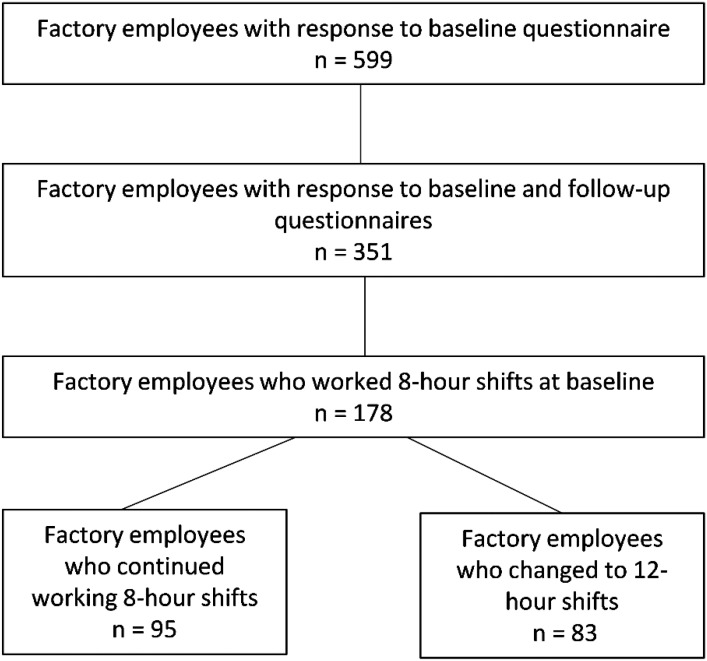
Employees often prefer 12-hour work shifts but they can increase sleepiness and injury risk. We assessed whether sleep, sleepiness, satisfaction and need for recovery changed after changing from an 8-hour to a 12-hour shift system. The participants were 178 employees of the paper, pulp and chemical industries. Using a quasi-experimental controlled intervention design, 83 employees, who changed from an 8-hour shift schedule to a 12-hour shift schedule were compared to those who remained in the 8-hour shift schedule (n=95). Participants filled in a survey on sleep, sleepiness, satisfaction and need for recovery at baseline and 9-12 months after the shift schedule change. We used generalized estimation equation models adjusted for age, sex, shift work experience in years and baseline shift system. Sleep length was longer in the 12-hour shift schedule before the first morning shift and between morning shifts. Sleepiness during morning shifts was less frequent and satisfaction with the shift system was more prevalent in the 12-hour shift schedule. Also, perceived negative associations of the current shift system with work-life balance were less common in the 12-hour shift schedule. The differences found between the shift systems were minor and the results did not indicate significant disadvantages of the 12-hour fast forward-rotating shift system.
Overview
The claims and statistics of this paper haven’t been checked yet.
Free: it reads the open-access text and checks the first 5 claims that cite a source we can check. Create a free account to check every claim.
Integrity signals
Registry
Cites
Statistics
Figures
Verification
Claims the paper makes
The claims and statistics of this paper haven’t been checked yet.
Free: it reads the open-access text and checks the first 5 claims that cite a source we can check. Create a free account to check every claim.
Claims other papers make about this one
Each is checked against this paper’s own text: does it say what the citing paper says it does?
The cited source says what the claim attributes to it.
In the citing paper
“Four other studies are awaiting classification because they were published after 13 December 2020, and we retrieved them in the updated search (Cori 2021; Hakola 2021; Puttonen 2022; Rahman 2021).”
From Adapting shift work schedules for sleep quality, sleep duration, and sleepiness in shift workers (2023) · cites this paper as Puttonen 2022
Self-check
Percentages, sums and reported differences re-computed from the paper’s own numbers.
The self-check needs the paper’s full text.
Citations
Cites
1 retracted
Yuan, X., Zhu, C., Wang, M., Mo, F., Du, W., & Ma, X. (2018) · Cancer Epidemiology, Biomarkers & Prevention · doi:10.1158/1055-9965.epi-17-0221 · Cited by 75
RetractedLongitudinal data analysis using generalized linear models
LIANG, K.-Y., & ZEGER, S. L. (1986) · Biometrika · doi:10.1093/biomet/73.1.13 · Cited by 18,550
Self-rated health and mortality: a review of twenty-seven community studies.
Idler, E. L., & Benyamini, Y. (1997) · Journal of Health and Social Behavior · doi:10.2307/2955359 · Cited by 8,598
A self-assessment questionnaire to determine morningness- eveningness in human circadian rhythms
Home, J. K. (1976) · Medical Entomology and Zoology · Cited by 4,783
(1976) · PubMed · Cited by 3,979
Subjective and objective sleepiness in the active individual
Åkerstedt, T., & Gillberg, M. (1990) · International Journal of Neuroscience · doi:10.3109/00207459008994241 · Cited by 3,088
Longitudinal Data Analysis Using Generalized Linear Models
Liang, K., & Zeger, S. L. (1986) · Biometrika · doi:10.2307/2336267 · Cited by 1,201
Basic Nordic Sleep Questionnaire (BNSQ): a quantitated measure of subjective sleep complaints
PARTINEN, M., & GISLASON, T. (1995) · Journal of Sleep Research · doi:10.1111/j.1365-2869.1995.tb00205.x · Cited by 527
Shift work and diabetes mellitus: a meta-analysis of observational studies
Gan, Y., Yang, C., Tong, X., Sun, H., Cong, Y., Yin, X., Li, L., Cao, S., Dong, X., Gong, Y., et al. (2015) · Occupational and Environmental Medicine · doi:10.1136/oemed-2014-102150 · Cited by 526
Torquati, L., Mielke, G. I., Brown, W. J., & Kolbe-Alexander, T. (2018) · Scandinavian Journal of Work, Environment & Health · doi:10.5271/sjweh.3700 · Cited by 510
Measurement quality and validity of the “need for recovery scale”
van Veldhoven, M., & Broersen, S. (2003) · Occupational and Environmental Medicine · doi:10.1136/oem.60.suppl_1.i3 · Cited by 416
Shift work, sleep, and sleepiness – differences between shift schedules and systems
Sallinen, M., & Kecklund, G. (2010) · Scandinavian Journal of Work, Environment & Health · doi:10.5271/sjweh.2900 · Cited by 412
Self-citationWorkhours in relation to work stress, recovery and health
Härmä, M. (2006) · Scandinavian Journal of Work, Environment & Health · doi:10.5271/sjweh.1055 · Cited by 387
Self-citationGriffiths, P., Dall’Ora, C., Simon, M., Ball, J., Lindqvist, R., Rafferty, A.-M., Schoonhoven, L., Tishelman, C., & Aiken, L. H. (2014) · Medical Care · doi:10.1097/mlr.0000000000000233 · Cited by 316
Dall’Ora, C., Ball, J., Recio-Saucedo, A., & Griffiths, P. (2016) · International Journal of Nursing Studies · doi:10.1016/j.ijnurstu.2016.01.007 · Cited by 286
Aging, work, life-style and work ability among Finnish municipal workers in 1981-1992.
Tuomi, K., Ilmarinen, J., Martikainen, R., Aalto, L., & Klockars, M. (1997) · PubMed · Cited by 253
Bambra, C. L., Whitehead, M. M., Sowden, A. J., Akers, J., & Petticrew, M. P. (2008) · American Journal of Preventive Medicine · doi:10.1016/j.amepre.2007.12.023 · Cited by 196
Need for recovery from work: evaluating short-term effects of working hours, patterns and schedules
Jansen, N., Kant, I., van Amelsvoort, L., Nijhuis, F., & van den Brandt, P. (2003) · Ergonomics · doi:10.1080/0014013031000085662 · Cited by 188
Fischer, D. R., Lombardi, D. A., Folkard, S., Willetts, J. L., & Christiani, D. C. (2017) · Chronobiology International · doi:10.1080/07420528.2017.1367305 · Cited by 170
Change from an 8-hour shift to a 12-hour shift, attitudes, sleep, sleepiness and performance.
Löwden, A., Kecklund, G., Axelsson, J., & Åkerstedt, T. (1998) · PubMed · Cited by 154
Health-related interventions among night shift workers: a critical review of the literature
Neil-Sztramko, S. E., Pahwa, M., Demers, P. A., & Gotay, C. C. (2014) · Scandinavian Journal of Work, Environment & Health · doi:10.5271/sjweh.3445 · Cited by 151
How to schedule night shift work in order to reduce health and safety risks
Garde, A. H., Begtrup, L., Bjorvatn, B., Bonde, J. P., Hansen, J., Hansen, Å. M., Härmä, M., Jensen, M. A., Kecklund, G., Kolstad, H. A., et al. (2020) · Scandinavian Journal of Work, Environment & Health · doi:10.5271/sjweh.3920 · Cited by 125
Self-citationEstryn-Béhar, M., Van der Heijden, B. I. J. M., & The NEXT Study Group (2012) · WORK: A Journal of Prevention, Assessment & Rehabilitation · doi:10.3233/wor-2012-0724-4283 · Cited by 109
Gan, Y., Li, L., Zhang, L., Yan, S., Gao, C., Hu, S., Qiao, Y., Tang, S., Wang, C., & Lu, Z. (2018) · Carcinogenesis · doi:10.1093/carcin/bgx129 · Cited by 89
Evaluation of an 8 hour versus a 12 hour shift roster on employees at a power station
Mitchell, R. J., & Williamson, A. M. (2000) · Applied Ergonomics · doi:10.1016/s0003-6870(99)00025-3 · Cited by 85
Performance and alertness on 8 h and 12 h rotating shifts at a natural gas utility
ROSA, R. R., & BONNET, M. H. (1993) · Ergonomics · doi:10.1080/00140139308967987 · Cited by 78
WILLIAMSON, A. M., GOWER, C. G. I., & CLARKE, B. C. (1994) · Ergonomics · doi:10.1080/00140139408963646 · Cited by 73
The effects of different roster schedules on sleep in miners
Paech, G. M., Jay, S. M., Lamond, N., Roach, G. D., & Ferguson, S. A. (2010) · Applied Ergonomics · doi:10.1016/j.apergo.2009.12.017 · Cited by 69
Performance, alertness, and sleep after 3·5 years of 12 h shifts: A follow-up study
Rosa, R. R. (1991) · Work & Stress · doi:10.1080/02678379108257008 · Cited by 63
12-h or 8-h shifts It depends.
Ferguson, S. A., & Dawson, D. (2012) · Sleep Medicine Reviews · doi:10.1016/j.smrv.2011.11.001 · Cited by 54
Shift length as a determinant of retrospective on-shift alertness.
Tucker, P., Smith, L. R., Macdonald, I., & Folkard, S. (1998) · PubMed · Cited by 52
Extended Workdays in an Underground Mine: A Work Performance Analysis
Duchon, J. C., Keran, C. M., & Smith, T. J. (1994) · Human Factors: The Journal of the Human Factors and Ergonomics Society · doi:10.1177/001872089403600207 · Cited by 52
A unique, fast-forwards rotating schedule with 12-h long shifts prevents chronic sleep debt
Fischer, D., Vetter, C., Oberlinner, C., Wegener, S., & Roenneberg, T. (2016) · Chronobiology International · doi:10.3109/07420528.2015.1113986 · Cited by 41
Sleep and Alertness in a 12-Hour Rotating Shift Work Environment
Budnick, L. D., Lerman, S. E., Baker, T. L., Jones, H., & Czeisler, C. A. (1994) · Journal of Occupational and Environmental Medicine · doi:10.1097/00043764-199412000-00010 · Cited by 40
Karhula, K., Härmä, M., Ropponen, A., Hakola, T., Sallinen, M., & Puttonen, S. (2016) · Chronobiology International · doi:10.3109/07420528.2016.1167726 · Cited by 40
Self-citationMeasurement properties of the Shiftwork Survey and Standard Shiftwork Index.
Smith, C. S., Gibby, R. E., Zickar, M. J., Crossley, C., Robie, C., Folkard, S., Tucker, P., & Barton, J. (2001) · PubMed · Cited by 20
Cited by
Adapting shift work schedules for sleep quality, sleep duration, and sleepiness in shift workers
Hulsegge, G., Coenen, P., Gascon, G. M., Pahwa, M., Greiner, B., Bohane, C., Wong, I. S., Liira, J., Riera, R., & Pachito, D. V. (2023) · Cochrane Database of Systematic Reviews · doi:10.1002/14651858.cd010639.pub2 · Cited by 31
Kubo, T., Matsumoto, S., Izawa, S., Ikeda, H., Nishimura, Y., Kawakami, S., Tamaki, M., & Masuda, S. (2022) · International Journal of Environmental Research and Public Health · doi:10.3390/ijerph192215042 · Cited by 20
“In contrast, previous interventional studies have greatly changed the shift schedule, such as the direction of the rotation from backward to forward rotations [30], the speed of rotation from a backward to a very quick forward shift rotation [29], and the shift length from an 8 h to a 12 h shift system [31].”
ResultBellacov, R. L., Davis, K. G., & He, C. (2025) · Human Factors in Healthcare · doi:10.1016/j.hfh.2025.100094 · Cited by 6
“Many studies have found a negative impact of shift work on health and well-being, yet gaps exist in how this affects musculoskeletal injuries (Boivin et al., 2022; Mélan & Cascino, 2022; Puttonen et al., 2022).”
The consequences of a compressed workweek: a systematic literature review
Bernstrøm, V. H., Alves, D., Houkes, I., Lillebråten, A., & Nilsen, W. (2025) · International Archives of Occupational and Environmental Health · doi:10.1007/s00420-025-02153-8 · Cited by 17
“Two studies found no significant difference in total or habitual sleep, but they found significant differences when dividing sleep according to shift type and work-free days (Casjens et al. 2022b; Puttonen et al. 2022).”
InfluentialSison, S., Valbuena, M. A., Nierva, R. L., Tuso, K. I., & Dalisay, J. D. E. (2025) · International Symposium on Multimedia and Communication Technology (ISMAC) · doi:10.1109/ismac65024.2025.11175976 · Cited by 1
“…the Karolinska Sleepiness Scale (KSS) scores for indicating drowsiness, but was dichotomized to a binary value setting 1 as drowsy and 0 as non-drowsy following the scale of [14] where KSS scores of less than or equal to six (6) were set as non-drowsy while the remaining scores were set to drowsy.”
Metadata
- Authors
- PUTTONEN, S., KARHULA, K., ROPPONEN, A., HAKOLA, T., SALLINEN, M., & HÄRMÄ, M.
- Affiliations
- Finnish Institute of Occupational Health (FI)
- Corresponding author
- PUTTONEN, Sampsa
- Venue
- Industrial Health
- Published
- 2021-10-15
- Volume
- 60
- Issue
- 2
- Pages
- 146-153
- ISSN
- 0019-8366 (ISSN-L)
- 1880-8026
- PMC
- PMC8980689
- OpenAlex
- W3207927088
- Semantic Scholar
- e8f155f2eb2abaccf1b475444076684bbe7a510e
- Cited by
- 7
- References
- 36
- Citations by year
- 2025: 5 · 2023: 1 · 2022: 1
- FWCI
- 0.48
- Type
- journal article
- Language
- en
- Open access
- diamond
- doi.org
- Locations
- Industrial Health (publishedVersion)
- PubMed Central (publishedVersion, cc-by-nc-nd)
- PubMed (publishedVersion)
- Funders
- Työsuojelurahasto (74809, 114114)
- NordForsk (74809)
- Topics
- Social Sciences › Psychology › Experimental and Cognitive Psychology › Sleep and Work-Related Fatigue
- Health Sciences › Medicine › Public Health, Environmental and Occupational Health › Workplace Health and Well-being
- Life Sciences › Neuroscience › Endocrine and Autonomic Systems › Circadian rhythm and melatonin
- Keywords
- shift work, sleep, sleepiness, need for recovery, work-life balance, job satisfaction, injury risk
- MeSH terms
- Sleepiness, Chemical Industry, Humans, Sleep, Wakefulness, Work Schedule Tolerance
About these checks
Registry, retraction, Cites and statistics results are computed, not judged, with one exception: a printed reference that no index lists is read once by a model before it counts as a citation error. Claims are extracted by a model and kept only when their quote appears verbatim in the text; each cited source is then checked, with a model’s help, for whether it says what the claim relies on. Those verdicts can be wrong — read the claim’s quote and the cited source before relying on one.
Statistics and arithmetic are recomputed, not judged.
Confidence bands are shown only for fields calibrated on our annotated test set. None is calibrated yet, so no band is shown.
What counts as a claim ›How we measure confidence ›How we check this ›
Are you an author, or do you see a problem with this page? Request a review
Data sources
Bibliographic data: Semantic Scholar, OpenAlex, Crossref.
Contains information from the Semantic Scholar Academic Graph Datasets, made available under the ODC Attribution License (ODC-BY 1.0).
Semantic Scholar’s data is described in: Kinney, R., et al. (2023). The Semantic Scholar Open Data Platform. arXiv:2301.10140.
