

The DOI matches its Crossref record; 63 of the 64 references it cites were found in a registry or an index, and 1 are not checked yet.
Link-INVENT: Generative Linker Design with Reinforcement Learning
Open accessAbstract
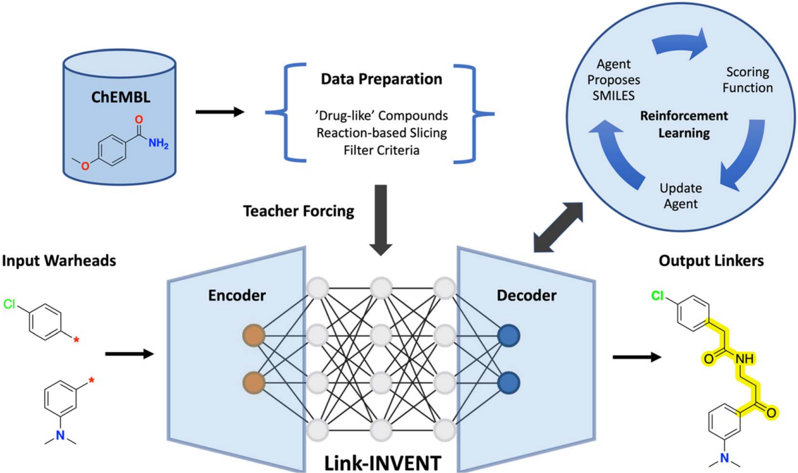
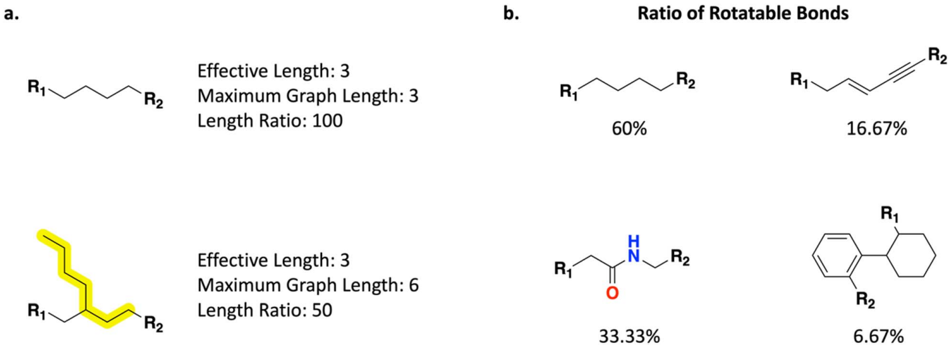
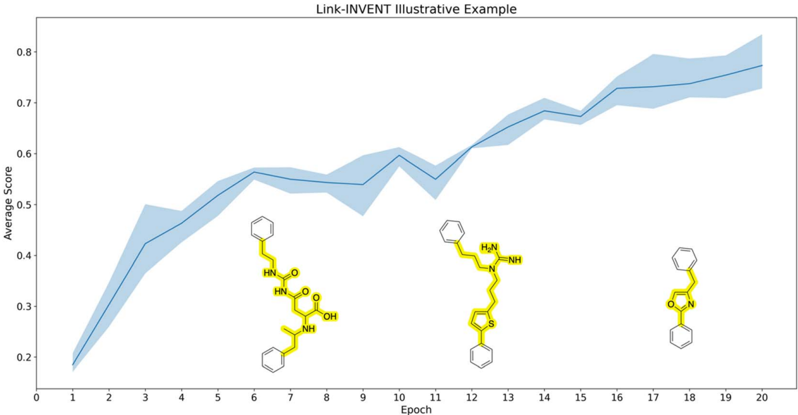
In this work, we present Link-INVENT as an extension to the existing de novo molecular design platform REINVENT. We provide illustrative examples on how Link-INVENT can be applied on fragment linking, scaffold hopping, and PROTACs design case studies where the desirable molecules should satisfy a combination of different criteria. With the help of Reinforcement Learning, the agent used by Link-INVENT learns to generate favourable linkers connecting molecular subunits that satisfy diverse objectives, facilitating practical application of the model for real-world drug discovery projects. We also introduce a range of linker-specific objectives in the scoring function of REINVENT. The code is freely available at https://github.com/MolecularAI/Reinvent.
Overview
The claims and statistics of this paper haven’t been checked yet.
Run the check — free, no account needed. It reads the open-access text and checks the sources it cites.
Integrity signals
Registry
Cites
Statistics
Figures
Verification
Claims the paper makes
The claims and statistics of this paper haven’t been checked yet.
Run the check — free, no account needed. It reads the open-access text and checks the sources it cites.
Claims other papers make about this one
Each is checked against this paper’s own text: does it say what the citing paper says it does?
In the citing paper
“Moreover, existing platforms have been versioned to design optimal linkers connecting the two molecular subunits in a PROTAC.163”
From Advancing Targeted Protein Degradation via Multiomics Profiling and Artificial Intelligence (2023) · cites this paper as [163]
Self-check
Percentages, sums and reported differences re-computed from the paper’s own numbers.
The self-check needs the paper’s full text.
Citations
Cites
Hochreiter, S., & Schmidhuber, J. (1997) · Neural Computation · doi:10.1162/neco.1997.9.8.1735 · Cited by 102,318
Trott, O., & Olson, A. J. (2010) · Journal of Computational Chemistry · doi:10.1002/jcc.21334 · Cited by 38,412
Lipinski, C. A., Lombardo, F., Dominy, B. W., & Feeney, P. J. (1997) · Advanced Drug Delivery Reviews · doi:10.1016/s0169-409x(96)00423-1 · Cited by 11,484
Friesner, R. A., Banks, J. L., Murphy, R. B., Halgren, T. A., Klicic, J. J., Mainz, D. T., Repasky, M. P., Knoll, E. H., Shelley, M., Perry, J. K., et al. (2004) · Journal of Medicinal Chemistry · doi:10.1021/jm0306430 · Cited by 10,057
Weininger, D. (1988) · Journal of Chemical Information and Computer Sciences · doi:10.1021/ci00057a005 · Cited by 7,436
Friesner, R. A., Murphy, R. B., Repasky, M. P., Frye, L. L., Greenwood, J. R., Halgren, T. A., Sanschagrin, P. C., & Mainz, D. T. (2006) · Journal of Medicinal Chemistry · doi:10.1021/jm051256o · Cited by 7,012
Halgren, T. A., Murphy, R. B., Friesner, R. A., Beard, H. S., Frye, L. L., Pollard, W. T., & Banks, J. L. (2004) · Journal of Medicinal Chemistry · doi:10.1021/jm030644s · Cited by 5,340
A Learning Algorithm for Continually Running Fully Recurrent Neural Networks
Williams, R. J., & Zipser, D. (1989) · Neural Computation · doi:10.1162/neco.1989.1.2.270 · Cited by 4,369
Automatic Chemical Design Using a Data-Driven Continuous Representation of Molecules
Gómez-Bombarelli, R., Wei, J. N., Duvenaud, D., Hernández-Lobato, J. M., Sánchez-Lengeling, B., Sheberla, D., Aguilera-Iparraguirre, J., Hirzel, T. D., Adams, R. P., & Aspuru-Guzik, A. (2018) · ACS Central Science · doi:10.1021/acscentsci.7b00572 · Cited by 3,106
Sakamoto, K. M., Kim, K. B., Kumagai, A., Mercurio, F., Crews, C. M., & Deshaies, R. J. (2001) · Proceedings of the National Academy of Sciences · doi:10.1073/pnas.141230798 · Cited by 2,609
Research works printed but not linked: 56
- P. Schneider, W. P. Walters, A. T. Plowright, N. Sieroka, J. Listgarten, R. A. Goodnow, J. Fisher, J. M. Jansen, J. S. Duca, T. S. Rush, M. Zentgraf, J. E. Hill, E. Krutoholow, M. Kohler, J. Blaney, K. Funatsu, C. Luebkemann and G. Schneider, Nat. Rev. Drug Discovery, 2020, 19, 353-364.
- P. G. Polishchuk, T. I. Madzhidov and A. Varnek, J. Comput.- Aided Mol. Des., 2013, 27, 675-679.
- T. Blaschke, J. Arús-Pous, H. Chen, C. Margreitter, C. Tyrchan, O. Engkvist, K. Papadopoulos and A. Patronov, J. Chem. Inf. Model., 2020, 60, 5918-5922.
- M. Thomas, R. T. Smith, N. M. O'Boyle, C. de Graaf and A. Bender, J. Cheminf., 2021, 13, 39.
- Y. Li, L. Zhang and Z. Liu, J. Cheminf., 2018, 10, 33.
- R. Mercado, T. Rastemo, E. Lindelöf, G. Klambauer, O. Engkvist, H. Chen and E. Jannik Bjerrum, Mach. Learn.: Sci. Technol., 2021, 2, 025023.
- S. R. Atance, J. V. Diez, O. Engkvist, S. Olsson and R. Mercado, J. Chem. Inf. Model., 2022, 62(20), 4863-4872.
- R. Gómez-Bombarelli, J. N. Wei, D. Duvenaud, J. M. Hernández-Lobato, B. Sánchez-Lengeling, D. Sheberla, J. Aguilera-Iparraguirre, T. D. Hirzel, R. P. Adams and A. Aspuru-Guzik, ACS Cent. Sci., 2018, 4, 268-276.
- J. Choi and J. Lee, Int. J. Mol. Sci., 2021, 22(21), 11635.
- A. Nigam, R. Pollice and A. Aspuru-Guzik, Digital Discovery, 2022, 1(4), 390-404.
- D. Weininger, J. Chem. Inf. Comput. Sci., 1988, 28, 31-36.
- F. Imrie, A. R. Bradley, M. van der Schaar and C. M. Deane, J. Chem. Inf. Model., 2020, 60, 1983-1995.
- Y. Yang, S. Zheng, S. Su, C. Zhao, J. Xu and H. Chen, Chem. Sci., 2020, 11, 8312-8322.
- L. Hu, Y. Yang, S. Zheng, J. Xu, T. Ran and H. Chen, J. Chem. Inf. Model., 2021, 61, 4900-4912.
- M. Langevin, H. Minoux, M. Levesque and M. Bianciotto, J. Chem. Inf. Model., 2020, 60, 5637-5646.
- F. Imrie, T. E. Hadeld, A. R. Bradley and C. M. Deane, Chem. Sci., 2021, 12, 14577-14589.
- Y. Feng, Y. Yang, W. Deng, H. Chen and T. Ran, Artif. Intell. Life Sci., 2022, 2, 100035.
- D. A. Erlanson, R. S. McDowell and T. O'Brien, J. Med. Chem., 2004, 47, 3463-3482.
- C. W. Murray and D. C. Rees, Nat. Chem., 2009, 1, 187-192.
- H.-J. Böhm, A. Flohr and M. Stahl, Drug Discovery Today: Technol., 2004, 1, 217-224.
- K. M. Sakamoto, K. B. Kim, A. Kumagai, F. Mercurio, C. M. Crews and R. J. Deshaies, Proc. Natl. Acad. Sci. U. S. A., 2001, 98, 8554-8559.
- M. Toure and C. M. Crews, Angew. Chem., Int. Ed., 2016, 55, 1966-1973.
- X. Sun, H. Gao, Y. Yang, M. He, Y. Wu, Y. Song, Y. Tong and Y. Rao, Signal Transduction Targeted Ther., 2019, 4, 1-33.
- J. D. Chodera and D. L. Mobley, Annu. Rev. Biophys., 2013, 42, 121-142.
- A. Bancet, C. Raingeval, T. Lomberget, M. Le Borgne, J.-F. Guichou and I. Krimm, J. Med. Chem., 2020, 63, 11420-11435.
- H. S. Yu, K. Modugula, O. Ichihara, K. Kramschuster, S. Keng, R. Abel and L. Wang, J. Chem. Theory Comput., 2021, 17, 450-462.
- C. A. Lipinski, F. Lombardo, B. W. Dominy and P. J. Feeney, Adv. Drug Delivery Rev., 1997, 23, 3-25.
- H. J. Maple, N. Clayden, A. Baron, C. Stacey and R. Felix, Med. Chem. Commun., 2019, 10, 1755-1764.
- G. Weng, C. Shen, D. Cao, J. Gao, X. Dong, Q. He, B. Yang, D. Li, J. Wu and T. Hou, Nucleic Acids Res., 2021, 49, D1381-D1387.
- T. A. Bemis, J. J. La Clair and M. D. Burkart, J. Med. Chem., 2021, 64, 8042-8052.
- T. Cheeseright, M. Mackey, S. Rose and A. Vinter, J. Chem. Inf. Model., 2006, 46, 665-676.
- P. Maass, T. Schulz-Gasch, M. Stahl and M. Rarey, J. Chem. Inf. Model., 2007, 47, 390-399.
- D. C. Thompson, R. A. Denny, R. Nilakantan, C. Humblet, D. Joseph-McCarthy and E. Feyfant, J. Comput.-Aided Mol. Des., 2008, 22, 761-772.
- M. J. Vainio, T. Kogej, F. Raubacher and J. Sadowski, J. Chem. Inf. Model., 2013, 53, 1825-1835.
- A. Yoshimori, Y. Asawa, E. Kawasaki, T. Tasaka, S. Matsuda, T. Sekikawa, S. Tanabe, M. Neya, H. Natsugari and C. Kanai, ChemMedChem, 2021, 16, 955-958.
- A. Gaulton, A. Hersey, M. Nowotka, A. P. Bento, J. Chambers, D. Mendez, P. Mutowo, F. Atkinson, L. J. Bellis, E. Cibrián- Uhalte, M. Davies, N. Dedman, A. Karlsson, M. P. Magariños, J. P. Overington, G. Papadatos, I. Smit and A. R. Leach, Nucleic Acids Res., 2017, 45, D945-D954.
- V. Fialková, J. Zhao, K. Papadopoulos, O. Engkvist, E. Bjerrum, T. Kogej and A. Patronov, J. Chem. Inf. Model., 2022, 62(9), 2046-2063.
- J. Arús-Pous, A. Patronov, E. J. Bjerrum, C. Tyrchan, J.-L. Reymond, H. Chen and O. Engkvist, J. Cheminf., 2020, 12, 38.
- S. Hochreiter and J. Schmidhuber, Neural Comput., 1997, 9, 1735-1780.
- G. W. Bemis and M. A. Murcko, J. Med. Chem., 1996, 39, 2887-2893.
- J. Arús-Pous, S. V. Johansson, O. Prykhodko, E. J. Bjerrum, C. Tyrchan, J.-L. Reymond, H. Chen and O. Engkvist, J. Cheminf., 2019, 11, 71.
- R. J. Williams and D. Zipser, Neural Comput., 1989, 1, 270- 280.
- M. Olivecrona, T. Blaschke, O. Engkvist and H. Chen, J. Cheminf., 2017, 9, 48.
- T. Blaschke, O. Engkvist, J. Bajorath and H. Chen, J. Cheminf., 2020, 12, 68.
- C. De Fusco, P. Brear, J. Iegre, K. H. Georgiou, H. F. Sore, M. Hyvönen and D. R. Spring, Bioorg. Med. Chem., 2017, 25, 3471-3482.
- P. Brear, C. De Fusco, K. Hadje Georgiou, N. J. Francis- Newton, C. J. Stubbs, H. F. Sore, A. R. Venkitaraman, C. Abell, D. R. Spring and M. Hyvönen, Chem. Sci., 2016, 7, 6839-6845.
- J. Guo, J. P. Janet, M. R. Bauer, E. Nittinger, K. A. Giblin, K. Papadopoulos, A. Voronov, A. Patronov, O. Engkvist and C. Margreitter, J. Cheminf., 2021, 13, 89. 55 Schrödinger Release 2019-4: Glide, Schrödinger, LLC, New York, NY, 2019.
- R. A. Friesner, J. L. Banks, R. B. Murphy, T. A. Halgren, J. J. Klicic, D. T. Mainz, M. P. Repasky, E. H. Knoll, M. Shelley, J. K. Perry, D. E. Shaw, P. Francis and P. S. Shenkin, J. Med. Chem., 2004, 47, 1739-1749.
- T. A. Halgren, R. B. Murphy, R. A. Friesner, H. S. Beard, L. L. Frye, W. T. Pollard and J. L. Banks, J. Med. Chem., 2004, 47, 1750-1759.
- R. A. Friesner, R. B. Murphy, M. P. Repasky, L. L. Frye, J. R. Greenwood, T. A. Halgren, P. C. Sanschagrin and D. T. Mainz, J. Med. Chem., 2006, 49, 6177-6196. 59 Schrödinger Release 2019-4: LigPrep, Schrödinger, LLC, New York, NY, 2019.
- A. Alex, D. S. Millan, M. Perez, F. Wakenhut and G. A. Whitlock, Med. Chem. Commun., 2011, 2, 669-674.
- A. Trapero, A. Pacitto, V. Singh, M. Sabbah, A. G. Coyne, V. Mizrahi, T. L. Blundell, D. B. Ascher and C. Abell, J. Med. Chem., 2018, 61, 2806-2822.
- O. Trott and A. J. Olson, J. Comput. Chem., 2010, 31, 455-461.
- S. Patel, F. Cohen, B. J. Dean, K. De La Torre, G. Deshmukh, A. A. Estrada, A. S. Ghosh, P. Gibbons, A. Gustafson, M. P. Huestis, C. E. Le Pichon, H. Lin, W. Liu, X. Liu, Y. Liu, C. Q. Ly, J. P. Lyssikatos, C. Ma, K. Scearce-Levie, Y. G. Shin, H. Solanoy, K. L. Stark, J. Wang, B. Wang, X. Zhao, J. W. Lewcock and M. Siu, J. Med. Chem., 2015, 58, 401-418.
- S. Patel, S. F. Harris, P. Gibbons, G. Deshmukh, A. Gustafson, T. Kellar, H. Lin, X. Liu, Y. Liu, Y. Liu, C. Ma, K. Scearce-Levie, A. S. Ghosh, Y. G. Shin, H. Solanoy, J. Wang, B. Wang, J. Yin, M. Siu and J. W. Lewcock, J. Med. Chem., 2015, 58, 8182-8199.
- Z. Wang, N. He, Z. Guo, C. Niu, T. Song, Y. Guo, K. Cao, A. Wang, J. Zhu, X. Zhang and Z. Zhang, J. Med. Chem., 2019, 62, 8152-8163.
Cited by
Sorted by citations
Reinvent 4: Modern AI–driven generative molecule design
Loeffler, H. H., He, J., Tibo, A., Janet, J. P., Voronov, A., Mervin, L., & Engkvist, O. (2024) · Journal of Cheminformatics · doi:10.1186/s13321-024-00812-5 · Cited by 440
Self-citationMachine learning-aided generative molecular design
Du, Y., Jamasb, A. R., Guo, J., Fu, T., Harris, C., Wang, Y., Duan, C., Lió, P., Schwaller, P., & Blundell, T. L. (2024) · Nature Machine Intelligence · doi:10.1038/s42256-024-00843-5 · Cited by 221
Self-citationCharacteristic roadmap of linker governs the rational design of PROTACs
Dong, Y., Ma, T., Xu, T., Feng, Z., Li, Y., Song, L., Yao, X., Ashby, C. R., & Hao, G.-F. (2024) · Acta Pharmaceutica Sinica B · doi:10.1016/j.apsb.2024.04.007 · Cited by 146
Computer-Aided Drug Discovery for Undruggable Targets
Sun, Q., Wang, H., Xie, J., Wang, L., Mu, J., Li, J., Ren, Y., & Lai, L. (2025) · Chemical Reviews · doi:10.1021/acs.chemrev.4c00969 · Cited by 72
Development of PROTACs using computational approaches
Ge, J., Hsieh, C., Fang, M., Sun, H., & Hou, T. (2024) · Trends in Pharmacological Sciences · doi:10.1016/j.tips.2024.10.006 · Cited by 68
Integrating structure-based approaches in generative molecular design
Thomas, M. C., Bender, A., & de Graaf, C. (2023) · Current Opinion in Structural Biology · doi:10.1016/j.sbi.2023.102559 · Cited by 60
3D based generative PROTAC linker design with reinforcement learning
Li, B., Ran, T., & Chen, H. (2023) · Briefings in Bioinformatics · doi:10.1093/bib/bbad323 · Cited by 57
Deep Lead Optimization: Leveraging Generative AI for Structural Modification
Zhang, O., Lin, H., Zhang, H., Zhao, H., Huang, Y., Hsieh, C., Pan, P., & Hou, T. (2024) · Journal of the American Chemical Society · doi:10.1021/jacs.4c11686 · Cited by 64
Advancing Targeted Protein Degradation via Multiomics Profiling and Artificial Intelligence
Duran-Frigola, M., Cigler, M., & Winter, G. E. (2023) · Journal of the American Chemical Society · doi:10.1021/jacs.2c11098 · Cited by 50
Danishuddin, M., Jamal, M. S., Song, K. S., Lee, K., Kim, J.-J., & Park, Y. (2023) · Pharmaceuticals · doi:10.3390/ph16121649 · Cited by 51
Docking-based generative approaches in the search for new drug candidates
Danel, T., Łȩski, J., Podlewska, S., & Podolak, I. T. (2022) · Drug Discovery Today · doi:10.1016/j.drudis.2022.103439 · Cited by 46
Gotta be SAFE: a new framework for molecular design
Noutahi, E., Gabellini, C., Craig, M. J., Lim, J. S. C., & Tossou, P. (2024) · Digital Discovery · doi:10.1039/d4dd00019f · Cited by 73
Generative Deep Learning for de Novo Drug Design─A Chemical Space Odyssey
Özçelik, R., Brinkmann, H., Criscuolo, E., & Grisoni, F. (2025) · Journal of Chemical Information and Modeling · doi:10.1021/acs.jcim.5c00641 · Cited by 57
Fragment Linker Prediction Using the Deep Encoder-Decoder Network for PROTACs Drug Design
Kao, C., Lin, C., Chou, C.-L., & Lin, C. (2023) · Journal of Chemical Information and Modeling · doi:10.1021/acs.jcim.2c01287 · Cited by 38
Thomas, M. C., O’Boyle, N. M., Bender, A., & de Graaf, C. (2024) · Journal of Cheminformatics · doi:10.1186/s13321-024-00861-w · Cited by 44
SILVR: Guided Diffusion for Molecule Generation
Runcie, N. T., & Mey, A. S. J. S. (2023) · Journal of Chemical Information and Modeling · doi:10.1021/acs.jcim.3c00667 · Cited by 36
Directly optimizing for synthesizability in generative molecular design using retrosynthesis models
Guo, J., & Schwaller, P. (2025) · Chemical Science · doi:10.1039/d5sc01476j · Cited by 47
Self-citationA Novel Rational PROTACs Design and Validation via AI-Driven Drug Design Approach
Chou, C.-L., Lin, C., Kao, C., & Lin, C. (2024) · ACS Omega · doi:10.1021/acsomega.3c10183 · Cited by 33
Peptide-functionalized nanoparticles for brain-targeted therapeutics
Tang, S. N., Han, E. L., & Mitchell, M. J. (2025) · Drug Delivery and Translational Research · doi:10.1007/s13346-025-01840-w · Cited by 39
Abbas, A., & Ye, F. (2024) · International Journal of Biological Macromolecules · doi:10.1016/j.ijbiomac.2024.134293 · Cited by 29
A comprehensive review of emerging approaches in machine learning for de novo PROTAC design
Gharbi, Y., & Mercado, R. (2024) · Digital Discovery · doi:10.1039/d4dd00177j · Cited by 32
Drug Discovery in the Age of Artificial Intelligence: Transformative Target-Based Approaches
Patne, A. Y., Dhulipala, S. M., Lawless, W., Prakash, S., Mohapatra, S. S., & Mohapatra, S. (2024) · International Journal of Molecular Sciences · doi:10.3390/ijms252212233 · Cited by 32
Scaffold Hopping with Generative Reinforcement Learning
Rossen, L., Sirockin, F., Schneider, N., & Grisoni, F. (2025) · Journal of Chemical Information and Modeling · doi:10.1021/acs.jcim.5c00029 · Cited by 30
Augmented Memory: Sample-Efficient Generative Molecular Design with Reinforcement Learning
Guo, J., & Schwaller, P. (2024) · JACS Au · doi:10.1021/jacsau.4c00066 · Cited by 32
Self-citationComputer aided drug design in the development of proteolysis targeting chimeras
Tunjic, T. M., Weber, N., & Brunsteiner, M. (2023) · Computational and Structural Biotechnology Journal · doi:10.1016/j.csbj.2023.02.042 · Cited by 29
Progress of AI-Driven Drug–Target Interaction Prediction and Lead Optimization
Wang, Q., Sun, B., Yi, Y., Velkov, T., Shen, J., Dai, C., & Jiang, H. (2025) · International Journal of Molecular Sciences · doi:10.3390/ijms262010037 · Cited by 33
Loeffler, H. H., Wan, S., Klähn, M., Bhati, A. P., & Coveney, P. V. (2024) · Journal of Chemical Theory and Computation · doi:10.1021/acs.jctc.4c00576 · Cited by 31
Shaik, S., Gayam, P. K. R., Chaudhary, M., Singh, G., & Pai, A. (2024) · Bioorganic Chemistry · doi:10.1016/j.bioorg.2024.107868 · Cited by 26
In silico modeling of targeted protein degradation
Lv, W., Jia, X., Tang, B., Ma, C., Fan, X., Jin, X., Niu, Z., & Han, X. (2025) · European Journal of Medicinal Chemistry · doi:10.1016/j.ejmech.2025.117432 · Cited by 27
Liu, C.-S., Yan, B., Sun, H., Lu, J., & Puno, P. (2025) · Natural Products and Bioprospecting · doi:10.1007/s13659-025-00521-y · Cited by 24
REINVENT4: Modern AI–Driven Generative Molecule DesignPreprint
Loeffler, H. H., He, J., Tibo, A., Janet, J. P., Voronov, A., Mervin, L., & Engkvist, O. (2023) · ChemRxiv · doi:10.26434/chemrxiv-2023-xt65x · Cited by 23
Self-citationEvaluation of reinforcement learning in transformer-based molecular design
He, J., Tibo, A., Janet, J. P., Nittinger, E., Tyrchan, C., Czechtizky, W., & Engkvist, O. (2024) · Journal of Cheminformatics · doi:10.1186/s13321-024-00887-0 · Cited by 22
Self-citationRational Proteolysis Targeting Chimera Design Driven by Molecular Modeling and Machine Learning
Tan, S., Chen, Z., Lu, R., Liu, H., & Yao, X. (2025) · Wiley Interdisciplinary Reviews Computational Molecular Science · doi:10.1002/wcms.70013 · Cited by 24
Generative organic electronic molecular design informed by quantum chemistry
Li, C.-H., & Tabor, D. P. (2023) · Chemical Science · doi:10.1039/d3sc03781a · Cited by 23
Bjerrum, E. J., Margreitter, C., Blaschke, T., Kolarova, S., & de Castro, R. L.-R. (2023) · Journal of Computer-Aided Molecular Design · doi:10.1007/s10822-023-00512-6 · Cited by 23
Self-citationAbbasi, K., Razzaghi, P., Gharizadeh, A., Ghareyazi, A., Dehnad, A., Rabiee, H. R., & Mofrad, M. R. K. (2025) · Pharmacological Reviews · doi:10.1016/j.pharmr.2025.100095 · Cited by 24
Zhang, D., He, T., Shi, T., Huang, K., & Peng, A. (2025) · Frontiers in Pharmacology · doi:10.3389/fphar.2025.1553853 · Cited by 22
Park, K., & Jeon, M. (2025) · Pharmaceuticals · doi:10.3390/ph18121793 · Cited by 20
Lin, C., Shiau, Y., & Lin, C. (2025) · Drug Discovery Today · doi:10.1016/j.drudis.2025.104563 · Cited by 21
DrugDiff: small molecule diffusion model with flexible guidance towards molecular properties
Oestreich, M., Merdivan, E., Lee, M., Schultze, J. L., Piraud, M., & Becker, M. (2025) · Journal of Cheminformatics · doi:10.1186/s13321-025-00965-x · Cited by 23
Tumor Targeting with Peptide-Drug Conjugates: Showcasing Key Progress and Hurdles
Parang, K., Do, T., Dinh, C., Davani-Davari, D., Foroughi, M., Khong, T., Moazen, M., & Shirazi, A. N. (2026) · Drug Design Development and Therapy · doi:10.2147/dddt.s562135 · Cited by 17
Interpretable PROTAC Degradation Prediction With Structure‐Informed Deep Ternary Attention Framework
Chen, Z., Gu, C., Tan, S., Wang, X., Li, Y., He, M., Lu, R., Sun, S., Hsieh, C., Yao, X., et al. (2025) · Advanced Science · doi:10.1002/advs.202508138 · Cited by 18
From part to whole: AI-driven progress in fragment-based drug discovery
Yoo, J., Jang, W., & Shin, W. (2025) · Current Opinion in Structural Biology · doi:10.1016/j.sbi.2025.102995 · Cited by 16
FSscore: A Personalized Machine Learning‐Based Synthetic Feasibility Score
Neeser, R. M., Correia, B. E., & Schwaller, P. (2024) · Chemistry - Methods · doi:10.1002/cmtd.202400024 · Cited by 18
Machine Learning for De Novo Molecular Generation: A Comprehensive Review
Chen, Y., & Xue, W. (2026) · ACS Chemical Neuroscience · doi:10.1021/acschemneuro.5c00861 · Cited by 13
Zhang, H., Huang, J., Xie, J., Huang, W., Yang, Y., Xu, M., Lei, J., & Chen, H. (2024) · Journal of Chemical Information and Modeling · doi:10.1021/acs.jcim.3c01700 · Cited by 13
PromptSMILES: prompting for scaffold decoration and fragment linking in chemical language models
Thomas, M. C., Ahmad, M., Tresadern, G., & Fabritiis, G. D. (2024) · Journal of Cheminformatics · doi:10.1186/s13321-024-00866-5 · Cited by 12
Developments and challenges in hit progression within fragment-based drug discovery
Grosjean, H., & Biggin, P. C. (2026) · Nature Communications · doi:10.1038/s41467-026-68941-z · Cited by 15
A comprehensive primer and review of PROTACs and their In Silico design
Zattoni, J., Vottero, P., Carena, G., Uliveto, C., Pozzati, G., Morabito, B., Gitari, E., Tuszyński, J. A., & Aminpour, M. (2025) · Computer Methods and Programs in Biomedicine · doi:10.1016/j.cmpb.2025.108687 · Cited by 14
Ivanov, S. M. (2026) · Frontiers in Bioinformatics · doi:10.3389/fbinf.2026.1756279 · Cited by 11
Su, A., Luo, Y., Zhang, C., & Duan, H. (2025) · Scientific Reports · doi:10.1038/s41598-025-05555-3 · Cited by 12
Tree-Invent: A Novel Multipurpose Molecular Generative Model Constrained with a Topological Tree
Xu, M., & Chen, H. (2023) · Journal of Chemical Information and Modeling · doi:10.1021/acs.jcim.3c01626 · Cited by 11
Luo, Y., Song, D., Zhang, C., & Su, A. (2025) · Applied Sciences · doi:10.3390/app15105616 · Cited by 10
Structure-Based Drug Design with Geometric Deep Learning: A Comprehensive Survey
Zhang, Z., Yan, J., Huang, Y., Liu, Q., Chen, E., Wang, M., & Žitnik, M. (2025) · ACM Computing Surveys · doi:10.1145/3769677 · Cited by 33
Data-Driven Design of PROTAC Linkers to Improve PROTAC Cell Membrane Permeability
Murakami, Y., Ishida, S., Cho, N., Yuki, H., Ohta, M., Honma, T., Demizu, Y., & Terayama, K. (2026) · JACS Au · doi:10.1021/jacsau.6c00033 · Cited by 10
Calculated hydration free energies become less accurate with increases in molecular weight
Ivanov, S. M. (2024) · PLoS ONE · doi:10.1371/journal.pone.0309996 · Cited by 9
Advances in computational methods for PROTAC drug discovery
Martínez-Cortés, M. S., Velázquez‐Martínez, C. A., & Medina‐Franco, J. L. (2026) · Drug Discovery Today · doi:10.1016/j.drudis.2026.104627 · Cited by 7
Talevi, A., Alberca, L. N., & Bellera, C. L. (2025) · Expert Opinion on Drug Discovery · doi:10.1080/17460441.2025.2555275 · Cited by 6
Bayesian Flow Network Framework for Chemistry Tasks
Tao, N., & Abe, M. (2025) · Journal of Chemical Information and Modeling · doi:10.1021/acs.jcim.4c01792 · Cited by 8
Xu, C., Zeng, C., Yang, X. J., Liu, Y., Ning, X., Zheng, L., Liu, Y., Fan, Q., Xu, C., Liu, H., et al. (2025) · Molecular Informatics · doi:10.1002/minf.70005 · Cited by 4
PROTACs in targeted protein degradation: Advances in development and AI-enhanced drug discovery
Du, M., Liu, T., Wang, W., Fan, S., Tian, M., Du, Q., Wang, Z., Li, X., Liu, X., Xia, Q., et al. (2026) · European Journal of Medicinal Chemistry Reports · doi:10.1016/j.ejmcr.2026.100332 · Cited by 4
The expectations of in silico fragment-based drug design and future challenges
Chikhale, R. V. (2026) · Expert Opinion on Drug Discovery · doi:10.1080/17460441.2026.2623154 · Cited by 3
Generative AI in structure-based drug discovery
Zhong, Z., & Durrant, J. D. (2026) · BMC Biology · doi:10.1186/s12915-026-02575-x · Cited by 3
Advancing PROTAC therapeutics through chemistry-guided design of smart delivery systems
Yao, T., Zhou, Z., Wang, G., Zhu, Z.-Y., & Li, X.-N. (2026) · Acta Pharmacologica Sinica · doi:10.1038/s41401-026-01853-2 · Cited by 5
Jiménez-Boi, R., Miñán, R., Pallara, C., Lozoya, E., Guallar, V., Molina, A., & Soliva, R. (2025) · Journal of Chemical Information and Modeling · doi:10.1021/acs.jcim.5c01581 · Cited by 2
Integrating Medicinal Chemist Expertise with Deep Learning for Automated Molecular Optimization
Liang, L., Yang, X., Wan, B., Gu, L., Yang, Y., Xie, W., Dai, X., Xu, Y., Wei, X., Liu, H., et al. (2026) · Journal of Medicinal Chemistry · doi:10.1021/acs.jmedchem.5c03746 · Cited by 2
From fragments to drugs: How AI and in silico methods accelerate fragment-to-lead optimization
Aledavood, E., Born, J., & Gil, C. (2026) · European Journal of Medicinal Chemistry · doi:10.1016/j.ejmech.2026.118997 · Cited by 3
Generative AI-Assisted Discovery of HPK1 Inhibitors
Giblin, K. A., Song, K., Chen, H., Chen, W., Dong, Z., Escobar, R. A., Grebe, T. P., Grimster, N. P., Hird, A. W., Hughes, S. J., et al. (2026) · Journal of Medicinal Chemistry · doi:10.1021/acs.jmedchem.6c01048 · Cited by 2
Liang, H., Huang, S., Xu, X., Yin, Z., Hussain, M., Song, X., Yi, J., He, Y., Guo, J., Tu, Z., et al. (2025) · Journal of Medicinal Chemistry · doi:10.1021/acs.jmedchem.5c00087 · Cited by 4
Self-citationComputational approaches to aid PROTAC drug discovery
Chakraborti, S., & McAulay, K. (2025) · Elsevier eBooks · doi:10.1016/b978-0-443-29808-0.00004-2 · Cited by 1
Bellerophon: An Automated Tool for PROTAC Decomposition
Apprato, G., Bertola, M., LOCATELLI, A., Caron, G., Mauri, A., & Ermondi, G. (2026) · ACS Medicinal Chemistry Letters · doi:10.1021/acsmedchemlett.5c00769 · Cited by 1
Alsarra, I. A., Suryawanshi, V. S., Al-Mohizea, A. M., Patil, P. C., Chikhale, R. V., & Islam, M. A. (2026) · Scientific Reports · doi:10.1038/s41598-026-49174-y · Cited by 1
Carneiro, A., Barreiro, S., Machado, C. S., Pinto, M., Chavarria, D., Novás, M., Crucitti, D., Fernandes, C., & Matos, M. J. (2026) · ChemMedChem · doi:10.1002/cmdc.70307 · Cited by 1
Qin, S., Peng, R., Zhang, G., Yan, S., Xiao, J., Liu, Z., Tan, Z., Xie, Q., Li, S., Luo, W., et al. (2026) · Smart Molecules · doi:10.1002/smo2.70089 · Cited by 2
Novel Technologies in PROTAC Design
Jain, K., Reddy, S. C., Moode, S., Mehra, P., Tarannum, S., Patel, M., Jain, V. K., & Popli, H. (2024) · Springer eBooks · doi:10.1007/978-981-97-5077-1_5 · Cited by 1
Li, C.-H., & Tabor, D. P. (2023) · ChemRxiv · doi:10.26434/chemrxiv-2023-bgcjg-v2 · Cited by 1
Evaluation of Reinforcement Learning inTransformer-based Molecular DesignPreprint
He, J., Tibo, A., Janet, J. P., Nittinger, E., Tyrchan, C., Czechtizky, W., & Engkvist, O. (2024) · ChemRxiv · doi:10.26434/chemrxiv-2024-r9ljm · Cited by 1
Self-citationEndless Data for Drug Discovery Pipeline Validation for Free – Computational Chemistry’s GiftPreprint
Ivanov, S. M. (2025) · Research Square · doi:10.21203/rs.3.rs-6225625/v1 · Cited by 1
Tree-Invent: A novel molecular generative model constrained with topological treePreprint
Xu, M., & Chen, H. (2023) · ChemRxiv · doi:10.26434/chemrxiv-2023-m77vk
Li, C.-H., & Tabor, D. P. (2023) · ChemRxiv · doi:10.26434/chemrxiv-2023-bgcjg
Tree-Invent: A novel molecular generative model constrained with topological treePreprint
Xu, M., & Chen, H. (2023) · Research Square · doi:10.21203/rs.3.rs-3140995/v1
Kamaraj, R., Nencka, R., & Pávek, P. (2024) · Annual reports in medicinal chemistry · doi:10.1016/bs.armc.2024.10.002
Li, V., & Sun, Y. (2024) · International Conference on Computational Biology and Bioinformatics (ICCBB) · doi:10.1145/3715020.3715039
AI-aided drug development for protein degraders: Design, lead identification, and optimization
Karki, R., Pokharel, B., Zaliani, A., Huchting, J., & Gribbon, P. M. (2025) · Annual reports in medicinal chemistry · doi:10.1016/bs.armc.2025.09.001
Discovery of Novel MsbA Inhibitors with a Bivalent Molecular Generative Model
Qiu, H., Wang, L., Li, B., Wu, S., Chen, Y., Ran, T., Xia, J., & Chen, H. (2025) · Journal of Chemical Information and Modeling · doi:10.1021/acs.jcim.5c01426
Additional file 1 of Reinvent 4: Modern AI–driven generative molecule design
Loeffler, H. H., He, J., Tibo, A., Janet, J. P., Voronov, A., Mervin, L., & Engkvist, O. (2024) · Figshare · doi:10.6084/m9.figshare.26683852
Self-citationThomas, M., O’Boyle, N. M., Bender, A., & de Graaf, C. (2024) · Figshare · doi:10.6084/m9.figshare.26727727
Thomas, M., Ahmad, M., Tresadern, G., & Fabritiis, G. D. (2024) · Figshare · doi:10.6084/m9.figshare.26743262
Additional file 2 of Reinvent 4: Modern AI–driven generative molecule design
Loeffler, H. H., He, J., Tibo, A., Janet, J. P., Voronov, A., Mervin, L., & Engkvist, O. (2024) · Figshare · doi:10.6084/m9.figshare.26683855
Self-citationHatfield, S. C., Mattingley, A. N., Sujeta, K. K., Humphrey, L. D., Crook, T., Aranda, H., Freckleton, C. H., Clayson, J. V., Renstrom, C., & Price, J. L. (2026) · RSC Chemical Biology · doi:10.1039/d5cb00326a
Jin, J., Hou, T., Liu, H., & Yao, X. (2026) · Journal of Chemical Information and Modeling · doi:10.1021/acs.jcim.5c03212
Generative Models for PROTAC Linker Design Using Ternary Complex Geometry and Degradation Data
Wright, E., Bennett, C., & Turner, J. (2026) · Pharmacophore · doi:10.51847/jr4vtce12r
ReLink-PyB: an adapted REINVENT-based framework for non-DSM PfDHODH inhibitor discovery
Thomas, T. V., Thakur, A., Kumar, U., Tom, A., Krishnan, A., & Nagaraja, S. (2026) · Scientific Reports · doi:10.1038/s41598-026-47293-0
Tuly, J. A., Zeng, Z., Tian, Y., Zhu, S., Mahmud, S. M. H., Yun, J., Zhang, G., Zhang, Y., Zabed, H. M., Li, J., et al. (2026) · Green Carbon · doi:10.1016/j.greenca.2026.05.006
Zhang, Y., Fu, Y., & Wang, G. (2026) · Journal of Computer-Aided Molecular Design · doi:10.1007/s10822-026-00887-2 · Cited by 1
Pang, H., Zhang, P. Z., Pan, B., Zhao, L., Yu, X., & Zhang, L. (2026) · Journal of Chemical Information and Modeling · doi:10.1021/acs.jcim.6c01032
Generative virtual screening: from search to generate and back
Thomas, M. C., Astudillo, R., Raouf, Y. S., Navarro, C., Fabritiis, G. D., & Bender, A. (2026) · Digital Discovery · doi:10.1039/d6dd00025h
Joo, K. S., Kwon, I. A., Park, J.-Y., & Khang, D. (2026) · Materials Today Nano · doi:10.1016/j.mtnano.2026.100941
Li, Y., Zhao, Y., Zhou, L., Huang, C., Xu, Q., Chen, Y., Zheng, Q., Fan, K., Yang, J., & Cao, D. (2026) · bioRxiv (Cold Spring Harbor Laboratory) · doi:10.64898/2026.08.26.747172
Artificial intelligence-enabled tools used in drug designing
Verma, D., & Kapoor, S. (2026) · Elsevier eBooks · doi:10.1016/b978-0-443-40338-5.00002-0
Metadata
- Authors
- Guo, J., Knuth, F., Margreitter, C., Janet, J. P., Papadopoulos, K., Engkvist, O., & Patronov, A.
- Affiliations
- AstraZeneca (Sweden) (SE)
- Norwegian University of Science and Technology (NO)
- Corresponding author
- Patronov, Atanas
- ORCID
- Venue
- Digital Discovery
- Publisher
- American Chemical Society (ACS)
- Published
- 2022-04-24
- Volume
- 2
- Issue
- 2
- Pages
- 392-408
- ISSN
- 2635-098X (ISSN-L)
- OpenAlex
- W4319164354
- Cited by
- 101
- References
- 62
- Citations by year
- 2026: 30 · 2025: 29 · 2024: 26 · 2023: 15 · 2022: 1
- FWCI
- 14.46
- Type
- journal article
- Language
- en
- Open access
- diamond
- doi.org
- Locations
- Digital Discovery (publishedVersion, cc-by)
- ChemRxiv (acceptedVersion, cc-by)
- Chalmers Research (Chalmers University of Technology) (submittedVersion)
- Topics
- Life Sciences › Pharmacology, Toxicology and Pharmaceutics › Drug Discovery › Computational Drug Discovery Methods
- Life Sciences › Biochemistry, Genetics and Molecular Biology › Molecular Biology › Protein Degradation and Inhibitors
- Physical Sciences › Chemistry › Organic Chemistry › Chemical Synthesis and Analysis
- Keywords
- PROTACs, linker design, fragment linking, scaffold hopping, generative design, reinforcement learning
About these checks
Registry, retraction, Cites and statistics results are computed, not judged, with one exception: a printed reference that no index lists is read once by a model before it counts as a citation error. Claims are extracted by a model and kept only when their quote appears verbatim in the text; each cited source is then checked, with a model’s help, for whether it says what the claim relies on. Those verdicts can be wrong — read the claim’s quote and the cited source before relying on one.
Statistics and arithmetic are recomputed, not judged.
Confidence bands are shown only for fields calibrated on our annotated test set. None is calibrated yet, so no band is shown.
What counts as a claim ›How we measure confidence ›How we check this ›
Are you an author, or do you see a problem with this page? Request a review
