

The DOI matches its Crossref record; 63 of the 64 references it cites were found in a registry or an index, and 1 are not checked yet.
Link-INVENT: Generative Linker Design with Reinforcement Learning
Open accessAbstract
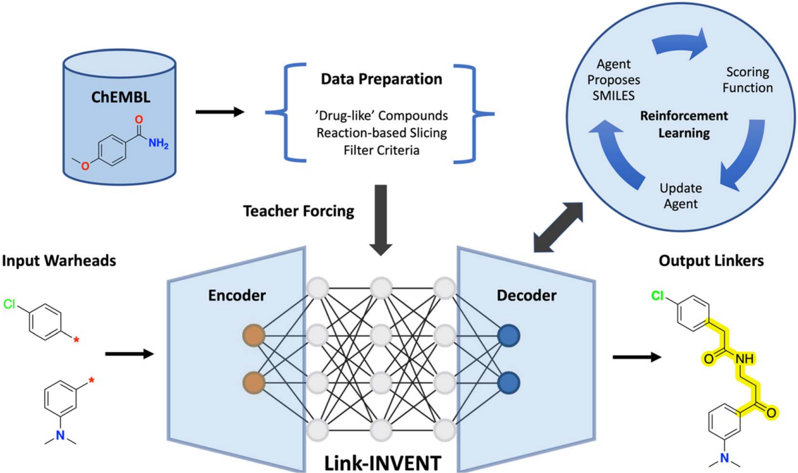
In this work, we present Link-INVENT as an extension to the existing de novo molecular design platform REINVENT. We provide illustrative examples on how Link-INVENT can be applied on fragment linking, scaffold hopping, and PROTACs design case studies where the desirable molecules should satisfy a combination of different criteria. With the help of Reinforcement Learning, the agent used by Link-INVENT learns to generate favourable linkers connecting molecular subunits that satisfy diverse objectives, facilitating practical application of the model for real-world drug discovery projects. We also introduce a range of linker-specific objectives in the scoring function of REINVENT. The code is freely available at https://github.com/MolecularAI/Reinvent.
Overview
The claims and statistics of this paper haven’t been checked yet.
Run the check — free, no account needed. It reads the open-access text and checks the sources it cites.
Integrity signals
Registry
Cites
Statistics
Figures
Verification
Claims the paper makes
The claims and statistics of this paper haven’t been checked yet.
Run the check — free, no account needed. It reads the open-access text and checks the sources it cites.
Claims other papers make about this one
Each is checked against this paper’s own text: does it say what the citing paper says it does?
In the citing paper
“Moreover, existing platforms have been versioned to design optimal linkers connecting the two molecular subunits in a PROTAC.163”
From Advancing Targeted Protein Degradation via Multiomics Profiling and Artificial Intelligence (2023) · cites this paper as [163]
Self-check
Percentages, sums and reported differences re-computed from the paper’s own numbers.
The self-check needs the paper’s full text.
Citations
Cites
Hochreiter, S., & Schmidhuber, J. (1997) · Neural Computation · doi:10.1162/neco.1997.9.8.1735 · Cited by 102,318
Trott, O., & Olson, A. J. (2010) · Journal of Computational Chemistry · doi:10.1002/jcc.21334 · Cited by 38,412
Lipinski, C. A., Lombardo, F., Dominy, B. W., & Feeney, P. J. (1997) · Advanced Drug Delivery Reviews · doi:10.1016/s0169-409x(96)00423-1 · Cited by 11,484
Friesner, R. A., Banks, J. L., Murphy, R. B., Halgren, T. A., Klicic, J. J., Mainz, D. T., Repasky, M. P., Knoll, E. H., Shelley, M., Perry, J. K., et al. (2004) · Journal of Medicinal Chemistry · doi:10.1021/jm0306430 · Cited by 10,057
Weininger, D. (1988) · Journal of Chemical Information and Computer Sciences · doi:10.1021/ci00057a005 · Cited by 7,436
Friesner, R. A., Murphy, R. B., Repasky, M. P., Frye, L. L., Greenwood, J. R., Halgren, T. A., Sanschagrin, P. C., & Mainz, D. T. (2006) · Journal of Medicinal Chemistry · doi:10.1021/jm051256o · Cited by 7,012
Halgren, T. A., Murphy, R. B., Friesner, R. A., Beard, H. S., Frye, L. L., Pollard, W. T., & Banks, J. L. (2004) · Journal of Medicinal Chemistry · doi:10.1021/jm030644s · Cited by 5,340
A Learning Algorithm for Continually Running Fully Recurrent Neural Networks
Williams, R. J., & Zipser, D. (1989) · Neural Computation · doi:10.1162/neco.1989.1.2.270 · Cited by 4,369
Automatic Chemical Design Using a Data-Driven Continuous Representation of Molecules
Gómez-Bombarelli, R., Wei, J. N., Duvenaud, D., Hernández-Lobato, J. M., Sánchez-Lengeling, B., Sheberla, D., Aguilera-Iparraguirre, J., Hirzel, T. D., Adams, R. P., & Aspuru-Guzik, A. (2018) · ACS Central Science · doi:10.1021/acscentsci.7b00572 · Cited by 3,106
Sakamoto, K. M., Kim, K. B., Kumagai, A., Mercurio, F., Crews, C. M., & Deshaies, R. J. (2001) · Proceedings of the National Academy of Sciences · doi:10.1073/pnas.141230798 · Cited by 2,609
The Properties of Known Drugs. 1. Molecular Frameworks
Bemis, G. W., & Murcko, M. A. (1996) · Journal of Medicinal Chemistry · doi:10.1021/jm9602928 · Cited by 2,501
Gaulton, A., Hersey, A., Nowotka, M., Bento, A. P., Chambers, J. K., Méndez, D., Mutowo, P., Atkinson, F. L., Bellis, L. J., Cibrián–Uhalte, E., et al. (2016) · Nucleic Acids Research · doi:10.1093/nar/gkw1074 · Cited by 2,394
Automatic Chemical Design Using a Data-Driven Continuous Representation of Molecules.
Gómez‐Bombarelli, R., Wei, J. N., Duvenaud, D., Hernández-Lobato, J. M., Sánchez-Lengeling, B., Sheberla, D., Aguilera‐Iparraguirre, J., Hirzel, T. D., Adams, R. P., & Aspuru‐Guzik, A. (2018) · Cambridge University Engineering Department Publications Database · doi:10.17863/cam.34134 · Cited by 1,813
Molecular de-novo design through deep reinforcement learning
Olivecrona, M., Blaschke, T., Engkvist, O., & Chen, H. (2017) · Journal of Cheminformatics · doi:10.1186/s13321-017-0235-x · Cited by 1,443
Self-citationDeep reinforcement learning for de novo drug design
Popova, M., Isayev, O., & Tropsha, A. (2018) · Science Advances · doi:10.1126/sciadv.aap7885 · Cited by 1,433
Wager, T. T., Hou, X., Verhoest, P. R., & Villalobos, A. (2010) · ACS Chemical Neuroscience · doi:10.1021/cn100008c · Cited by 1,131
Rethinking drug design in the artificial intelligence era
Schneider, P., Walters, W. P., Plowright, A. T., Sieroka, N., Listgarten, J., Goodnow, R. A., Fisher, J., Jansen, J. M., Duca, J. S., Rush, T. S., et al. (2020) · Nature Reviews Drug Discovery · doi:10.1038/s41573-019-0050-3 · Cited by 894
The rise of fragment-based drug discovery
Murray, C. W., & Rees, D. C. (2009) · Nature Chemistry · doi:10.1038/nchem.217 · Cited by 803
Small‐Molecule PROTACS: New Approaches to Protein Degradation
Toure, M., & Crews, C. M. (2016) · Angewandte Chemie International Edition · doi:10.1002/anie.201507978 · Cited by 674
PROTACs: great opportunities for academia and industry
Sun, X., Gao, H., Yang, Y., He, M., Wu, Y., Song, Y.-G., Tong, Y., & Rao, Y. (2019) · Signal Transduction and Targeted Therapy · doi:10.1038/s41392-019-0101-6 · Cited by 663
Erlanson, D. A., McDowell, R. S., & O'Brien, T. (2004) · Journal of Medicinal Chemistry · doi:10.1021/jm040031v · Cited by 645
Estimation of the size of drug-like chemical space based on GDB-17 data
Polishchuk, P. G., Madzhidov, T. I., & Varnek, A. (2013) · Journal of Computer-Aided Molecular Design · doi:10.1007/s10822-013-9672-4 · Cited by 619
Entropy-Enthalpy Compensation: Role and Ramifications in Biomolecular Ligand Recognition and Design
Chodera, J. D., & Mobley, D. L. (2013) · Annual Review of Biophysics · doi:10.1146/annurev-biophys-083012-130318 · Cited by 531
REINVENT 2.0: An AI Tool for De Novo Drug Design
Blaschke, T., Arús-Pous, J., Chen, H., Margreitter, C., Tyrchan, C., Engkvist, O., Papadopoulos, K., & Patronov, A. (2020) · Journal of Chemical Information and Modeling · doi:10.1021/acs.jcim.0c00915 · Cited by 496
Self-citationArtificial intelligence in drug discovery: recent advances and future perspectives
Jiménez-Luna, J., Grisoni, F., Weskamp, N., & Schneider, G. (2021) · Expert Opinion on Drug Discovery · doi:10.1080/17460441.2021.1909567 · Cited by 464
Multi-objective de novo drug design with conditional graph generative model
Li, Y., Zhang, L., & Liu, Z. (2018) · Journal of Cheminformatics · doi:10.1186/s13321-018-0287-6 · Cited by 416
Molecular Field Extrema as Descriptors of Biological Activity: Definition and Validation
Cheeseright, T., Mackey, M. D., Rose, S., & Vinter, A. (2006) · Journal of Chemical Information and Modeling · doi:10.1021/ci050357s · Cited by 409
Randomized SMILES strings improve the quality of molecular generative models
Arús‐Pous, J., Johansson, S., Prykhodko, O., Bjerrum, E. J., Tyrchan, C., Reymond, J., Chen, H., & Engkvist, O. (2019) · Journal of Cheminformatics · doi:10.1186/s13321-019-0393-0 · Cited by 403
Self-citationAlex, A., Millan, D. S., Perez, M., Wakenhut, F., & Whitlock, G. A. (2011) · MedChemComm · doi:10.1039/c1md00093d · Cited by 338
Böhm, H., Flohr, A., & Ståhl, M. (2004) · Drug Discovery Today Technologies · doi:10.1016/j.ddtec.2004.10.009 · Cited by 337
Bai, Q., Tan, S., Xu, T., Liu, H., Huang, J., & Yao, X. (2020) · Briefings in Bioinformatics · doi:10.1093/bib/bbaa161 · Cited by 299
Deep Generative Models for 3D Linker Design
Imrie, F., Bradley, A. R., van der Schaar, M., & Deane, C. M. (2020) · Journal of Chemical Information and Modeling · doi:10.1021/acs.jcim.9b01120 · Cited by 285
Unraveling the Role of Linker Design in Proteolysis Targeting Chimeras
Bemis, T. A., Clair, J. J. L., & Burkart, M. D. (2021) · Journal of Medicinal Chemistry · doi:10.1021/acs.jmedchem.1c00482 · Cited by 250
PROTAC-DB: an online database of PROTACs
Weng, G., Shen, C., Cao, D., Gao, J., Dong, X., He, Q., Yang, B., Li, D., Wu, J., & Hou, T. (2021) · Nucleic Acids Research · doi:10.1093/nar/gkaa807 · Cited by 219
Graph networks for molecular design
Mercado, R., Rastemo, T., Lindelöf, E., Klambauer, G., Engkvist, O., Chen, H., & Bjerrum, E. J. (2020) · Machine Learning Science and Technology · doi:10.1088/2632-2153/abcf91 · Cited by 211
Self-citationSMILES-based deep generative scaffold decorator for de-novo drug design
Arús‐Pous, J., Patronov, A., Bjerrum, E. J., Tyrchan, C., Reymond, J., Chen, H., & Engkvist, O. (2020) · Journal of Cheminformatics · doi:10.1186/s13321-020-00441-8 · Cited by 209
Self-citationPredicting responses to platin chemotherapy agents with biochemically-inspired machine learning
Mucaki, E. J., Zhao, J. Z. L., Lizotte, D. J., & Rogan, P. K. (2019) · Signal Transduction and Targeted Therapy · doi:10.1038/s41392-018-0034-5 · Cited by 200
Developing degraders: principles and perspectives on design and chemical space
Maple, H. J., Clayden, N., Baron, A., Stacey, C., & Felix, R. L. (2019) · MedChemComm · doi:10.1039/c9md00272c · Cited by 163
SyntaLinker: automatic fragment linking with deep conditional transformer neural networks
Yang, Y., Zheng, S., Su, S., Zhao, C., Xu, J., & Chen, H. (2020) · Chemical Science · doi:10.1039/d0sc03126g · Cited by 154
Maaß, P. C., Schulz‐Gasch, T., Ståhl, M., & Rarey, M. (2007) · Journal of Chemical Information and Modeling · doi:10.1021/ci060094h · Cited by 141
Memory-assisted reinforcement learning for diverse molecular de novo design
Blaschke, T., Engkvist, O., Bajorath, J., & Chen, H. (2020) · Journal of Cheminformatics · doi:10.1186/s13321-020-00473-0 · Cited by 135
Self-citationDeep generative design with 3D pharmacophoric constraints
Imrie, F., Hadfield, T. E., Bradley, A. R., & Deane, C. M. (2021) · Chemical Science · doi:10.1039/d1sc02436a · Cited by 122
Wang, Z., He, N., Guo, Z., Niu, C., Song, T., Guo, Y., Cao, K., Wang, A., Zhu, J., Zhang, X., et al. (2019) · Journal of Medicinal Chemistry · doi:10.1021/acs.jmedchem.9b00919 · Cited by 120
Parallel tempered genetic algorithm guided by deep neural networks for inverse molecular design
Nigam, A., Pollice, R., & Aspuru‐Guzik, A. (2022) · Digital Discovery · doi:10.1039/d2dd00003b · Cited by 117
De Novo Drug Design Using Reinforcement Learning with Graph-Based Deep Generative Models
Atance, S. R., Diez, J. V., Engkvist, O., Olsson, S., & Mercado, R. (2022) · Journal of Chemical Information and Modeling · doi:10.1021/acs.jcim.2c00838 · Cited by 117
Self-citationFragment Linking Strategies for Structure-Based Drug Design
Bancet, A., Raingeval, C., Lomberget, T., Borgne, M. L., Guichou, J., & Krimm, I. (2020) · Journal of Medicinal Chemistry · doi:10.1021/acs.jmedchem.0c00242 · Cited by 109
LibINVENT: Reaction-based Generative Scaffold Decoration for in Silico Library Design
Fialková, V., Zhao, J., Papadopoulos, K., Engkvist, O., Bjerrum, E. J., Kogej, T., & Patronov, A. (2021) · Journal of Chemical Information and Modeling · doi:10.1021/acs.jcim.1c00469 · Cited by 107
Self-citationBeam Search for Automated Design and Scoring of Novel ROR Ligands with Machine Intelligence**
Moret, M., Helmstädter, M., Grisoni, F., Schneider, G., & Merk, D. (2021) · Angewandte Chemie International Edition · doi:10.1002/anie.202104405 · Cited by 92
Patel, S. D., Cohen, F., Dean, B. J., Torre, K. D. L., Deshmukh, G. S., Estrada, A. A., Ghosh, A. S., Gibbons, P., Gustafson, A. E., Huestis, M. P., et al. (2014) · Journal of Medicinal Chemistry · doi:10.1021/jm5013984 · Cited by 88
DockStream: a docking wrapper to enhance de novo molecular design
Guo, J., Janet, J. P., Bauer, M. R., Nittinger, E., Giblin, K. A., Papadopoulos, K., Voronov, A., Patronov, A., Engkvist, O., & Margreitter, C. (2021) · Journal of Cheminformatics · doi:10.1186/s13321-021-00563-7 · Cited by 84
Self-citationScaffold-Constrained Molecular Generation
Langevin, M., Minoux, H., Levesque, M., & Bianciotto, M. (2020) · Journal of Chemical Information and Modeling · doi:10.1021/acs.jcim.0c01015 · Cited by 79
Thomas, M., Smith, R. T., O’Boyle, N. M., de Graaf, C., & Bender, A. (2021) · Journal of Cheminformatics · doi:10.1186/s13321-021-00516-0 · Cited by 78
Specific inhibition of CK2α from an anchor outside the active site
Brear, P., Fusco, C. D., Georgiou, K. H., Francis-Newton, N. J., Stubbs, C. J., Sore, H. F., Venkitaraman, A. R., Abell, C., Spring, D. R., & Hyvönen, M. (2016) · Chemical Science · doi:10.1039/c6sc02335e · Cited by 68
Fusco, C. D., Brear, P., Iegre, J., Georgiou, K. H., Sore, H. F., Hyvönen, M., & Spring, D. R. (2017) · Bioorganic & Medicinal Chemistry · doi:10.1016/j.bmc.2017.04.037 · Cited by 66
Trapero, A., Pacitto, A., Singh, V., Sabbah, M., Coyne, A. G., Mizrahi, V., Blundell, T. L., Ascher, D. B., & Abell, C. (2018) · Journal of Medicinal Chemistry · doi:10.1021/acs.jmedchem.7b01622 · Cited by 63
Patel, S. D., Harris, S. F., Gibbons, P., Deshmukh, G. S., Gustafson, A. E., Kellar, T., Lin, H., Liu, X., Liu, Y., Liu, Y., et al. (2015) · Journal of Medicinal Chemistry · doi:10.1021/acs.jmedchem.5b01072 · Cited by 62
Design and Synthesis of DDR1 Inhibitors with a Desired Pharmacophore Using Deep Generative Models
Yoshimori, A., Asawa, Y., Kawasaki, E., Tasaka, T., Matsuda, S., Sekikawa, T., Tanabe, S., Neya, M., Natsugari, H., & Kanai, C. (2020) · ChemMedChem · doi:10.1002/cmdc.202000786 · Cited by 48
Scaffold Hopping by Fragment Replacement
Vainio, M. J., Kogej, T., Raubacher, F., & Sadowski, J. (2013) · Journal of Chemical Information and Modeling · doi:10.1021/ci4001019 · Cited by 43
Yu, H. S., Modugula, K., Ichihara, O., Kramschuster, K., Keng, S., Abel, R., & Wang, L. (2020) · Journal of Chemical Theory and Computation · doi:10.1021/acs.jctc.0c01004 · Cited by 39
CONFIRM: connecting fragments found in receptor molecules
Thompson, D. C., Denny, R. A., Nilakantan, R., Humblet, C. C., Joseph‐McCarthy, D., & Feyfant, E. (2008) · Journal of Computer-Aided Molecular Design · doi:10.1007/s10822-008-9221-8 · Cited by 37
Choi, J., & Lee, J. (2021) · International Journal of Molecular Sciences · doi:10.3390/ijms222111635 · Cited by 30
Equivariant 3D-Conditional Diffusion Models for Molecular Linker DesignPreprint
Igashov, I., Stärk, H., Vignac, C., Satorras, V. G., Pascal Frossard, B., Welling, M., Bronstein, M. M., & Correia, B. E. (2022) · arXiv (Cornell University) · doi:10.48550/arxiv.2210.05274 · Cited by 30
Kinase Inhibitor Scaffold Hopping with Deep Learning Approaches
Hu, L., Yang, Y., Zheng, S., Xu, J., Ran, T., & Chen, H. (2021) · Journal of Chemical Information and Modeling · doi:10.1021/acs.jcim.1c00608 · Cited by 25
3DLinker: An E(3) Equivariant Variational Autoencoder for Molecular Linker DesignPreprint
Huang, Y., Peng, X., Ma, J., & Zhang, M. (2022) · arXiv (Cornell University) · doi:10.48550/arxiv.2205.07309 · Cited by 24
Research works printed but not linked: 56
- P. Schneider, W. P. Walters, A. T. Plowright, N. Sieroka, J. Listgarten, R. A. Goodnow, J. Fisher, J. M. Jansen, J. S. Duca, T. S. Rush, M. Zentgraf, J. E. Hill, E. Krutoholow, M. Kohler, J. Blaney, K. Funatsu, C. Luebkemann and G. Schneider, Nat. Rev. Drug Discovery, 2020, 19, 353-364.
- P. G. Polishchuk, T. I. Madzhidov and A. Varnek, J. Comput.- Aided Mol. Des., 2013, 27, 675-679.
- T. Blaschke, J. Arús-Pous, H. Chen, C. Margreitter, C. Tyrchan, O. Engkvist, K. Papadopoulos and A. Patronov, J. Chem. Inf. Model., 2020, 60, 5918-5922.
- M. Thomas, R. T. Smith, N. M. O'Boyle, C. de Graaf and A. Bender, J. Cheminf., 2021, 13, 39.
- Y. Li, L. Zhang and Z. Liu, J. Cheminf., 2018, 10, 33.
- R. Mercado, T. Rastemo, E. Lindelöf, G. Klambauer, O. Engkvist, H. Chen and E. Jannik Bjerrum, Mach. Learn.: Sci. Technol., 2021, 2, 025023.
- S. R. Atance, J. V. Diez, O. Engkvist, S. Olsson and R. Mercado, J. Chem. Inf. Model., 2022, 62(20), 4863-4872.
- R. Gómez-Bombarelli, J. N. Wei, D. Duvenaud, J. M. Hernández-Lobato, B. Sánchez-Lengeling, D. Sheberla, J. Aguilera-Iparraguirre, T. D. Hirzel, R. P. Adams and A. Aspuru-Guzik, ACS Cent. Sci., 2018, 4, 268-276.
- J. Choi and J. Lee, Int. J. Mol. Sci., 2021, 22(21), 11635.
- A. Nigam, R. Pollice and A. Aspuru-Guzik, Digital Discovery, 2022, 1(4), 390-404.
- D. Weininger, J. Chem. Inf. Comput. Sci., 1988, 28, 31-36.
- F. Imrie, A. R. Bradley, M. van der Schaar and C. M. Deane, J. Chem. Inf. Model., 2020, 60, 1983-1995.
- Y. Yang, S. Zheng, S. Su, C. Zhao, J. Xu and H. Chen, Chem. Sci., 2020, 11, 8312-8322.
- L. Hu, Y. Yang, S. Zheng, J. Xu, T. Ran and H. Chen, J. Chem. Inf. Model., 2021, 61, 4900-4912.
- M. Langevin, H. Minoux, M. Levesque and M. Bianciotto, J. Chem. Inf. Model., 2020, 60, 5637-5646.
- F. Imrie, T. E. Hadeld, A. R. Bradley and C. M. Deane, Chem. Sci., 2021, 12, 14577-14589.
- Y. Feng, Y. Yang, W. Deng, H. Chen and T. Ran, Artif. Intell. Life Sci., 2022, 2, 100035.
- D. A. Erlanson, R. S. McDowell and T. O'Brien, J. Med. Chem., 2004, 47, 3463-3482.
- C. W. Murray and D. C. Rees, Nat. Chem., 2009, 1, 187-192.
- H.-J. Böhm, A. Flohr and M. Stahl, Drug Discovery Today: Technol., 2004, 1, 217-224.
- K. M. Sakamoto, K. B. Kim, A. Kumagai, F. Mercurio, C. M. Crews and R. J. Deshaies, Proc. Natl. Acad. Sci. U. S. A., 2001, 98, 8554-8559.
- M. Toure and C. M. Crews, Angew. Chem., Int. Ed., 2016, 55, 1966-1973.
- X. Sun, H. Gao, Y. Yang, M. He, Y. Wu, Y. Song, Y. Tong and Y. Rao, Signal Transduction Targeted Ther., 2019, 4, 1-33.
- J. D. Chodera and D. L. Mobley, Annu. Rev. Biophys., 2013, 42, 121-142.
- A. Bancet, C. Raingeval, T. Lomberget, M. Le Borgne, J.-F. Guichou and I. Krimm, J. Med. Chem., 2020, 63, 11420-11435.
- H. S. Yu, K. Modugula, O. Ichihara, K. Kramschuster, S. Keng, R. Abel and L. Wang, J. Chem. Theory Comput., 2021, 17, 450-462.
- C. A. Lipinski, F. Lombardo, B. W. Dominy and P. J. Feeney, Adv. Drug Delivery Rev., 1997, 23, 3-25.
- H. J. Maple, N. Clayden, A. Baron, C. Stacey and R. Felix, Med. Chem. Commun., 2019, 10, 1755-1764.
- G. Weng, C. Shen, D. Cao, J. Gao, X. Dong, Q. He, B. Yang, D. Li, J. Wu and T. Hou, Nucleic Acids Res., 2021, 49, D1381-D1387.
- T. A. Bemis, J. J. La Clair and M. D. Burkart, J. Med. Chem., 2021, 64, 8042-8052.
- T. Cheeseright, M. Mackey, S. Rose and A. Vinter, J. Chem. Inf. Model., 2006, 46, 665-676.
- P. Maass, T. Schulz-Gasch, M. Stahl and M. Rarey, J. Chem. Inf. Model., 2007, 47, 390-399.
- D. C. Thompson, R. A. Denny, R. Nilakantan, C. Humblet, D. Joseph-McCarthy and E. Feyfant, J. Comput.-Aided Mol. Des., 2008, 22, 761-772.
- M. J. Vainio, T. Kogej, F. Raubacher and J. Sadowski, J. Chem. Inf. Model., 2013, 53, 1825-1835.
- A. Yoshimori, Y. Asawa, E. Kawasaki, T. Tasaka, S. Matsuda, T. Sekikawa, S. Tanabe, M. Neya, H. Natsugari and C. Kanai, ChemMedChem, 2021, 16, 955-958.
- A. Gaulton, A. Hersey, M. Nowotka, A. P. Bento, J. Chambers, D. Mendez, P. Mutowo, F. Atkinson, L. J. Bellis, E. Cibrián- Uhalte, M. Davies, N. Dedman, A. Karlsson, M. P. Magariños, J. P. Overington, G. Papadatos, I. Smit and A. R. Leach, Nucleic Acids Res., 2017, 45, D945-D954.
- V. Fialková, J. Zhao, K. Papadopoulos, O. Engkvist, E. Bjerrum, T. Kogej and A. Patronov, J. Chem. Inf. Model., 2022, 62(9), 2046-2063.
- J. Arús-Pous, A. Patronov, E. J. Bjerrum, C. Tyrchan, J.-L. Reymond, H. Chen and O. Engkvist, J. Cheminf., 2020, 12, 38.
- S. Hochreiter and J. Schmidhuber, Neural Comput., 1997, 9, 1735-1780.
- G. W. Bemis and M. A. Murcko, J. Med. Chem., 1996, 39, 2887-2893.
- J. Arús-Pous, S. V. Johansson, O. Prykhodko, E. J. Bjerrum, C. Tyrchan, J.-L. Reymond, H. Chen and O. Engkvist, J. Cheminf., 2019, 11, 71.
- R. J. Williams and D. Zipser, Neural Comput., 1989, 1, 270- 280.
- M. Olivecrona, T. Blaschke, O. Engkvist and H. Chen, J. Cheminf., 2017, 9, 48.
- T. Blaschke, O. Engkvist, J. Bajorath and H. Chen, J. Cheminf., 2020, 12, 68.
- C. De Fusco, P. Brear, J. Iegre, K. H. Georgiou, H. F. Sore, M. Hyvönen and D. R. Spring, Bioorg. Med. Chem., 2017, 25, 3471-3482.
- P. Brear, C. De Fusco, K. Hadje Georgiou, N. J. Francis- Newton, C. J. Stubbs, H. F. Sore, A. R. Venkitaraman, C. Abell, D. R. Spring and M. Hyvönen, Chem. Sci., 2016, 7, 6839-6845.
- J. Guo, J. P. Janet, M. R. Bauer, E. Nittinger, K. A. Giblin, K. Papadopoulos, A. Voronov, A. Patronov, O. Engkvist and C. Margreitter, J. Cheminf., 2021, 13, 89. 55 Schrödinger Release 2019-4: Glide, Schrödinger, LLC, New York, NY, 2019.
- R. A. Friesner, J. L. Banks, R. B. Murphy, T. A. Halgren, J. J. Klicic, D. T. Mainz, M. P. Repasky, E. H. Knoll, M. Shelley, J. K. Perry, D. E. Shaw, P. Francis and P. S. Shenkin, J. Med. Chem., 2004, 47, 1739-1749.
- T. A. Halgren, R. B. Murphy, R. A. Friesner, H. S. Beard, L. L. Frye, W. T. Pollard and J. L. Banks, J. Med. Chem., 2004, 47, 1750-1759.
- R. A. Friesner, R. B. Murphy, M. P. Repasky, L. L. Frye, J. R. Greenwood, T. A. Halgren, P. C. Sanschagrin and D. T. Mainz, J. Med. Chem., 2006, 49, 6177-6196. 59 Schrödinger Release 2019-4: LigPrep, Schrödinger, LLC, New York, NY, 2019.
- A. Alex, D. S. Millan, M. Perez, F. Wakenhut and G. A. Whitlock, Med. Chem. Commun., 2011, 2, 669-674.
- A. Trapero, A. Pacitto, V. Singh, M. Sabbah, A. G. Coyne, V. Mizrahi, T. L. Blundell, D. B. Ascher and C. Abell, J. Med. Chem., 2018, 61, 2806-2822.
- O. Trott and A. J. Olson, J. Comput. Chem., 2010, 31, 455-461.
- S. Patel, F. Cohen, B. J. Dean, K. De La Torre, G. Deshmukh, A. A. Estrada, A. S. Ghosh, P. Gibbons, A. Gustafson, M. P. Huestis, C. E. Le Pichon, H. Lin, W. Liu, X. Liu, Y. Liu, C. Q. Ly, J. P. Lyssikatos, C. Ma, K. Scearce-Levie, Y. G. Shin, H. Solanoy, K. L. Stark, J. Wang, B. Wang, X. Zhao, J. W. Lewcock and M. Siu, J. Med. Chem., 2015, 58, 401-418.
- S. Patel, S. F. Harris, P. Gibbons, G. Deshmukh, A. Gustafson, T. Kellar, H. Lin, X. Liu, Y. Liu, Y. Liu, C. Ma, K. Scearce-Levie, A. S. Ghosh, Y. G. Shin, H. Solanoy, J. Wang, B. Wang, J. Yin, M. Siu and J. W. Lewcock, J. Med. Chem., 2015, 58, 8182-8199.
- Z. Wang, N. He, Z. Guo, C. Niu, T. Song, Y. Guo, K. Cao, A. Wang, J. Zhu, X. Zhang and Z. Zhang, J. Med. Chem., 2019, 62, 8152-8163.
Cited by
Sorted by citations
Reinvent 4: Modern AI–driven generative molecule design
Loeffler, H. H., He, J., Tibo, A., Janet, J. P., Voronov, A., Mervin, L., & Engkvist, O. (2024) · Journal of Cheminformatics · doi:10.1186/s13321-024-00812-5 · Cited by 440
Self-citationMachine learning-aided generative molecular design
Du, Y., Jamasb, A. R., Guo, J., Fu, T., Harris, C., Wang, Y., Duan, C., Lió, P., Schwaller, P., & Blundell, T. L. (2024) · Nature Machine Intelligence · doi:10.1038/s42256-024-00843-5 · Cited by 221
Self-citationCharacteristic roadmap of linker governs the rational design of PROTACs
Dong, Y., Ma, T., Xu, T., Feng, Z., Li, Y., Song, L., Yao, X., Ashby, C. R., & Hao, G.-F. (2024) · Acta Pharmaceutica Sinica B · doi:10.1016/j.apsb.2024.04.007 · Cited by 146
Computer-Aided Drug Discovery for Undruggable Targets
Sun, Q., Wang, H., Xie, J., Wang, L., Mu, J., Li, J., Ren, Y., & Lai, L. (2025) · Chemical Reviews · doi:10.1021/acs.chemrev.4c00969 · Cited by 72
Development of PROTACs using computational approaches
Ge, J., Hsieh, C., Fang, M., Sun, H., & Hou, T. (2024) · Trends in Pharmacological Sciences · doi:10.1016/j.tips.2024.10.006 · Cited by 68
Metadata
- Authors
- Guo, J., Knuth, F., Margreitter, C., Janet, J. P., Papadopoulos, K., Engkvist, O., & Patronov, A.
- Affiliations
- AstraZeneca (Sweden) (SE)
- Norwegian University of Science and Technology (NO)
- Corresponding author
- Patronov, Atanas
- ORCID
- Venue
- Digital Discovery
- Publisher
- American Chemical Society (ACS)
- Published
- 2022-04-24
- Volume
- 2
- Issue
- 2
- Pages
- 392-408
- ISSN
- 2635-098X (ISSN-L)
- OpenAlex
- W4319164354
- Cited by
- 101
- References
- 62
- Citations by year
- 2026: 30 · 2025: 29 · 2024: 26 · 2023: 15 · 2022: 1
- FWCI
- 14.46
- Type
- journal article
- Language
- en
- Open access
- diamond
- doi.org
- Locations
- Digital Discovery (publishedVersion, cc-by)
- ChemRxiv (acceptedVersion, cc-by)
- Chalmers Research (Chalmers University of Technology) (submittedVersion)
- Topics
- Life Sciences › Pharmacology, Toxicology and Pharmaceutics › Drug Discovery › Computational Drug Discovery Methods
- Life Sciences › Biochemistry, Genetics and Molecular Biology › Molecular Biology › Protein Degradation and Inhibitors
- Physical Sciences › Chemistry › Organic Chemistry › Chemical Synthesis and Analysis
- Keywords
- PROTACs, linker design, fragment linking, scaffold hopping, generative design, reinforcement learning
About these checks
Registry, retraction, Cites and statistics results are computed, not judged, with one exception: a printed reference that no index lists is read once by a model before it counts as a citation error. Claims are extracted by a model and kept only when their quote appears verbatim in the text; each cited source is then checked, with a model’s help, for whether it says what the claim relies on. Those verdicts can be wrong — read the claim’s quote and the cited source before relying on one.
Statistics and arithmetic are recomputed, not judged.
Confidence bands are shown only for fields calibrated on our annotated test set. None is calibrated yet, so no band is shown.
What counts as a claim ›How we measure confidence ›How we check this ›
Are you an author, or do you see a problem with this page? Request a review
