

The DOI matches its Crossref record; 63 of the 64 references it cites were found in a registry or an index, and 1 are not checked yet.
Link-INVENT: Generative Linker Design with Reinforcement Learning
Open accessAbstract
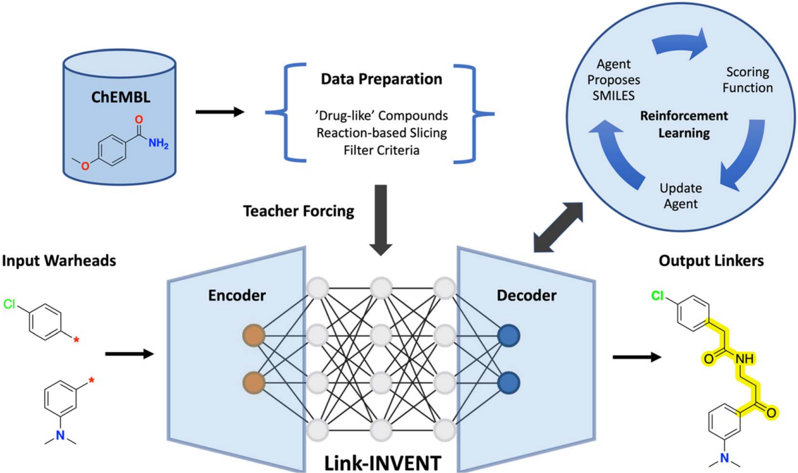
In this work, we present Link-INVENT as an extension to the existing de novo molecular design platform REINVENT. We provide illustrative examples on how Link-INVENT can be applied on fragment linking, scaffold hopping, and PROTACs design case studies where the desirable molecules should satisfy a combination of different criteria. With the help of Reinforcement Learning, the agent used by Link-INVENT learns to generate favourable linkers connecting molecular subunits that satisfy diverse objectives, facilitating practical application of the model for real-world drug discovery projects. We also introduce a range of linker-specific objectives in the scoring function of REINVENT. The code is freely available at https://github.com/MolecularAI/Reinvent.
Overview
The claims and statistics of this paper haven’t been checked yet.
Run the check — free, no account needed. It reads the open-access text and checks the sources it cites.
Integrity signals
Registry
Cites
Statistics
Figures
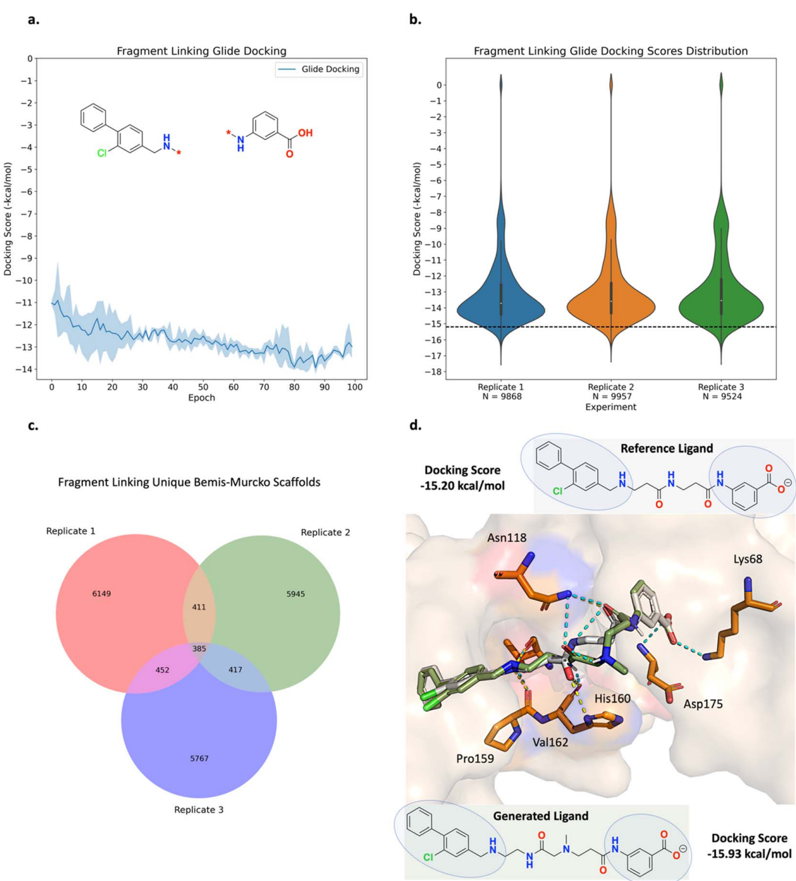
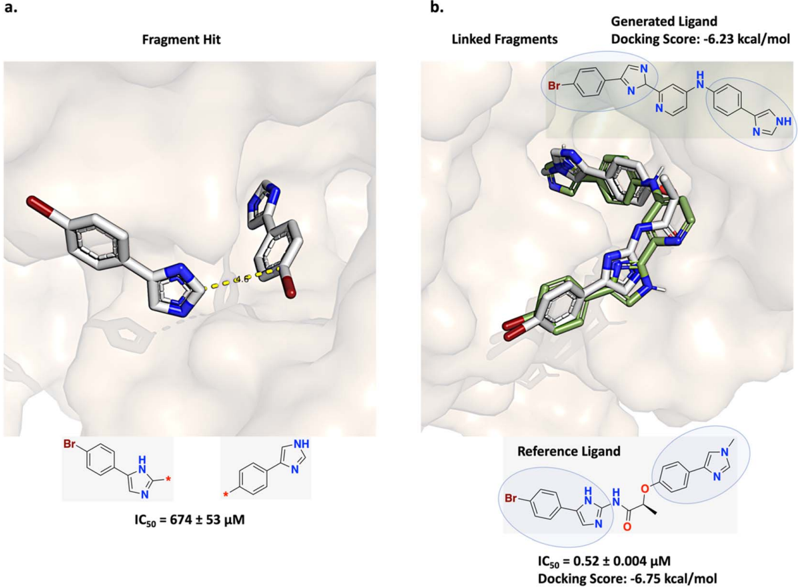
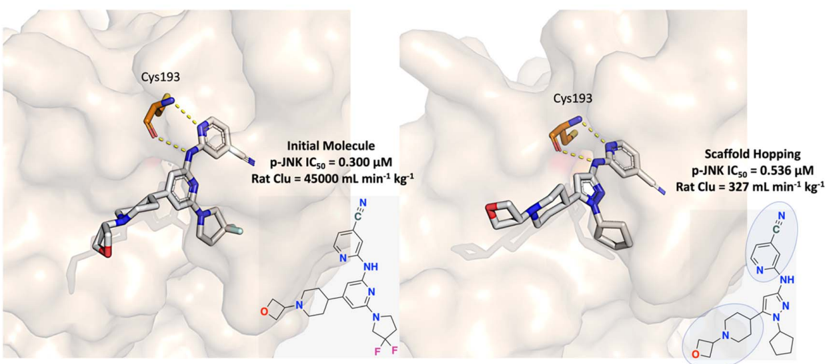
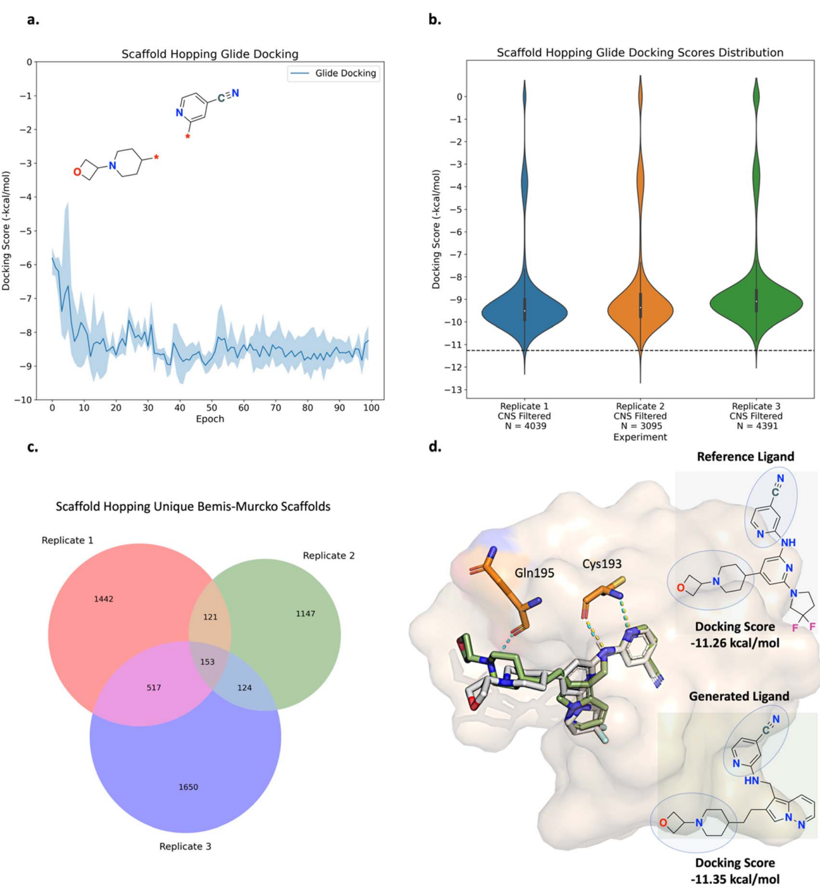
Verification
Claims the paper makes
The claims and statistics of this paper haven’t been checked yet.
Run the check — free, no account needed. It reads the open-access text and checks the sources it cites.
Claims other papers make about this one
Each is checked against this paper’s own text: does it say what the citing paper says it does?
In the citing paper
“Moreover, existing platforms have been versioned to design optimal linkers connecting the two molecular subunits in a PROTAC.163”
From Advancing Targeted Protein Degradation via Multiomics Profiling and Artificial Intelligence (2023) · cites this paper as [163]
Self-check
Percentages, sums and reported differences re-computed from the paper’s own numbers.
The self-check needs the paper’s full text.
Citations
Cites
Hochreiter, S., & Schmidhuber, J. (1997) · Neural Computation · doi:10.1162/neco.1997.9.8.1735 · Cited by 102,318
Trott, O., & Olson, A. J. (2010) · Journal of Computational Chemistry · doi:10.1002/jcc.21334 · Cited by 38,412
Lipinski, C. A., Lombardo, F., Dominy, B. W., & Feeney, P. J. (1997) · Advanced Drug Delivery Reviews · doi:10.1016/s0169-409x(96)00423-1 · Cited by 11,484
Friesner, R. A., Banks, J. L., Murphy, R. B., Halgren, T. A., Klicic, J. J., Mainz, D. T., Repasky, M. P., Knoll, E. H., Shelley, M., Perry, J. K., et al. (2004) · Journal of Medicinal Chemistry · doi:10.1021/jm0306430 · Cited by 10,057
Weininger, D. (1988) · Journal of Chemical Information and Computer Sciences · doi:10.1021/ci00057a005 · Cited by 7,436
Friesner, R. A., Murphy, R. B., Repasky, M. P., Frye, L. L., Greenwood, J. R., Halgren, T. A., Sanschagrin, P. C., & Mainz, D. T. (2006) · Journal of Medicinal Chemistry · doi:10.1021/jm051256o · Cited by 7,012
Halgren, T. A., Murphy, R. B., Friesner, R. A., Beard, H. S., Frye, L. L., Pollard, W. T., & Banks, J. L. (2004) · Journal of Medicinal Chemistry · doi:10.1021/jm030644s · Cited by 5,340
A Learning Algorithm for Continually Running Fully Recurrent Neural Networks
Williams, R. J., & Zipser, D. (1989) · Neural Computation · doi:10.1162/neco.1989.1.2.270 · Cited by 4,369
Automatic Chemical Design Using a Data-Driven Continuous Representation of Molecules
Gómez-Bombarelli, R., Wei, J. N., Duvenaud, D., Hernández-Lobato, J. M., Sánchez-Lengeling, B., Sheberla, D., Aguilera-Iparraguirre, J., Hirzel, T. D., Adams, R. P., & Aspuru-Guzik, A. (2018) · ACS Central Science · doi:10.1021/acscentsci.7b00572 · Cited by 3,106
Sakamoto, K. M., Kim, K. B., Kumagai, A., Mercurio, F., Crews, C. M., & Deshaies, R. J. (2001) · Proceedings of the National Academy of Sciences · doi:10.1073/pnas.141230798 · Cited by 2,609
Research works printed but not linked: 56
- P. Schneider, W. P. Walters, A. T. Plowright, N. Sieroka, J. Listgarten, R. A. Goodnow, J. Fisher, J. M. Jansen, J. S. Duca, T. S. Rush, M. Zentgraf, J. E. Hill, E. Krutoholow, M. Kohler, J. Blaney, K. Funatsu, C. Luebkemann and G. Schneider, Nat. Rev. Drug Discovery, 2020, 19, 353-364.
- P. G. Polishchuk, T. I. Madzhidov and A. Varnek, J. Comput.- Aided Mol. Des., 2013, 27, 675-679.
- T. Blaschke, J. Arús-Pous, H. Chen, C. Margreitter, C. Tyrchan, O. Engkvist, K. Papadopoulos and A. Patronov, J. Chem. Inf. Model., 2020, 60, 5918-5922.
- M. Thomas, R. T. Smith, N. M. O'Boyle, C. de Graaf and A. Bender, J. Cheminf., 2021, 13, 39.
- Y. Li, L. Zhang and Z. Liu, J. Cheminf., 2018, 10, 33.
- R. Mercado, T. Rastemo, E. Lindelöf, G. Klambauer, O. Engkvist, H. Chen and E. Jannik Bjerrum, Mach. Learn.: Sci. Technol., 2021, 2, 025023.
- S. R. Atance, J. V. Diez, O. Engkvist, S. Olsson and R. Mercado, J. Chem. Inf. Model., 2022, 62(20), 4863-4872.
- R. Gómez-Bombarelli, J. N. Wei, D. Duvenaud, J. M. Hernández-Lobato, B. Sánchez-Lengeling, D. Sheberla, J. Aguilera-Iparraguirre, T. D. Hirzel, R. P. Adams and A. Aspuru-Guzik, ACS Cent. Sci., 2018, 4, 268-276.
- J. Choi and J. Lee, Int. J. Mol. Sci., 2021, 22(21), 11635.
- A. Nigam, R. Pollice and A. Aspuru-Guzik, Digital Discovery, 2022, 1(4), 390-404.
- D. Weininger, J. Chem. Inf. Comput. Sci., 1988, 28, 31-36.
- F. Imrie, A. R. Bradley, M. van der Schaar and C. M. Deane, J. Chem. Inf. Model., 2020, 60, 1983-1995.
- Y. Yang, S. Zheng, S. Su, C. Zhao, J. Xu and H. Chen, Chem. Sci., 2020, 11, 8312-8322.
- L. Hu, Y. Yang, S. Zheng, J. Xu, T. Ran and H. Chen, J. Chem. Inf. Model., 2021, 61, 4900-4912.
- M. Langevin, H. Minoux, M. Levesque and M. Bianciotto, J. Chem. Inf. Model., 2020, 60, 5637-5646.
- F. Imrie, T. E. Hadeld, A. R. Bradley and C. M. Deane, Chem. Sci., 2021, 12, 14577-14589.
- Y. Feng, Y. Yang, W. Deng, H. Chen and T. Ran, Artif. Intell. Life Sci., 2022, 2, 100035.
- D. A. Erlanson, R. S. McDowell and T. O'Brien, J. Med. Chem., 2004, 47, 3463-3482.
- C. W. Murray and D. C. Rees, Nat. Chem., 2009, 1, 187-192.
- H.-J. Böhm, A. Flohr and M. Stahl, Drug Discovery Today: Technol., 2004, 1, 217-224.
- K. M. Sakamoto, K. B. Kim, A. Kumagai, F. Mercurio, C. M. Crews and R. J. Deshaies, Proc. Natl. Acad. Sci. U. S. A., 2001, 98, 8554-8559.
- M. Toure and C. M. Crews, Angew. Chem., Int. Ed., 2016, 55, 1966-1973.
- X. Sun, H. Gao, Y. Yang, M. He, Y. Wu, Y. Song, Y. Tong and Y. Rao, Signal Transduction Targeted Ther., 2019, 4, 1-33.
- J. D. Chodera and D. L. Mobley, Annu. Rev. Biophys., 2013, 42, 121-142.
- A. Bancet, C. Raingeval, T. Lomberget, M. Le Borgne, J.-F. Guichou and I. Krimm, J. Med. Chem., 2020, 63, 11420-11435.
- H. S. Yu, K. Modugula, O. Ichihara, K. Kramschuster, S. Keng, R. Abel and L. Wang, J. Chem. Theory Comput., 2021, 17, 450-462.
- C. A. Lipinski, F. Lombardo, B. W. Dominy and P. J. Feeney, Adv. Drug Delivery Rev., 1997, 23, 3-25.
- H. J. Maple, N. Clayden, A. Baron, C. Stacey and R. Felix, Med. Chem. Commun., 2019, 10, 1755-1764.
- G. Weng, C. Shen, D. Cao, J. Gao, X. Dong, Q. He, B. Yang, D. Li, J. Wu and T. Hou, Nucleic Acids Res., 2021, 49, D1381-D1387.
- T. A. Bemis, J. J. La Clair and M. D. Burkart, J. Med. Chem., 2021, 64, 8042-8052.
- T. Cheeseright, M. Mackey, S. Rose and A. Vinter, J. Chem. Inf. Model., 2006, 46, 665-676.
- P. Maass, T. Schulz-Gasch, M. Stahl and M. Rarey, J. Chem. Inf. Model., 2007, 47, 390-399.
- D. C. Thompson, R. A. Denny, R. Nilakantan, C. Humblet, D. Joseph-McCarthy and E. Feyfant, J. Comput.-Aided Mol. Des., 2008, 22, 761-772.
- M. J. Vainio, T. Kogej, F. Raubacher and J. Sadowski, J. Chem. Inf. Model., 2013, 53, 1825-1835.
- A. Yoshimori, Y. Asawa, E. Kawasaki, T. Tasaka, S. Matsuda, T. Sekikawa, S. Tanabe, M. Neya, H. Natsugari and C. Kanai, ChemMedChem, 2021, 16, 955-958.
- A. Gaulton, A. Hersey, M. Nowotka, A. P. Bento, J. Chambers, D. Mendez, P. Mutowo, F. Atkinson, L. J. Bellis, E. Cibrián- Uhalte, M. Davies, N. Dedman, A. Karlsson, M. P. Magariños, J. P. Overington, G. Papadatos, I. Smit and A. R. Leach, Nucleic Acids Res., 2017, 45, D945-D954.
- V. Fialková, J. Zhao, K. Papadopoulos, O. Engkvist, E. Bjerrum, T. Kogej and A. Patronov, J. Chem. Inf. Model., 2022, 62(9), 2046-2063.
- J. Arús-Pous, A. Patronov, E. J. Bjerrum, C. Tyrchan, J.-L. Reymond, H. Chen and O. Engkvist, J. Cheminf., 2020, 12, 38.
- S. Hochreiter and J. Schmidhuber, Neural Comput., 1997, 9, 1735-1780.
- G. W. Bemis and M. A. Murcko, J. Med. Chem., 1996, 39, 2887-2893.
- J. Arús-Pous, S. V. Johansson, O. Prykhodko, E. J. Bjerrum, C. Tyrchan, J.-L. Reymond, H. Chen and O. Engkvist, J. Cheminf., 2019, 11, 71.
- R. J. Williams and D. Zipser, Neural Comput., 1989, 1, 270- 280.
- M. Olivecrona, T. Blaschke, O. Engkvist and H. Chen, J. Cheminf., 2017, 9, 48.
- T. Blaschke, O. Engkvist, J. Bajorath and H. Chen, J. Cheminf., 2020, 12, 68.
- C. De Fusco, P. Brear, J. Iegre, K. H. Georgiou, H. F. Sore, M. Hyvönen and D. R. Spring, Bioorg. Med. Chem., 2017, 25, 3471-3482.
- P. Brear, C. De Fusco, K. Hadje Georgiou, N. J. Francis- Newton, C. J. Stubbs, H. F. Sore, A. R. Venkitaraman, C. Abell, D. R. Spring and M. Hyvönen, Chem. Sci., 2016, 7, 6839-6845.
- J. Guo, J. P. Janet, M. R. Bauer, E. Nittinger, K. A. Giblin, K. Papadopoulos, A. Voronov, A. Patronov, O. Engkvist and C. Margreitter, J. Cheminf., 2021, 13, 89. 55 Schrödinger Release 2019-4: Glide, Schrödinger, LLC, New York, NY, 2019.
- R. A. Friesner, J. L. Banks, R. B. Murphy, T. A. Halgren, J. J. Klicic, D. T. Mainz, M. P. Repasky, E. H. Knoll, M. Shelley, J. K. Perry, D. E. Shaw, P. Francis and P. S. Shenkin, J. Med. Chem., 2004, 47, 1739-1749.
- T. A. Halgren, R. B. Murphy, R. A. Friesner, H. S. Beard, L. L. Frye, W. T. Pollard and J. L. Banks, J. Med. Chem., 2004, 47, 1750-1759.
- R. A. Friesner, R. B. Murphy, M. P. Repasky, L. L. Frye, J. R. Greenwood, T. A. Halgren, P. C. Sanschagrin and D. T. Mainz, J. Med. Chem., 2006, 49, 6177-6196. 59 Schrödinger Release 2019-4: LigPrep, Schrödinger, LLC, New York, NY, 2019.
- A. Alex, D. S. Millan, M. Perez, F. Wakenhut and G. A. Whitlock, Med. Chem. Commun., 2011, 2, 669-674.
- A. Trapero, A. Pacitto, V. Singh, M. Sabbah, A. G. Coyne, V. Mizrahi, T. L. Blundell, D. B. Ascher and C. Abell, J. Med. Chem., 2018, 61, 2806-2822.
- O. Trott and A. J. Olson, J. Comput. Chem., 2010, 31, 455-461.
- S. Patel, F. Cohen, B. J. Dean, K. De La Torre, G. Deshmukh, A. A. Estrada, A. S. Ghosh, P. Gibbons, A. Gustafson, M. P. Huestis, C. E. Le Pichon, H. Lin, W. Liu, X. Liu, Y. Liu, C. Q. Ly, J. P. Lyssikatos, C. Ma, K. Scearce-Levie, Y. G. Shin, H. Solanoy, K. L. Stark, J. Wang, B. Wang, X. Zhao, J. W. Lewcock and M. Siu, J. Med. Chem., 2015, 58, 401-418.
- S. Patel, S. F. Harris, P. Gibbons, G. Deshmukh, A. Gustafson, T. Kellar, H. Lin, X. Liu, Y. Liu, Y. Liu, C. Ma, K. Scearce-Levie, A. S. Ghosh, Y. G. Shin, H. Solanoy, J. Wang, B. Wang, J. Yin, M. Siu and J. W. Lewcock, J. Med. Chem., 2015, 58, 8182-8199.
- Z. Wang, N. He, Z. Guo, C. Niu, T. Song, Y. Guo, K. Cao, A. Wang, J. Zhu, X. Zhang and Z. Zhang, J. Med. Chem., 2019, 62, 8152-8163.
Cited by
Sorted by citations
Items 101–102 of 102
Tjegbe, M. J. M., Onguéné, P. A., Bekono, B. D., Betow, J. Y., Simoben, C. V., Cassel, J. A., Salvino, J. M., Montaner, L. J., Andrae‐Marobela, K., Ntie‐Kang, F., et al. (2026) · BMC Pharmacology and Toxicology · doi:10.1186/s40360-026-01264-3
Metadata
- Authors
- Guo, J., Knuth, F., Margreitter, C., Janet, J. P., Papadopoulos, K., Engkvist, O., & Patronov, A.
- Affiliations
- AstraZeneca (Sweden) (SE)
- Norwegian University of Science and Technology (NO)
- Corresponding author
- Patronov, Atanas
- ORCID
- Venue
- Digital Discovery
- Publisher
- American Chemical Society (ACS)
- Published
- 2022-04-24
- Volume
- 2
- Issue
- 2
- Pages
- 392-408
- ISSN
- 2635-098X (ISSN-L)
- OpenAlex
- W4319164354
- Cited by
- 101
- References
- 62
- Citations by year
- 2026: 30 · 2025: 29 · 2024: 26 · 2023: 15 · 2022: 1
- FWCI
- 14.46
- Type
- journal article
- Language
- en
- Open access
- diamond
- doi.org
- Locations
- Digital Discovery (publishedVersion, cc-by)
- ChemRxiv (acceptedVersion, cc-by)
- Chalmers Research (Chalmers University of Technology) (submittedVersion)
- Topics
- Life Sciences › Pharmacology, Toxicology and Pharmaceutics › Drug Discovery › Computational Drug Discovery Methods
- Life Sciences › Biochemistry, Genetics and Molecular Biology › Molecular Biology › Protein Degradation and Inhibitors
- Physical Sciences › Chemistry › Organic Chemistry › Chemical Synthesis and Analysis
- Keywords
- PROTACs, linker design, fragment linking, scaffold hopping, generative design, reinforcement learning
About these checks
Registry, retraction, Cites and statistics results are computed, not judged, with one exception: a printed reference that no index lists is read once by a model before it counts as a citation error. Claims are extracted by a model and kept only when their quote appears verbatim in the text; each cited source is then checked, with a model’s help, for whether it says what the claim relies on. Those verdicts can be wrong — read the claim’s quote and the cited source before relying on one.
Statistics and arithmetic are recomputed, not judged.
Confidence bands are shown only for fields calibrated on our annotated test set. None is calibrated yet, so no band is shown.
What counts as a claim ›How we measure confidence ›How we check this ›
Are you an author, or do you see a problem with this page? Request a review
