

When Problem Solving Followed by Instruction Works: Evidence for Productive Failure
Open accessThe DOI matches its Crossref record; 79 of the 79 references it cites were found in a registry or an index; 8 of the 35 sources its claims cite were checked for support.
Abstract
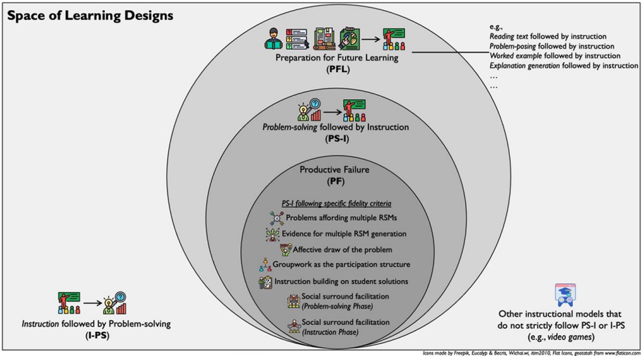
When learning a new concept, should students engage in problem solving followed by instruction (PS-I) or instruction followed by problem solving (I-PS)? Noting that there is a passionate debate about the design of initial learning, we report evidence from a meta-analysis of 53 studies with 166 comparisons that compared PS-I with I-PS design. Our results showed a significant, moderate effect in favor of PS-I (Hedge’s g 0.36 [95% confidence interval 0.20; 0.51]). The effects were even stronger (Hedge’s g ranging between 0.37 and 0.58) when PS-I was implemented with high fidelity to the principles of Productive Failure (PF), a subset variant of PS-I design. Students’ grade level, intervention time span, and its (quasi-)experimental nature contributed to the efficacy of PS-I over I-PS designs. Contrasting trends were, however, observed for younger age learners (second to fifth graders) and for the learning of domain-general skills, for which effect sizes favored I-PS. Overall, an estimation of true effect sizes after accounting for publication bias suggested a strong effect size favoring PS-I (Hedge’s g 0.87).
Overview
CoChat Summary
TL;DR
This meta-analysis of 53 studies with 166 comparisons found that problem solving followed by instruction (PS-I) produced a significant, moderate advantage over instruction followed by problem solving (I-PS) for conceptual knowledge and transfer (Hedge’s g = 0.36). Effects were stronger when PS-I was implemented with high fidelity to Productive Failure principles, and after accounting for publication bias the estimated true effect was Hedge’s g = 0.87.
Key findings
- Overall, PS-I outperformed I-PS for conceptual knowledge and transfer: Hedge’s g = 0.36, 95% CI [0.20, 0.51], p < .0001. For procedural knowledge, the effect was nonsignificant: Hedge’s g = −0.03, 95% CI [−0.20, 0.15].
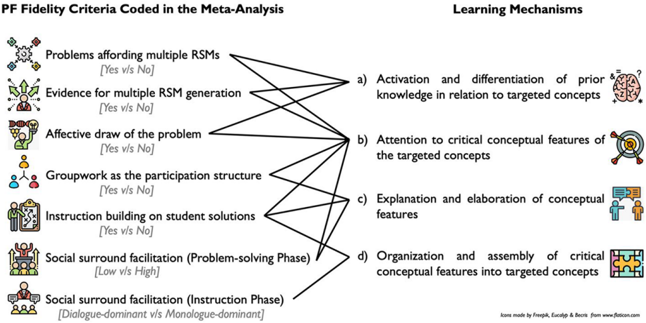
- Higher fidelity to Productive Failure (PF) design criteria was associated with larger effects favoring PS-I; the overall PF fidelity score significantly predicted effect size (β = 0.0065, p < .001, 95% CI [0.0044, 0.0087]). Effects ranged between Hedge’s g = 0.37 and 0.58 when PS-I was implemented with high PF fidelity.
- Subgroup differences: younger learners (2nd–5th graders) showed an effect favoring I-PS (Hedge’s g = −0.09, 95% CI [−0.92, −0.16]), and domain-general skills also favored I-PS (Hedge’s g = −0.17, 95% CI [−1.11, −0.02]). Quasi-experimental comparisons (g = 0.46) and interventions spanning a few days (g = 0.41) descriptively favored PS-I more than experimental comparisons and shorter interventions, though these subgroup differences were not significant.
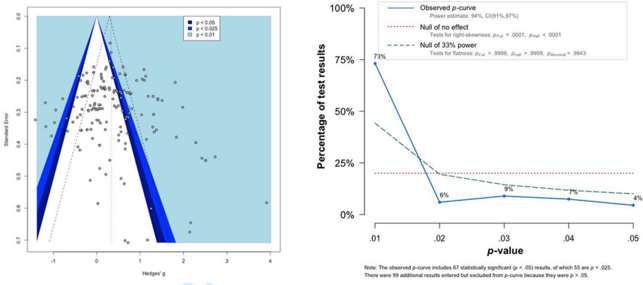
- Publication-bias checks: funnel plot and Egger’s test were not significant (intercept = 0.63, p = .219), but p-curve analysis indicated evidential value and estimated a true effect size of Hedge’s g = 0.87 favoring PS-I; heterogeneity was moderate (I² = 42.01%).
Methods
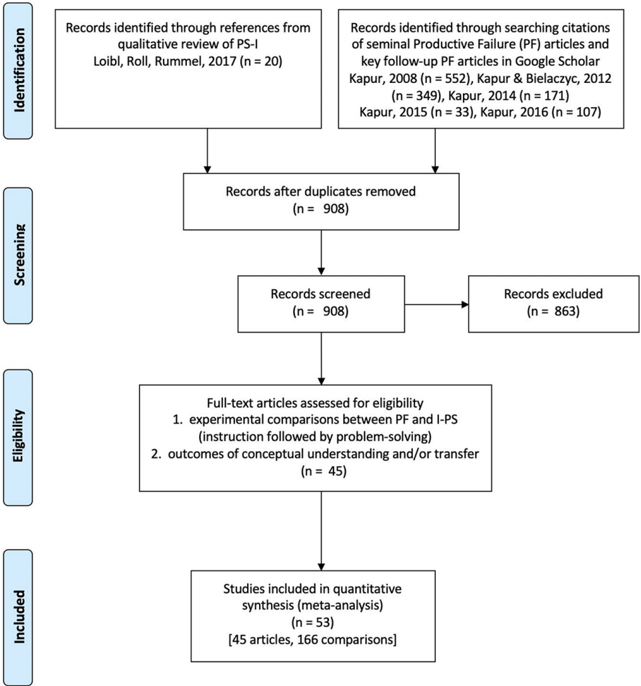
- Meta-analysis of 53 studies comprising 166 experimental comparisons that compared PS-I with I-PS; inclusion required experimental or quasi-experimental comparison and assessment of conceptual knowledge or transfer, with procedural knowledge optional.
- Searches used Google Scholar citations to seminal PF articles and key follow-up PF articles; 45 articles met criteria after screening and duplicate removal.
- Pooled effect sizes used a three-level multilevel meta-analysis model (participants nested within studies, studies nested within articles), Hedge’s g with 95% CIs, Cochran’s Q, and I². Subgroup and meta-regression analyses examined seven PF fidelity criteria, student characteristics, and intervention characteristics; publication bias was assessed with funnel plots, Egger’s test, trim-and-fill, and p-curve analysis.
Limitations
- The paper states that nearly 75% of included comparisons targeted math and physics, with skewed subtopics; more studies are needed in other STEM and non-STEM domains and with postgraduates/professionals before generalizing.
- The paper states that individual differences were not available, few studies reported actual failure rates, multiple RSM generation is a weak proxy for failure, and only one study explicitly assessed negative knowledge. It also notes that PF fidelity criteria and other characteristics were dichotomized, and that experimental versus quasi-experimental designs may not be directly comparable because learning objectives can differ.
- The paper states that the identified list of influencing factors is important but not exhaustive, and that the current meta-analysis lacks studies involving students with learning disabilities or difficulties.
Model-written summary. Check it against the paper before relying on it.
Integrity signals
Registry
Cites
Statistics
Figures

Verification
Claims the paper makes
7 Valid · 4 Not valid · 21 Not checked · 106 Own results and interpretations
At least one cited source doesn’t support this claim or points to a different paper, and none confirmed it — see the verdicts below.
In the paper
“With a moderate ( < 50%) level of heterogeneity in included comparisons ( I 2 = 42.01%), we expect these estimates to be robust (van Aert etal., 2016).”
What the sources say
- Disputedcites van Aert et al., 2016 matched to “Conducting Meta-Analyses Based on p Values: Reservations and Recommendations for Applying p -Uniform and p -Curve” (2016) sourceExperimental — accuracy not yet measured
In the section “If Heterogeneity Is Moderate to Large, p-Curve and p-Uniform Overestimate Effect Size” (page unavailable), the paper reports that effect-size estimates are biased at its moderate-heterogeneity condition (I² ≈ 0.5). It does not assess I² = 42.01%, so that exact threshold is not tested; its finding does not support the cited expectation that moderate heterogeneity makes the estimates robust. (LLM, conf=0.84)
Checked by a reasoning model — may be wrong.
hedgedstates an association- Asserted: passes — The authors put it forward as true.
- Checkable: passes — It can be checked against evidence.
- Load-bearing: passes — The paper’s conclusions depend on it.
- Based: passes — The paper gives a reason why it holds.
- Disputed
The cited sources support only part of this claim — read each source’s verdict below.
In the paper
“Research on goal specificity (e.g., Miller etal., 1999; Vollmeyer etal., 1996), mechanisms of errorful generation (Cyr & Anderson, 2015), as well as prior PS-I work (e.g., Kapur, 2015; Schwartz etal., 2011) has suggested that the benefits of prior knowledge activation such as noticing inconsistencies across multiple problem instances, encoding critical features from instruction, and so on, are”
- Also stated in: § Students' Incoming Characteristics We found that effects favoring PS-I over I-PS were higher if students belonged to a higher grade level. Younger age students (2nd to 5th graders), however, seemed to benefit from I-PS interventions, although the average effect size favoring I-PS was low (Hedge's g of -0.09 [95% CI -0.92, -0.16]. This is despite 72% ( n = 18/25) of the comparisons involving 2nd to 5th graders providing evidence for high prior knowledge activation (reflected in the PF fidelity criteria of evidence for multiple RSM generation ). However, the extent to which the activated prior knowledge is relevant for learning the targeted concepts can substantially affect students' performance. Research on goal specificity (e.g., Miller etal., 1999; Vollmeyer etal., 1996), mechanisms of errorful generation (Cyr & Anderson, 2015), as well as prior PS-I work (e.g., Kapur, 2015; Schwartz etal., 2011) has suggested that the benefits of prior knowledge activation such as noticing inconsistencies across multiple problem instances, encoding critical features from instruction, and so on, are contingent on the relevance of the activation. One explanation for the negative effect sizes disfavoring PS-I for young learners might therefore be the low relevance (albeit, high activation ) of prior knowledge. Factors stemming from students' unawareness of productive metacognitive learning strategies (e.g., planning and monitoring solution generation efficacy, self-explaining, debugging, and error-evaluation) might alternatively contribute to this contrasting trend. Finally, across the comparisons involving 2nd to 5th graders, the low overall PF fidelity score ( M = 56.86%, SD = 27.84%) might also be responsible for negative effects for PS-I. For these younger students then, scaffolding the initial problem-solving phase of PS-I to compensate for their insufficient prior knowledge about cognitive and metacognitive learning strategies might be critical. Richland and Simms (2015), more generally, have documented the importance of scaffolding exploratory problem solving through a series of studies on induction within (non-) STEM domains. They emphasize explicit support in noticing the relevance of relational thinking, providing adequate processing resources to mentally hold and manipulate relations, and facilitating recognition of both similarities and differences when drawing analogies. We further found that comparisons where students were pretested on concepts targeted in the intervention showed a higher effect size favoring PS-I (Hedge's g 0.39 [95% CI -0.26, 0.42]), relative to interventions where no pretest was held (Hedge's g 0.31 [95% CI -0.44, 0.30]), or the pretest targeted only prerequisite concepts (Hedge's g 0.30 [95% CI -0.63, 0.50]). Therefore, including a pretest targeting similar learning materials as the PS-I intervention itself may serve to enhance the differential advantages over I-PS (see Yang etal., 2018, for the facilitatory effects of forward testing), instead of diminishing PS-I's effectiveness due to potential overlap with the triggered learning mechanisms (Newman & DeCaro, 2019). · plain
“contingent on the relevance of the activation.”
What the sources say
- Partly supportedcites Miller et al., 1999 matched to “Goals and Learning in Microworlds” (1999) sourceExperimental — accuracy not yet measured
In “Implications for Learning Theory: Knowledge Dependencies” (page unavailable), the paper says that learning transfers when goal-dependent relationships coincide with pedagogically relevant relationships. This supports the importance of relevance, but the passage concerns knowledge acquired through microworld interaction, not the benefits of activating prior knowledge or the stated examples of noticing inconsistencies and encoding features from instruction. (LLM, conf=0.82)
- Not checked — no full text of the sourcecites Vollmeyer et al., 1996 matched to “The Impact of Goal Specificity on Strategy Use and the Acquisition of Problem Structure” (1996) source
- Not matchedcites Cyr & Anderson, 2015
An author–year citation the paper’s reference list doesn’t settle. We don’t search these by name.
plainstates a possible cause- Asserted: passes — The authors put it forward as true.
- Checkable: passes — It can be checked against evidence.
- Load-bearing: passes — The paper’s conclusions depend on it.
- Based: passes — The paper gives a reason why it holds.
- Also stated in: § Students' Incoming Characteristics We found that effects favoring PS-I over I-PS were higher if students belonged to a higher grade level. Younger age students (2nd to 5th graders), however, seemed to benefit from I-PS interventions, although the average effect size favoring I-PS was low (Hedge's g of -0.09 [95% CI -0.92, -0.16]. This is despite 72% ( n = 18/25) of the comparisons involving 2nd to 5th graders providing evidence for high prior knowledge activation (reflected in the PF fidelity criteria of evidence for multiple RSM generation ). However, the extent to which the activated prior knowledge is relevant for learning the targeted concepts can substantially affect students' performance. Research on goal specificity (e.g., Miller etal., 1999; Vollmeyer etal., 1996), mechanisms of errorful generation (Cyr & Anderson, 2015), as well as prior PS-I work (e.g., Kapur, 2015; Schwartz etal., 2011) has suggested that the benefits of prior knowledge activation such as noticing inconsistencies across multiple problem instances, encoding critical features from instruction, and so on, are contingent on the relevance of the activation. One explanation for the negative effect sizes disfavoring PS-I for young learners might therefore be the low relevance (albeit, high activation ) of prior knowledge. Factors stemming from students' unawareness of productive metacognitive learning strategies (e.g., planning and monitoring solution generation efficacy, self-explaining, debugging, and error-evaluation) might alternatively contribute to this contrasting trend. Finally, across the comparisons involving 2nd to 5th graders, the low overall PF fidelity score ( M = 56.86%, SD = 27.84%) might also be responsible for negative effects for PS-I. For these younger students then, scaffolding the initial problem-solving phase of PS-I to compensate for their insufficient prior knowledge about cognitive and metacognitive learning strategies might be critical. Richland and Simms (2015), more generally, have documented the importance of scaffolding exploratory problem solving through a series of studies on induction within (non-) STEM domains. They emphasize explicit support in noticing the relevance of relational thinking, providing adequate processing resources to mentally hold and manipulate relations, and facilitating recognition of both similarities and differences when drawing analogies. We further found that comparisons where students were pretested on concepts targeted in the intervention showed a higher effect size favoring PS-I (Hedge's g 0.39 [95% CI -0.26, 0.42]), relative to interventions where no pretest was held (Hedge's g 0.31 [95% CI -0.44, 0.30]), or the pretest targeted only prerequisite concepts (Hedge's g 0.30 [95% CI -0.63, 0.50]). Therefore, including a pretest targeting similar learning materials as the PS-I intervention itself may serve to enhance the differential advantages over I-PS (see Yang etal., 2018, for the facilitatory effects of forward testing), instead of diminishing PS-I's effectiveness due to potential overlap with the triggered learning mechanisms (Newman & DeCaro, 2019). · plain
Every source the paper cites for this claim was checked and supports it.
In the paper
“To the best of our knowledge, this is the first integrative empirical counterevidence against the claim that problem solving as a sensemaking activity for novices is not an effective instructional approach (cf. Kirschner etal., 2006, and follow-up work).”
What the sources say
- Supportedcites Kirschner et al., 2006 matched to “Why Minimal Guidance During Instruction Does Not Work: An Analysis of the Failure of Constructivist, Discovery, Problem-Based, Experiential, and Inquiry-Based Teaching” (2006) source
The cited paper’s Current Research Supporting Direct Guidance section says that problem solving becomes relatively effective only when learners have sufficient experience and that novices need extensive guidance to avoid unproductive problem-solving search. Its Conclusions likewise favor strong guidance over minimally guided instruction for novice to intermediate learners. The citing authors’ assertion that their meta-analysis is the first counterevidence is their own claim, not one attributed to Kirschner et al. (LLM, conf=0.87)
hedged- Asserted: passes — The authors put it forward as true.
- Checkable: passes — It can be checked against evidence.
- Load-bearing: passes — The paper’s conclusions depend on it.
- Based: passes — The paper gives a reason why it holds.
- Rests on an assumption not shown here.
- Supported
The sources with a verdict support this claim; the rest weren’t checked yet, have no full text we could read, or their verdicts aren’t rated yet.
In the paper
“12 Results from a complementary Bayesian multilevel meta-analysis model (Harrer etal., 2019; Williams etal., 2018) with weakly informative priors for true pooled effect size (µ ~ N (0, 1)) and between-study heterogeneity ( τ ~ HC (0, 0.5)) aligned with these pooled effect size estimates: Hedge's g = 0.36, 95% CI [0.19, 0.52].”
What the sources say
- Not checked — no full text of the sourcecites Harrer et al., 2019 matched to “Doing Meta-Analysis in R” (2019) source
- Supportedcites Williams et al., 2018 matched to “Bayesian Meta-Analysis with Weakly Informative Prior Distributions” (2018) source
The Introduction and Random-Effects Model section describe Bayesian random-effects meta-analysis using weakly informative priors, supporting the citation as a reference for the method. The Hedges’ g estimate and interval are presented as the citing authors’ results, not as findings attributed to Williams et al. (LLM, conf=0.84)
plain- Asserted: passes — The authors put it forward as true.
- Checkable: passes — It can be checked against evidence.
- Load-bearing: passes — The paper’s conclusions depend on it.
- Based: passes — The paper gives a reason why it holds.
Every source the paper cites for this claim was checked and supports it.
In the paper
“13 Previous reviews regarding the forward testing effect (Yang et al., 2018) suggest inconclusive evidence for the extent to which it might generalize to younger children (and older adults).”
What the sources say
- Supportedcites Yang et al., 2018 matched to “Enhancing learning and retrieval of new information: a review of the forward testing effect” (2018) source
The Individual differences section reports no forward testing effect in younger children learning single items, but says this does not rule out an effect with complex materials. The Future research directions section explicitly asks whether the effect generalizes to older adults. Page numbers are not supplied in our copy. (LLM, conf=0.92)
hedged- Asserted: passes — The authors put it forward as true.
- Checkable: passes — It can be checked against evidence.
- Load-bearing: passes — The paper’s conclusions depend on it.
- Based: passes — The paper gives a reason why it holds.
- Supported
75 more claims
Create a free account to see all 138 claims and to verify the 1 reference still open.
- Probably not a substantial claim. 36
- It may state two separate claims as one. 33
- The quote only partly states this claim. 1
Claims other papers make about this one
Each is checked against this paper’s own text: does it say what the citing paper says it does?
The source backs part of the claim, not all of it — or backs it for a different population, condition or comparison.
In the citing paper
“While PF works across learning subjects, this work focuses on high school math, as it has been most explored in PF research (Sinha and Kapur, 2021).”
From Towards the Pedagogical Steering of Large Language Models for Tutoring: A Case Study with Modeling Productive Failure (2025) · cites this paper as Sinha and Kapur, 2021
Experimental — accuracy not yet measuredThe source backs part of the claim, not all of it — or backs it for a different population, condition or comparison.
In the citing paper
“which is more effective for human learning than other classical teaching methods (Sinha and Kapur, 2021).”
From Towards the Pedagogical Steering of Large Language Models for Tutoring: A Case Study with Modeling Productive Failure (2025) · cites this paper as Sinha and Kapur, 2021
Experimental — accuracy not yet measuredThe source backs part of the claim, not all of it — or backs it for a different population, condition or comparison.
In the citing paper
“While PF works across learning subjects, this work focuses on high school math, as it has been most explored in PF research (Sinha and Kapur, 2021).”
From Towards the Pedagogical Steering of Large Language Models for Tutoring: A Case Study with Modeling Productive Failure (2025) · cites this paper as Sinha and Kapur, 2021
Experimental — accuracy not yet measuredThe cited source says what the claim attributes to it.
In the citing paper
“As a case study, we create a prototype tutor for high school math following Productive Failure (PF), an advanced and effective learning design.”
From Towards the Pedagogical Steering of Large Language Models for Tutoring: A Case Study with Modeling Productive Failure (2025) · cites this paper as Sinha and Kapur, 2021
In the citing paper
“younger learners in Grades 2-5 and domain-general skills showed trends favoring I-PS”
From From Obstacle to Catalyst: A Narrative Review of Learning from Errors in Science Education (2026) · cites this paper as [88]
3 more claims about this paper
Create a free account to see every claim other papers make about this one.
Statistics recomputed
Every reported test result, recomputed from its test statistic and degrees of freedom. A result shows as not adding up only once an independent check has confirmed it.
- ConsistentF(3, 162) = 6.485reported p = .0004 · recomputed p < .001
“F (3, 162) = 6.485, p = .0004”
- Consistentχ²(1) = 33.15reported p < .001 · recomputed p < .001
“χ 2 (1) = 33.15, p < .001”
Self-check
Percentages, sums and reported differences re-computed from the paper’s own numbers.
Each contradiction between two passages listed here was confirmed by an independent check.
Rated major: it would touch a result — a value a result rests on, reported and recomputed p-values on opposite sides of the significance level, two passages that conflict with no sign which is right, or a cited work retracted before this paper was published.
In the paper
§ Intervention Characteristics
“conceptual knowledge (Hedge's g = 0.33”
§ Intervention Characteristics
“95% CI [-0.30, 0.22]”
Rated major: it would touch a result — a value a result rests on, reported and recomputed p-values on opposite sides of the significance level, two passages that conflict with no sign which is right, or a cited work retracted before this paper was published.
In the paper
§ Productive Failure Fidelity for the PS-I Design
“Undergraduates (0.28”
§ Productive Failure Fidelity for the PS-I Design
“[-0.46, 0.24])”
Rated major: it would touch a result — a value a result rests on, reported and recomputed p-values on opposite sides of the significance level, two passages that conflict with no sign which is right, or a cited work retracted before this paper was published.
In the paper
§ Students' Incoming Characteristics
“Hedge's g of -0.09”
§ Students' Incoming Characteristics
“[95% CI -0.92, -0.16]”
Rated major: it would touch a result — a value a result rests on, reported and recomputed p-values on opposite sides of the significance level, two passages that conflict with no sign which is right, or a cited work retracted before this paper was published.
In the paper
§ Intervention Characteristics
“transfer (Hedge's g = 0.40”
§ Intervention Characteristics
“95% CI [-0.19, 0.32]”
Rated minor: it would not touch a result — a value no result rests on, a p-value that stays on the same side of the significance level, or a conflict that is clerical, resolved elsewhere in the paper, or outside its own findings.
In the paper
§ Students' Incoming Characteristics
“these estimates increased (or became more positive) with the age range.”
§ Productive Failure Fidelity for the PS-I Design
“6th to 10th graders (0.50 [-0.04, 0.58]) Undergraduates (0.28 [-0.46, 0.24])”
2 more findings
Create a free account to see every finding of this check.
Citations
Cites
Preferred reporting items for systematic reviews and meta-analyses: The PRISMA statement
Moher, D., Liberati, A., Tetzlaff, J., Altman, D. G., & the PRISMA Group* (2009) · Annals of Internal Medicine · doi:10.7326/0003-4819-151-4-200908180-00135 · Cited by 37,554
Data Mining: Practical Machine Learning Tools and Techniques
(2011) · Elsevier eBooks · doi:10.1016/c2009-0-19715-5 · Cited by 25,437
Cochrane Handbook for Systematic Reviews of Interventions: Cochrane Book Series
(2008) · doi:10.1002/9780470712184 · Cited by 25,048 · cited 1×
“Higgins and Green (2011) was used as a reference text to guide all analyses.”
Duval, S., & Tweedie, R. (2000) · Biometrics · doi:10.1111/j.0006-341x.2000.00455.x · Cited by 14,099 · cited 1×
“Additionally, we also used inferential statistics (Egger’s test) for evaluating presence of asymmetry in the funnel plot and trim-and-fill procedures (Duval & Tweedie, 2000) if applicable.”
Active learning increases student performance in science, engineering, and mathematics
Freeman, S., Eddy, S. L., McDonough, M., Smith, M. K., Okoroafor, N., Jordt, H., & Wenderoth, M. P. (2014) · Proceedings of the National Academy of Sciences · doi:10.1073/pnas.1319030111 · Cited by 9,787 · cited 1×
“Meta-analysis has been shown to be an effective technique in evaluating broadscale pedagogical changes (Freeman et al., 2014).”
Kirschner, P. A., Sweller, J., & Clark, R. E. (2006) · Educational Psychologist · doi:10.1207/s15326985ep4102_1 · Cited by 7,776 · cited 4×
“…explicitly via cognitive scaffolds, worked examples, and so on, our view is that the first stage of PF does not resemble (direct) instruction, a learning experience where students are introduced to formal concepts of a domain in the most unambiguous (eloquent) way possible (Kirschner et al., 2006).”
InfluentialCochrane Handbook for Systematic Reviews of Interventions
Tarsilla, M. (2010) · Journal of MultiDisciplinary Evaluation · doi:10.56645/jmde.v6i14.284 · Cited by 5,178
Colman (2022) · doi:10.1073/pnas · Cited by 4,370
Advances in Instructional Psychology
(2019) · Routledge eBooks · doi:10.4324/9781315864341 · Cited by 2,532
Proceedings for the Annual Meeting of the Cognitive Science Society
Dziemianko, M., Clarke, A. D. F., & Keller, F. (2013) · Cited by 1,726
Research works printed but not linked: 3
- Fukaya, T., Uesaka, Y., & Ichikawa, S. (2019). Investigating the effects of thinking after instruction approach. Educational Technology Research , 41 (1), 1-11. https:// doi.org/10.15077/etr.42105 · doi:10.15077/etr.42105
- Hall, M. A. (1999). Correlation-based feature selection for machine learning [Doctoral dissertation, The University of Waikato Hamilton]. https://www.cs.waikato.ac. nz/~mhall/thesis.pdf
- Sears, D. A. (2006). Effects of innovation versus efficiency tasks on collaboration and learning [Doctoral dissertation, Stanford University]. https://iase-web.org/documents/dissertations/06.Sears.pdf
Cited by
Making Sense of Generative Learning
Fiorella, L. (2023) · Educational Psychology Review · doi:10.1007/s10648-023-09769-7 · Cited by 135
“The benefits of problem-solving-first approaches appear strongest when learners attempt to solve rich problems that afford generating multiple potential solutions (Kapur, 2016; Sinha & Kapur, 2021).”
BackgroundCognitive Load Theory in Computing Education Research: A Review
Duran, R., Zavgorodniaia, A., & Sorva, J. (2022) · ACM Transactions on Computing Education · doi:10.1145/3483843 · Cited by 92
“Lately, such discussions have frequently featured the pedagogical pattern of productive failure [39, 92], in which a problem-solving activity that fails by design precedes other activities that teach a solution.”
BackgroundLichtenfeld, S., Pekrun, R. H., Marsh, H. W., Nett, U. E., & Reiss, K. M. (2023) · Journal of Educational Psychology · doi:10.1037/edu0000748 · Cited by 123
“However, a recent meta-analysis (Sinha & Kapur, 2021) has suggested that failures in complex learning prior to a memory consolidation phase can be detrimental rather than beneficial for young students’ learning (2nd to 5th graders).”
BackgroundMastery experiences in immersive virtual reality promote pro-environmental waste-sorting behavior
Stenberdt, V. A., & Makransky, G. (2023) · Computers & Education · doi:10.1016/j.compedu.2023.104760 · Cited by 99
Kapur, M., Hattie, J., Grossman, I., & Sinha, T. (2022) · Frontiers in Education · doi:10.3389/feduc.2022.956416 · Cited by 114
“However, to the extent they can generate and explore multiple solutions to the problem, even if they are suboptimal or incorrect, this failure prepares them to learn from subsequent instruction (Sinha and Kapur, 2021a).”
Self-citationPan, S. C., & Carpenter, S. K. (2023) · Educational Psychology Review · doi:10.1007/s10648-023-09814-5 · Cited by 60
“Explanations of productive failure effects include scaffolding via the activation of relevant knowledge, attention being focused on critical problem features, and high-lighting knowledge gaps (Loibl & Rummel, 2014; Sinha & Kapur, 2021).”
BackgroundThe neuroscience of active learning and direct instruction
Dubinsky, J. M., & Hamid, A. (2024) · Neuroscience & Biobehavioral Reviews · doi:10.1016/j.neubiorev.2024.105737 · Cited by 155
“Thus, one practical mechanism to achieve student agency (exerting effort and making choices) is to have both active classroom learning and active out-of-class studying (Hood Cattaneo, 2017; Lombardi et al., 2021; Sinha and Kapur, 2021; Smith and Baik, 2021).”
BackgroundRestructuring processes and Aha! experiences in insight problem solving
Wiley, J., & Danek, A. H. (2023) · Nature Reviews Psychology · doi:10.1038/s44159-023-00257-x · Cited by 71
“Several modern instructional paradigms leverage initial failures or mistakes in educational contexts 193–195 .”
Collins, A., & Kapur, M. (2022) · Cambridge University Press eBooks · doi:10.1017/9781108888295.010 · Cited by 63
Self-citationMavrikis, M., Rummel, N., Wiedmann, M., Loibl, K., & Holmes, W. (2022) · Educational Technology Research and Development · doi:10.1007/s11423-022-10104-0 · Cited by 66
“…pedagogical intervention model of iTalk2learn specifies that students begin their session in the ELE, where they engage with an exploratory task ( c.f. also a recent meta-analysis Sinha & Kapur, 2021 that favours engaging in problem solving followed by instruction akin to the model described here).”
BackgroundMethodSinha, T., & Kapur, M. (2021) · Learning and Instruction · doi:10.1016/j.learninstruc.2021.101488 · Cited by 48
“However, meta-analytic evidence from Sinha & Kapur (2021b) suggests that relative to an unscaffolded PS-I design, such scaffolding attempts have largely been unsuccessful (Hedge ’ s g = (cid:0) 0.08, 95% CI [-0.20, 0.04], N = 60 comparisons).”
BackgroundMethodInfluentialSelf-citationChen, Y., Jordan, M. E., Park, J., & Starrett, E. (2024) · Science Education · doi:10.1002/sce.21864 · Cited by 44
CID: a framework for the cognitive analysis of composite instructional designs
Loibl, K., Leuders, T., Glogger‐Frey, I., & Rummel, N. (2024) · Instructional Science · doi:10.1007/s11251-024-09665-9 · Cited by 44
“Research on problem-solving prior to instruction (PS-I) often investigates the effect of PS-I in comparison to the opposite sequence of the two phases, i.e., I-PS (Loibl et al., 2017; Sinha & Kapur, 2021).”
InfluentialLearners’ adjustment strategies following impasses in simulations - Effects of prior knowledge
Heitzmann, N., Stadler, M. J., Richters, C., Radkowitsch, A., Schmidmaier, R., Weidenbusch, M. J., & Fischer, M. R. (2022) · Learning and Instruction · doi:10.1016/j.learninstruc.2022.101632 · Cited by 40
Questioning central assumptions of the ICAP framework
Thurn, C., Edelsbrunner, P. A., Berkowitz, M., Deiglmayr, A., & Schalk, L. (2023) · npj Science of Learning · doi:10.1038/s41539-023-00197-4 · Cited by 43
“26,27 ).”
Brand, C., Hartmann, C., Loibl, K., & Rummel, N. (2023) · Instructional Science · doi:10.1007/s11251-023-09619-7 · Cited by 35
“…socio-cognitive conflict in collaboration could enable students to unravel deep features of the canonical solution already before instruction (see Kapur & Bielaczyc, 2012; Sinha & Kapur, 2021), expanding beyond their individual limited knowledge and capabilities (see e.g., Mugny & Doise, 1978).”
BackgroundMethodResultInfluentialCandido, V., & Cattaneo, A. (2025) · Computers in Human Behavior Reports · doi:10.1016/j.chbr.2025.100678 · Cited by 70
Opportunities and Challenges in Neural Dialog Tutoring
Mačina, J., Daheim, N., Wang, L., Sinha, T., Kapur, M., Gurevych, I., & Sachan, M. (2023) · Conference of the European Chapter of the Association for Computational Linguistics · doi:10.18653/v1/2023.eacl-main.173 · Cited by 76
Self-citationDeLiema, D., Kwon, Y. A., Chisholm, A., Williams, I. J., Dahn, M., Flood, V. J., Abrahamson, D., & Steen, F. F. (2022) · Cognition and Instruction · doi:10.1080/07370008.2022.2118279 · Cited by 25
The more, the better? Learning with feedback and instruction
Wagner, S., Sibley, L., Weiler, D., Burde, J., Scheiter, K., & Lachner, A. (2023) · Learning and Instruction · doi:10.1016/j.learninstruc.2023.101844 · Cited by 24
Ouaazki, A., Bergram, K., Farah, J. C., Gillet, D., & Holzer, A. (2024) · ACM Conference on Conversational User Interfaces (CUI) · doi:10.1145/3640794.3665542 · Cited by 38
Identifying Deception as a Critical Component of Visualization Literacy
Camba, J. D., Pedro Company, & Byrd, V. (2022) · IEEE Computer Graphics and Applications · doi:10.1109/mcg.2021.3132004 · Cited by 18
Productive versus vicarious failure: Do students need to fail themselves in order to learn?
Hartmann, C., van Gog, T., & Rummel, N. (2022) · Applied Cognitive Psychology · doi:10.1002/acp.4004 · Cited by 23
Designing novel activities before instruction: Use of contrasting cases and a rich dataset
Bego, C. R., Chastain, R. J., & DeCaro, M. S. (2022) · British Journal of Educational Psychology · doi:10.1111/bjep.12555 · Cited by 23
Advancing project leadership education through AI-enhanced game-based learning
Daniels, M., Kelly, É., Flynn, S., & Kelly, J. J. (2025) · Project Leadership and Society · doi:10.1016/j.plas.2025.100189 · Cited by 30
Prior math achievement and inventive production predict learning from productive failure
Kapur, M., Saba, J., & Roll, I. (2023) · npj Science of Learning · doi:10.1038/s41539-023-00165-y · Cited by 24
“Sinha and Kapur (2021) address that engaging students in preparatory problem-solving allows them to maximally activate their knowledge and generate new suboptimal solutions, which in turn prepare them for the following subsequence of direct instruction.”
BackgroundSelf-citationAre Inductive Teaching Methods Compatible with Cognitive Load Theory?
Gorbunova, A., van Merriënboer, J. J. G., & Costley, J. (2023) · Educational Psychology Review · doi:10.1007/s10648-023-09828-z · Cited by 31
“…however, even when students fail to solve problems, they may still construct valuable knowledge that prepares them for future learning and problem-solving, as explanation and reflection processes are initiated that lead to deeper understanding of complex concepts and ideas (Sinha & Kapur, 2021).”
BackgroundInfluentialProblem-solving support and instructional sequence: impact on cognitive load and student performance
Costley, J., Gorbunova, A., Courtney, M., Chen, O., & Lange, C. (2024) · European Journal of Psychology of Education · doi:10.1007/s10212-023-00757-7 · Cited by 13
“During problem-solving learners attempt to generate solutions before receiving instruction, which will possibly induce failure (Sinha & Kapur, 2021).”
Trninić, D., Sinha, T., & Kapur, M. (2022) · Learning and Instruction · doi:10.1016/j.learninstruc.2022.101688 · Cited by 21
Self-citationKolbe, M., Goldhahn, J., Useini, M., & Grande, B. (2023) · Frontiers in Psychology · doi:10.3389/fpsyg.2023.1214091 · Cited by 15
“Simulation activities in SimZone 2 and 3 typically involve complex and challenging team tasks and allow learners to deliberately learn from “productive” failure (Sinha and Kapur, 2021).”
BackgroundVulic, J., Jacobson, M. J., & Levin, J. A. (2024) · Education Sciences · doi:10.3390/educsci14050551 · Cited by 15
“These experiments were informed by a meta-analytic review by Sinha and Kapur [25], with our initial focus on the potential impact of a Learning Activities independent variable on student learning.”
BackgroundMethodResultInfluentialBoomgaarden, A., Loibl, K., & Leuders, T. (2024) · Journal für Mathematik-Didaktik · doi:10.1007/s13138-024-00232-w · Cited by 16
“Productive failure is one specific implementation of PS-I with specific criteria (Sinha and Kapur 2021).”
Velić, L., & DeCaro, M. S. (2025) · Instructional Science · doi:10.1007/s11251-024-09701-8 · Cited by 19
“For example, Kapur (2014a) asked students to “design as many measures of consistency as you can” (see also Brand et al., 2023; Hartmann et al., 2021; Kapur, 2012, 2014b, 2015; Loibl et al., 2020; Loibl & Rummel, 2014b; Sinha & Kapur, 2021; Sinha et al., 2021; Trninic et al., 2022).”
Grounding Graph Theory in Embodied Concreteness with Virtual Reality
Chatain, J., Varga, R., Fayolle, V., Kapur, M., & Sumner, R. W. (2023) · International Conference on Tangible, Embedded, and Embodied Interaction (TEI) · doi:10.1145/3569009.3572733 · Cited by 18
Self-citationRos, G., Rey, A. F., Calonge, A., & Carrillo, M. D. L. (2022) · Eurasia Journal of Mathematics Science and Technology Education · doi:10.29333/ejmste/11487 · Cited by 20
“This approach, from manipulative to abstraction, is widely recommended in science and mathematics education (Bruner, 1996; Bybee et al., 2006; Sinha & Kapur, 2021).”
BackgroundRethinking pre-training: cognitive load implications for learners with varying prior knowledge
Gorbunova, A., Kapuza, A., Chen, O., & Costley, J. (2025) · Frontiers in Psychology · doi:10.3389/fpsyg.2025.1628047 · Cited by 14
Productive Failure as a Method for Learning about Effective Collaborative Problem Solving
Buseyne, S., Vrijdags, A., & Raes, A. (2023) · International Journal of Designs for Learning · doi:10.14434/ijdl.v14i1.35221 · Cited by 14
Savelson, Z. M., & Müldner, K. (2023) · Computer Science Education · doi:10.1080/08993408.2023.2237365 · Cited by 13
“Some researchers have predicted that the uncertainty inherent in PS-I would foster curiosity, which would increase learning (Lamnina & Chase, 2019, 2021; Sinha & Kapur, 2021a).”
InfluentialDeveloping initial notions of variability when learning about box plots
Abt, M., Leuders, T., Loibl, K., & Reinhold, F. (2024) · Mathematical Thinking and Learning · doi:10.1080/10986065.2024.2421412 · Cited by 16
“It would be interesting, also in terms of a productive failure (Sinha & Kapur, 2021) or problem-solving prior to instruction approach (Loibl & Rummel, 2014; Loibl et al., 2017), to investigate to what extent a subsequent instruction could further positively influence the outcome of conceptual…”
Brand, C., Hartmann, C., Loibl, K., & Rummel, N. (2024) · Learning and Instruction · doi:10.1016/j.learninstruc.2024.102052 · Cited by 12
Brand, C., Loibl, K., & Rummel, N. (2025) · Instructional Science · doi:10.1007/s11251-025-09727-6 · Cited by 29
“The solution attempts represent a proxy for students’ prior knowledge activation (Sinha & Kapur, 2021).”
InfluentialMontes, J. M. Z., Campos, M. Á. V., & Velázquez, A. O. (2022) · TRASCENDER CONTABILIDAD Y GESTIÓN · doi:10.36791/tcg.v8i20.168 · Cited by 58
Beuchat, P. N., Bradford, G. J., & Buskes, G. (2022) · IFAC-PapersOnLine · doi:10.1016/j.ifacol.2022.09.277 · Cited by 9
Safadi, R., & Hawa, N. (2023) · Instructional Science · doi:10.1007/s11251-023-09648-2 · Cited by 11
“This fidelity corresponds to the extent to which the principles of productive failure as articulated by Kapur and Bielaczyc (2012) are implemented within problem-solving prior to instruction designs (Sinha & Kapur, 2021a).”
InfluentialTucholka, I., & Gold, B. (2025) · Learning and Instruction · doi:10.1016/j.learninstruc.2025.102084 · Cited by 18
Boomgaarden, A., Loibl, K., & Leuders, T. (2022) · Interactive Learning Environments · doi:10.1080/10494820.2022.2038636 · Cited by 10
“Learning approaches with an initial problem-solving phase followed by an instructional phase (PS-I) have received a considerable amount of attention in the mathematics classroom and, recently, in research (for reviews, see Loibl et al., 2017 and Sinha & Kapur, 2019, 2021).”
MethodThe Development of Multivariable Causality Strategy: Instruction or Simulation First?
Saba, J., Kapur, M., & Roll, I. (2023) · Lecture notes in computer science · doi:10.1007/978-3-031-36272-9_4 · Cited by 11
Self-citationLoibl, K., & Leukel, C. (2023) · Learning and Instruction · doi:10.1016/j.learninstruc.2023.101828 · Cited by 14
Tobler, S., Sinha, T., Köhler, K., & Kapur, M. (2024) · Learning and Instruction · doi:10.1016/j.learninstruc.2024.101944 · Cited by 10
Self-citationBeyond Good AI: The Need for Sound Learning Theories in AIED
Sinha, T. (2025) · Technology Knowledge and Learning · doi:10.1007/s10758-025-09843-9 · Cited by 15
“…talk, where teachers continually draw out, contrast and synthesize different student ideas, and involves (ii) speaking to students with respect to normalize failures and intentionally help them form a positive identity with the subject being learned (Sinha & Kapur, 2021 ; Tawfik et al., 2015).”
Self-citationObserving a robot peer’s failures facilitates students’ classroom learning
Chen, L., Cai, Y., Fang, Y., Yang, Z., Xia, D., You, J., Xiao, S., Song, Y., Zhan, L., Chen, J., et al. (2025) · Science Robotics · doi:10.1126/scirobotics.adu5257 · Cited by 8
Nordström, T., Bruns, A. K., & Batinović, L. (2023) · Review of Education · doi:10.1002/rev3.3443 · Cited by 21
Puech, R., Macina, J., Chatain, J., Sachan, M., & Kapur, M. (2025) · Findings of the Association for Computational Linguistics: ACL 2025 · doi:10.18653/v1/2025.findings-acl.1348 · Cited by 11
Self-citationLarraín, A., Grau, V., Barrera, M. J., Freire, P., López, P., Verdugo, S., Gómez, M., Ramírez, F., & Sánchez, G. (2022) · Journal of the Learning Sciences · doi:10.1080/10508406.2022.2120398 · Cited by 6
“Other research groups have delivered concurrent evidence (Anderson et al., 2018; Lai et al., 2017; Loibl & Rummel, 2014; Loibl & Leuders, 2019; among many others), and two meta-analyses showed moderate positive effects of productive failure on learning (Darabi et al., 2018; Sinha & Kapur, 2021a).”
BackgroundResultInfluentialCao, X. (2022) · Frontiers in Psychology · doi:10.3389/fpsyg.2022.881866 · Cited by 7
“However, previous studies have found classroom interaction has a positive impact on HOTS (Sinha and Kapur, 2021).”
BackgroundLim, S.-A., Jung, J. Y., & Kalyuga, S. (2023) · Instructional Science · doi:10.1007/s11251-023-09616-w · Cited by 12
“For example, Sinha and Kapur (2021) found, in a meta-analytic review, that while older students seemed to benefit from invention-first methods, this was not the case for students in younger age groups (2nd–5th graders).”
BackgroundContrasting stances at the crossroads of debugging learning opportunities
DeLiema, D., Hufnagle, A. S., & Ovies-Bocanegra, M. A. (2024) · British Journal of Educational Psychology · doi:10.1111/bjep.12666 · Cited by 7
“…research on failure and learning, this tendency has resulted in research that foregrounds a valued outcome, such as the efficiency with which errors are fixed (e.g., Ko & Myers, 2004) or the capacity of students to transfer learning to a similar problem (e.g., Kapur, 2008; Sinha & Kapur, 2021).”
Designing Simulations in the Metaverse: A Blueprint for Experiential Immersive Learning Experiences
Mystakidis, S., & Lympouridis, V. (2024) · Springer series on cultural computing · doi:10.1007/978-3-031-57746-8_4 · Cited by 12
Baihaqi, H. K., Jumadi, J., Mardiani, A., & Religia, R. (2021) · Momentum Physics Education Journal · doi:10.21067/mpej.v5i2.5567 · Cited by 9
“With instructions explaining why there is a gap, students' perceptions become deeper and gain higher knowledge (Sinha & Kapur, 2021).”
BackgroundSinha, T., & Kapur, M. (2021) · EdArXiv (OSF Preprints) · doi:10.35542/osf.io/83p7e · Cited by 12
Self-citationDeCaro, M. S., McClellan, D., Patrick, R. J., Powe, A. M., Franco, D., Chastain, R. J., Fuselier, L., & Hieb, J. (2025) · British Journal of Educational Psychology · doi:10.1111/bjep.70007 · Cited by 8
Persaud, S., Flipsen, B., & Thomassen, E. (2022) · International Conference on Engineering and Product Design Education (EPDE) · doi:10.35199/epde.2022.36 · Cited by 5
Exploring Barriers in Productive Failure
Steinhorst, P., Petersen, A., Simion, B., & Vahrenhold, J. (2023) · ACM Conference on International Computing Education Research (ICER) · doi:10.1145/3568813.3600111 · Cited by 6
Camacho-Lie, M., Hernández-Ochoa, R. A., & Palacios, A. (2024) · Education for Chemical Engineers · doi:10.1016/j.ece.2024.09.002 · Cited by 7
Asking meaningful questions in digital outdoor learning tool - a way to support conceptual change
Malleus, E., Arro, G., Jesmin, T., Kaal, E., Kangur, M., Olesk, A., Puusepp, L., Terasmaa, J., & Väljataga, T. (2023) · Environmental Education Research · doi:10.1080/13504622.2023.2213415 · Cited by 6
“…that not all questions work similarly (e.g. Morris and Chi 2020) and it is also important to notice how questions are combined with instruction in order to produce better conceptual understanding and transfer of knowledge into new contexts (Kapur 2008; Jacobson et al. 2017; Sinha and Kapur 2021).”
BackgroundLeverage Biology to Learn Rapidly From Mistakes Without Feeling Like a Failure
Margulieux, L. E., Prather, J. E., Rahimi, M., & Uzun, G. C. (2023) · Computing in Science & Engineering · doi:10.1109/mcse.2023.3297750 · Cited by 6
“Meta-analyses of instructional design studies have shown that productive failure before instruction has a significant, strong effect on learning outcomes.(5) In fact, the larger quantity of incorrect solutions learners create, the better they perform on later tasks.”
BackgroundThinking Smarter, not Harder? Google NotebookLM's Misalignment Problem in Education
Albrecht-Crane, C. (2025) · Proceedings of the 43rd ACM International Conference on Design of Communication · doi:10.1145/3711670.3764628 · Cited by 4
Hubbard, J., Russo, J., Livy, S., & Sullivan, P. (2026) · Mathematics Education Research Journal · doi:10.1007/s13394-025-00555-y · Cited by 10
Werewolf on campus: A case study in inoculation theory and gamified one-shot library instruction
Adams, A. D. (2023) · Public & Access Services Quarterly · doi:10.1080/15228959.2023.2252322 · Cited by 11
“The combination of students working to discover the answer on their own followed by formal instruction has proven effective in other academic scenarios (Sinha & Kapur, 2021, p. 790).”
BackgroundZheng, X., Puad, M. H. M., & Jalil, H. A. (2025) · Education Sciences · doi:10.3390/educsci15070850 · Cited by 6
Krause-Wichmann, T., Greisel, M., Wekerle, C., Kollar, I., & Stark, R. (2023) · Frontiers in Education · doi:10.3389/feduc.2023.1001523 · Cited by 8
Active before passive tasks improve long-term visual learning in difficult-to-classify skin lesions
Beeler, N., Ziegler, E., Navarini, A. A., & Kapur, M. (2023) · Learning and Instruction · doi:10.1016/j.learninstruc.2023.101821 · Cited by 5
“However, if the learning design fulfils certain criteria, it increases learning outcomes, as the sub-strand of research on productive failure has shown (Kapur, 2008, 2014; Sinha & Kapur, 2021; Ziegler, Trninic, & Kapur, 2021).”
InfluentialSelf-citationExamining TPACK Enactment in Elementary Mathematics with Various Learning Technologies
Polly, D. (2024) · Education Sciences · doi:10.3390/educsci14101091 · Cited by 11
Problem-solving prior to instructional explanations when learning javelin throwing in primary school
Leukel, C., & Loibl, K. (2025) · Instructional Science · doi:10.1007/s11251-024-09700-9 · Cited by 4
“Previous findings of PS-I largely focus on the instructional design (Loibl et al., 2017; Sinha & Kapur, 2021 ) showing beneficial effects of PS-I over I-PS with medium to large effect sizes (Sinha & Kapur, 2021) on conceptual understanding (DeCaro & Rittle-Johnson, 2012; Kapur, 2011, 2012, 2014;…”
InfluentialThe Biological Benefits of Failure on Learning and Tools to Manage the Fallout
Margulieux, L. E., Prather, J. E., & Rahimi, M. (2025) · Educational Psychology Review · doi:10.1007/s10648-025-10013-7 · Cited by 24
“A recent meta-analysis of studies on instructional design showed a significant, strong effect of productive failure before instruction compared to instruction followed by problem-solving (Sinha & Kapur, 2021).”
Shame Regulation in Learning: A Double-Edged Sword
Sinha, T., Wang, F., & Kapur, M. (2025) · Education Sciences · doi:10.3390/educsci15040502 · Cited by 6
“We used meta-analytic evidence (Sinha & Kapur, 2021b) on the effectiveness of productive failure (Kapur & Bielaczyc, 2012) to situate our study within this pedagogical framework.”
InfluentialSelf-citationProblem-solving before instruction for learning linear algebra in university mathematics
Baumgartner, V. R., Daguati, S., Trninić, D., Akveld, M., Caspar, A., Hungerbühler, N., & Kapur, M. (2025) · Instructional Science · doi:10.1007/s11251-025-09709-8 · Cited by 14
“So far, existing research on PS-I and PF designs focused on short-term interventions (Sinha & Kapur, 2021).”
InfluentialSelf-citationDoes Deliberately Failing Improve Learning in Introductory Computer Science?
Thorgeirsson, S., Sinha, T., Friedrich, F., & Su, Z. (2022) · Lecture notes in computer science · doi:10.1007/978-3-031-16290-9_57 · Cited by 7
Self-citationThe effects of procedural and conceptual knowledge on visual learning
Beeler, N., Ziegler, E., Volz, A., Navarini, A. A., & Kapur, M. (2023) · Advances in Health Sciences Education · doi:10.1007/s10459-023-10304-0 · Cited by 9
“As proposed by Sinha and Kapur (2021), we calculated metacognitive calibration by sub-tracting the observed average performance from the expected average performance based on the reported confidence level.”
Self-citationKurban, F. (2024) · Problems of Education in the 21st Century · doi:10.33225/pec/24.82.202 · Cited by 11
“This research finding aligns with other studies (González-Cabañes et al., 2021; Loibl & Rummel, 2014; Sinha & Kapur, 2021)suggesting that problem-solving-first can aid learners in recognising their knowledge gaps by exposing them to challenging aspects of the problem.”
ResultRenkl, A. (2022) · Elsevier eBooks · doi:10.1016/b978-0-12-818630-5.14067-9 · Cited by 4
Suriyaarachchi, H., Denny, P. C., & Nanayakkara, S. C. (2025) · ACM Technical Symposium on Computer Science Education (SIGCSE) · doi:10.1145/3641554.3701911 · Cited by 7
“Since its introduction, PF has gained recognition among researchers and educators for its success in STEM disciplines, most popularly mathematics and physics, where it has been shown to promote more robust learning outcomes compared to traditional instructional methods [13, 26, 37].”
Can failure be made productive also in Bayesian reasoning? A conceptual replication study
Loibl, K., & Leuders, T. (2024) · Instructional Science · doi:10.1007/s11251-024-09670-y · Cited by 4
“Multiple studies have shown beneficial effects of PS-I on the acquisition of conceptual knowledge when compared to the reversed order (explicit instruction prior to problem solving, I-PS) (for a meta-analysis see Sinha & Kapur, 2021).”
InfluentialFailure beliefs in school and beyond: From the perspective of social and emotional learning
Akamatsu, D., & Gherghel, C. (2025) · Social and Emotional Learning Research Practice and Policy · doi:10.1016/j.sel.2025.100095 · Cited by 7
Loibl, K., Leuders, T., Glogger‐Frey, I., & Rummel, N. (2023) · Computer-supported collaborative learning/The Computer-Supported Collaborative Learning Conference · doi:10.22318/cscl2023.638393 · Cited by 3
Perceptions of psychological safety in healthcare professionals’ online learner-learner interactions
Knickerbocker, J., & Tawfik, A. A. (2024) · Journal of Computing in Higher Education · doi:10.1007/s12528-024-09401-9 · Cited by 6
“This is an issue because learning from failure is an important aspect of constructivist learning (Mills & Watson, 2021 ; Sinha & Kapur, 2021 ; Tawfik & Jonassen, 2013).”
The Multiple Student Conceptions of the Chemical Bond in a Quantum Chemical Context
Müller, C. H., Reiher, M., & Kapur, M. (2024) · Journal of Chemical Education · doi:10.1021/acs.jchemed.4c00024 · Cited by 10
Self-citationSaba, J., Kapur, M., & Roll, I. (2025) · Instructional Science · doi:10.1007/s11251-025-09726-7 · Cited by 5
“The lack of a pre-post difference between approaches in Chase and Klahr’s study may have been due to the age of the sample, in that PS-I is considered less effective for this age group (Sinha & Kapur, 2021 ).”
InfluentialSelf-citationFrom Obstacle to Catalyst: A Narrative Review of Learning from Errors in Science Education
Fabre-Mitjans, N., Jiménez-Valverde, G., Viciana, S., & Crespo i Torres, F. (2026) · Encyclopedia · doi:10.3390/encyclopedia6090192 · Cited by 2
“I over I–PS (Hedges’ g = 0.36, 95% CI [0.20, 0.51]), with larger effects when implementations more closely adhered to PF design principles [88].”
InfluentialPalominos, E., Levett-Jones, T., Power, T., & Martinez-Maldonado, R. (2022) · Nurse Education in Practice · doi:10.1016/j.nepr.2022.103500 · Cited by 3
Decision Making and Problem-Solving: Implications for Learning Design
Tawfik, A. A., & Gatewood, J. D. (2022) · Journal of Applied Instructional Design · doi:10.59668/377.8032 · Cited by 12
Jerrim, J., López-Agudo, L. A., Sims, S., & Gutiérrez, Ó. D. M. (2024) · Learning and Individual Differences · doi:10.1016/j.lindif.2024.102609 · Cited by 2
THE REALITY OF USING QUANTITATIVE METHODS IN DECISION-MAKING AT MUTAH UNIVERSITY
(2025) · Journal of Trends and Challenges in Artificial Intelligence · doi:10.61552/jai.2025.02.004 · Cited by 2
Developing an AI-Driven NC Programming Assistant: A Productive Failure Approach in CNC Education
Aspra, N. O., & Chong, C. H. (2025) · Systems and Information Engineering Design Symposium · doi:10.1109/sieds65500.2025.11021219 · Cited by 2
“Similar insights from productive failure research indicate that students benefit when they are allowed to generate and test their own solutions prior to receiving corrective instruction [16].”
Chang, S.-J., Lin, C.-T., & Chen, Y.-H. (2026) · Thinking Skills and Creativity · doi:10.1016/j.tsc.2026.102143 · Cited by 4
Fässler, C., Sinha, T., Schmied, C. M., Goldhahn, J., & Kapur, M. (2022) · MedEdPublish · doi:10.12688/mep.19348.1 · Cited by 10
“…learning mechanisms between groups might be explained the fidelity of my CVE-I instructional design to criteria which make the problem-solving prior to instruction approach superior to other instructional designs (Kapur & Bielaczyc, 2012; Sinha & Kapur, 2021b) of my CVE-I instructional design.”
Self-citationUnterrichtsqualität und Instruktionsstrategien
Ufer, S., Heinze, A., & Lipowsky, F. (2023) · Springer eBooks · doi:10.1007/978-3-662-66604-3_15 · Cited by 5
Nugent, A., Carroll, A., Lodge, J. M., Matthews, K., MacMahon, S. J., & Sah, P. (2023) · Frontiers in Education · doi:10.3389/feduc.2023.1233651 · Cited by 7
Macko, V., Felber, P. A., Bergram, K., & Holzer, A. (2023) · IEEE International Conference on Teaching, Assessment, and Learning for Engineering · doi:10.1109/tale56641.2023.10398343 · Cited by 2
“PF has been shown to be an effective teaching method in teaching STEM concepts [14], but again, non-STEM audiences are scarcely investigated in previous research [15].”
BackgroundResultDoes Instruction-First or Problem-Solving-First Depend on Learners’ Prior Knowledge?
He, C.-W., Fiorella, L., & Lemons, P. P. (2025) · Educational Psychology Review · doi:10.1007/s10648-025-09993-3 · Cited by 8
“Some have argued that collaboration is important for the effectiveness of PS-I, such as by increasing engagement, providing students the opportunity to cue each other’s prior knowledge, and building on the complementary knowledge of others (Nokes-Malach et al., 2015; Sinha & Kapur, 2021).”
Influential
Metadata
- Authors
- Sinha, T., & Kapur, M.
- Affiliations
- ETH Zurich (CH)
- Venue
- Review of Educational Research
- Published
- 2021-06-18
- Volume
- 91
- Issue
- 5
- Pages
- 761-798
- ISSN
- 0034-6543 (ISSN-L)
- 1935-1046
- OpenAlex
- W3174759423
- Cited by
- 212
- References
- 77
- Citations by year
- 2026: 49 · 2025: 57 · 2024: 30 · 2023: 44 · 2022: 29 · 2021: 3
- FWCI
- 25.61
- Type
- journal article
- Language
- en
- Open access
- hybrid
- doi.org
- Locations
- Review of Educational Research (publishedVersion, cc-by)
- Repository for Publications and Research Data (ETH Zurich) (submittedVersion, cc-by)
- ETH Zürich Research Collection (cc-by)
- Topics
- Social Sciences › Psychology › Experimental and Cognitive Psychology › Visual and Cognitive Learning Processes
- Social Sciences › Psychology › Developmental and Educational Psychology › Innovative Teaching and Learning Methods
- Social Sciences › Education › Science Education and Pedagogy
- Keywords
- productive failure, conceptual learning, publication bias, grade level effects, domain-general skills
About these checks
Registry, retraction, Cites and statistics results are computed, not judged, with one exception: a printed reference that no index lists is read once by a model before it counts as a citation error. Claims are extracted by a model and kept only when their quote appears verbatim in the text; each cited source is then checked, with a model’s help, for whether it says what the claim relies on. Those verdicts can be wrong — read the claim’s quote and the cited source before relying on one.
The claim verdicts this report counts are experimental: their accuracy is not yet measured.
A language model drew the claims from the paper on 2026-10-05, under version 3 of the claim definition (model deepseek-v4.1-flash, prompt extract-v3).
A second model labelled each claim on 2026-10-05 (model jev-1.13-20260917, definition revision gold-guideline-v0.2).
Cited sources are checked with a language model’s help (gpt-6-sol).
Statistics and arithmetic are recomputed, not judged.
Confidence bands are shown only for fields calibrated on our annotated test set. None is calibrated yet, so no band is shown.
What counts as a claim ›How we measure confidence ›How we check this ›
Are you an author, or do you see a problem with this page? Request a review
Data sources
Bibliographic data: Semantic Scholar, OpenAlex, Crossref.
Contains information from the Semantic Scholar Academic Graph Datasets, made available under the ODC Attribution License (ODC-BY 1.0).
Semantic Scholar’s data is described in: Kinney, R., et al. (2023). The Semantic Scholar Open Data Platform. arXiv:2301.10140.
