

First-time parents’ experiences of home-based postnatal care in Sweden
Open accessThe DOI matches its Crossref record; 33 of the 33 references it cites were found in a registry or an index.
Abstract
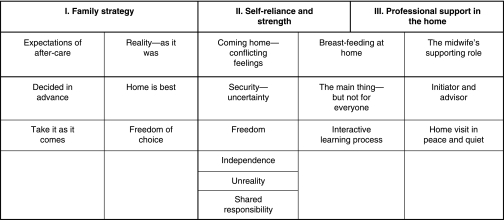
AIM: To gain a deeper understanding of first-time parents' experiences of early discharge from hospital after delivery and home-based postnatal care. MATERIAL AND METHODS: The study was comprised of focus group interviews, interviews with couples and with fathers. Twenty-one parents participated. INCLUSION CRITERIA: healthy women who have given birth to their first child after a normal pregnancy and delivery, the women's partners, healthy and full term babies, Swedish-speaking, discharge from the delivery ward within 24 hours, resident in the Uppsala community, the parents cohabited at the time of the delivery. The material was analysed by qualitative content analysis. RESULTS: Three themes emerged: The family's strategy, which describes the family's expectations of postnatal care and their experiences of the real situation. Some are flexible concerning going home early, and others have decided in advance. Self-reliance and strength, which explores the parents' feelings of security and uncertainty, freedom and independence, and shared responsibility. Breast-feeding is described as the 'main thing', an interactive learning process. Professional support in the home summarizes the parents' experience of the midwife's support at home. While conflicting feelings may be revealed during the first days, the midwife confirms their new roles as parents. The midwife is seen as a support and adviser to the parents. CONCLUSION: This study shows that parents welcome home-based postnatal care with professional support from midwives. We conclude that this care suits healthy families. We think it will be more important in the future to discriminate between healthy families and those in need of hospital care, than to focus on the moment when they leave the hospital, early or late.
Overview
The claims and statistics of this paper haven’t been checked yet.
Free: it reads the open-access text and checks the first 5 claims that cite a source we can check. Create a free account to check every claim.
Integrity signals
Registry
Cites
Statistics
Figures
Verification
Claims the paper makes
The claims and statistics of this paper haven’t been checked yet.
Free: it reads the open-access text and checks the first 5 claims that cite a source we can check. Create a free account to check every claim.
Claims other papers make about this one
Each is checked against this paper’s own text: does it say what the citing paper says it does?
The source backs part of the claim, not all of it — or backs it for a different population, condition or comparison.
In the citing paper
“Unfortunately, only three out of 43 hospitals in Sweden offer postnatal home visits by a midwife [10,40].”
From Fulfilment of expectations on birth and the postpartum period – A Swedish cohort study (2022) · cites this paper as [10]
Experimental — accuracy not yet measuredThe source backs part of the claim, not all of it — or backs it for a different population, condition or comparison.
In the citing paper
“Only three hospitals in Sweden offer home visits after birth; one such initiative has been successful over a period of 20 years [10].”
From Fulfilment of expectations on birth and the postpartum period – A Swedish cohort study (2022) · cites this paper as [10]
Experimental — accuracy not yet measuredThe source backs part of the claim, not all of it — or backs it for a different population, condition or comparison.
In the citing paper
“Previous studies where postnatal home visits were offered show that women are generally more satisfied with home visits, and that home care does not result in any adverse outcome [10,41].”
From Fulfilment of expectations on birth and the postpartum period – A Swedish cohort study (2022) · cites this paper as [10]
Experimental — accuracy not yet measuredThe cited source says what the claim attributes to it.
In the citing paper
“However, Johansson et al. (2010) reported that first-time mothers also appreciated home-based postnatal care”
From Mothers´ experiences in relation to a new Swedish postnatal home-based model of midwifery care–A cross-sectional study (2019) · cites this paper as Johansson et al. (2010)
The cited source says what the claim attributes to it.
In the citing paper
“Johansson et al. (2010) highlight that home-based postnatal care suits healthy families and that it is important to differentiate between healthy families and families in need of hospital care.”
From Women's experiences of home visits by midwives in the early postnatal period (2016) · cites this paper as Johansson et al., 2010
Self-check
Percentages, sums and reported differences re-computed from the paper’s own numbers.
The self-check needs the paper’s full text.
Citations
Cites
Graneheim, U. H., & Lundman, B. (2004) · Nurse Education Today · doi:10.1016/j.nedt.2003.10.001 · Cited by 20,772 · cited 1×
“All interviews were audiotaped and transcribed verbatim, after which the material was analysed for qualitative manifest and latent content (21).”
MethodNursing Research: Principles and Methods
McFarland, G. K., Polit, D. F., & Hungler, B. P. (1987) · The American Journal of Nursing · doi:10.2307/3425916 · Cited by 6,942
(2012) · The Scientific World JOURNAL · doi:10.1100/tswj · Cited by 2,595
Erickson, H., & Orem, D. E. (1986) · The American Journal of Nursing · doi:10.2307/3425287 · Cited by 1,963
Getting the Focus and the Group: Enhancing Analytical Rigor in Focus Group Research
Kidd, P. S., & Parshall, M. B. (2000) · Qualitative Health Research · doi:10.1177/104973200129118453 · Cited by 1,013 · cited 1×
“Some researchers recommend this triangulation method in order to obtain as much information as possible (32,33).”
MethodAnalyzing and Reporting Focus Group Results
Krueger, R. A. (1997) · Medical Entomology and Zoology · Cited by 918
Analyzing & Reporting Focus Group Results
Krueger, R. (1998) · Sage eBooks · doi:10.4135/9781483328157 · Cited by 646
Music therapy for premature infants and their parents: an integrative review
Haslbeck, F. B. (2012) · Nordic Journal of Music Therapy · doi:10.1080/08098131.2011.648653 · Cited by 410
Braveman, P., Egerter, S. A., Pearl, M., Marchi, K. S., & Miller, C. (1995) · PubMed · Cited by 244
Early Discharge of Newborns and Mothers: A Critical Review of the Literature
Braveman, P., Egerter, S., Pearl, M., Marchi, K., & Miller, C. (1995) · Pediatrics · doi:10.1542/peds.96.4.716 · Cited by 197
Research works printed but not linked: 2
- Orem ED Nursing: concepts of practise New York McGraw-Hill 1980
- Morgan D Planning focus groups The focus group kit, no 2 Thousand Oak, USA Sage Publications 1998
Cited by
Shorey, S., Lau, Y., Dennis, C., Chan, Y. S., Tam, W. W. S., & Chan, Y. H. (2017) · Journal of Advanced Nursing · doi:10.1111/jan.13293 · Cited by 110
Danbjørg, D. B., Wagner, L., Kristensen, B. R., & Clemensen, J. (2015) · Midwifery · doi:10.1016/j.midw.2015.02.007 · Cited by 88
“This has been described in the literature as an issue because new parents are reluctant to contact health-care professionals in case they disturb them, even when they have important questions (Johansson et al., 2010; Danbjørg et al., 2013).”
BackgroundResultInfluentialFirst time mothers' experiences of breastfeeding their newborn
Kronborg, H., Harder, I., & Hall, E. O. C. (2014) · Sexual & Reproductive Healthcare · doi:10.1016/j.srhc.2014.08.004 · Cited by 133
“Our findings support those of Burns and colleagues [8] who described breastfeeding as embedded in a social and cultural context.”
BackgroundResultKurth, E., Krähenbühl, K., Eicher, M., Rodmann, S., Fölmli, L., Conzelmann, C., & Zemp, E. (2016) · BMC Health Services Research · doi:10.1186/s12913-016-1300-2 · Cited by 68
“In each focus group, participants emphasized that the professional home visits alleviated their concerns, conveyed parenting skills and enhanced their parental self-confidence, confirming findings from previous research [9, 49, 51].”
ResultWomen's experiences of home visits by midwives in the early postnatal period
Dahlberg, U., Haugan, G., & Aune, I. (2016) · Midwifery · doi:10.1016/j.midw.2016.05.003 · Cited by 62
Maternal self-care in the early postpartum period: An integrative review
Lambermon, F. J., Vandenbussche, F. P. H. A., Dedding, C. W. M., & van Duijnhoven, N. T. L. (2020) · Midwifery · doi:10.1016/j.midw.2020.102799 · Cited by 86
Benahmed, N., San Miguel, L., Devos, C., Fairon, N., & Christiaens, W. (2017) · BMC Pregnancy and Childbirth · doi:10.1186/s12884-017-1465-7 · Cited by 59
“In Sweden, early discharge corresponds to a length of stay of 6 h after birth [3, 37], while in France, a discharge after a length of stay of less than 72 h is considered as early [19].”
BackgroundDanbjørg, D. B., Wagner, L., & Clemensen, J. (2013) · Midwifery · doi:10.1016/j.midw.2013.06.006 · Cited by 68
“These issues are concurrent with international reporting (Kanotra et al., 2007; Johansson et al., 2010).”
BackgroundParental experiences of early postnatal discharge: A meta-synthesis
Nilsson, I., Danbjørg, D. B., Aagaard, H., Strandberg-Larsen, K., Clemensen, J., & Kronborg, H. (2015) · Midwifery · doi:10.1016/j.midw.2015.07.004 · Cited by 58
Parents' experiences of midwifery students providing continuity of care
Aune, I., Dahlberg, M., & Ingebrigtsen, O. (2012) · Midwifery · doi:10.1016/j.midw.2011.06.006 · Cited by 52
Perceptions of primiparas on a postnatal psychoeducation programme: The process evaluation
Shorey, S., Chan, S. W., Chong, Y. S., & He, H. G. (2014) · Midwifery · doi:10.1016/j.midw.2014.08.001 · Cited by 71
Home care after early discharge: Impact on healthy mothers and newborns
Áskelsdóttir, B., Jonge, W. L.-D., Edman, G., & Wiklund, I. E. (2013) · Midwifery · doi:10.1016/j.midw.2012.11.001 · Cited by 54
James, L., Sweet, L. P., & Donnellan-Fernandez, R. E. (2020) · International Breastfeeding Journal · doi:10.1186/s13006-020-00337-1 · Cited by 54
Apoio paterno ao aleitamento materno: uma revisão integrativa
Silva, B. T., Santiago, L. B., & Lamonier, J. A. (2012) · Revista Paulista de Pediatria · doi:10.1590/s0103-05822012000100018 · Cited by 82
“O impacto da intervenção educativa sobre aleitamento para pais (Quadro 3) A saúde feminina engloba também o ciclo gravídicopuerperal e, dentre tantos assuntos, o aleitamento é descrito por primíparas e seus companheiros como tema principal no processo de aprendizagem((42)).”
BackgroundKoçak, V., Ege, E., & Iyısoy, M. S. (2021) · Archives of Psychiatric Nursing · doi:10.1016/j.apnu.2021.06.009 · Cited by 37
Johansson, M., Thies-Lagergren, L., & Wells, M. B. (2019) · Midwifery · doi:10.1016/j.midw.2019.07.010 · Cited by 31
Women's Experiences of Breastfeeding-Related Pain
Jackson, K. T., Mantler, T., & O’Keefe-McCarthy, S. (2019) · MCN The American Journal of Maternal/Child Nursing · doi:10.1097/nmc.0000000000000508 · Cited by 35
Designing, Developing, and Testing an App for Parents Being Discharged Early Postnatally
Danbjørg, D. B., Wagner, L., & Clemensen, J. (2014) · The Journal for Nurse Practitioners · doi:10.1016/j.nurpra.2014.07.023 · Cited by 37
James, L., Sweet, L., & Donnellan-Fernandez, R. (2017) · Women and Birth · doi:10.1016/j.wombi.2016.09.013 · Cited by 29
“The majority of research demonstrated that women found their home a more comfortable environment compared to postnatal wards, as they were more relaxed, together with the father or family, and could start to get into their own routines.(9,22,24,25,27,29,32) Only two studies found the postnatal hospital environment to…”
InfluentialShorey, S., Ng, Y. P. M., Danbjørg, D. B., Dennis, C., & Morelius, E. (2017) · Journal of Advanced Nursing · doi:10.1111/jan.13151 · Cited by 25
“Most of the previous educational interventions were non-experimental in nature and only very few were randomized trials (Lock & Gibb 2003, Bashour et al. 2008, Johansson et al. 2010).”
BackgroundSakala, B., & Chirwa, E. (2019) · Malawi Medical Journal · doi:10.4314/mmj.v31i2.12 · Cited by 25
Dessì, A., Pianese, G., Mureddu, P., Fanos, V., & Bosco, A. (2024) · Nutrients · doi:10.3390/nu16142285 · Cited by 48
“Moreover, learning to breastfeed varies from woman to woman, with some taking longer than others [71,77,78].”
BackgroundInfluentialFamilies with twins - a systematic review
Andrade, L., Martins, M. M., Angelo, M., & Martinho, J. (2014) · Texto & Contexto - Enfermagem · doi:10.1590/0104-07072014002950013 · Cited by 22
Brunstad, A., Aasekjær, K., Aune, I., & Nilsen, A. B. V. (2018) · Scandinavian Journal of Public Health · doi:10.1177/1403494818809856 · Cited by 28
“In order to feel confident at home, the father needed the midwife to be available and present; she was the one who could give explicit guidance about both mother and baby, and was able to demonstrate her knowledge and competencies in order to assure the fathers of the normality of the situation at home [36], and this…”
BackgroundMethodInfluentialDanbjørg, D. B., Wagner, L., Kristensen, B. R., & Clemensen, J. (2015) · International Journal of Telemedicine and Applications · doi:10.1155/2015/851803 · Cited by 32
“They feel that it connects the hospital setting with the home and goes some way towards reducing the gap, which families can experience as a barrier, in the fact that they are reluctant to contact the hospital staff for support after discharge [2, 6, 43].”
BackgroundResultGoodwin, L. D., Taylor, B., Kokab, F., & Kenyon, S. L. (2018) · Midwifery · doi:10.1016/j.midw.2018.02.006 · Cited by 19
Improvements of postnatal care are required by Swedish fathers
Johansson, M., Rubertsson, C., Rådestad, I., & Hildingsson, I. (2013) · International Journal of Health Care Quality Assurance · doi:10.1108/ijhcqa-08-2011-0052 · Cited by 16
Shorey, S., Chan, W. S., Chong, Y. S., & He, H. G. (2014) · Journal of Advanced Nursing · doi:10.1111/jan.12461 · Cited by 16
Barclay, K., Baranowska-Rataj, A., Kolk, M., & Ivarsson, A. (2020) · Population Studies · doi:10.1080/00324728.2020.1714701 · Cited by 15
“In Sweden doctors typically prefer a child to be at home with the parents if at all possible, rather than being hospitalized (Socialstyrelsen 1993; Braveman et al. 1995; Johansson et al. 2010).”
BackgroundAune, I., Voldhagen, H., Welve, I., & Dahlberg, U. E. (2021) · Sexual & Reproductive Healthcare · doi:10.1016/j.srhc.2021.100672 · Cited by 19
Høgmo, B. K., Bondas, T. E., & Alstveit, M. (2022) · Scandinavian Journal of Caring Sciences · doi:10.1111/scs.13117 · Cited by 16
Llorente-Pulido, S., Custodio, E., López‐Giménez, M. R., & Otero‐García, L. (2021) · International Journal of Environmental Research and Public Health · doi:10.3390/ijerph19010128 · Cited by 11
Shaban, I., Al-Awamreh, K., Mohammad, K., & Gharaibeh, H. (2018) · Home Health Care Services Quarterly · doi:10.1080/01621424.2018.1454865 · Cited by 15
Knudsen, R. K., Kruse, A. R., & Lou, S. (2020) · Midwifery · doi:10.1016/j.midw.2020.102706 · Cited by 17
Health-promoting influences among Norwegian women following early postnatal home visit by a midwife
Aune, I., Dahlberg, U., & Haugan, G. (2018) · Nordic Journal of Nursing Research · doi:10.1177/2057158517733244 · Cited by 9
“Johansson et al.16 highlight that home-based postnatal care suits healthy families and that it is important to differentiate between healthy families and families in need of hospital care.”
BackgroundInfluentialSchwind, B., Zemp, E., Jafflin, K. G., Späth, A., Barth, M., Maigetter, K., Merten, S., & Kurth, E. (2023) · BMC Health Services Research · doi:10.1186/s12913-023-09352-4 · Cited by 17
“Johansson K, Aarts C, Darj E. First-time parents’ experiences of home-based postnatal care in Sweden.”
BackgroundResultInfluentialEarly discharge of first-time parents and their newborn: A scoping review
Lindblad, V., Gaardsted, P. S., & Melgaard, D. (2021) · European Journal of Midwifery · doi:10.18332/ejm/140792 · Cited by 13
Fulfilment of expectations on birth and the postpartum period – A Swedish cohort study
Larsson, B., Elfving, M., Vesterlund, E., Karlström, A., & Hildingsson, I. (2022) · Sexual & Reproductive Healthcare · doi:10.1016/j.srhc.2022.100748 · Cited by 7
Blöchlinger, P., Kurth, E., Kammerer, M. H., & Frei, I. A. (2014) · Pflege · doi:10.1024/1012-5302/a000348 · Cited by 13
The Risk of Readmission after Early Postpartum Discharge during the COVID-19 Pandemic
Gulersen, M., Husk, G. A., Lenchner, E., Blitz, M. J., Rafael, T. J., Rochelson, B. L., Chakravarthy, S., Grunebaum, A. N., Chervenak, F. A., Fruhman, G., et al. (2021) · American Journal of Perinatology · doi:10.1055/s-0041-1740061 · Cited by 7
Levorstad, T., Saue, M.-S., Nilsen, A. B. V., & Vik, E. S. (2022) · European Journal of Midwifery · doi:10.18332/ejm/147746 · Cited by 9
Aune, I., Dahlberg, U., Backe, B., & Haugan, G. (2013) · Nordic Journal of Nursing Research · doi:10.1177/010740831303300304 · Cited by 5
“Home-based postnatal care is suitable for healthy families and there should be an attempt to draw a clearer distinction between such healthy families and those in need of hospital care, rather than limiting the focus to the amount of time spent before leaving the hospital (41).”
Background“I’m used to doing it by myself”: exploring self-reliance in pregnancy
McNamara, B. C., Cutler, A. S., Lundsberg, L. S., Kennedy, H. P., & Gariepy, A. M. (2018) · BMC Pregnancy and Childbirth · doi:10.1186/s12884-018-2022-8 · Cited by 9
Johansson, M. (2012) · Cited by 13
Imperial-Perez, F., Heilemann, M. V., Doering, L. V., Eastwood, J.-A., & Pike, N. A. (2021) · Cardiology in the Young · doi:10.1017/s1047951121002407 · Cited by 6
Breastfeeding metaphors: A qualitative study of first time mothers
Uçtu, A. K., & Uludağ, E. (2022) · Journal of Neonatal Nursing · doi:10.1016/j.jnn.2022.01.008 · Cited by 6
Skarsgaard, B. K., Henriksen, T. H., Dahlberg, U. E., Løvvik, T. S., & Aune, I. (2024) · Sexual & Reproductive Healthcare · doi:10.1016/j.srhc.2024.100967 · Cited by 8
Wells, M. B. (2015) · Uppsala University Publications (Uppsala University) · Cited by 7
Parents' Postnatal Sense of Security: A Concept Analysis
Zeng, T., Jiang, L., Huang, D., Wu, M., & Tu, A. (2024) · Nursing Open · doi:10.1002/nop2.70102 · Cited by 3
“Medi-Mom”: maternal mortality and extending postpartum Medicaid coverage
Shah, S. I., Patel, M. S., Raphael, J. L., Keller, D., Chamberlain, L. J., Devaskar, S. U., Cheng, T. L., Javier, J. R., & Lee, L. K. (2023) · Pediatric Research · doi:10.1038/s41390-023-02719-7 · Cited by 4
“Only 40% of USwomen have at least 1 post-partum healthcare visit, compared to 98% in industrialized nations with national health coverage, where visits can be daily within a week after delivery and include 3- and 6-month follow-up visits.(13) In the US, the postpartum period is a time of high volatility in health cove…”
Lutfi, S. A., Al-Rifai, H., & Alansari, K. (2013) · Journal of Clinical Neonatology · doi:10.4103/2249-4847.109238 · Cited by 4
“[14,15] Over the past three decades, the postnatal length of hospital stay has been gradually reduced to 2 days or less.[16] With declining length of postnatal hospital stay concerns with increasing re-admission rates, increased severity of jaundice and risk of missing heart defects emerged.”
BackgroundInfluentialAune, I., & Lilleengen, A. M. (2013) · British Journal of Midwifery · doi:10.12968/bjom.2013.21.7.510 · Cited by 5
Healthy Parenting Skills Program toward First-Time Father’s Skills on Caring for Newborn Baby
Khasanah, U., & Suratni, S. (2013) · Nurse Media Journal of Nursing · doi:10.14710/nmjn.v3i2.6000 · Cited by 2
“…of Caesareandelivered infants, a rise in the survival rate of low-birth-weight preterm infants, and the diminished role of the extended family as a major support mechanism, the economic considerations (Brown, et al., 2004; Cooke & Barclay, 1999; Dachman, et al., 1986; Johansson et al., 2010).”
BackgroundInfluentialKnudsen, R. K., Lou, S., & Aagaard, H. (2019) · Nordisk Sygeplejeforskning · doi:10.18261/issn.1892-2686-2019-03-04 · Cited by 1
Occupational Therapy For Pregnat Women With Spinal Cord Injury
Fizzotti, G. (2023) · British journal of healthcare and medical research · doi:10.14738/bjhmr.105.15499 · Cited by 1
Hjemmebesøk av jordmor i tidlig barseltid
Aaserud, T. G., Tveiten, S., & Gjerlaug, A. K. (2016) · Sykepleien Forskning · doi:10.4220/sykepleienf.2016.59215 · Cited by 3
Kawajiri, M., Saito, F., Takeishi, Y., Mori, H., Chiba, K., Odaira, T., Saito, M., & Yoshida, M. (2025) · Journal of Affective Disorders · doi:10.1016/j.jad.2025.119459 · Cited by 5
As percepções de pais pela primeira vez na transição para a paternidade
Palmeira, J. D. S. (2012) · Digital Library of Theses and Dissertations (Universidade de São Paulo) · doi:10.11606/d.7.2012.tde-27072012-203118 · Cited by 2
Internal and External Variables Associated with Late Preterm Infant Mothers' Readiness for Discharge
Sparks, M. C. (2019) · UA Campus Repository (The University of Arizona) · Cited by 2
BB vård i hemmet efter hemgång direkt från förlossningsenhet
Pettersson, U., Svanberg, A. S., & Rubertsson, C. (2013) · Uppsala University Publications (Uppsala University)
Ngunyulu, R. N. (2012) · UpSpace Institutional Repository (University of Pretoria)
Kvinnors upplevelse av amningsinformation under graviditeten
Silva, A. D. (2015) · Lund University Publications Student Papers (Lund University)
Rapinyana, O., & Magowe, M. K. M. (2016) · African Journal of Midwifery and Women s Health · doi:10.12968/ajmw.2016.10.3.127
Silva, B. T., Santiago, L. B., & Lamonier, J. A. (2012)
Examining Japanese women's preferences for a new style of postnatal care facility and its attributes
Shen, J., Nakashima, T., Karasawa, I., Furui, T., Morishige, K., & Saijo, T. (2018) · The International Journal of Health Planning and Management · doi:10.1002/hpm.2544
Barclay, K., Baranowska-Rataj, A., Kolk, M., & Ivarsson, A. (2018) · doi:10.4054/mpidr-wp-2018-004
Zuluaga, J. S. P., Palacios, D. A. B., Vargas, Y. A. C., Socha, N., Gómez, J. G. B., & Pena, A. (2021) · Colombian Journal of Anesthesiology · doi:10.5554/22562087.e1005
“The postpartum surveillance time used in this study was below that threshold, and below the time period used in other countries (17-19) (Table 3).”
MethodTowards restorative spaces for postnatal recovery in urban tertiary hospitals
Lawal, L. (2020) · Open Access Victoria University of Wellington | Te Herenga Waka (Figshare) · doi:10.26686/wgtn.17147624.v1 · Cited by 1
Pancieri, L. (2019) · Digital Library of Theses and Dissertations (Universidade de São Paulo) · doi:10.11606/t.22.2019.tde-24032022-104345 · Cited by 4
Paraskevopoulou-Kollia, E.-A., & Michalakopoulos, C.-A. (2024) · European Journal of Alternative Education Studies · doi:10.46827/ejae.v9i1.5315
“With the first child, all possible scenarios involve uncharted territory, the fear of the unknown (Johansson, Aarts, and Darj 2010; Leavitt et al. 2017), the belief that you will not be able to cope and that you have run out of superpowers.”
BackgroundSchwind, B., Zemp, E., Jafflin, K. G., Späth, A., Barth, M., Maigetter, K., Merten, S., & Kurth, E. (2023) · Figshare · doi:10.6084/m9.figshare.22662483
Åsman, E., Rubertsson, C., Mangrio, E., & Häggsgård, C. (2026) · European Journal of Midwifery · doi:10.18332/ejm/219215
“Several studies have shown that HBPMC is a model of care that is appreciated by women and their partners 16-19 .”
Focus on postpartum care transitions: a pathway to improve perinatal health
Stekelenburg, B. V., Brandt, K., Whitaker, R., & Gee, R. (2026) · Health Affairs Scholar · doi:10.1093/haschl/qxag111
Metadata
- Authors
- Johansson, K., Aarts, C., & Darj, E.
- Affiliations
- Uppsala University (SE)
- Corresponding author
- Johansson, Katarina
- Venue
- Upsala Journal of Medical Sciences
- Publisher
- Uppsala Medical Society
- Published
- 2010-01-14
- Volume
- 115
- Issue
- 2
- Pages
- 131-137
- ISSN
- 0300-9734 (ISSN-L)
- 2000-1967
- PMC
- PMC2853791
- OpenAlex
- W2119599942
- Cited by
- 76
- References
- 33
- Citations by year
- 2026: 2 · 2025: 1 · 2024: 4 · 2023: 4 · 2022: 4 · 2021: 7 · 2020: 6 · 2019: 6 · 2018: 6 · 2017: 3 · 2016: 6 · 2015: 5 · 2014: 8 · 2013: 8 · 2012: 5
- FWCI
- 6.11
- Type
- journal article
- Language
- en
- Open access
- diamond
- doi.org
- Licence
- cc-by
- Locations
- Upsala Journal of Medical Sciences (publishedVersion, cc-by)
- PubMed Central (publishedVersion, cc-by)
- PubMed (publishedVersion)
- Topics
- Health Sciences › Medicine › Obstetrics and Gynecology › Maternal and Perinatal Health Interventions
- Health Sciences › Medicine › Pediatrics, Perinatology and Child Health › Infant Development and Preterm Care
- Health Sciences › Medicine › Pediatrics, Perinatology and Child Health › Maternal and Neonatal Healthcare
- Keywords
- early discharge, new parents, parental experiences, midwife support, breastfeeding, shared parental responsibility, healthy family, postpartum care
- MeSH terms
- Female, Humans, Parents, Postnatal Care, Pregnancy, Sweden, Focus Groups, Self Efficacy
About these checks
Registry, retraction, Cites and statistics results are computed, not judged, with one exception: a printed reference that no index lists is read once by a model before it counts as a citation error. Claims are extracted by a model and kept only when their quote appears verbatim in the text; each cited source is then checked, with a model’s help, for whether it says what the claim relies on. Those verdicts can be wrong — read the claim’s quote and the cited source before relying on one.
Statistics and arithmetic are recomputed, not judged.
Confidence bands are shown only for fields calibrated on our annotated test set. None is calibrated yet, so no band is shown.
What counts as a claim ›How we measure confidence ›How we check this ›
Are you an author, or do you see a problem with this page? Request a review
Data sources
Bibliographic data: Semantic Scholar, OpenAlex, Crossref.
Contains information from the Semantic Scholar Academic Graph Datasets, made available under the ODC Attribution License (ODC-BY 1.0).
Semantic Scholar’s data is described in: Kinney, R., et al. (2023). The Semantic Scholar Open Data Platform. arXiv:2301.10140.
