

Depression profiles among adolescents and their parents: A group-based multi-trajectory modeling
Open accessThe DOI matches its Crossref record; 59 of the 59 references it cites were found in a registry or an index.
Abstract
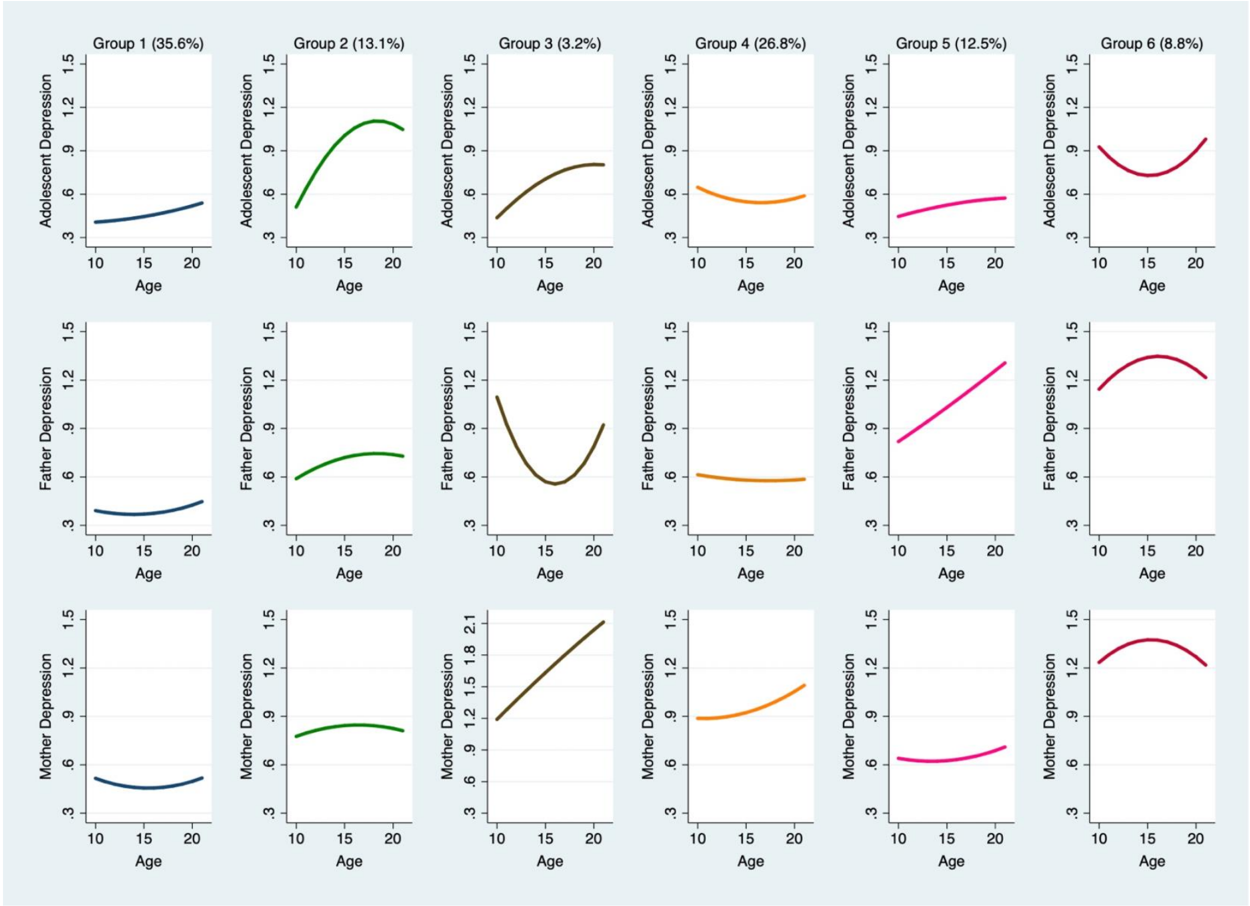
Background: Early onset of depression predicts unfavorable psychosocial and health outcomes, and depression often co-occurs for children and their parents, yet family profiles of depression trajectories are not fully examined. Methods: This population-based longitudinal prospective cohort study included 2,111 families drawn from the Chinese Family Panel Study (CFPS) with biannual assessments from 2010 to 2018. Group-based multi-trajectory modeling was used to identify depression trajectories of children, fathers, and mothers. Results: Six distinct profiles of depression symptoms were identified: 1) low stable among all family members (35.6%); (2) low increasing in child and moderate stable in parents (13.1%); (3) low increasing in child, father resurging, and mother high increasing (3.2%); (4) low/moderate stable in child and father, and moderate increasing in mother (26.8%); (5) low/moderate stable in child and mother, and moderate increasing in father (12.5%); (6) moderate/high symptoms in all family members (8.8%). Conclusions: Based upon multi-trajectory findings of family depression profiles, when adolescents are at risk for depression, there is likely at least one parent concurrently at risk for depression, but not vice versa. Families with social disadvantages and children of delayed developmental milestones are at elevated risk for depression. Even when children are at low risk for depression, depression in parents can spill over to impact other psychosocial and health outcomes. These findings suggest examining depression and its associating psychosocial factors could help identify trajectories of varying onset and continuity, which can inform early prevention and intervention from a family system perspective.
Overview
The claims and statistics of this paper haven’t been checked yet.
Free: it reads the open-access text and checks the first 5 claims that cite a source we can check. Create a free account to check every claim.
Integrity signals
Registry
Cites
Statistics
Figures
Verification
Claims the paper makes
The claims and statistics of this paper haven’t been checked yet.
Free: it reads the open-access text and checks the first 5 claims that cite a source we can check. Create a free account to check every claim.
Claims other papers make about this one
Each is checked against this paper’s own text: does it say what the citing paper says it does?
The check wasn’t confident either way, so it gives no verdict — never disputed.
In the citing paper
“Adolescents with this type of culture opt to get inspired by family, but students who live in hostels or share the room with other students lose this family inspiration. This transformation can be a big risk to encounter depression (72).”
From Family and Academic Stress and Their Impact on Students' Depression Level and Academic Performance (2022) · cites this paper as [72]
Experimental — accuracy not yet measured
Self-check
Percentages, sums and reported differences re-computed from the paper’s own numbers.
The self-check needs the paper’s full text.
Citations
Cites
Controlling the False Discovery Rate: A Practical and Powerful Approach to Multiple Testing
Benjamini, Y., & Hochberg, Y. (1995) · Journal of the Royal Statistical Society Series B: Statistical Methodology · doi:10.1111/j.2517-6161.1995.tb02031.x · Cited by 109,482
The CES-D Scale: A Self-Report Depression Scale for Research in the General Population
Radloff, L. S. (1977) · Applied Psychological Measurement · doi:10.1177/014662167700100306 · Cited by 53,267
Missing data analysis: making it work in the real world
Graham, J. W. (2009) · Annual Review of Psychology · doi:10.1146/annurev.psych.58.110405.085530 · Cited by 6,163
Induced root-secreted phenolic compounds as a belowground plant defense
Lanoue, A., Burlat, V., Schurr, U., & Röse, U. S. R. (2010) · Plant Signaling & Behavior · doi:10.4161/psb.5.8.12337 · Cited by 5,461
Malhi, G. S., & Mann, J. J. (2018) · The Lancet · doi:10.1016/s0140-6736(18)31948-2 · Cited by 4,099
The clinical application of the biopsychosocial model
(1980) · American Journal of Psychiatry · doi:10.1176/ajp.137.5.535 · Cited by 3,294
A SAS Procedure Based on Mixture Models for Estimating Developmental Trajectories
JONES, B. L., NAGIN, D. S., & ROEDER, K. (2001) · Sociological Methods & Research · doi:10.1177/0049124101029003005 · Cited by 2,370
Mood disorders in children and adolescents: an epidemiologic perspective
Kessler, R. C., Avenevoli, S., & Ries Merikangas, K. (2001) · Biological Psychiatry · doi:10.1016/s0006-3223(01)01129-5 · Cited by 1,181
Connell, A. M., & Goodman, S. H. (2002) · Psychological Bulletin · doi:10.1037/0033-2909.128.5.746 · Cited by 943
Group-based multi-trajectory modeling
Nagin, D. S., Jones, B. L., Passos, V. L., & Tremblay, R. E. (2018) · Statistical Methods in Medical Research · doi:10.1177/0962280216673085 · Cited by 932
Goodman, S. H. (2007) · Annual Review of Clinical Psychology · doi:10.1146/annurev.clinpsy.3.022806.091401 · Cited by 609
Adult mental health outcomes of adolescent depression: A systematic review
Johnson, D., Dupuis, G., Piche, J., Clayborne, Z., & Colman, I. (2018) · Depression and Anxiety · doi:10.1002/da.22777 · Cited by 563
The Clinical Application of the Biopsychosocial Model
Engel, G. L. (1981) · Journal of Medicine and Philosophy · doi:10.1093/jmp/6.2.101 · Cited by 531
Kane, P., & Garber, J. (2004) · Clinical Psychology Review · doi:10.1016/j.cpr.2004.03.004 · Cited by 498
Documentation of Affective Functioning Measures in the Health and Retirement Study
Steffick, D. (2000) · doi:10.7826/isr-um.06.585031.001.05.0005.2000 · Cited by 476
Kendler, K. S., Davis, C. G., & Kessler, R. C. (1997) · British Journal of Psychiatry · doi:10.1192/bjp.170.6.541 · Cited by 412
Depression and school performance in middle adolescent boys and girls
Fröjd, S. A., Nissinen, E. S., Pelkonen, M. U. I., Marttunen, M. J., Koivisto, A., & Kaltiala‐Heino, R. (2008) · Journal of Adolescence · doi:10.1016/j.adolescence.2007.08.006 · Cited by 411
Change in Child Psychopathology With Improvement in Parental Depression: A Systematic Review
GUNLICKS, M. L., & WEISSMAN, M. M. (2008) · Journal of the American Academy of Child & Adolescent Psychiatry · doi:10.1097/chi.0b013e3181640805 · Cited by 352
Tests for linkage of multiple cohorts in an accelerated longitudinal design.
Miyazaki, Y., & Raudenbush, S. W. (2000) · Psychological Methods · doi:10.1037//1082-989x.5.1.44 · Cited by 319
Intergenerational Transmission of Depression
Goodman, S. H. (2020) · Annual Review of Clinical Psychology · doi:10.1146/annurev-clinpsy-071519-113915 · Cited by 268
Beardslee, W. R., Wright, E. J., Gladstone, T. R. G., & Forbes, P. (2007) · Journal of Family Psychology · doi:10.1037/0893-3200.21.4.703 · Cited by 258
The effects of paternal depression on child and adolescent outcomes: A systematic review
Sweeney, S., & MacBeth, A. (2016) · Journal of Affective Disorders · doi:10.1016/j.jad.2016.05.073 · Cited by 257
The Causal Effects of Rural-to-Urban Migration on Children’s Well-being in China
Xu, H., & Xie, Y. (2015) · European Sociological Review · doi:10.1093/esr/jcv009 · Cited by 245
Asendorpf, J. B., van de Schoot, R., Denissen, J. J. A., & Hutteman, R. (2014) · International Journal of Behavioral Development · doi:10.1177/0165025414542713 · Cited by 237
A Systematic Review of Depressed Mood and Anxiety by SES in Youth Aged 10–15 Years
Lemstra, M., Neudorf, C., D’Arcy, C., Kunst, A., Warren, L. M., & Bennett, N. R. (2008) · Canadian Journal of Public Health · doi:10.1007/bf03405459 · Cited by 234
Qin, X., Wang, S., & Hsieh, C.-R. (2018) · China Economic Review · doi:10.1016/j.chieco.2016.04.001 · Cited by 226
Youth Depression in the Family Context: Familial Risk Factors and Models of Treatment
Sander, J. B., & McCarty, C. A. (2005) · Clinical Child and Family Psychology Review · doi:10.1007/s10567-005-6666-3 · Cited by 222
Shore, L., Toumbourou, J. W., Lewis, A. J., & Kremer, P. (2018) · Child and Adolescent Mental Health · doi:10.1111/camh.12220 · Cited by 219
Goodman, S. H., Simon, H. F. M., Shamblaw, A. L., & Kim, C. Y. (2020) · Clinical Child and Family Psychology Review · doi:10.1007/s10567-020-00322-4 · Cited by 215
Briggs, R., Carey, D., O’Halloran, A. M., Kenny, R. A., & Kennelly, S. P. (2018) · European Geriatric Medicine · doi:10.1007/s41999-017-0016-0 · Cited by 211
Maternal Depression, Family Functioning and Children's Longitudinal Development
Letourneau, N. L., Tramonte, L., & Willms, J. D. (2013) · Journal of Pediatric Nursing · doi:10.1016/j.pedn.2012.07.014 · Cited by 207
A Meta‐Analysis of Parent–Adolescent Conflict: Disagreement, Hostility, and Youth Maladjustment
Weymouth, B. B., Buehler, C., Zhou, N., & Henson, R. A. (2016) · Journal of Family Theory & Review · doi:10.1111/jftr.12126 · Cited by 192
Marmorstein, N. R., & Iacono, W. G. (2004) · Journal of Child Psychology and Psychiatry · doi:10.1111/j.1469-7610.2004.00228.x · Cited by 187
A Longitudinal Typology of Symptoms of Depression and Anxiety Over the Life Course
Colman, I., Ploubidis, G. B., Wadsworth, M. E. J., Jones, P. B., & Croudace, T. J. (2007) · Biological Psychiatry · doi:10.1016/j.biopsych.2007.05.012 · Cited by 167
KLEIN, D. N., LEWINSOHN, P. M., ROHDE, P., SEELEY, J. R., & OLINO, T. M. (2005) · Psychological Medicine · doi:10.1017/s0033291704003587 · Cited by 159
Depressive symptom trajectories in late adolescence and early adulthood: A systematic review
Schubert, K. O., Clark, S. R., Van, L. K., Collinson, J. L., & Baune, B. T. (2017) · Australian & New Zealand Journal of Psychiatry · doi:10.1177/0004867417700274 · Cited by 156
The One-Child Policy and Its Impact on Chinese Families
Settles, B. H., Sheng, X., Zang, Y., & Zhao, J. M. (2012) · Springer eBooks · doi:10.1007/978-1-4614-0266-4_38 · Cited by 139
Kang, Y., Guo, W., Xu, H. Y., Chen, Y.-H., Li, X., Tan, Z.-P., Li, N., Gesang, Z.-R., Wang, Y., Liu, C., et al. (2015) · Comprehensive Psychiatry · doi:10.1016/j.comppsych.2015.08.011 · Cited by 134
Measurement equivalence of the CES-D 8 in the general population in Belgium: a gender perspective
Van de Velde, S., Levecque, K., & Bracke, P. (2009) · Archives of Public Health · doi:10.1186/0778-7367-67-1-15 · Cited by 132
Structure and validity of Family Harmony Scale: An instrument for measuring harmony.
Kavikondala, S., Stewart, S. M., Ni, M. Y., Chan, B. H. Y., Lee, P. H., Li, K., McDowell, I., Johnston, J. M., Chan, S. S. C., Lam, T., et al. (2015) · Psychological Assessment · doi:10.1037/pas0000131 · Cited by 129
Ellis, R., Seal, M. L., Simmons, J. G., Whittle, S., Schwartz, O., Byrne, M. L., & Allen, N. B. (2016) · Child Psychiatry & Human Development · doi:10.1007/s10578-016-0682-z · Cited by 123
Gotlib, I. H., Goodman, S. H., & Humphreys, K. L. (2020) · Current Directions in Psychological Science · doi:10.1177/0963721420901590 · Cited by 120
Myrtveit, S. M., Sivertsen, B., Skogen, J. C., Frostholm, L., Stormark, K. M., & Hysing, M. (2014) · Journal of Adolescent Health · doi:10.1016/j.jadohealth.2014.02.016 · Cited by 114
Development and challenges of mental health in China
Que, J., Lu, L., & Shi, L. (2019) · General Psychiatry · doi:10.1136/gpsych-2019-100053 · Cited by 111
Prematurity at birth and adolescent depressive disorder
Patton, G. C., Coffey, C., Carlin, J. B., Olsson, C. A., & Morley, R. (2004) · British Journal of Psychiatry · doi:10.1192/bjp.184.5.446 · Cited by 97
Maternal Psychological Distress: Adult Sons' and Daughters' Mental Health and Educational Attainment
Ensminger, M. E., Hanson, S., Riley, A. W., & Juon, H. (2003) · Journal of the American Academy of Child & Adolescent Psychiatry · doi:10.1097/01.chi.0000070261.24125.f8 · Cited by 86
Xu, Z., Huang, F., Kösters, M., & Rüsch, N. (2017) · Psychiatry Research · doi:10.1016/j.psychres.2017.05.002 · Cited by 86
Gutierrez-Galve, L., Stein, A., Hanington, L., Heron, J., Lewis, G., O’Farrelly, C., & Ramchandani, P. G. (2019) · JAMA Psychiatry · doi:10.1001/jamapsychiatry.2018.3667 · Cited by 85
Fernandez Castelao, C., & Kröner-Herwig, B. (2013) · Journal of Youth and Adolescence · doi:10.1007/s10964-012-9858-4 · Cited by 79
Kouros, C. D., & Garber, J. (2010) · Journal of Abnormal Child Psychology · doi:10.1007/s10802-010-9433-y · Cited by 77
Timmons, A. C., & Preacher, K. J. (2015) · Multivariate Behavioral Research · doi:10.1080/00273171.2014.961056 · Cited by 74
China Family Panel Studies (CFPS)
Institute of Social Science Survey, P. U. (2015) · Peking University Library · doi:10.18170/dvn/45lcso · Cited by 65
The Influence of Paternal and Maternal Major Depressive Disorder on Offspring Psychiatric Disorders
Jacobs, R. H., Talati, A., WICKRAMARATNE, P. J., & Warner, V. (2014) · Journal of Child and Family Studies · doi:10.1007/s10826-014-0037-y · Cited by 59
Reeb, B. T., Conger, K. J., & Wu, E. Y. (2010) · Fathering: A Journal of Theory, Research, and Practice about Men as Fathers · doi:10.3149/fth.0801.131 · Cited by 53
Wilkinson, P. O., Harris, C., Kelvin, R. G., Dubicka, B., & Goodyer, I. M. (2012) · European Child & Adolescent Psychiatry · doi:10.1007/s00787-012-0310-9 · Cited by 52
Depression in China: Integrating Developmental Psychopathology and Cultural-Clinical Psychology
Ryder, A. G., Sun, J., Zhu, X., Yao, S., & Chentsova-Dutton, Y. E. (2012) · Journal of Clinical Child & Adolescent Psychology · doi:10.1080/15374416.2012.710163 · Cited by 48
Parental Depressive Symptoms as a Predictor of Outcome in the Treatment of Child Depression
Eckshtain, D., Marchette, L. K., Schleider, J., & Weisz, J. R. (2018) · Journal of Abnormal Child Psychology · doi:10.1007/s10802-017-0323-4 · Cited by 44
Pelham, W. E., West, S. G., Lemery‐Chalfant, K., Goodman, S. H., Wilson, M. N., Dishion, T. J., & Shaw, D. S. (2021) · Journal of Abnormal Psychology · doi:10.1037/abn0000640 · Cited by 36
Li, Z., Qin, W., & Patel, V. (2021) · PLoS Medicine · doi:10.1371/journal.pmed.1003464 · Cited by 27
Cited by
Family and Academic Stress and Their Impact on Students' Depression Level and Academic Performance
Deng, Y., Cherian, J., Khan, N. U. N., Kumari, K., Sial, M. S., Comite, U., Gavurova, B., & Popp, J. (2022) · Frontiers in Psychiatry · doi:10.3389/fpsyt.2022.869337 · Cited by 371
“This transformation can be a big risk to encounter depression (72).”
Background
Metadata
- Authors
- Zhou, X., & Sun, X.
- Affiliations
- Purdue University West Lafayette (US)
- Shanghai Jiao Tong University (CN)
- Corresponding author
- Zhou, Xiang
- Publisher
- Center for Open Science
- Published
- 2020-10-20
- OpenAlex
- W4238065592
- Cited by
- 1
- References
- 59
- Citations by year
- 2022: 1
- Type
- posted content
- Language
- en
- Open access
- green
- doi.org
- Locations
- OSF Preprints (OSF Preprints) (submittedVersion, cc-by)
- OSF Preprints (OSF Preprints) (submittedVersion)
- Topics
- Social Sciences › Psychology › Clinical Psychology › Child and Adolescent Psychosocial and Emotional Development
- Health Sciences › Medicine › Psychiatry and Mental health › Mental Health Treatment and Access
- Health Sciences › Medicine › Public Health, Environmental and Occupational Health › Maternal Mental Health During Pregnancy and Postpartum
- Keywords
- adolescent depression, parental depression, depression trajectories, early-onset depression, intergenerational transmission of depression, social deprivation, developmental milestones, China Family Panel Studies
About these checks
Registry, retraction, Cites and statistics results are computed, not judged, with one exception: a printed reference that no index lists is read once by a model before it counts as a citation error. Claims are extracted by a model and kept only when their quote appears verbatim in the text; each cited source is then checked, with a model’s help, for whether it says what the claim relies on. Those verdicts can be wrong — read the claim’s quote and the cited source before relying on one.
Statistics and arithmetic are recomputed, not judged.
Confidence bands are shown only for fields calibrated on our annotated test set. None is calibrated yet, so no band is shown.
What counts as a claim ›How we measure confidence ›How we check this ›
Are you an author, or do you see a problem with this page? Request a review
Data sources
Bibliographic data: Semantic Scholar, OpenAlex, Crossref.
Contains information from the Semantic Scholar Academic Graph Datasets, made available under the ODC Attribution License (ODC-BY 1.0).
Semantic Scholar’s data is described in: Kinney, R., et al. (2023). The Semantic Scholar Open Data Platform. arXiv:2301.10140.
