

Do discontinuation symptoms predict depression relapse after antidepressant cessation?
Open accessThe DOI matches its Crossref record; 46 of the 48 references it cites were found in a registry or an index.
Abstract
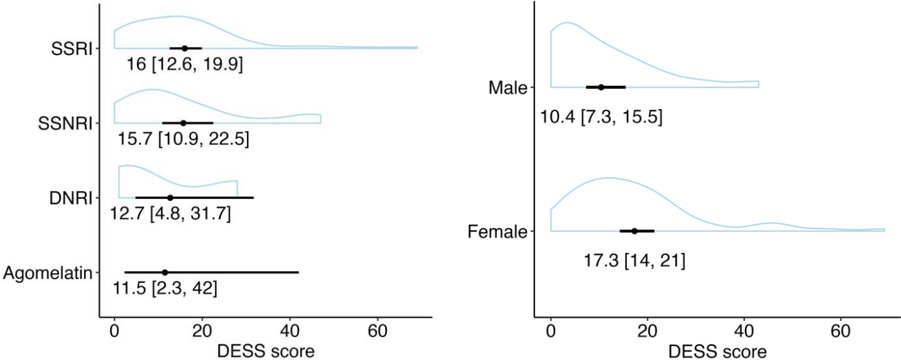
Background: Discontinuing antidepressants after recovering from a depressive episode is associated with a risk for two events: discontinuation symptoms and relapse. Little is known about who can discontinue safely and whether discontinuation symptoms constitute a risk factor for relapse. This study investigated risk factors for experiencing discontinuation symptoms and whether discontinuation symptoms are associated with depression relapse.Methods: 103 patients with a currently remitted major depressive disorder were randomized to continuation or discontinuation of antidepressants. Discontinuation symptoms were assessed with the Discontinuation Emergent Signs and Symptoms (DESS) scale. The discontinuation syndrome (ADS) was defined as experiencing at least 4 DESS symptoms. We investigated the association of clinical factors with the number of discontinuation symptoms in Bayesian linear regressions. After the randomization phase, all patients discontinued their antidepressant and were followed up over 6 months. We investigated the association of discontinuation symptoms and clinical factors with relapse risk in logistic regressions and a cox proportional hazards model. Results: An ADS was experienced by 29% (95% PI [8.3%, 72%]) of patients. Women reported more discontinuation symptoms than men (factor 1.67 (95% interval [1.06, 2.56])). None of the other prespecified predictors were associated with the risk or severity of ADS. Trait anxiety (Slope = 0.42, 95% PI [-0.01, 0.90]), ADS severity (0.58, 95% PI [0.07, 1.16]) and early depressive symptoms (0.63, 95% PI [0.16, 1.17]) were associated with a higher relapse risk. Conclusion: Antidepressant discontinuation symptoms were relatively common and experienced mainly by women. Experiencing discontinuation symptoms may adversely impact relapse risk.
Overview
The claims and statistics of this paper haven’t been checked yet.
Free: it reads the open-access text and checks the first 5 claims that cite a source we can check. Create a free account to check every claim.
Integrity signals
Registry
Cites
Statistics
Figures



Verification
Claims the paper makes
The claims and statistics of this paper haven’t been checked yet.
Free: it reads the open-access text and checks the first 5 claims that cite a source we can check. Create a free account to check every claim.
Claims other papers make about this one
Each is checked against this paper’s own text: does it say what the citing paper says it does?
The cited source doesn’t support the claim as written.
In the citing paper
“At baseline, pa ents who went on to relapse and those who did not did not differ in any clinical or neuro-psychological variable or in terms of medica on (cf. [13, 41]).”
From Amygdala Reactivity, Antidepressant Discontinuation, and Relapse (2024) · cites this paper as [41]
Checked by a reasoning model — may be wrong.
Experimental — accuracy not yet measuredThe source backs part of the claim, not all of it — or backs it for a different population, condition or comparison.
In the citing paper
“While clinical features and even discon nua on symptoms are not predic ve of relapse [13, 48] in this sample, several neurocogni ve measures have shown promise.”
From Amygdala Reactivity, Antidepressant Discontinuation, and Relapse (2024) · cites this paper as [48]
Experimental — accuracy not yet measured
Self-check
Percentages, sums and reported differences re-computed from the paper’s own numbers.
The self-check needs the paper’s full text.
Citations
Cites
Home visits: a strategy to improve newborn survival - Authors' reply
(2008) · Americanae (AECID Library) · doi:10.1016/s0140 · Cited by 22,524
Diagnostic and Statistical Manual of Mental Disorders.
Widiger, T. A. (2000) · Encyclopedia of Psychology, Vol. 3. · doi:10.1037/10518-009 · Cited by 19,744
STAI manual for the State-trait anxiety inventory
Cd, S. (1970) · Medical Entomology and Zoology · Cited by 2,492
The Inventory of Depressive Symptomatology (IDS): Psychometric properties
Rush, A. J., Gullion, C. M., Basco, M. R., Jarrett, R. B., & Trivedi, M. H. (1996) · Psychological Medicine · doi:10.1017/s0033291700035558 · Cited by 2,177
Wilamowska (2010) · doi:10.1001/archpsyc.1988.01800320058007 · Cited by 2,115
Relapse prevention with antidepressant drug treatment in depressive disorders: a systematic review
Geddes, J. R., Carney, S. M., Davies, C., Furukawa, T. A., Kupfer, D. J., Frank, E., & Goodwin, G. M. (2003) · The Lancet · doi:10.1016/s0140-6736(03)12599-8 · Cited by 945
How do antidepressants work? New perspectives for refining future treatment approaches
Harmer, C. J., Duman, R. S., & Cowen, P. J. (2017) · The Lancet Psychiatry · doi:10.1016/s2215-0366(17)30015-9 · Cited by 616
Selective serotonin reuptake inhibitor discontinuation syndrome: a randomized clinical trial
Rosenbaum, J. F., Fava, M., Hoog, S. L., Ascroft, R. C., & Krebs, W. B. (1998) · Biological Psychiatry · doi:10.1016/s0006-3223(98)00126-7 · Cited by 574
Fava, G. A., Gatti, A., Belaise, C., Guidi, J., & Offidani, E. (2015) · Psychotherapy and Psychosomatics · doi:10.1159/000370338 · Cited by 436
Davies, J., & Read, J. (2019) · Addictive Behaviors · doi:10.1016/j.addbeh.2018.08.027 · Cited by 387
Tapering of SSRI treatment to mitigate withdrawal symptoms
Horowitz, M. A., & Taylor, D. (2019) · The Lancet Psychiatry · doi:10.1016/s2215-0366(19)30032-x · Cited by 280
Side effects of antidepressants during long-term use in a naturalistic setting
Bet, P. M., Hugtenburg, J. G., Penninx, B. W. J. H., & Hoogendijk, W. J. G. (2013) · European Neuropsychopharmacology · doi:10.1016/j.euroneuro.2013.05.001 · Cited by 239
Fava, G. A., Benasi, G., Lucente, M., Offidani, E., Cosci, F., & Guidi, J. (2018) · Psychotherapy and Psychosomatics · doi:10.1159/000491524 · Cited by 209
Emotional blunting with antidepressant treatments: A survey among depressed patients
Goodwin, G. M., Price, J., De Bodinat, C., & Laredo, J. (2017) · Journal of Affective Disorders · doi:10.1016/j.jad.2017.05.048 · Cited by 202
Emergence of Adverse Events Following Discontinuation of Treatment With Extended-Release Venlafaxine
Fava, M., Mulroy, R., Alpert, J., Nierenberg, A. A., & Rosenbaum, J. F. (1997) · American Journal of Psychiatry · doi:10.1176/ajp.154.12.1760 · Cited by 198
Studying depression using imaging and machine learning methods
Patel, M. J., Khalaf, A., & Aizenstein, H. J. (2016) · NeuroImage: Clinical · doi:10.1016/j.nicl.2015.11.003 · Cited by 178
(1997) · PubMed · Cited by 149
Antidepressant-related adverse effects impacting treatment compliance: Results of a patient survey
Ashton, A. K., Jamerson, B. D., Weinstein, W., & Wagoner, C. (2005) · Current Therapeutic Research · doi:10.1016/j.curtheres.2005.04.006 · Cited by 144
Discontinuation symptoms in depression and anxiety disorders
Baldwin, D. S., Montgomery, S. A., Nil, R., & Lader, M. (2007) · The International Journal of Neuropsychopharmacology · doi:10.1017/s1461145705006358 · Cited by 140
Antidepressant Withdrawal Syndrome: Recognition, Prevention and Management
Lejoyeux, M., Adès, J., Mourad, I., Solomon, J., & Dilsaver, S. C. (1996) · CNS Drugs · doi:10.2165/00023210-199605040-00006 · Cited by 136
The SSRI discontinuation syndrome
Haddad, P. (1998) · Journal of Psychopharmacology · doi:10.1177/026988119801200311 · Cited by 126
WITHDRAWAL SYMPTOMS FOLLOWING DISCONTINUATION OF IMIPRAMINE THERAPY
KRAMER, J. C., KLEIN, D. F., & FINK, M. (1961) · American Journal of Psychiatry · doi:10.1176/ajp.118.6.549 · Cited by 113
Recognising and managing antidepressant discontinuation symptoms
Haddad, P. M., & Anderson, I. M. (2007) · Advances in Psychiatric Treatment · doi:10.1192/apt.bp.105.001966 · Cited by 109
Renoir, T. (2013) · Frontiers in Pharmacology · doi:10.3389/fphar.2013.00045 · Cited by 107
Predicting relapse after antidepressant withdrawal – a systematic review
Berwian, I. M., Walter, H., Seifritz, E., & Huys, Q. J. M. (2017) · Psychological Medicine · doi:10.1017/s0033291716002580 · Cited by 93
Self-citationSerotonin Reuptake Inhibitor Discontinuation Syndrome: A Hypothetical Definition
Schatzberg, A. F., Haddad, P. M., Kaplan, E. M., Lejoyeux, M., Rosenbaum, J. F., Young, A. H., & Zajecka, J. (1997) · The Journal of Clinical Psychiatry · Cited by 82
Bogetto, F., Bellino, S., Revello, R. B., & Patria, L. (2002) · CNS Drugs · doi:10.2165/00023210-200216040-00006 · Cited by 80
When Discontinuing SSRI Antidepressants Is a Challenge: Management Tips
Jha, M. K., Rush, A. J., & Trivedi, M. H. (2018) · American Journal of Psychiatry · doi:10.1176/appi.ajp.2018.18060692 · Cited by 73
van Geffen, E. C. G., Hugtenburg, J. G., Heerdink, E. R., van Hulten, R. P., & Egberts, A. C. G. (2005) · European Journal of Clinical Pharmacology · doi:10.1007/s00228-005-0921-x · Cited by 72
Neurobiology of antidepressant withdrawal: implications for the longitudinal outcome of depression
Harvey, B. H., McEwen, B. S., & Stein, D. J. (2003) · Biological Psychiatry · doi:10.1016/s0006-3223(03)00528-6 · Cited by 65
Psychological predictors of single and recurrent major depressive episodes
Wilhelm, K. A., Parker, G. B., Dewhurst-Savellis, J., & Asghari, A. (1999) · Journal of Affective Disorders · doi:10.1016/s0165-0327(98)00170-0 · Cited by 65
Salzer, S., Winkelbach, C., Leweke, F., Leibing, E., & Leichsenring, F. (2011) · The Canadian Journal of Psychiatry · doi:10.1177/070674371105600809 · Cited by 62
New insights on the antidepressant discontinuation syndrome
Harvey, B. H., & Slabbert, F. N. (2014) · Human Psychopharmacology: Clinical and Experimental · doi:10.1002/hup.2429 · Cited by 58
Himei, A., & Okamura, T. (2006) · CNS Drugs · doi:10.2165/00023210-200620080-00005 · Cited by 56
Antidepressant Withdrawal and Rebound Phenomena
Henssler, J., Heinz, A., Brandt, L., & Bschor, T. (2019) · Deutsches Ärzteblatt international · doi:10.3238/arztebl.2019.0355 · Cited by 50
Liebowitz, M. R., Asnis, G., Mangano, R., & Tzanis, E. (2009) · The Journal of Clinical Psychiatry · doi:10.4088/jcp.08m04238 · Cited by 49
Antidepressant withdrawal – the tide is finally turning
Hengartner, M. P., Davies, J., & Read, J. (2020) · Epidemiology and Psychiatric Sciences · doi:10.1017/s2045796019000465 · Cited by 48
Michelson, D., Amsterdam, J. D., Apter, J. T., Fava, M., Londborg, P. D., Tamura, R., & Pagh, L. M. (2000) · Psychoneuroendocrinology · doi:10.1016/s0306-4530(99)00046-3 · Cited by 42
Ninomiya, A., Sado, M., Park, S., Fujisawa, D., Kosugi, T., Nakagawa, A., Shirahase, J., & Mimura, M. (2020) · Psychiatry and Clinical Neurosciences · doi:10.1111/pcn.12960 · Cited by 42
Antidepressant Discontinuation Syndrome
Antai-Otong, D. (2003) · Perspectives In Psychiatric Care · doi:10.1111/j.1744-6163.2003.00127.x · Cited by 38
Withdrawal and Discontinuation Phenomena Associated with Tranylcypromine: A Systematic Review
Gahr, M. L., Schönfeldt‐Lecuona, C., Kölle, M. A., & Freudenmann, R. W. (2013) · Pharmacopsychiatry · doi:10.1055/s-0032-1333265 · Cited by 26
Long-Term Treatment Outcomes of Depression With Associated Anxiety
Joliat, M. J., Schmidt, M. E., D, M. F. M., Zhang, S., Michelson, D., Trapp, N. J., & Miner, C. M. (2004) · The Journal of Clinical Psychiatry · doi:10.4088/jcp.v65n0313 · Cited by 16
Understanding antidepressant discontinuation syndrome (ADS) through preclinical experimental models
Zabegalov, K. N., Kolesnikova, T. O., Khatsko, S. L., Volgin, A. D., Yakovlev, O. A., Amstislavskaya, T. G., Alekseeva, P. A., Мешалкина, Д. А., Friend, A. J., Bao, W., et al. (2018) · European Journal of Pharmacology · doi:10.1016/j.ejphar.2018.04.003 · Cited by 15
Berwian, I. M., Wenzel, J. G., Kuehn, L., Schnuerer, I., Seifritz, E., Stephan, K. E., Walter, H., & Huys, Q. J. M. (2022) · Scientific Reports · doi:10.1038/s41598-022-13893-9 · Cited by 13
Self-citationPredictors of successful discontinuation of antipsychotics and antidepressants
Lincoln, T. M., Sommer, D., Quazzola, M., Witzgall, T., & Schlier, B. (2021) · Psychological Medicine · doi:10.1017/s0033291721005146 · Cited by 13
Withdrawal, dependence and adverse events of antidepressants: lessons from patients and data
Tomlinson, A., Boaden, K., & Cipriani, A. (2019) · Evidence-Based Mental Health · doi:10.1136/ebmental-2019-300121 · Cited by 9
Research works printed but not linked: 7
- [2]2. Andrews, P. W., Kornstein, S. G., Halberstadt, L. J., Gardner, C. O., & Neale, M. C. (2011). Blue again: Perturbational effects of antidepressants suggest monoaminergic homeostasis in major depression. Frontiers in Psychology, 2(JUL), 159. https://doi.org/10.3389/FPSYG.2011.00159/BIBTEX · doi:10.3389/fpsyg.2011.00159/bibtex
- [15]15. Glenmullen, J. (2006). The Antidepressant Solution: A Step-by-Step Guide to Safety Overcoming Antidepressant Withdrawal, Dependence, and "Addiction." NW: Free Press.
- [23]23. Harvey, B. H., & Slabbert, F. N. (2014b). New insights on the antidepressant discontinuation syndrome. Human Psychopharmacology, 29(6), 503-516. https://doi.org/10.1002/HUP.2429 · DOI · Paper page
- [28]28. Horowitz, M. A., & Taylor, D. (2022). Distinguishing relapse from antidepressant withdrawal: clinical practice and antidepressant discontinuation studies. BJPsych Advances, 28(5), 297- 311. https://doi.org/10.1192/BJA.2021. · doi:10.1192/bja.2021
- [33]33. Lewis, G., Marston, L., Duffy, L., Freemantle, N., Gilbody, S., Hunter, R., Kendrick, T., Kessler, D., Mangin, D., King, M., Lanham, P., Moore, M., Nazareth, I., Wiles, N., Bacon, F., Bird, M., Brabyn, S., Burns, A., Clarke, C. S., … Lewis, G. (2021). Maintenance or Discontinuation of Antidepressants in Primary Care. New England Journal of Medicine, 385(14), 1257-1267. https://doi.org/10.1056/NEJMOA2106356/SUPPL_FILE/NEJMOA2106356_DATA- SHARING.PDF · doi:10.1056/nejmoa2106356/suppl_file/nejmoa2106356_data-
- [37]37. Michelson, D., Amsterdam, J., Apter, J., Fava, M., Londborg, P., Tamura, R., & Pagh, L. (2000b). Hormonal markers of stress response following interruption of selective serotonin reuptake inhibitor treatment. Psychoneuroendocrinology, 25(2), 169-177. https://doi.org/10.1016/S0306-4530(99)00046-3 · DOI
- [45]45. Sah, A., Schmuckermair, C., Sartori, S. B., Gaburro, S., Kandasamy, M., Irschick, R., Klimaschewski, L., Landgraf, R., Aigner, L., & Singewald, N. (2012). Anxiety-rather than depression-like behavior is associated with adult neurogenesis in a female mouse model of higher trait anxiety-and comorbid depression-like behavior. Translational Psychiatry, 2(10). https://doi.org/10.1038/TP.2012. · doi:10.1038/tp.2012
Cited by
Amygdala Reactivity, Antidepressant Discontinuation, and Relapse
Erdmann, T., Berwian, I. M., Stephan, K. E., Seifritz, E., Walter, H., & Huys, Q. J. M. (2024) · JAMA Psychiatry · doi:10.1001/jamapsychiatry.2024.2136 · Cited by 18
Self-citationErdmann, T., Berwian, I. M., Stephan, K. E., Seifritz, E., Walter, H., & Huys, Q. J. M. (2024) · doi:10.31234/osf.io/zpf9c · Cited by 1
Self-citation
Metadata
- Authors
- Volkmann, C., Abulikemu, S., Berwian, I. M., Huys, Q. J., & Walter, H.
- Affiliations
- Humboldt-Universität zu Berlin (DE)
- Imperial College London (GB)
- Princeton University (US)
- Wellcome Centre for Human Neuroimaging (GB)
- Corresponding author
- Volkmann, Constantin
- Publisher
- Center for Open Science
- Published
- 2023-02-23
- OpenAlex
- W4321788780
- Cited by
- 2
- References
- 48
- Citations by year
- 2024: 2
- Type
- posted content
- Language
- en
- Open access
- green
- doi.org
- Locations
- PsyArXiv (OSF Preprints) (submittedVersion, cc-by)
- PsyArXiv (OSF Preprints) (submittedVersion)
- Funders
- National Science Foundation
- Wellcome Trust
- National Institute for Health and Care Research
- Deutsche Forschungsgemeinschaft
- Schweizerischer Nationalfonds zur Förderung der Wissenschaftlichen Forschung (320030L_153449/1)
- University College London Hospitals NHS Foundation Trust
- Topics
- Health Sciences › Medicine › Pharmacology (medical) › Treatment of Major Depression
- Social Sciences › Psychology › Experimental and Cognitive Psychology › Anxiety, Depression, Psychometrics, Treatment, Cognitive Processes
- Health Sciences › Medicine › Psychiatry and Mental health › Mental Health Treatment and Access
- Keywords
- antidepressant discontinuation syndrome, discontinuation symptoms, depression relapse, major depressive disorder, antidepressant discontinuation, remitted depression, risk factors, trait anxiety, sex differences
About these checks
Registry, retraction, Cites and statistics results are computed, not judged, with one exception: a printed reference that no index lists is read once by a model before it counts as a citation error. Claims are extracted by a model and kept only when their quote appears verbatim in the text; each cited source is then checked, with a model’s help, for whether it says what the claim relies on. Those verdicts can be wrong — read the claim’s quote and the cited source before relying on one.
Statistics and arithmetic are recomputed, not judged.
Confidence bands are shown only for fields calibrated on our annotated test set. None is calibrated yet, so no band is shown.
What counts as a claim ›How we measure confidence ›How we check this ›
Are you an author, or do you see a problem with this page? Request a review
Data sources
Bibliographic data: Semantic Scholar, OpenAlex, Crossref.
Contains information from the Semantic Scholar Academic Graph Datasets, made available under the ODC Attribution License (ODC-BY 1.0).
Semantic Scholar’s data is described in: Kinney, R., et al. (2023). The Semantic Scholar Open Data Platform. arXiv:2301.10140.
