

The DOI matches its Crossref record; 91 of the 91 references it cites were found in a registry or an index.
Learning Loss Due to School Closures During the COVID-19 Pandemic
Open accessAbstract
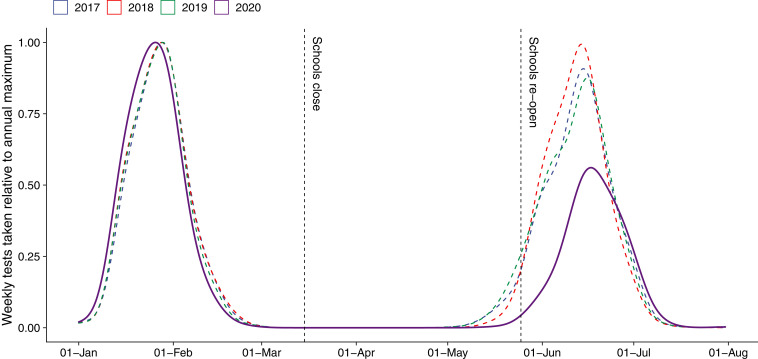
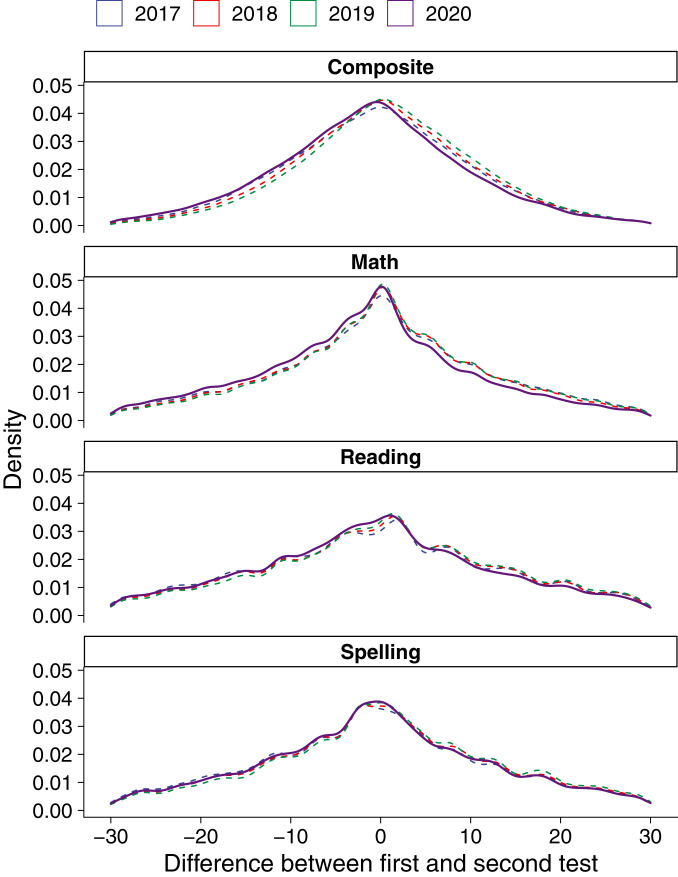
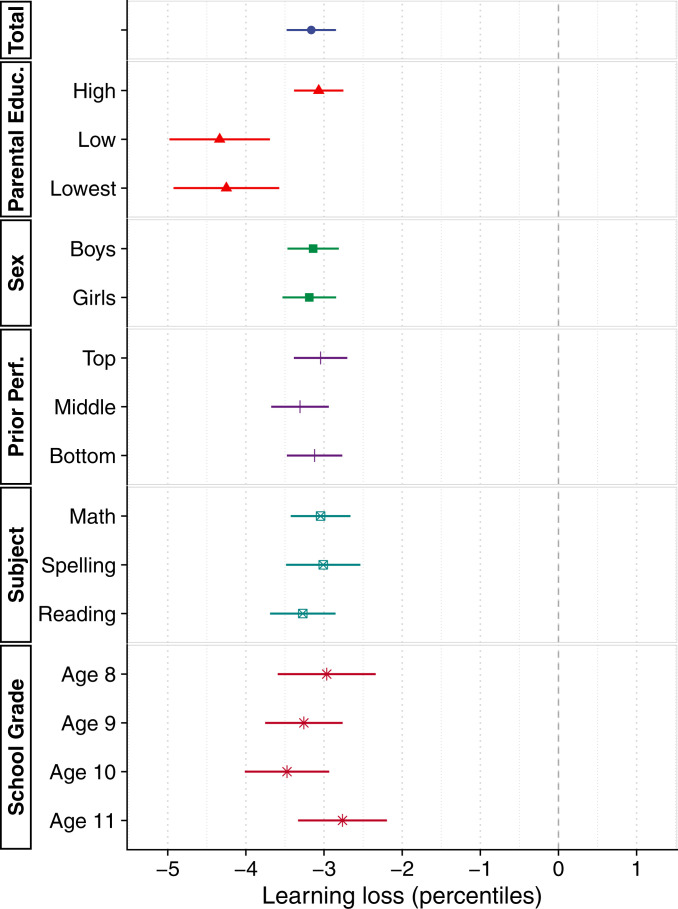
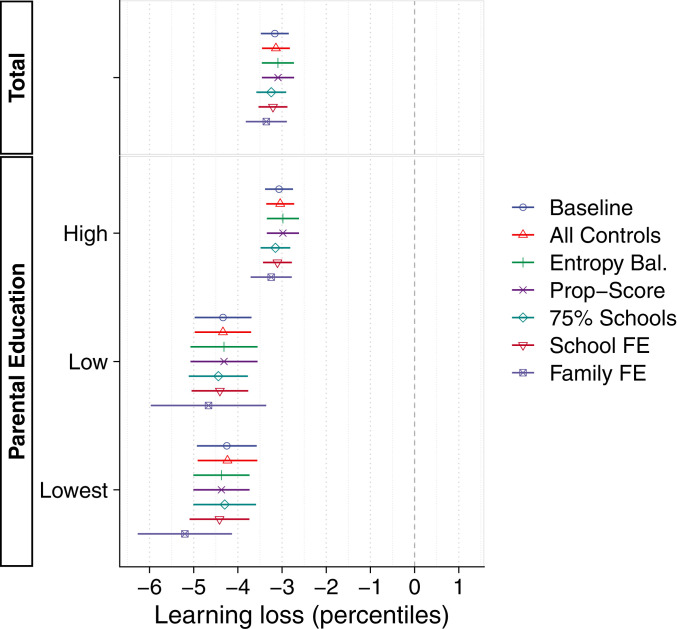
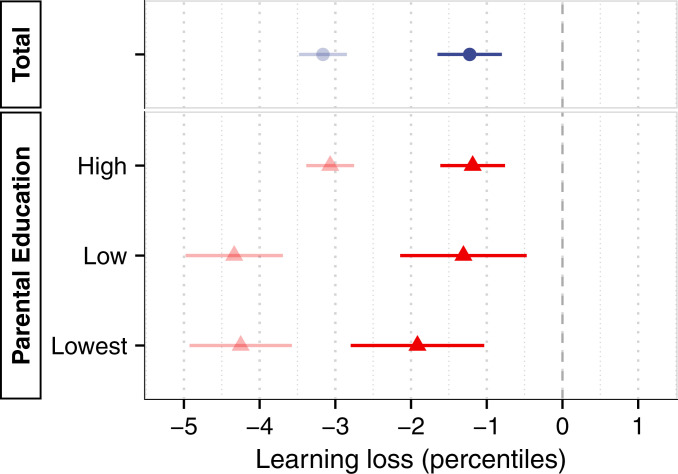
Suspension of face-to-face instruction in schools during the COVID-19 pandemic has led to concerns about consequences for student learning. So far, data to study this question have been limited. Here we evaluate the effect of school closures on primary school performance using exceptionally rich data from the Netherlands (n≈350,000). We use the fact that national exams took place before and after lockdown, and compare progress during this period to the same period in the three previous years. The Netherlands underwent only a relatively short lockdown (8 weeks), and features an equitable system of school funding and the world's highest rate of broadband access. Still, our results reveal a learning loss of about 3 percentile points or 0.08 standard deviations. The effect is equivalent to a fifth of a school year, the same period that schools remained closed. Losses are up to 60% larger among students from less-educated homes, confirming worries about the uneven toll of the pandemic on children and families. Investigating mechanisms, we find that most of the effect reflects the cumulative impact of knowledge learned rather than transitory influences on the day of testing. Results remain robust when balancing on the estimated propensity of treatment and using maximum entropy weights, or with fixed-effects specifications that compare students within the same school and family. The findings imply that students made little or no progress whilst learning from home, and suggest losses even larger in countries with weaker infrastructure or longer school closures.
Overview
The claims and statistics of this paper haven’t been checked yet.
Run the check — free, no account needed. It reads the open-access text and checks the sources it cites.
Integrity signals
Registry
Cites
Statistics
Figures
Verification
Claims the paper makes
The claims and statistics of this paper haven’t been checked yet.
Run the check — free, no account needed. It reads the open-access text and checks the sources it cites.
Claims other papers make about this one
Each is checked against this paper’s own text: does it say what the citing paper says it does?
The cited source says what the claim attributes to it.
In the citing paper
“Second, children from families with a low socioeconomic status (SES) were more affected than children from families with a high SES were (Maldonado and De Witte, 2020; Engzell et al., 2021).”
From Effects of COVID-19-Related School Closures on Student Achievement-A Systematic Review (2021) · cites this paper as Engzell et al., 2021
Self-check
Percentages, sums and reported differences re-computed from the paper’s own numbers.
The self-check needs the paper’s full text.
Citations
Cites
Statistical power analysis for the behavioral sciences
Cohen, J. (1990) · Computers Environment and Urban Systems · doi:10.1016/0198-9715(90)90050-4 · Cited by 65,417
The central role of the propensity score in observational studies for causal effects
ROSENBAUM, P. R., & RUBIN, D. B. (1983) · Biometrika · doi:10.1093/biomet/70.1.41 · Cited by 31,241
(2001) · RePEc: Research Papers in Economics · Cited by 27,577
Statistical Power Analysis for the Behavioral Sciences
Cohen, J. (2013) · doi:10.4324/9780203771587 · Cited by 25,373
The Psychological Impact of Quarantine and How to Reduce It: Rapid Review of the Evidence
Brooks, S. K., Webster, R. K., Smith, L. E., Woodland, L., Wessely, S., Greenberg, N., & Rubin, G. J. (2020) · doi:10.2139/ssrn.3532534 · Cited by 16,394
The psychological impact of quarantine and how to reduce it: Rapid review of the evidence
Brooks, S. K., Webster, R. K., Smith, L. E., Woodland, L., Wessely, S., Greenberg, N., & Rubin, G. J. (2020) · The Lancet · doi:10.1016/s0140-6736(20)30460-8 · Cited by 16,378
Multilevel analysis : an introduction to basic and advanced multilevel modeling
Snijders, T. A. B., & Bosker, R. (1999) · Cited by 6,830
Hainmueller, J. (2012) · Political Analysis · doi:10.1093/pan/mpr025 · Cited by 6,026
Recent Developments in the Econometrics of Program Evaluation
Imbens, G. W., & Wooldridge, J. M. (2009) · Journal of Economic Literature · doi:10.1257/jel.47.1.5 · Cited by 4,926
The Central Role of the Propensity Score in Observational Studies for Causal Effects
Rosenbaum, P. R., & Rubin, D. B. (1983) · Biometrika · doi:10.2307/2335942 · Cited by 3,495
Research works printed but not linked: 9
- Angrist, J. D., and Pischke, J., Mostly Harmless Econometrics: An empiricist's companion; Princeton University Press: 2008.
- Aigner, D. J. (1973). Regression with a binary independent variable subject to errors of observation. Journal of Econometrics 1, 49-59.
- Bollinger, C. R. (1996). Bounding mean regressions when a binary regressor is mismeasured. Journal of Econometrics 73, 387-399.
- Jerrim, J., and Micklewright, J. (2014). Socio-economic gradients in children's cognitive skills: Are cross-country comparisons robust to who reports family back- ground? European Sociological Review 30, 766-781.
- Black, D., Sanders, S., and Taylor, L. (2003). Measurement of higher education in the census and current population survey. Journal of the American Statistical Association 98, 545-554.
- Kapteyn, A., and Ypma, J. Y. (2007). Measurement error and misclassification: A comparison of survey and administrative data. Journal of Labor Economics 25, 513-551.
- Abowd, J. M., and Stinson, M. H. (2013). Estimating measurement error in an- nual job earnings: A comparison of survey and administrative data. Review of Economics and Statistics 95, 1451-1467.
- Buchmann, C., and DiPrete, T. A. (2006). The growing female advantage in college completion: The role of family background and academic achievement. American Sociological Review 71, 515-541.
- Autor, D., Figlio, D., Karbownik, K., Roth, J., and Wasserman, M. (2019). Fam- ily disadvantage and the gender gap in behavioral and educational outcomes. American Economic Journal: Applied Economics 11, 338-81.
Cited by
Sorted by citations
Items 501–600 of 1,000
Voltmer, K., Hondrich, F., & von Salisch, M. (2023) · Scientific Reports · doi:10.1038/s41598-023-49354-0 · Cited by 7
Valenzuela, J. P., Kuzmanic, D., & Cortés, F. (2024) · International Journal of Educational Development · doi:10.1016/j.ijedudev.2023.102978 · Cited by 9
Trotta, E., Serio, G., Monacis, L., Carlucci, L., Marinelli, C. V., Petito, A., Celia, G., Bonvino, A., Calvio, A., Stallone, R., et al. (2024) · PLoS ONE · doi:10.1371/journal.pone.0303991 · Cited by 10
Ragonnet, R. R., Hughes, A. E., Shipman, D. S., Meehan, M. T., Henderson, A. S., Briffoteaux, G., Melab, N., Tuyttens, D., McBryde, E. S., & Trauer, J. M. (2025) · PLoS Medicine · doi:10.1371/journal.pmed.1004512 · Cited by 7
Repo, J., Reimer, D., & Kilpi‐Jakonen, E. (2025) · Large-scale Assessments in Education · doi:10.1186/s40536-025-00251-0 · Cited by 10
Intelligent Tutoring Systems Need Teachers
Bardach, L., Moeller, K., Ruiz-García, M., Strittmatter, Y., Meyer, J., Musslick, S., & Spitzer, M. (2025) · Journal of Computer Assisted Learning · doi:10.1002/jcal.70159 · Cited by 15
Volante, L., Lara, C., Klinger, D. A., & Siegel, M. (2022) · Canadian Journal of Education / Revue canadienne de l éducation · doi:10.53967/cje-rce.5555 · Cited by 7
Miyauchi, S., Hiyama, T., Nakano, Y., Yoshino, A., Miyake, Y., & Okamoto, Y. (2022) · American Journal of Infection Control · doi:10.1016/j.ajic.2022.11.015 · Cited by 9
COVID-19 and School Closures: A Narrative Review of Pediatric Mental Health Impacts
Marshall, D. T. (2023) · Routledge eBooks · doi:10.1080/15582159.2023.2201734 · Cited by 8
Walls, J., & Zuckerman, S. J. (2023) · Education Policy Analysis Archives · doi:10.14507/epaa.31.8059 · Cited by 7
Harbatkin, E., Strunk, K. O., & Mcilwain, A. (2023) · Economics of Education Review · doi:10.1016/j.econedurev.2023.102484 · Cited by 7
The Marginal Returns to Distance Education: Evidence from Mexico’s Telesecundarias
Borghesan, E., & Vasey, G. (2023) · American Economic Journal Applied Economics · doi:10.1257/app.20220065 · Cited by 8
Asakawa, S., Ohtake, F., & Sano, S. (2024) · Review of Economics of the Household · doi:10.1007/s11150-024-09715-8 · Cited by 10
Developmental Losses in Young Children from Preprimary Program Closures during the COVID-19 Pandemic
Abufhele, A., Bravo, D., Bóo, F. L., & Soto‐Ramírez, P. (2024) · Comparative Education Review · doi:10.1086/731588 · Cited by 22
Ross, S. L., Jiang, S., Young, M. F., Meyer, J. L., & Strambler, M. J. (2024) · Proceedings of the National Academy of Sciences · doi:10.1073/pnas.2407322121 · Cited by 7
Alvarado-Socarrás, J. L., Quintero-Lesmes, D. C., Valle, J. C. C., Lopez, M. F., & Niederbacher-Velásquez, J. (2021) · Salud UIS · doi:10.18273/saluduis.53.e:21018 · Cited by 7
Aplikasi konseling online pada masa pandemi Covid-19: systematic literature review
Purwaningrum, R., Asrowi, A., Susilo, A. T., & Suryawati, C. T. (2021) · TERAPUTIK Jurnal Bimbingan dan Konseling · doi:10.26539/teraputik.52705 · Cited by 7
Simm, I., Winklhofer, U., Naab, T., Langmeyer, A. N., & Linberg, A. (2021) · Frontiers in Psychology · doi:10.3389/fpsyg.2021.733428 · Cited by 7
Afable, T. M. M., Lamberto, J. C. D., Ng, T. A. N. P., Umandap, A. N. S., & Arcinas, M. M. (2022) · International Journal of Multidisciplinary Applied Business and Education Research · doi:10.11594/ijmaber.03.06.16 · Cited by 7
Qvortrup, A. (2022) · Scandinavian Journal of Educational Research · doi:10.1080/00313831.2022.2116483 · Cited by 7
Rollett, W., Leitgeb, T., & Scharenberg, K. (2022) · Zeitschrift für Bildungsforschung · doi:10.1007/s35834-022-00358-2 · Cited by 7
Computer-Based Development of Reading Skills to Reduce Dropout in Uncertain Times
Szili, K., Kiss, R., Csapó, B., & Molnár, G. (2022) · Journal of Intelligence · doi:10.3390/jintelligence10040089 · Cited by 7
Eriksen, I. M., Stefansen, K., & Smette, I. (2022) · Journal of Youth Studies · doi:10.1080/13676261.2022.2144716 · Cited by 7
Modeling the Impact of Nonpharmaceutical Interventions on COVID-19 Transmission in K-12 Schools
Zhang, Y., Mayorga, M. E., Ivy, J. S., Lich, K. H., & Swann, J. (2022) · MDM Policy & Practice · doi:10.1177/23814683221140866 · Cited by 7
Britton, D., Thermer, S., Perez, J. A., & Montclare, J. K. (2022) · Technology & Innovation · doi:10.21300/22.3.2022.3 · Cited by 7
Rotevatn, T. A., Nygård, K. M., Espenhain, L., Legarth, R. A., Møller, K. L., Sarvikivi, E., Helve, O., Aspelund, G., Ersson, A., Nordahl, M., et al. (2023) · BMC Public Health · doi:10.1186/s12889-022-14906-y · Cited by 7
Covid 19 Pandemisi Sürecinde Yükseköğretimde Öğretmenlik Uygulamasına İlişkin Öğrenci Deneyimleri
Can, E. (2022) · Journal of Higher Education and Science · doi:10.5961/higheredusci.1118080 · Cited by 7
Learning loss experience and control motive by Zillennial generation in Indonesia
Parahita, B. N., Astutik, D., Ghufronudin, G., & Yuhastina, Y. (2023) · International Journal of Evaluation and Research in Education (IJERE) · doi:10.11591/ijere.v12i1.23824 · Cited by 10
Godwin, K. E., Kaur, F., & Sonnenschein, S. (2023) · Education Sciences · doi:10.3390/educsci13040426 · Cited by 7
Gans, N. E., Zohery, V., Jaffe, J. B., Ahmed, A., Kim, L., & Lombardi, D. (2023) · Journal of Science Education and Technology · doi:10.1007/s10956-023-10046-z · Cited by 8
Dobrotić, I., & Blum, S. (2023) · European Journal of Politics and Gender · doi:10.1332/251510821x16812994360871 · Cited by 7
Saville, K., Gray, S. L., Perryman, J., & Hargreaves, E. (2023) · Education 3-13 · doi:10.1080/03004279.2023.2186977 · Cited by 7
AlMunifi, A. A., & Alfawzan, M. S. (2023) · Sustainability · doi:10.3390/su151813510 · Cited by 7
Dental Student Perceptions of Distance Education over Time: A Mixed-Methods Study
Yeh, S. Y., Ramesh, N. P., Kaczmarek-Stewart, K., Ahn, C., Li, A., & Ohyama, H. (2023) · Dentistry Journal · doi:10.3390/dj11100233 · Cited by 8
Wahyudi, R., Handayani, L., Nuryana, Z., & Riduwan, R. (2023) · Journal of Education and Learning (EduLearn) · doi:10.11591/edulearn.v17i4.20947 · Cited by 7
Pittas, E., & Papanastasiou, E. C. (2023) · Research in Developmental Disabilities · doi:10.1016/j.ridd.2023.104635 · Cited by 7
Bibliometric analysis and scientific mapping of research trends on ‘digital divide’
Tyagi, S. (2023) · Global Knowledge, Memory and Communication · doi:10.1108/gkmc-10-2023-0376 · Cited by 7
Vogel, S., von Both, U., Nowak, E., Ludwig, J., Köhler, A., Lee, N., Dick, E., Rack-Hoch, A., Wicklein, B., Neusser, J., et al. (2022) · Diagnostics · doi:10.3390/diagnostics12010162 · Cited by 7
Rivas, J., Sparey, R. T., Davies, J., Gleason-Mercier, C., Hughes, S., Knights, S., & Cavett, E. (2021) · International Journal of Community Music · doi:10.1386/ijcm_00043_1 · Cited by 7
Schule und Corona. Ein Überblick über Forschungsaktivitäten an Hand von Projektsteckbriefen
Fickermann, D., & Edelstein, B. (2021) · Waxmann Verlag GmbH eBooks · doi:10.31244/9783830993315.05 · Cited by 7
Porru, A., Dicataldo, R., Leo, I., Roch, M., & Lucangeli, D. (2022) · International Journal of Environmental Research and Public Health · doi:10.3390/ijerph191811652 · Cited by 10
COVID-19 knowledge deconstruction and retrieval: an intelligent bibliometric solution
Wu, M., Zhang, Y., Markley, M., Cassidy, C., Newman, N. C., & Porter, A. L. (2023) · Scientometrics · doi:10.1007/s11192-023-04747-w · Cited by 7
Inequality and the Covid crisis in the United Kingdom
Blundell, R. W., Dias, M. C., Cribb, J., Joyce, R. C., Waters, T., Wernham, T., & Xu, X. (2022) · doi:10.1920/wp.ifs.2022.0122 · Cited by 7
Secondary Education and COVID-19
Siakalli, M., Mousoulidou, M., Christodoulou, A., Savvidou, A., & Kouppa, K. (2022) · Encyclopedia · doi:10.3390/encyclopedia2010025 · Cited by 9
Global warming, pollution and cognitive developments
Horvath, D., & Borgonovi, F. (2022) · OECD social employment and migration working papers · doi:10.1787/319b9a1f-en · Cited by 12
Garcia‐Bernardo, J., Westernhagen, C. H.-V., Emery, T., & van Hoek, A. J. (2024) · Scientific Reports · doi:10.1038/s41598-024-82646-7 · Cited by 6
Effect of class size on student achievement in the COVID‐19 “new normal”
Carro, J. M., & Gallardo, P. (2023) · Bulletin of Economic Research · doi:10.1111/boer.12426 · Cited by 6
Pistellato, I., Fonzo, M., Calzavara, A., Sorrentino, P., Selle, V., Sbrogiò, L. G., & Bertoncello, C. (2022) · European Journal of Pediatrics · doi:10.1007/s00431-022-04654-x · Cited by 6
The role of social institutions in community resilience following extreme natural hazard events
Hassan, E. M., Mahmoud, H. N., & Ellingwood, B. R. (2023) · Disaster Prevention and Resilience · doi:10.20517/dpr.2023.01 · Cited by 6
Systems Thinking for Public Health: A Case Study Using U.S. Public Education
National Academies of Sciences, E., Ashby, E., Minicucci, C., National Academies of Sciences, E., Liao, J., National Academies of Sciences, E., Buonsenso, D., González‐Dambrauskas, S., de Latinoamérica, L. R. C. P., Obregón, R., et al. (2023) · NAM Perspectives · doi:10.31478/202311a · Cited by 6
Women in political power and school closure during COVID times
Danzer, N., Garcia-Torres, S., Steinhardt, M. F., & Stella, L. (2024) · Economic Policy · doi:10.1093/epolic/eiae033 · Cited by 6
The impact of personality type on online learning performance among high school students
Wang, Y., Yu, R., Wu, X., Chen, Z., & Huang, Y. (2024) · Education and Information Technologies · doi:10.1007/s10639-024-13161-5 · Cited by 6
Implications of COVID-19 Mitigation Policies for National Well-Being: A Systems Perspective
Strelkovskii, N. V., Rovenskaya, E., Ilmola‐Sheppard, L., Bartmann, R., Rein‐Sapir, Y., & Feitelson, E. I. (2021) · Sustainability · doi:10.3390/su14010433 · Cited by 6
Prior home learning environment is associated with adaptation to homeschooling during COVID lockdown
Girard, C., & Prado, J. (2022) · Heliyon · doi:10.1016/j.heliyon.2022.e09294 · Cited by 6
Nurrachmawati, A., Permana, L., & Agustini, R. T. (2021) · JATI EMAS (Jurnal Aplikasi Teknik dan Pengabdian Masyarakat) · doi:10.36339/je.v5i3.486 · Cited by 6
Schreiner, C., Kraler, C., Berger, F., Hagleitner, W., Jesacher-Rößler, L., & Roßnagl, S. (2022) · Zeitschrift für Bildungsforschung · doi:10.1007/s35834-022-00352-8 · Cited by 6
de Casteele, M. V., Waterschoot, J., Anthierens, S., DeSmet, A., Galand, B., Goossens, H., Morbée, S., & Vansteenkiste, M. (2022) · Social Science & Medicine · doi:10.1016/j.socscimed.2022.115295 · Cited by 7
Parenting and Adjustment Problems among Preschoolers during COVID-19
Ostrov, J. M., Murray-Close, D. K., Perry, K. J., Perhamus, G. R., Memba, G. V., Rice, D. R., & Nowalis, S. (2022) · Journal of Child and Family Studies · doi:10.1007/s10826-022-02439-2 · Cited by 6
Ramadhan, M. A., & Daryati, D. (2022) · AIP conference proceedings · doi:10.1063/5.0094284 · Cited by 6
Battisti, A., Lazzaro, G., Varuzza, C., Vicari, S., & Menghini, D. (2022) · Frontiers in Psychiatry · doi:10.3389/fpsyt.2022.995484 · Cited by 6
Examining the Learning Losses of Students in the Covid-19 Process According to Teachers’ Opinions
Demir, F., Özdaş, F., & ÇAKMAK, M. (2022) · International Journal of Psychology and Educational Studies · doi:10.52380/ijpes.2022.9.4.978 · Cited by 8
Haris, A., Sentaya, I. M., & Sulindra, I. G. M. (2022) · Jurnal Ilmiah Mandala Education · doi:10.58258/jime.v8i1.2756 · Cited by 6
Panel data evidence on the effects of the COVID-19 pandemic on livelihoods in urban Côte d’Ivoire
Pascaline Dupas, Y., Marcel Fafchamps, A., & Lestant, E. (2023) · PLoS ONE · doi:10.1371/journal.pone.0277559 · Cited by 6
Reduced in-person learning in COVID-19 widens student achievement gaps in schools
Shin, C., An, Y., & Oh, S.-Y. (2023) · Asia Pacific Education Review · doi:10.1007/s12564-023-09862-0 · Cited by 10
In-Person Instruction and Educational Outcomes of K–8 Students During the COVID-19 Pandemic
Uthappa, D. M., Pak, J., McGann, K. A., Brookhart, M. A., McKinzie, K., Abdelbarr, M., Cockrell, J., Hickerson, J., Armstrong, S., D’Agostino, E. M., et al. (2023) · Pediatrics · doi:10.1542/peds.2022-060352l · Cited by 6
INVESTIGATING THE IMPLEMENTATION OF GAMIFICATION APPROACH TO ENHANCE STUDENTS LEARNING ENGAGEMENT
Kang, S. P., & Recard, M. (2023) · Journey Journal of English Language and Pedagogy · doi:10.33503/journey.v6i2.2846 · Cited by 6
Learning Loss and Recovery from the COVID-19 Pandemic: A Systematic Review of Evidence
Cruz, N. A. D., Adona, A. J., Molato-Gayares, R., & Park, A. F. (2024) · doi:10.22617/wps240093-2 · Cited by 7
Making space for play in the global post-COVID landscape
Alwani, S. E., Day, N., & Kulkarni, K. (2024) · International Journal of Play · doi:10.1080/21594937.2024.2323411 · Cited by 7
Takaku, R., Shobako, N., & Nakata, T. (2024) · Scientific Reports · doi:10.1038/s41598-024-67138-y · Cited by 7
Hubungan antara Learning Loss dan Motivasi Belajar Mahasiswa pada Proses Pembelajaran Jarak Jauh
Wicaksono, K. P. (2022) · Bioma Jurnal Biologi dan Pembelajaran Biologi · doi:10.32528/bioma.v7i1.7405 · Cited by 6
Oducado, R. M., Cleofas, J. V., & Soriano, G. P. (2022) · Nursing Forum · doi:10.1111/nuf.12732 · Cited by 6
Swindell, A., & Wright, J. (2022) · Globalisation, comparative education and policy research · doi:10.1007/978-3-030-90590-3_3 · Cited by 6
A breach in the social contract: Limited participation and limited evidence in COVID‐19 responses
Rangel, J. C., Crath, R., & Renade, S. (2022) · Journal of Evaluation in Clinical Practice · doi:10.1111/jep.13775 · Cited by 5
Zheng, C., Yu, Y., Lu, J., Hou, Y., & Li, K. (2022) · Early Education and Development · doi:10.1080/10409289.2022.2146386 · Cited by 6
Insights from a Catholic school’s transition to distance learning during Covid-19
Wright, S., Park, Y. S., & Saadé, A. (2022) · Open Learning The Journal of Open Distance and e-Learning · doi:10.1080/02680513.2022.2152667 · Cited by 11
Lee, H., & Han, B. (2021) · medRxiv · doi:10.1101/2021.08.12.21261943 · Cited by 6
de la Maisonneuve, C., Égert, B., & Turner, D. D. (2022) · OECD Economics Department working papers · doi:10.1787/eea048c5-en · Cited by 24
Ngo, G. R., Engay, D., Gaw, J. L., Kho, G. M. D., Lagamon, L., Sonaco, K. R., Salamante, L. M., & Trinidad, J. E. (2023) · SocArXiv (OSF Preprints) · doi:10.31235/osf.io/mbgsy · Cited by 6
Preparing teachers to deliver hybrid education: a framework for Latin America and the Caribbean
Villegas-Reimers, E., Pogré, P., Freire, S. M., & Näslund-Hadley, E. I. (2023) · doi:10.18235/0005008 · Cited by 11
Matone, M., Wang, X., Marshall, D., Huang, J., Worsley, D., Filograna, C., & Rubin, D. (2023) · JAMA Network Open · doi:10.1001/jamanetworkopen.2023.8300 · Cited by 5
The importance of schools in driving children’s applications for disability benefits
Levere, M., Hemmeter, J., & Wittenburg, D. (2024) · Journal of Public Economics · doi:10.1016/j.jpubeco.2024.105239 · Cited by 5
van de Werfhorst, H. G., Zwier, D., Geven, S., Bol, T., & Haelermans, C. (2024) · npj Science of Learning · doi:10.1038/s41539-024-00283-1 · Cited by 5
Online assessment in young children: Challenges and considerations
McBride, C. A., Ho, J. C., McQuade, M., Ngan, V. S. H., Ng, M. C. Y., Cheah, Z. R. E., & Maurer, U. (2024) · PsyCh Journal · doi:10.1002/pchj.805 · Cited by 5
Orbach, L., Fritz, A., Haase, V. G., Dowker, A., & Räsänen, P. (2023) · Frontiers in Education · doi:10.3389/feduc.2023.1083074 · Cited by 15
Learning During Stressful Situations: Optimizing Evidence-based Learning Strategies
de la Pena, I. C., & Pan, M. C. (2021) · The Journal of Adventist Education · doi:10.55668/fate6233 · Cited by 4
COVID-19 learning loss and recovery in Brazil: Assessing gaps across social groups
Miranda, E. D. M., & Baum, D. R. (2024) · Education Policy Analysis Archives · doi:10.14507/epaa.32.8082 · Cited by 10
Baty, J. J., & Bruns, H. A. (2024) · ImmunoHorizons · doi:10.4049/immunohorizons.2300073 · Cited by 5
Prihartono, I., Guo, X., Tariq, A., & Collins, M. E. (2024) · Social Sciences & Humanities Open · doi:10.1016/j.ssaho.2024.100871 · Cited by 5
The impact of COVID-19 school disruptions on children’s learning
Blackwell, C. K., Mansolf, M. A., Deoni, S., Ganiban, J. M., Leve, L. D., Margolis, A. E., McGrath, M., Nozadi, S. S., O’Shea, T. M., Sherlock, P., et al. (2024) · Frontiers in Education · doi:10.3389/feduc.2024.1295910 · Cited by 7
A perspective overview of the influence of the COVID-19 pandemic on the educational sector
Ukhurebor, K. E., Edetalehn, O. I., Wada, Z. B., Jokthan, G. E., Inegbedion, J. O., Ofulue, C., Efanodor-Obeten, H. O., Otsupius, A. I., Tanglang, N., Mai-inji, A. Y., et al. (2024) · Journal of Infrastructure Policy and Development · doi:10.24294/jipd.v8i5.2955 · Cited by 5
Niki, M. (2024) · Japan and the World Economy · doi:10.1016/j.japwor.2024.101254 · Cited by 5
Ronconi, A., Altoè, G., & Masón, L. (2024) · Learning and Individual Differences · doi:10.1016/j.lindif.2024.102604 · Cited by 17
Adolescents’ school experiences: Understanding the needs of young people post COVID-19
Patrick, P., & Pamflett, S. (2025) · Journal of Child and Adolescent Mental Health · doi:10.2989/17280583.2025.2490646 · Cited by 7
COVID-19: impatto sulla salute mentale e supporto psicosociale
Cantelmi, T., Lambiase, E., Pensavalli, M., Laselva, P., & Cecchetti, S. (2021) · MODELLI DELLA MENTE · doi:10.3280/mdm1-2020oa10908 · Cited by 6
A Precision Agriculture Technology Course for Regions with Lower Technology Adoption Levels
Mathanker, S. K. (2021) · Applied Engineering in Agriculture · doi:10.13031/aea.14669 · Cited by 5
The Government Support in Distance Education: Case of Bahrain
Alhalwachi, L., Karam, A., & Hamdan, A. (2022) · Studies in computational intelligence · doi:10.1007/978-3-030-93921-2_32 · Cited by 5
Haris, A., Sentaya, I. M., & Sulindra, I. G. M. (2022) · Jurnal Ilmiah Mandala Education · doi:10.36312/jime.v8i1.2756 · Cited by 5
Pandemi dönemi acil uzaktan eğitim uygulamalarında K12 düzeyinde öğrenme kayıplarının incelenmesi
ÖZGÜRDEN, S., & Okur, M. R. (2022) · Açıköğretim Uygulamaları ve Araştırmaları Dergisi · doi:10.51948/auad.1092674 · Cited by 5
Investigation of Reading Skill Development of Primary School Students in the Covid 19 Process
BAŞ, Ö., Sirem, Ö., Akyol, H., & Gök, B. (2022) · Reading & Writing Quarterly · doi:10.1080/10573569.2022.2103055 · Cited by 7
Factors Affecting the Student Performance during the COVID-19 Pandemic
Li, L. (2022) · Open Journal of Social Sciences · doi:10.4236/jss.2022.107032 · Cited by 6
Metadata
- Authors
- Engzell, P., Frey, A., & Verhagen, M. D.
- Affiliations
- Stockholm University (SE)
- University of Oxford (GB)
- Corresponding author
- Engzell, Per
- Frey, Arun
- Verhagen, Mark D.
- Venue
- Proceedings of the National Academy of Sciences
- Publisher
- Center for Open Science
- Published
- 2020-10-29
- Volume
- 118
- Issue
- 17
- ISSN
- 0027-8424 (ISSN-L)
- PMC
- PMC8092566
- OpenAlex
- W3143968054
- Cited by
- 1,739
- References
- 82
- Citations by year
- 2026: 110 · 2025: 170 · 2024: 293 · 2023: 463 · 2022: 464 · 2021: 235 · 2020: 3
- FWCI
- 639.03
- Type
- journal article
- Language
- en
- Open access
- hybrid
- doi.org
- Locations
- Proceedings of the National Academy of Sciences (publishedVersion, cc-by)
- PubMed Central (publishedVersion, cc-by)
- PubMed (publishedVersion)
- UCL Discovery (University College London) (submittedVersion, cc-by)
- RePEc: Research Papers in Economics (submittedVersion)
- SocArXiv (OSF Preprints) (submittedVersion, cc-by-nc-nd)
- SocArXiv (OSF Preprints) (submittedVersion)
- Zenodo (CERN European Organization for Nuclear Research) (submittedVersion, cc-by)
- Funders
- Leverhulme Trust
- University of Oxford
- Vetenskapsrådet (2016-07099)
- Forskningsrådet om Hälsa, Arbetsliv och Välfärd (2016-07099)
- Organisation de Coopération et de Développement Économiques
- Economic and Social Research Council
- Topics
- Social Sciences › Education › Education during COVID-19 pandemic
- Social Sciences › Education › School Choice and Performance
- Social Sciences › Economics, Econometrics and Finance › Economics and Econometrics › COVID-19 Pandemic Impacts
- Keywords
- learning loss, school closures, COVID-19 pandemic, lockdown, national examinations, academic performance, home background, parental education, home-based learning, educational inequality
- MeSH terms
- COVID-19, SARS-CoV-2, Child, Female, Humans, Learning, Male, Netherlands, Quarantine, Schools, Pandemics
About these checks
Registry, retraction, Cites and statistics results are computed, not judged, with one exception: a printed reference that no index lists is read once by a model before it counts as a citation error. Claims are extracted by a model and kept only when their quote appears verbatim in the text; each cited source is then checked, with a model’s help, for whether it says what the claim relies on. Those verdicts can be wrong — read the claim’s quote and the cited source before relying on one.
Statistics and arithmetic are recomputed, not judged.
Confidence bands are shown only for fields calibrated on our annotated test set. None is calibrated yet, so no band is shown.
What counts as a claim ›How we measure confidence ›How we check this ›
Are you an author, or do you see a problem with this page? Request a review
