

The DOI matches its Crossref record; 91 of the 91 references it cites were found in a registry or an index.
Learning Loss Due to School Closures During the COVID-19 Pandemic
Open accessAbstract
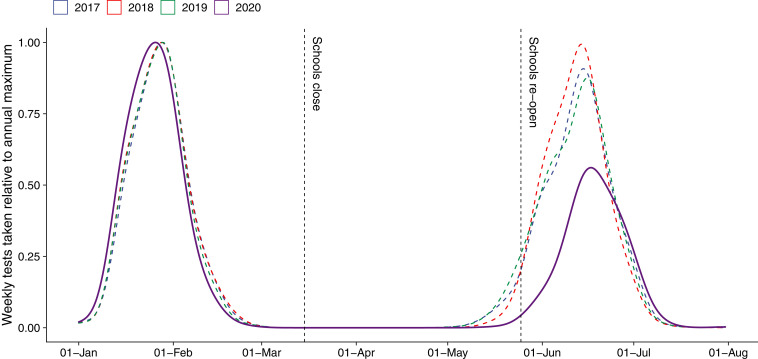
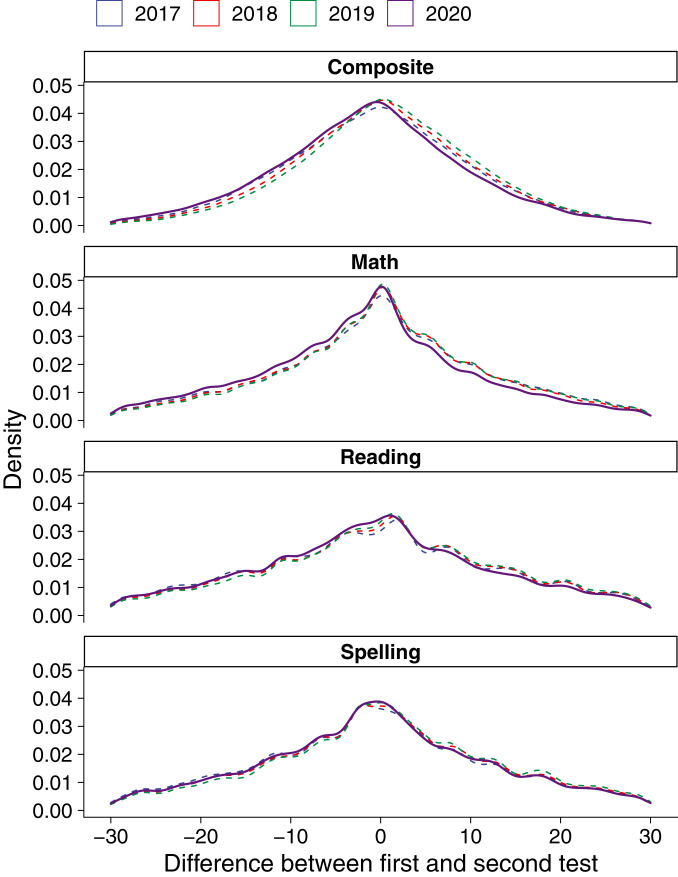
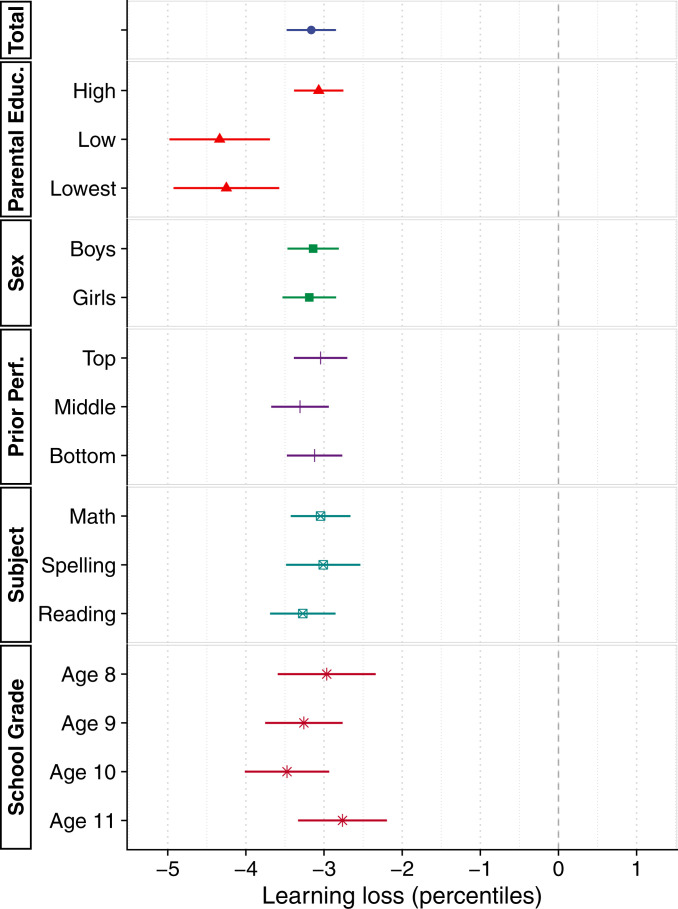
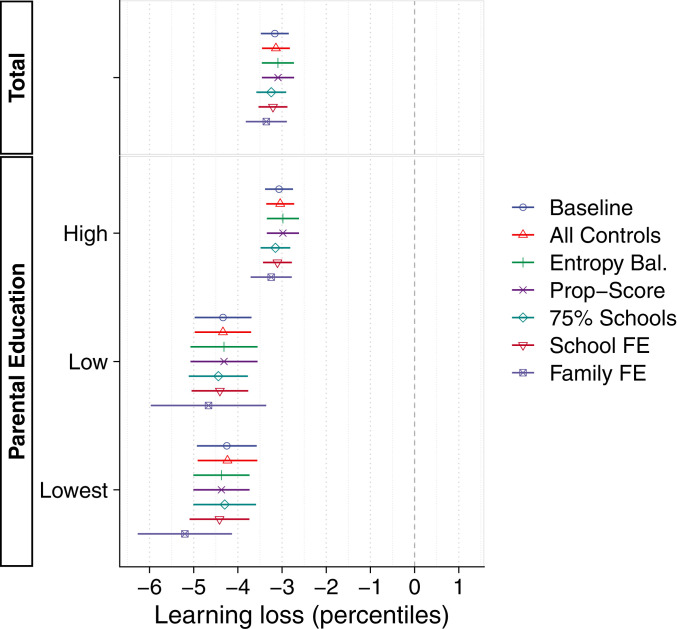
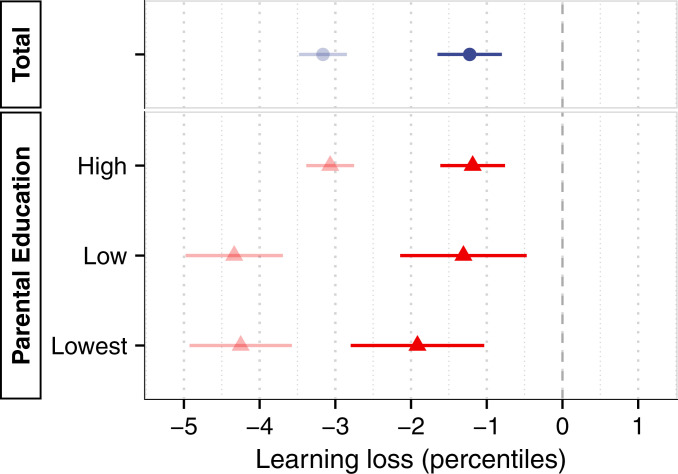
Suspension of face-to-face instruction in schools during the COVID-19 pandemic has led to concerns about consequences for student learning. So far, data to study this question have been limited. Here we evaluate the effect of school closures on primary school performance using exceptionally rich data from the Netherlands (n≈350,000). We use the fact that national exams took place before and after lockdown, and compare progress during this period to the same period in the three previous years. The Netherlands underwent only a relatively short lockdown (8 weeks), and features an equitable system of school funding and the world's highest rate of broadband access. Still, our results reveal a learning loss of about 3 percentile points or 0.08 standard deviations. The effect is equivalent to a fifth of a school year, the same period that schools remained closed. Losses are up to 60% larger among students from less-educated homes, confirming worries about the uneven toll of the pandemic on children and families. Investigating mechanisms, we find that most of the effect reflects the cumulative impact of knowledge learned rather than transitory influences on the day of testing. Results remain robust when balancing on the estimated propensity of treatment and using maximum entropy weights, or with fixed-effects specifications that compare students within the same school and family. The findings imply that students made little or no progress whilst learning from home, and suggest losses even larger in countries with weaker infrastructure or longer school closures.
Overview
The claims and statistics of this paper haven’t been checked yet.
Run the check — free, no account needed. It reads the open-access text and checks the sources it cites.
Integrity signals
Registry
Cites
Statistics
Figures
Verification
Claims the paper makes
The claims and statistics of this paper haven’t been checked yet.
Run the check — free, no account needed. It reads the open-access text and checks the sources it cites.
Claims other papers make about this one
Each is checked against this paper’s own text: does it say what the citing paper says it does?
The cited source says what the claim attributes to it.
In the citing paper
“Second, children from families with a low socioeconomic status (SES) were more affected than children from families with a high SES were (Maldonado and De Witte, 2020; Engzell et al., 2021).”
From Effects of COVID-19-Related School Closures on Student Achievement-A Systematic Review (2021) · cites this paper as Engzell et al., 2021
Self-check
Percentages, sums and reported differences re-computed from the paper’s own numbers.
The self-check needs the paper’s full text.
Citations
Cites
Statistical power analysis for the behavioral sciences
Cohen, J. (1990) · Computers Environment and Urban Systems · doi:10.1016/0198-9715(90)90050-4 · Cited by 65,417
The central role of the propensity score in observational studies for causal effects
ROSENBAUM, P. R., & RUBIN, D. B. (1983) · Biometrika · doi:10.1093/biomet/70.1.41 · Cited by 31,241
(2001) · RePEc: Research Papers in Economics · Cited by 27,577
Statistical Power Analysis for the Behavioral Sciences
Cohen, J. (2013) · doi:10.4324/9780203771587 · Cited by 25,373
The Psychological Impact of Quarantine and How to Reduce It: Rapid Review of the Evidence
Brooks, S. K., Webster, R. K., Smith, L. E., Woodland, L., Wessely, S., Greenberg, N., & Rubin, G. J. (2020) · doi:10.2139/ssrn.3532534 · Cited by 16,394
The psychological impact of quarantine and how to reduce it: Rapid review of the evidence
Brooks, S. K., Webster, R. K., Smith, L. E., Woodland, L., Wessely, S., Greenberg, N., & Rubin, G. J. (2020) · The Lancet · doi:10.1016/s0140-6736(20)30460-8 · Cited by 16,378
Multilevel analysis : an introduction to basic and advanced multilevel modeling
Snijders, T. A. B., & Bosker, R. (1999) · Cited by 6,830
Hainmueller, J. (2012) · Political Analysis · doi:10.1093/pan/mpr025 · Cited by 6,026
Recent Developments in the Econometrics of Program Evaluation
Imbens, G. W., & Wooldridge, J. M. (2009) · Journal of Economic Literature · doi:10.1257/jel.47.1.5 · Cited by 4,926
The Central Role of the Propensity Score in Observational Studies for Causal Effects
Rosenbaum, P. R., & Rubin, D. B. (1983) · Biometrika · doi:10.2307/2335942 · Cited by 3,495
Research works printed but not linked: 9
- Angrist, J. D., and Pischke, J., Mostly Harmless Econometrics: An empiricist's companion; Princeton University Press: 2008.
- Aigner, D. J. (1973). Regression with a binary independent variable subject to errors of observation. Journal of Econometrics 1, 49-59.
- Bollinger, C. R. (1996). Bounding mean regressions when a binary regressor is mismeasured. Journal of Econometrics 73, 387-399.
- Jerrim, J., and Micklewright, J. (2014). Socio-economic gradients in children's cognitive skills: Are cross-country comparisons robust to who reports family back- ground? European Sociological Review 30, 766-781.
- Black, D., Sanders, S., and Taylor, L. (2003). Measurement of higher education in the census and current population survey. Journal of the American Statistical Association 98, 545-554.
- Kapteyn, A., and Ypma, J. Y. (2007). Measurement error and misclassification: A comparison of survey and administrative data. Journal of Labor Economics 25, 513-551.
- Abowd, J. M., and Stinson, M. H. (2013). Estimating measurement error in an- nual job earnings: A comparison of survey and administrative data. Review of Economics and Statistics 95, 1451-1467.
- Buchmann, C., and DiPrete, T. A. (2006). The growing female advantage in college completion: The role of family background and academic achievement. American Sociological Review 71, 515-541.
- Autor, D., Figlio, D., Karbownik, K., Roth, J., and Wasserman, M. (2019). Fam- ily disadvantage and the gender gap in behavioral and educational outcomes. American Economic Journal: Applied Economics 11, 338-81.
Cited by
Sorted by citations
Items 101–200 of 1,000
Socio‐Economic Status and Creativity: A Meta‐Analysis
Acar, S., Tadık, H., Uysal, R., Myers, D., & Inetas, B. (2022) · The Journal of Creative Behavior · doi:10.1002/jocb.568 · Cited by 63
Unequal experience of COVID-induced remote schooling in four developing countries
Hossain, M. (2021) · International Journal of Educational Development · doi:10.1016/j.ijedudev.2021.102446 · Cited by 51
Global learning loss in student achievement: First estimates using comparable reading scores
Jakubowski, M., Gajderowicz, T., & Patrinos, H. A. (2023) · Economics Letters · doi:10.1016/j.econlet.2023.111313 · Cited by 51
Building a multisystemic understanding of societal resilience to the COVID-19 pandemic
Wernli, D., Clausin, M., Antulov-Fantulin, N., Berezowski, J. A., Biller‐Andorno, N., Blanchet, K., Böttcher, L., Burton‐Jeangros, C., Escher, G., Flahault, A., et al. (2021) · BMJ Global Health · doi:10.1136/bmjgh-2021-006794 · Cited by 56
van Cappelle, F., Chopra, V., Ackers, J., & Gochyyev, P. (2021) · International Journal of Educational Development · doi:10.1016/j.ijedudev.2021.102439 · Cited by 50
Chambonnière, C., Fearnbach, N., Pélissier, L., Genin, P. M., Fillon, A., Boscaro, A., Bonjean, L., Bailly, M., Siroux, J., Guirado, T., et al. (2021) · International Journal of Environmental Research and Public Health · doi:10.3390/ijerph182111099 · Cited by 50
Schult, J., Mahler, N., Fauth, B., & Lindner, M. A. (2022) · Frontiers in Education · doi:10.3389/feduc.2022.867316 · Cited by 63
New Paradigm of Merdeka Belajar Curriculum in Schools
Hadi, A., Marniati, M., Ngindana, R., Kurdi, M. S., Kurdi, M. S., & Fauziah, F. (2023) · AL-ISHLAH Jurnal Pendidikan · doi:10.35445/alishlah.v15i2.3126 · Cited by 50
Isphording, I. E., Lipfert, M., & Pestel, N. (2020) · Journal of Public Economics · doi:10.1016/j.jpubeco.2021.104426 · Cited by 78
Who Lost the Most? Mathematics Achievement during the COVID-19 Pandemic
Contini, D., Tommaso, M. L. D., Muratori, C., Piazzalunga, D., & Schiavon, L. (2022) · The B E Journal of Economic Analysis & Policy · doi:10.1515/bejeap-2021-0447 · Cited by 49
Aliyyah, R. R., Rasmitadila, R., Gunadi, G., Sutisnawati, A., & Febriantina, S. (2023) · Journal of Education and e-Learning Research · doi:10.20448/jeelr.v10i2.4490 · Cited by 49
Evensen, M., Hart, R. K., Godøy, A. A., Hauge, L. J., Lund, I. O., Knudsen, A. K., Grøtting, M. W., Surén, P., & Reneflot, A. (2022) · European Child & Adolescent Psychiatry · doi:10.1007/s00787-022-02046-y · Cited by 48
Lerkkanen, M., Pakarinen, E., Salminen, J., & Torppa, M. (2022) · Reading and Writing · doi:10.1007/s11145-022-10358-3 · Cited by 77
The Unequal Impacts of COVID-19 on Student Learning
Azevedo, J. P., Gutierrez, M., Hoyos, R. E. D., & Saavedra, J. (2021) · Springer eBooks · doi:10.1007/978-3-030-81500-4_16 · Cited by 53
Blanden, J., Doepke, M., & Stuhler, J. (2022) · National Bureau of Economic Research · doi:10.3386/w29979 · Cited by 72
Inequalities in healthcare use during the COVID-19 pandemic
Frey, A., Tilstra, A. M., & Verhagen, M. D. (2024) · Nature Communications · doi:10.1038/s41467-024-45720-2 · Cited by 52
Vaillancourt, T., McDougall, P., Comeau, J., & Finn, C. (2021) · FACETS · doi:10.1139/facets-2021-0080 · Cited by 46
Schippers, M. C., Ioannidis, J. P. A., & Joffe, A. R. (2022) · Frontiers in Public Health · doi:10.3389/fpubh.2022.950965 · Cited by 51
Digital divide and access to online education: new evidence from Tamil Nadu, India
Jafar, K., Ananthpur, K., & Venkatachalam, L. (2023) · Journal of Social and Economic Development · doi:10.1007/s40847-023-00236-1 · Cited by 65
McLoone, J. K., Wakefield, C. E., Marshall, G. M., Pierce, K., Jaffé, A., Bye, A., Kennedy, S., Drew, D., & Lingam, R. (2022) · PLoS ONE · doi:10.1371/journal.pone.0273622 · Cited by 45
Kompetenzstände Hamburger Schüler*innen vor und während der Corona-Pandemie
Depping, D., Lücken, M., Musekamp, F., & Thonke, F. (2021) · Schule während der Corona-Pandemie. Neue Ergebnisse und Überblick über ein dynamisches Forschungsfeld · doi:10.31244/9783830993315.03 · Cited by 46
Relyea, J. E., Rich, P., Kim, J. S., & Gilbert, J. B. (2022) · Reading and Writing · doi:10.1007/s11145-022-10387-y · Cited by 54
Educators’ implementation and use of social and emotional learning early in the COVID-19 pandemic.
Zieher, A. K., Cipriano, C., Meyer, J. L., & Strambler, M. J. (2021) · School Psychology · doi:10.1037/spq0000461 · Cited by 40
The potential effects of the COVID-19 pandemic on learnings
Monroy-Gómez-Franco, L., Vélez-Grajales, R., & López-Calva, L. (2022) · International Journal of Educational Development · doi:10.1016/j.ijedudev.2022.102581 · Cited by 26
The Pandemic’s Effect on Demand for Public Schools, Homeschooling, and Private Schools
Musaddiq, T., Stange, K., Bacher-Hicks, A., & Goodman, J. (2021) · National Bureau of Economic Research · doi:10.3386/w29262 · Cited by 40
COVID-19, school closures, and student learning outcomes. New global evidence from PISA
Jakubowski, M., Gajderowicz, T., & Patrinos, H. A. (2025) · npj Science of Learning · doi:10.1038/s41539-025-00297-3 · Cited by 65
The impact of COVID-19 on children’s learning: a rapid review
Spiteri, J., Deguara, J., Muscat, T., Bonello, C., Farrugia, R., Milton, J., Gatt, S., & Said, L. (2022) · The Educational and Developmental Psychologist · doi:10.1080/20590776.2021.2024759 · Cited by 42
Online teaching, procrastination and student achievement
De Paola, M., Gioia, F., & Scoppa, V. (2023) · Economics of Education Review · doi:10.1016/j.econedurev.2023.102378 · Cited by 38
Steinmayr, R., Paschke, P., & Wirthwein, L. (2022) · Journal of Happiness Studies · doi:10.1007/s10902-022-00537-y · Cited by 48
LGBTQ+ Students’ Peer Victimization and Mental Health before and during the COVID-19 Pandemic
Gill, E. K., & McQuillan, M. T. (2022) · International Journal of Environmental Research and Public Health · doi:10.3390/ijerph191811537 · Cited by 41
Vaillancourt, T., Brittain, H. L., Krygsman, A., Farrell, A. H., Pepler, D. J., Landon, S., Saint-Georges, Z., & Vitoroulis, I. (2021) · Journal of Psychoeducational Assessment · doi:10.1177/07342829211053668 · Cited by 54
Early Childhood Learning Losses during COVID-19: Systematic Review
Uğraş, M., ZENGİN, E., Papadakis, S., & Kalogiannakis, M. (2023) · Sustainability · doi:10.3390/su15076199 · Cited by 57
The Impacts of Remote Learning in Secondary Education: Evidence from Brazil during the Pandemic
Lichand, G. F., Dória, C. A., Neto, O. L., & Cossi, J. (2021) · doi:10.18235/0003344 · Cited by 37
James, M., Marchant, E., Defeyter, M. A., Woodside, J. V., & Brophy, S. T. (2021) · BMJ Open · doi:10.1136/bmjopen-2021-051574 · Cited by 36
Liao, H., Ma, S., & Xue, H. (2022) · China Economic Review · doi:10.1016/j.chieco.2022.101847 · Cited by 64
Disparate impacts on online information access during the Covid-19 pandemic
Suh, J., Horvitz, E., White, R. W., & Althoff, T. (2022) · Nature Communications · doi:10.1038/s41467-022-34592-z · Cited by 39
Blanden, J., Doepke, M., & Stuhler, J. L. (2023) · Handbook of the economics of education · doi:10.1016/bs.hesedu.2022.11.003 · Cited by 52
Liu, S., & Fisher, P. A. (2022) · Developmental Cognitive Neuroscience · doi:10.1016/j.dcn.2022.101091 · Cited by 40
Yıldız, S., Kılıç, G. N., & Acar, İ. H. (2022) · Early Childhood Education Journal · doi:10.1007/s10643-022-01339-w · Cited by 47
del Olmo‐Muñoz, J., González‐Calero, J. A., Diago, P. D., Arnau, D., & Arevalillo‐Herráez, M. (2022) · ZDM · doi:10.1007/s11858-022-01396-w · Cited by 51
Abdurrahmansyah, A., Sugilar, H., Ismail, I., & Warna, D. (2022) · Education Sciences · doi:10.3390/educsci12080508 · Cited by 35
The Longer Students Were Out of School, the Less They Learned
Patrinos, H. A. (2023) · Journal of School Choice · doi:10.1080/15582159.2023.2210941 · Cited by 35
Schneider, R. M., Sachse, K. A., Schipolowski, S., & Enke, F. (2021) · Frontiers in Education · doi:10.3389/feduc.2021.702406 · Cited by 35
Family Disruption and Parenting During the COVID-19 Pandemic
Schmeer, K. K., Singletary, B., Purtell, K. M., & Justice, L. M. (2021) · Journal of Family Issues · doi:10.1177/0192513x211042852 · Cited by 34
Johansson, S. T., & Singal, N. (2021) · International Journal of Inclusive Education · doi:10.1080/13603116.2021.1965799 · Cited by 55
Open schools! Weighing the effects of viruses and lockdowns on children
Spitzer, M. (2021) · Trends in Neuroscience and Education · doi:10.1016/j.tine.2021.100151 · Cited by 39
The Fiscal and Welfare Effects of Policy Responses to the Covid-19 School Closures
Fuchs-Schündeln, N., Krueger, D., Kurmann, A., Lalé, E., Ludwig, A., & Popova, I. (2023) · IMF Economic Review · doi:10.1057/s41308-022-00196-2 · Cited by 33
Analysis of Learning Losses of Students During the COVID-19 Pandemic
Zhdanov, S. P., Baranova, K. M., Udina, N. N., Terpugov, A. E., Lobanova, E. V., & Zakharova, O. V. (2022) · Contemporary Educational Technology · doi:10.30935/cedtech/11812 · Cited by 33
Yusuf, A., Wright, N., Steiman, M., González, M., Karpur, A., Shih, A. J., Shikako‐Thomas, K., & Elsabbagh, M. (2022) · PLoS ONE · doi:10.1371/journal.pone.0271229 · Cited by 37
Workers’ well-being in the context of the first year of the COVID-19 pandemic
Nieuwenhuis, R., & Yerkes, M. A. (2021) · Community Work & Family · doi:10.1080/13668803.2021.1880049 · Cited by 32
Bormann, I., Brøgger, K., Pol, M., & Lazarová, B. (2021) · European Educational Research Journal · doi:10.1177/14749041211031356 · Cited by 32
Digital Comics in Online Learning During COVID-19: Its Effect on Student Cognitive Learning Outcomes
Damopolii, I., Lumembang, T., & İlhan, G. O. (2021) · International Journal of Interactive Mobile Technologies (iJIM) · doi:10.3991/ijim.v15i19.23395 · Cited by 32
Construir el conocimiento en la era digital: retos y reflexiones
Marimón, M., Almenara, J. C., Castañeda, L., Salvador, C. C., de Oliveira, J. M., & Rodríguez‐Triana, M. J. (2022) · Revista de Educación a Distancia (RED) · doi:10.6018/red.505661 · Cited by 73
Digital Divide or Digital Provide? Technology, Time Use and Learning Loss During Covid-19
Asadullah, M. N., & Bhattacharjee, A. (2022) · The Journal of Development Studies · doi:10.1080/00220388.2022.2094253 · Cited by 41
Akpan, I. J., Offodile, O. F., Akpanobong, A. C., & Kobara, Y. M. (2024) · Informatics · doi:10.3390/informatics11030053 · Cited by 31
A Flexible Future Education Model—Strategies Drawn from Teaching during the COVID-19 Pandemic
Srinivasan, S., Ramos, J. A. L., & Muhammad, N. (2021) · Education Sciences · doi:10.3390/educsci11090557 · Cited by 43
Bagnall, C. L., Skipper, Y., & Fox, C. L. (2022) · British Journal of Educational Psychology · doi:10.1111/bjep.12485 · Cited by 31
Durrani, N., Qanay, G., Mir, G., Helmer, J., Polat, F., Karimova, N., & Temirbekova, A. (2023) · Sustainability · doi:10.3390/su152014725 · Cited by 45
Ogodo, J. A. (2024) · Education Sciences · doi:10.3390/educsci14020124 · Cited by 30
Disparate Effects of Disruptive Events on Children
Torche, F., Fletcher, J. M., & Brand, J. E. (2024) · RSF The Russell Sage Foundation Journal of the Social Sciences · doi:10.7758/rsf.2024.10.1.01 · Cited by 36
Lai, A. Y. K., Sit, S. M.-M., Lam, S. K. K., Choi, A. C.-M., Yiu, D. Y.-S., Lai, T. T.-K., Ip, M. S.-M., & Lam, T.-H. (2021) · Frontiers in Psychiatry · doi:10.3389/fpsyt.2021.738474 · Cited by 34
Baten, E., Vlaeminck, F., Muès, M., Valcke, M., Desoete, A., & Warreyn, P. (2022) · Journal of Autism and Developmental Disorders · doi:10.1007/s10803-021-05383-0 · Cited by 33
Is Flow Possible in the Emergency Remote Teaching Foreign Language Classroom?
Dewaele, J., Albakistani, A., & Ahmed, I. K. (2022) · Education Sciences · doi:10.3390/educsci12070444 · Cited by 35
Sun, X., Marks, R. A., Eggleston, R. L., Zhang, K., Lau, C., Yu, C., Nickerson, N., & Kovelman, I. (2022) · Reading and Writing · doi:10.1007/s11145-022-10388-x · Cited by 38
Teachers’ Emotional Exhaustion and Teaching Enthusiasm Before Versus During the COVID-19 Pandemic
Voss, T., Klusmann, U., Bönke, N., Richter, D., & Kunter, M. (2023) · Zeitschrift für Psychologie · doi:10.1027/2151-2604/a000520 · Cited by 36
Grit and academic resilience during the COVID-19 pandemic
Chen, D. L., Ertaç, S., Evgeniou, T., Miao, X., Nadaf, A., & Yilmaz, E. (2024) · npj Science of Learning · doi:10.1038/s41539-024-00265-3 · Cited by 30
Dräger, J., Klein, M., & Sosu, E. (2024) · British Educational Research Journal · doi:10.1002/berj.3992 · Cited by 48
Inequality in learning is a major concern after school closures
van de Werfhorst, H. G. (2021) · Proceedings of the National Academy of Sciences · doi:10.1073/pnas.2105243118 · Cited by 29
The Impact of U.S. School Closures on Labor Market Outcomes during the COVID-19 Pandemic
Garcia, K. S., & Cowan, B. (2022) · National Bureau of Economic Research · doi:10.3386/w29641 · Cited by 29
Voto, C. D., Superfine, B. M., & DeWit, M. (2023) · Educational Administration Quarterly · doi:10.1177/0013161x231163870 · Cited by 28
Teachers’ emotional exhaustion and job satisfaction: How much does the school context matter?
Schulze-Hagenest, T., Carstensen, B., Weber, K. E., Jansen, T., Meyer, J., Köller, O., & Klusmann, U. (2023) · Teaching and Teacher Education · doi:10.1016/j.tate.2023.104360 · Cited by 50
Teaching and learning challenges due to the COVID-19 pandemic: A systematic review
Tan, C. Y., Jang, S. T., Lam, S. M., An, A. Q., & Lo, U. K. V. (2025) · Educational Research Review · doi:10.1016/j.edurev.2025.100667 · Cited by 35
COVID-19 Salgını Sürecinde Öğrencilerin Olası Öğrenme Kayıpları Üzerine Bir Değerlendirme
Baz, B. (2021) · Temel Eğitim · doi:10.52105/temelegitim.3.1.3 · Cited by 28
The COVID generation: how is the pandemic affecting kids’ brains?
Moyer, M. W. (2022) · Nature · doi:10.1038/d41586-022-00027-4 · Cited by 37
Connection between Teacher Support and Student’s Achievement: Could Growth Mindset Be the Moderator?
Brandišauskienė, A., Bukšnytė-Marmienė, L., Česnavičienė, J., Daugirdienė, A., Kemerytė-Ivanauskienė, E., & Nedzinskaitė, R. (2021) · Sustainability · doi:10.3390/su132413632 · Cited by 36
Changes in Cognitive Outcomes in Early Childhood: The Role of Family Income and Volatility
Sosu, E., & Schmidt, P. (2022) · Frontiers in Psychology · doi:10.3389/fpsyg.2022.758082 · Cited by 33
Spadafora, N., Reid‐Westoby, C., Pottruff, M. M., Wang, J., & Janus, M. (2022) · Early Childhood Education Journal · doi:10.1007/s10643-021-01304-z · Cited by 26
Christie, H., Hiscox, L. V., Halligan, S. L., & Creswell, C. (2022) · JCPP Advances · doi:10.1002/jcv2.12095 · Cited by 26
Baudin, P. V., Sacksteder, R. E., Worthington, A. K., Voitiuk, K., Ly, V. T., Hoffman, R. N., Elliott, M. A. T., Parks, D. F., Ward, R., Torres-Montoya, S., et al. (2022) · Heliyon · doi:10.1016/j.heliyon.2022.e11596 · Cited by 26
Borchering, R. K., Mullany, L. C., Howerton, E., Chinazzi, M., Smith, C. P., Qin, M., Reich, N. G., Contamin, L., Levander, J. D., Kerr, J., et al. (2022) · The Lancet Regional Health - Americas · doi:10.1016/j.lana.2022.100398 · Cited by 32
The academic left, human geography, and the rise of authoritarianism during the COVID-19 pandemic
Simandan, D., Rinner, C., & Capurri, V. (2023) · Geografiska Annaler Series B Human Geography · doi:10.1080/04353684.2023.2168560 · Cited by 25
Baumeister, R. F., Tice, D. M., & Bushman, B. J. (2023) · Perspectives on Psychological Science · doi:10.1177/17456916221121815 · Cited by 53
Covid-19: An urgent call for global “vaccines-plus” action
An open letter by a group of public health experts, & scientists (2022) · BMJ · doi:10.1136/bmj.o1 · Cited by 24
Desigualdades socioeconómicas y COVID-19 en España. Informe SESPAS 2022
Amaia Bacigalupe, H., Unai Martín, R., Franco, M., & Borrell, C. (2022) · Gaceta Sanitaria · doi:10.1016/j.gaceta.2022.01.011 · Cited by 25
Linnes, C., Ronzoni, G., Agrusa, J. F., & Lema, J. D. (2022) · Education Sciences · doi:10.3390/educsci12100721 · Cited by 35
Gorjón, L., & Osés, A. (2022) · Journal of Educational Computing Research · doi:10.1177/07356331221133408 · Cited by 31
Sabu, J. M., Zahid, I., Jacob, N., Alele, F. O., & Malau‐Aduli, B. S. (2022) · Vaccines · doi:10.3390/vaccines10111880 · Cited by 24
Effects of the COVID-19 pandemic on reading performance of second grade children in Germany
Förster, N., Forthmann, B., Back, M. D., & Souvignier, E. (2022) · Reading and Writing · doi:10.1007/s11145-022-10379-y · Cited by 37
Projek Penguatan Profil Pelajar Pancasila Sebagai Program Kokurikuler Di Jenjang Sekolah Dasar
Damayanti, I., & Ghozali, M. I. A. (2023) · Jurnal Elementaria Edukasia · doi:10.31949/jee.v6i2.5563 · Cited by 38
Adaptive Learning Based on Artificial Intelligence to Overcome Student Academic Inequalities
Ansor, F., Zulkifli, N. A., Jannah, D. S. M., & Krisnaresanti, A. (2023) · Journal of Social Science Utilizing Technology · doi:10.55849/jssut.v1i4.663 · Cited by 25
Pailhé, A., Panico, L., & Solaz, A. (2021) · Journal of Family Research · doi:10.20377/jfr-718 · Cited by 28
Welerubun, R. C., Wambrauw, H. L., Jeni, J., Wolo, D., & Damopolii, I. (2022) · Prima Magistra Jurnal Ilmiah Kependidikan · doi:10.37478/jpm.v3i1.1487 · Cited by 24
A Systematic Review of COVID-19 Geographical Research: Machine Learning and Bibliometric Approach
Xi, J., Liu, X., Wang, J., Yao, L., & Zhou, C. (2022) · Annals of the American Association of Geographers · doi:10.1080/24694452.2022.2130143 · Cited by 26
Cronert, A. (2022) · Journal of Public Policy · doi:10.1017/s0143814x22000101 · Cited by 21
Thorn, W., & Vincent‐Lancrin, S. (2021) · Springer eBooks · doi:10.1007/978-3-030-81500-4_15 · Cited by 23
Jensen, S. S., & Reimer, D. (2021) · SSM - Population Health · doi:10.1016/j.ssmph.2021.100945 · Cited by 22
Galiani, S. (2021) · Journal of Economic Behavior & Organization · doi:10.1016/j.jebo.2021.10.016 · Cited by 22
Namkung, J. M., Goodrich, J. M., Hebert, M., & Koziol, N. (2022) · Frontiers in Education · doi:10.3389/feduc.2022.921497 · Cited by 31
Aladsani, H. K., Al-Abdullatif, A. M., Almuhanna, M. A., & Gameil, A. A. (2022) · Sustainability · doi:10.3390/su14169931 · Cited by 23
Impacto de la pandemia en el aprendizaje: reflexiones desde la psicología educativa
Páez, V. C., Correa, R. A., Gutiérrez-Romero, M. F., Angrino, S. O., Ospina, T. R., & Osorio, H. T. (2022) · Praxis & Saber · doi:10.19053/22160159.v13.n34.2022.14532 · Cited by 23
Metadata
- Authors
- Engzell, P., Frey, A., & Verhagen, M. D.
- Affiliations
- Stockholm University (SE)
- University of Oxford (GB)
- Corresponding author
- Engzell, Per
- Frey, Arun
- Verhagen, Mark D.
- Venue
- Proceedings of the National Academy of Sciences
- Publisher
- Center for Open Science
- Published
- 2020-10-29
- Volume
- 118
- Issue
- 17
- ISSN
- 0027-8424 (ISSN-L)
- PMC
- PMC8092566
- OpenAlex
- W3143968054
- Cited by
- 1,739
- References
- 82
- Citations by year
- 2026: 110 · 2025: 170 · 2024: 293 · 2023: 463 · 2022: 464 · 2021: 235 · 2020: 3
- FWCI
- 639.03
- Type
- journal article
- Language
- en
- Open access
- hybrid
- doi.org
- Locations
- Proceedings of the National Academy of Sciences (publishedVersion, cc-by)
- PubMed Central (publishedVersion, cc-by)
- PubMed (publishedVersion)
- UCL Discovery (University College London) (submittedVersion, cc-by)
- RePEc: Research Papers in Economics (submittedVersion)
- SocArXiv (OSF Preprints) (submittedVersion, cc-by-nc-nd)
- SocArXiv (OSF Preprints) (submittedVersion)
- Zenodo (CERN European Organization for Nuclear Research) (submittedVersion, cc-by)
- Funders
- Leverhulme Trust
- University of Oxford
- Vetenskapsrådet (2016-07099)
- Forskningsrådet om Hälsa, Arbetsliv och Välfärd (2016-07099)
- Organisation de Coopération et de Développement Économiques
- Economic and Social Research Council
- Topics
- Social Sciences › Education › Education during COVID-19 pandemic
- Social Sciences › Education › School Choice and Performance
- Social Sciences › Economics, Econometrics and Finance › Economics and Econometrics › COVID-19 Pandemic Impacts
- Keywords
- learning loss, school closures, COVID-19 pandemic, lockdown, national examinations, academic performance, home background, parental education, home-based learning, educational inequality
- MeSH terms
- COVID-19, SARS-CoV-2, Child, Female, Humans, Learning, Male, Netherlands, Quarantine, Schools, Pandemics
About these checks
Registry, retraction, Cites and statistics results are computed, not judged, with one exception: a printed reference that no index lists is read once by a model before it counts as a citation error. Claims are extracted by a model and kept only when their quote appears verbatim in the text; each cited source is then checked, with a model’s help, for whether it says what the claim relies on. Those verdicts can be wrong — read the claim’s quote and the cited source before relying on one.
Statistics and arithmetic are recomputed, not judged.
Confidence bands are shown only for fields calibrated on our annotated test set. None is calibrated yet, so no band is shown.
What counts as a claim ›How we measure confidence ›How we check this ›
Are you an author, or do you see a problem with this page? Request a review
