

The DOI matches its Crossref record; 91 of the 91 references it cites were found in a registry or an index.
Learning Loss Due to School Closures During the COVID-19 Pandemic
Open accessAbstract
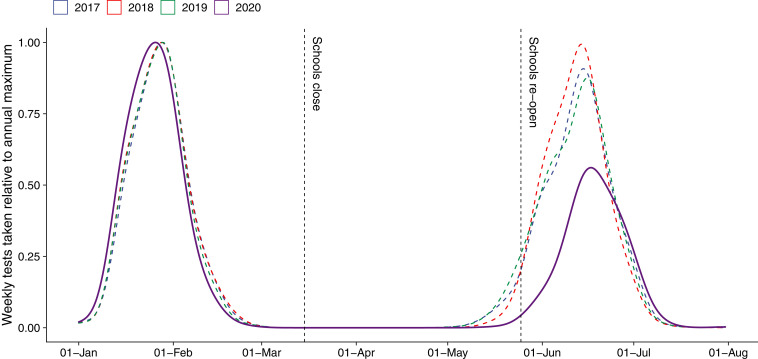
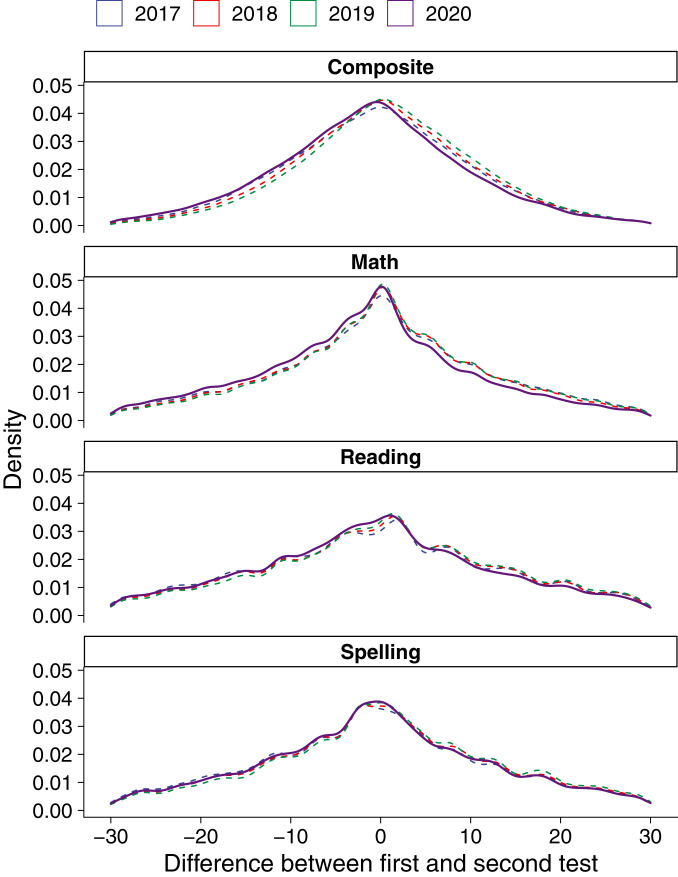
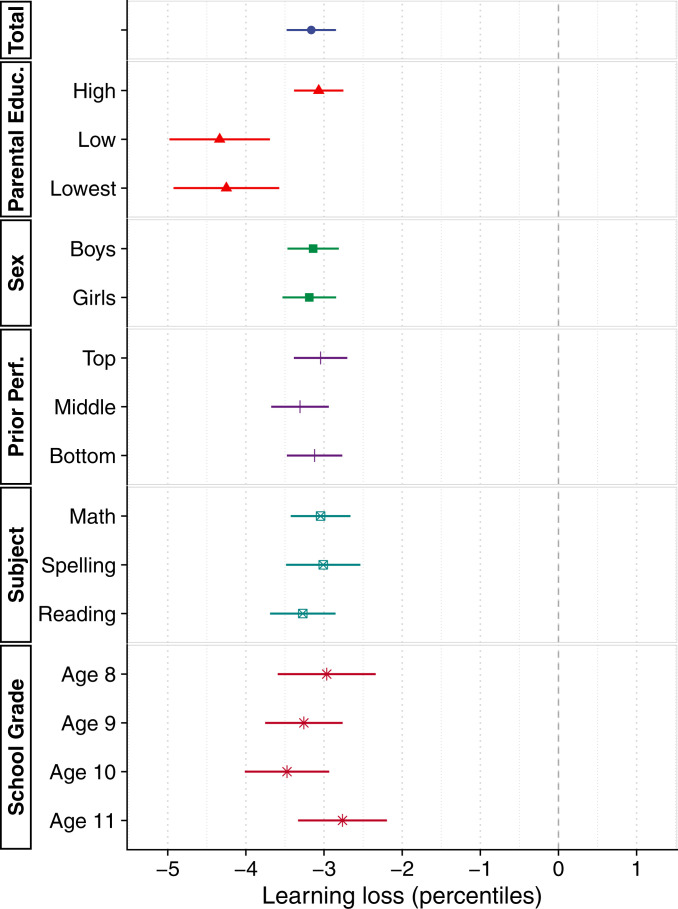
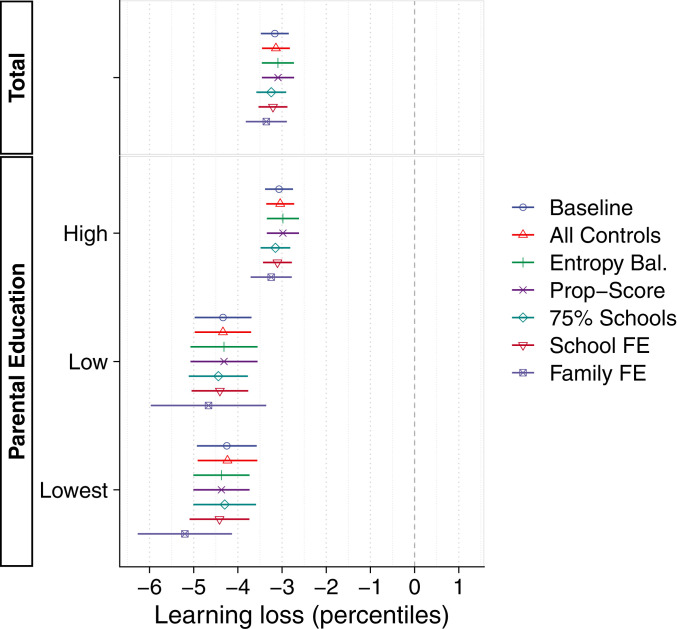
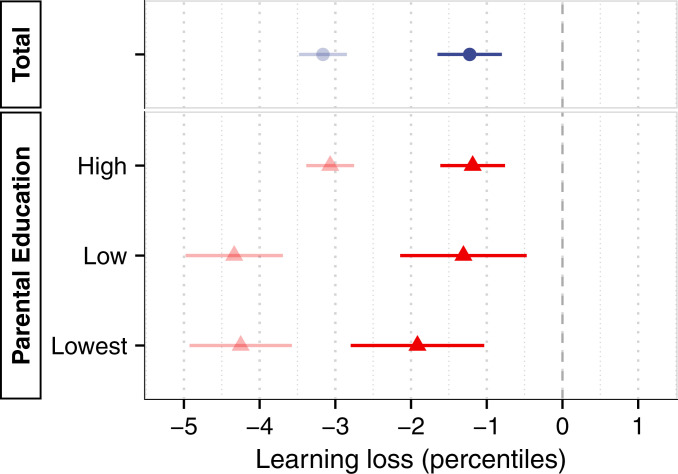
Suspension of face-to-face instruction in schools during the COVID-19 pandemic has led to concerns about consequences for student learning. So far, data to study this question have been limited. Here we evaluate the effect of school closures on primary school performance using exceptionally rich data from the Netherlands (n≈350,000). We use the fact that national exams took place before and after lockdown, and compare progress during this period to the same period in the three previous years. The Netherlands underwent only a relatively short lockdown (8 weeks), and features an equitable system of school funding and the world's highest rate of broadband access. Still, our results reveal a learning loss of about 3 percentile points or 0.08 standard deviations. The effect is equivalent to a fifth of a school year, the same period that schools remained closed. Losses are up to 60% larger among students from less-educated homes, confirming worries about the uneven toll of the pandemic on children and families. Investigating mechanisms, we find that most of the effect reflects the cumulative impact of knowledge learned rather than transitory influences on the day of testing. Results remain robust when balancing on the estimated propensity of treatment and using maximum entropy weights, or with fixed-effects specifications that compare students within the same school and family. The findings imply that students made little or no progress whilst learning from home, and suggest losses even larger in countries with weaker infrastructure or longer school closures.
Overview
The claims and statistics of this paper haven’t been checked yet.
Run the check — free, no account needed. It reads the open-access text and checks the sources it cites.
Integrity signals
Registry
Cites
Statistics
Figures
Verification
Claims the paper makes
The claims and statistics of this paper haven’t been checked yet.
Run the check — free, no account needed. It reads the open-access text and checks the sources it cites.
Claims other papers make about this one
Each is checked against this paper’s own text: does it say what the citing paper says it does?
The cited source says what the claim attributes to it.
In the citing paper
“Second, children from families with a low socioeconomic status (SES) were more affected than children from families with a high SES were (Maldonado and De Witte, 2020; Engzell et al., 2021).”
From Effects of COVID-19-Related School Closures on Student Achievement-A Systematic Review (2021) · cites this paper as Engzell et al., 2021
Self-check
Percentages, sums and reported differences re-computed from the paper’s own numbers.
The self-check needs the paper’s full text.
Citations
Cites
Statistical power analysis for the behavioral sciences
Cohen, J. (1990) · Computers Environment and Urban Systems · doi:10.1016/0198-9715(90)90050-4 · Cited by 65,417
The central role of the propensity score in observational studies for causal effects
ROSENBAUM, P. R., & RUBIN, D. B. (1983) · Biometrika · doi:10.1093/biomet/70.1.41 · Cited by 31,241
(2001) · RePEc: Research Papers in Economics · Cited by 27,577
Statistical Power Analysis for the Behavioral Sciences
Cohen, J. (2013) · doi:10.4324/9780203771587 · Cited by 25,373
The Psychological Impact of Quarantine and How to Reduce It: Rapid Review of the Evidence
Brooks, S. K., Webster, R. K., Smith, L. E., Woodland, L., Wessely, S., Greenberg, N., & Rubin, G. J. (2020) · doi:10.2139/ssrn.3532534 · Cited by 16,394
The psychological impact of quarantine and how to reduce it: Rapid review of the evidence
Brooks, S. K., Webster, R. K., Smith, L. E., Woodland, L., Wessely, S., Greenberg, N., & Rubin, G. J. (2020) · The Lancet · doi:10.1016/s0140-6736(20)30460-8 · Cited by 16,378
Multilevel analysis : an introduction to basic and advanced multilevel modeling
Snijders, T. A. B., & Bosker, R. (1999) · Cited by 6,830
Hainmueller, J. (2012) · Political Analysis · doi:10.1093/pan/mpr025 · Cited by 6,026
Recent Developments in the Econometrics of Program Evaluation
Imbens, G. W., & Wooldridge, J. M. (2009) · Journal of Economic Literature · doi:10.1257/jel.47.1.5 · Cited by 4,926
The Central Role of the Propensity Score in Observational Studies for Causal Effects
Rosenbaum, P. R., & Rubin, D. B. (1983) · Biometrika · doi:10.2307/2335942 · Cited by 3,495
Research works printed but not linked: 9
- Angrist, J. D., and Pischke, J., Mostly Harmless Econometrics: An empiricist's companion; Princeton University Press: 2008.
- Aigner, D. J. (1973). Regression with a binary independent variable subject to errors of observation. Journal of Econometrics 1, 49-59.
- Bollinger, C. R. (1996). Bounding mean regressions when a binary regressor is mismeasured. Journal of Econometrics 73, 387-399.
- Jerrim, J., and Micklewright, J. (2014). Socio-economic gradients in children's cognitive skills: Are cross-country comparisons robust to who reports family back- ground? European Sociological Review 30, 766-781.
- Black, D., Sanders, S., and Taylor, L. (2003). Measurement of higher education in the census and current population survey. Journal of the American Statistical Association 98, 545-554.
- Kapteyn, A., and Ypma, J. Y. (2007). Measurement error and misclassification: A comparison of survey and administrative data. Journal of Labor Economics 25, 513-551.
- Abowd, J. M., and Stinson, M. H. (2013). Estimating measurement error in an- nual job earnings: A comparison of survey and administrative data. Review of Economics and Statistics 95, 1451-1467.
- Buchmann, C., and DiPrete, T. A. (2006). The growing female advantage in college completion: The role of family background and academic achievement. American Sociological Review 71, 515-541.
- Autor, D., Figlio, D., Karbownik, K., Roth, J., and Wasserman, M. (2019). Fam- ily disadvantage and the gender gap in behavioral and educational outcomes. American Economic Journal: Applied Economics 11, 338-81.
Cited by
Sorted by citations
Viner, R., Russell, S., Saulle, R., Croker, H. A., Stansfield, C., Packer, J., Nicholls, D., Goddings, A., Bonell, C. P., Hudson, L. D., et al. (2022) · Archives of Pediatrics and Adolescent Medicine · doi:10.1001/jamapediatrics.2021.5840 · Cited by 798
Evaluation of the BNT162b2 Covid-19 Vaccine in Children 5 to 11 Years of Age
Walter, E. B., Talaat, K. R., Sabharwal, C., Gurtman, A., Lockhart, S., Paulsen, G. C., Barnett, E. D., Muñoz, F. M., Maldonado, Y., Pahud, B. A., et al. (2022) · New England Journal of Medicine · doi:10.1056/nejmoa2116298 · Cited by 593
A systematic review and meta-analysis of the evidence on learning during the COVID-19 pandemic
Betthäuser, B. A., Bach-Mortensen, A. M., & Engzell, P. (2023) · Nature Human Behaviour · doi:10.1038/s41562-022-01506-4 · Cited by 568
Effects of COVID-19-Related School Closures on Student Achievement-A Systematic Review
Hammerstein, S., König, C., Dreisörner, T., & Frey, A. (2021) · Frontiers in Psychology · doi:10.3389/fpsyg.2021.746289 · Cited by 588
Learning loss during Covid-19: An early systematic review
Donnelly, R., & Patrinos, H. A. (2022) · PROSPECTS · doi:10.1007/s11125-021-09582-6 · Cited by 445
Goudeau, S., Sanrey, C., Stanczak, A., Manstead, A. S. R., & Darnon, C. (2021) · Nature Human Behaviour · doi:10.1038/s41562-021-01212-7 · Cited by 286
Compensating for academic loss: Online learning and student performance during the COVID-19 pandemic
Clark, A. E., Nong, H., Zhu, H., & Zhu, R. (2021) · China Economic Review · doi:10.1016/j.chieco.2021.101629 · Cited by 271
Dahalan, F., Alias, N., & Shaharom, M. S. N. (2023) · Education and Information Technologies · doi:10.1007/s10639-022-11548-w · Cited by 420
Teachers, Stress, and the COVID-19 Pandemic: A Qualitative Analysis
Robinson, L. E., Valido, A., Drescher, A., Woolweaver, A. B., Espelage, D. L., LoMurray, S., Long, A. C. J., Wright, A. A., & Dailey, M. M. (2022) · School Mental Health · doi:10.1007/s12310-022-09533-2 · Cited by 252
When the Great Equalizer Shuts Down: Schools, Peers, and Parents in Pandemic TimesPreprint
Agostinelli, F., Doepke, M., Sorrenti, G., & Zilibotti, F. (2020) · SSRN Electronic Journal · doi:10.1016/j.jpubeco.2021.104574 · Cited by 252
COVID-19 and educational inequality: How school closures affect low- and high-achieving students
Grewenig, E., Lergetporer, P., Werner, K., Woessmann, L., & Zierow, L. (2021) · European Economic Review · doi:10.1016/j.euroecorev.2021.103920 · Cited by 260
Glaeser, E. L. (2021) · Urban Studies · doi:10.1177/00420980211052230 · Cited by 192
Large socio-economic, geographic and demographic disparities exist in exposure to school closures
Parolin, Z., & Lee, E. K. (2021) · Nature Human Behaviour · doi:10.1038/s41562-021-01087-8 · Cited by 217
The impact of Covid-19 on student achievement: Evidence from a recent meta-analysis
Di Pietro, G. (2023) · Educational Research Review · doi:10.1016/j.edurev.2023.100530 · Cited by 173
Artificial intelligence for low income countries
Khan, M. S., Umer, H., & Faruqe, F. (2024) · Humanities and Social Sciences Communications · doi:10.1057/s41599-024-03947-w · Cited by 250
COVID-19 learning losses: Early grade reading in South Africa
Ardington, C., Wills, G., & Kotze, J. (2021) · International Journal of Educational Development · doi:10.1016/j.ijedudev.2021.102480 · Cited by 164
Hevia, F. J., Vergara-Lope, S., Velásquez-Durán, A., & Calderón, D. (2022) · International Journal of Educational Development · doi:10.1016/j.ijedudev.2021.102515 · Cited by 158
Zulaika, G., Bulbarelli, M., Nyothach, E., van Eijk, A. M., Mason, L., Fwaya, E., Obor, D., Kwaro, D., Wang, D., Mehta, S. D., et al. (2022) · BMJ Global Health · doi:10.1136/bmjgh-2021-007666 · Cited by 155
Helm, C., Huber, S. G., & Loisinger, T. (2021) · Zeitschrift für Erziehungswissenschaft · doi:10.1007/s11618-021-01000-z · Cited by 151
Spitzer, M. W. H., & Musslick, S. (2021) · PLOS ONE · doi:10.1371/journal.pone.0255629 · Cited by 138
Inequality and the COVID-19 Crisis in the United Kingdom
Blundell, R. W., Dias, M. C., Cribb, J., Joyce, R. C., Waters, T., Wernham, T., & Xu, X. (2022) · Annual Review of Economics · doi:10.1146/annurev-economics-051520-030252 · Cited by 138
Achievement Gaps in the Wake of COVID-19
Bailey, D. H., Duncan, G. J., Murnane, R. J., & Au Yeung, N. (2021) · Educational Researcher · doi:10.3102/0013189x211011237 · Cited by 134
Zhao, L., Cao, C., Li, Y., & Li, Y. (2021) · Computers in Human Behavior · doi:10.1016/j.chb.2021.107177 · Cited by 158
The Impact of COVID‐19‐Related School Closures on Student Achievement—A Meta‐Analysis
König, C., & Frey, A. (2022) · Educational Measurement: Issues and Practice · doi:10.1111/emip.12495 · Cited by 147
Socioeconomic status and school absenteeism: A systematic review and narrative synthesis
Sosu, E., Dare, S., Goodfellow, C., & Klein, M. (2021) · Review of Education · doi:10.1002/rev3.3291 · Cited by 155
Sharp increase in inequality in education in times of the COVID-19-pandemic
Haelermans, C., Korthals, R. A., Jacobs, M., de Leeuw, S. G., Vermeulen, S., van Vugt, L., Aarts, B., Prokic‐Breuer, T., van der Velden, R., van Wetten, S., et al. (2022) · PLoS ONE · doi:10.1371/journal.pone.0261114 · Cited by 125
OECD (2021) · OECD eBooks · doi:10.1787/1a23bb23-en · Cited by 147
COVID-19 and Education Disruption in Ontario: Emerging Evidence on Impacts
Gallagher‐Mackay, K., Srivastava, P., Underwood, K., Dhuey, E., McCready, L. T., Born, K. B., Maltsev, A., Perkhun, A., Steiner, R., Barrett, K. A., et al. (2021) · doi:10.47326/ocsat.2021.02.34.1.0 · Cited by 124
School Performance among Children and Adolescents during COVID-19 Pandemic: A Systematic Review
Panagouli, E. D., Stavridou, A., Savvidi, C., Kourti, A., Ψαλτοπούλου, Θ., Sergentanis, T. Ν., & Τσίτσικα, Ά. (2021) · Children · doi:10.3390/children8121134 · Cited by 148
Zierer, K. (2021) · Education Sciences · doi:10.3390/educsci11060252 · Cited by 118
The impacts of remote learning in secondary education during the pandemic in Brazil
Lichand, G., Doria, C. A., Leal-Neto, O., & Fernandes, J. P. C. (2022) · Nature Human Behaviour · doi:10.1038/s41562-022-01350-6 · Cited by 139
Schult, J., Mahler, N., Fauth, B., & Lindner, M. A. (2022) · School Effectiveness and School Improvement · doi:10.1080/09243453.2022.2061014 · Cited by 262
COVID-19 Vaccine Hesitancy among Parents of Children and Adolescents Living in Brazil
Bagateli, L. E., SAEKI, E. Y., Fadda, M., Agostoni, C. V., Marchisio, P., & Milani, G. P. (2021) · Vaccines · doi:10.3390/vaccines9101115 · Cited by 117
An Analysis of COVID-19 Student Learning Loss
Patrinos, H. A., Vegas, E., & Carter-Rau, R. (2022) · World Bank policy research working paper · doi:10.1596/1813-9450-10033 · Cited by 105
Pandemic Schooling Mode and Student Test Scores: Evidence from US School Districts
Jack, R., Halloran, C., Okun, J., & Oster, E. (2023) · American Economic Review: Insights · doi:10.1257/aeri.20210748 · Cited by 103
Experimental evidence on learning using low-tech when school is out
Angrist, N., Bergman, P., & Matsheng, M. (2022) · Nature Human Behaviour · doi:10.1038/s41562-022-01381-z · Cited by 105
Jordan, K., David, R., Phillips, T., & Pellini, A. (2021) · Revista de Educación a Distancia (RED) · doi:10.6018/red.453621 · Cited by 103
Tang, K. H. D. (2022) · Educational Research for Policy and Practice · doi:10.1007/s10671-022-09319-y · Cited by 123
Deoni, S., Beauchemin, J., Volpe, A. R., & D’Sa, V. A. (2021) · medRxiv · doi:10.1101/2021.08.10.21261846 · Cited by 152
The legacy of Covid-19 in education
Werner, K., & Woessmann, L. (2023) · Economic Policy · doi:10.1093/epolic/eiad016 · Cited by 118
Klusmann, U., Aldrup, K., Roloff, J., Carstensen, B., Wartenberg, G., Hansen, J., & Hanewinkel, R. (2022) · Teaching and Teacher Education · doi:10.1016/j.tate.2022.103908 · Cited by 161
Grooms, A. A., & Childs, J. (2021) · Journal of Education for Students Placed at Risk (JESPAR) · doi:10.1080/10824669.2021.1906251 · Cited by 99
Lewalter, D. (2023) · Waxmann Verlag GmbH eBooks · doi:10.31244/9783830998488 · Cited by 188
The impact of COVID-19 on the learning and achievement of vulnerable Canadian children and youth
Whitley, J., Beauchamp, M. H., & Brown, C. (2021) · FACETS · doi:10.1139/facets-2021-0096 · Cited by 104
Remote Learning During COVID-19
Munoz-Najar, A., Gilberto, A., Hasan, A., Cobo, C., Azevedo, J. P., & Akmal, M. (2021) · World Bank, Washington, DC eBooks · doi:10.1596/36665 · Cited by 97
Evaluating the Impact of COVID-19 on Society, Environment, Economy, and Education
Kumar, V., Alshazly, H. A., Idris, S. A., & Bourouis, S. (2021) · Sustainability · doi:10.3390/su132413642 · Cited by 109
Mendoza, N. B., Yan, Z., & King, R. B. (2022) · Computers & Education · doi:10.1016/j.compedu.2022.104663 · Cited by 122
Mazrekaj, D., & Witte, K. D. (2023) · Perspectives on Psychological Science · doi:10.1177/17456916231181108 · Cited by 128
Hossain, M. J., Ahmmed, F., Rahman, S. M. A., Sanam, S., Emran, T. B., & Mitra, S. (2021) · Heliyon · doi:10.1016/j.heliyon.2021.e07388 · Cited by 104
Blaskó, Z., Costa, P. D., & Schnepf, S. V. (2022) · Journal of European Social Policy · doi:10.1177/09589287221091687 · Cited by 87
Meeter, M. (2021) · Trends in Neuroscience and Education · doi:10.1016/j.tine.2021.100163 · Cited by 90
The Mental Health Impacts of COVID-19 on PK–12 Students: A Systematic Review of Emerging Literature
Naff, D., Williams, S. E., Furman, J., & Yeung, M. (2022) · AERA Open · doi:10.1177/23328584221084722 · Cited by 100
COVID-19 Pandemic and Student Reading Achievement: Findings From a School Panel Study
Ludewig, U., Kleinkorres, R., Schaufelberger, R., Schlitter, T., Lorenz, R., König, C., Frey, A., & McElvany, N. (2022) · Frontiers in Psychology · doi:10.3389/fpsyg.2022.876485 · Cited by 112
Thorn, W., & Vincent‐Lancrin, S. (2021) · OECD eBooks · doi:10.1787/1c78681e-en · Cited by 95
No causal effect of school closures in Japan on the spread of COVID-19 in spring 2020
Fukumoto, K., McClean, C. T., & Nakagawa, K. (2021) · Nature Medicine · doi:10.1038/s41591-021-01571-8 · Cited by 82
Learning Loss During COVID-19: An Early Systematic ReviewPreprint
Patrinos, H. A., & Donnelly, R. (2021) · Research Square · doi:10.21203/rs.3.rs-518655/v1 · Cited by 82
Penanggulangan Dampak Learning Loss dalam Meningkatkan Mutu Pembelajaran pada Sekolah Menengah Atas
Hanafiah, H., Sauri, R. S., Mulyadi, D., & Arifudin, O. (2022) · JIIP - Jurnal Ilmiah Ilmu Pendidikan · doi:10.54371/jiip.v5i6.642 · Cited by 81
Aktan, O., & Toraman, Ç. (2022) · Education and Information Technologies · doi:10.1007/s10639-022-11027-2 · Cited by 80
Belastungen von Kindern, Jugendlichen und Eltern in der Corona-Pandemie
Bujard, M., von den Driesch, E., Ruckdeschel, K., Laß, I., Thönnissen, C., Schumann, A., & Schneider, N. (2021) · doi:10.12765/bro-2021-02 · Cited by 80
Dewaele, J.-M., Albakistani, A., & Ahmed, I. K. (2024) · The Language Learning Journal · doi:10.1080/09571736.2022.2110607 · Cited by 78
The Long-Term Distributional and Welfare Effects of Covid-19 School Closures
Fuchs‐Schündeln, N., Krueger, D., Ludwig, A., & Popova, I. (2022) · The Economic Journal · doi:10.1093/ej/ueac028 · Cited by 76
Klootwijk, C. L. T., Koele, I. J., van Hoorn, J., Güroğlu, B., & van Duijvenvoorde, A. C. K. (2021) · Journal of Research on Adolescence · doi:10.1111/jora.12660 · Cited by 96
Pfefferbaum, B. J. (2021) · Current Psychiatry Reports · doi:10.1007/s11920-021-01279-z · Cited by 78
The COVID-19 Pandemic Disrupted Both School Bullying and Cyberbullying
Bacher-Hicks, A., Goodman, J., Green, J. G., & Holt, M. K. (2022) · American Economic Review Insights · doi:10.1257/aeri.20210456 · Cited by 82
COVID-19, college academic performance, and the flexible grading policy: A longitudinal analysis
Rodríguez‐Planas, N. (2022) · Journal of Public Economics · doi:10.1016/j.jpubeco.2022.104606 · Cited by 73
School readiness losses during the COVID-19 outbreak. A comparison of two cohorts of young children
González, M., Loose, T., Liz, M., Pérez, M., Rodríguez‐Vinçon, J. I., Llerena, C. T., & Vásquez‐Echeverría, A. (2022) · Child Development · doi:10.1111/cdev.13738 · Cited by 73
Hsiao, J.-C., & Chang, J. S. (2024) · Interactive Learning Environments · doi:10.1080/10494820.2023.2207187 · Cited by 73
Higher Education Students’ Online Instruction Perceptions: A Quality Virtual Learning Environment
Tan, K. H., Chan, P. P., & Said, N. E. M. (2021) · Sustainability · doi:10.3390/su131910840 · Cited by 70
The Covid-19 Pandemic and School Closure: Learning Loss in Mathematics in Primary EducationPreprint
Contini, D., Tommaso, M. L. D., Muratori, C., Piazzalunga, D., & Schiavon, L. (2022) · SSRN Electronic Journal · doi:10.2139/ssrn.4114323 · Cited by 73
Yeh, C.-Y., & Tsai, C. (2022) · Frontiers in Psychology · doi:10.3389/fpsyg.2022.928717 · Cited by 108
Samala, A. D., Rawas, S., Criollo-C, S., Bojić, L., Prasetya, F., Ranuharja, F., & Marta, R. (2024) · SN Computer Science · doi:10.1007/s42979-024-03538-1 · Cited by 85
Pandemic Schooling Mode and Student Test Scores: Evidence from US States
Halloran, C., Jack, R., Okun, J., & Oster, E. (2021) · doi:10.3386/w29497 · Cited by 110
No learning loss in Sweden during the pandemic: Evidence from primary school reading assessments
Hallin, A. E., Danielsson, H., Nordström, T., & Fälth, L. (2022) · International Journal of Educational Research · doi:10.1016/j.ijer.2022.102011 · Cited by 68
Herby, J., Jonung, L., & Hanke, S. H. (2023) · medRxiv · doi:10.1101/2023.08.30.23294845 · Cited by 73
Impacts of the COVID-19 Control Measures on Widening Educational Inequalities
Darmody, M., Smyth, E., & Russell, H. (2021) · Young · doi:10.1177/11033088211027412 · Cited by 80
Measures implemented in the school setting to contain the COVID-19 pandemic
Krishnaratne, S., Littlecott, H., Sell, K., Burns, J., Rabe, J. E., Stratil, J. M., Litwin, T., Kreutz, C., Coenen, M., Geffert, K., et al. (2022) · Cochrane Database of Systematic Reviews · doi:10.1002/14651858.cd015029 · Cited by 72
Parents' work arrangements and gendered time use during the COVID ‐19 pandemic
Lyttelton, T., Zang, E. X., & Musick, K. (2022) · Journal of Marriage and the Family · doi:10.1111/jomf.12897 · Cited by 66
Neidhöfer, G., Lustig, N. C., & Tommasi, M. (2021) · The Journal of Economic Inequality · doi:10.1007/s10888-021-09501-x · Cited by 67
Spitzer, M., Gutsfeld, R., Wirzberger, M., & Moeller, K. (2021) · Trends in Neuroscience and Education · doi:10.1016/j.tine.2021.100168 · Cited by 72
Fong, C. J. (2022) · Educational Psychology · doi:10.1080/01443410.2022.2026891 · Cited by 76
No evidence of a major learning slide 14 months into the COVID-19 pandemic in Denmark
Birkelund, J. F., & Karlson, K. B. (2022) · European Societies · doi:10.1080/14616696.2022.2129085 · Cited by 70
Aurini, J., & Davies, S. (2021) · Canadian Review of Sociology/Revue canadienne de sociologie · doi:10.1111/cars.12334 · Cited by 69
Widnall, E., Adams, E. A., Plackett, R., Winstone, L., Haworth, C. M. A., Mars, B., & Kidger, J. (2022) · International Journal of Environmental Research and Public Health · doi:10.3390/ijerph19127163 · Cited by 63
Resilience in educational system: A systematic review and directions for future research
Borazon, E. Q., & Chuang, H. (2023) · International Journal of Educational Development · doi:10.1016/j.ijedudev.2023.102761 · Cited by 106
The impact of the COVID-19 pandemic on child and adolescent development around the world
Rao, N., Fisher, P. A., & Editors, C.-1. S. S. (2021) · Child Development · doi:10.1111/cdev.13653 · Cited by 62
Garagiola, E. R., Lam, Q., Wachsmuth, L. S., Tan, T. Y., Ghali, S., Asafo, S. M., & Swarna, M. (2022) · Behavioral Sciences · doi:10.3390/bs12070220 · Cited by 78
Parents’ Acceptance of Educational Technology: Lessons From Around the World
Osorio-Saez, E. M., Eryılmaz, N., & Sandoval-Hernández, A. (2021) · Frontiers in Psychology · doi:10.3389/fpsyg.2021.719430 · Cited by 84
Alharthi, M. J. (2022) · Early Childhood Education Journal · doi:10.1007/s10643-021-01286-y · Cited by 59
Chernozhukov, V., Kasahara, H., & Schrimpf, P. (2021) · Proceedings of the National Academy of Sciences · doi:10.1073/pnas.2103420118 · Cited by 63
van der Velde, M., Sense, F., Spijkers, R., Meeter, M., & van Rijn, H. (2021) · Frontiers in Education · doi:10.3389/feduc.2021.712987 · Cited by 57
Molnár, G., & Hermann, Z. (2022) · Learning and Instruction · doi:10.1016/j.learninstruc.2022.101706 · Cited by 73
Social Inequality and Solidarity in Times of COVID-19
Stok, F. M., Bal, M., Yerkes, M. A., & de Wit, J. B. F. (2021) · International Journal of Environmental Research and Public Health · doi:10.3390/ijerph18126339 · Cited by 63
The Pandemic’s effect on demand for public schools, homeschooling, and private schools
Musaddiq, T., Stange, K., Bacher-Hicks, A., & Goodman, J. (2022) · Journal of Public Economics · doi:10.1016/j.jpubeco.2022.104710 · Cited by 56
Causes and costs of global COVID-19 vaccine inequity
Ferranna, M. (2023) · Seminars in Immunopathology · doi:10.1007/s00281-023-00998-0 · Cited by 59
The COVID-19 Pandemic Disrupted Both School Bullying and Cyberbullying
Bacher-Hicks, A., Goodman, J., Green, J. G., & Holt, M. K. (2021) · National Bureau of Economic Research · doi:10.3386/w29590 · Cited by 56
González, S., & Bonal, X. (2021) · European Journal of Education · doi:10.1111/ejed.12476 · Cited by 54
Haser, Ç., Doğan, O., & Erhan, G. K. (2021) · International Journal of Educational Development · doi:10.1016/j.ijedudev.2021.102536 · Cited by 54
Frohn, J. (2021) · European Educational Research Journal · doi:10.1177/14749041211020974 · Cited by 53
Promoting Fair and Just School Environments: Developing Inclusive Youth
Killen, M., & Rutland, A. (2022) · Policy Insights from the Behavioral and Brain Sciences · doi:10.1177/23727322211073795 · Cited by 72
Mäder, S., & Rüttenauer, T. (2022) · Frontiers in Public Health · doi:10.3389/fpubh.2022.820642 · Cited by 53
Metadata
- Authors
- Engzell, P., Frey, A., & Verhagen, M. D.
- Affiliations
- Stockholm University (SE)
- University of Oxford (GB)
- Corresponding author
- Engzell, Per
- Frey, Arun
- Verhagen, Mark D.
- Venue
- Proceedings of the National Academy of Sciences
- Publisher
- Center for Open Science
- Published
- 2020-10-29
- Volume
- 118
- Issue
- 17
- ISSN
- 0027-8424 (ISSN-L)
- PMC
- PMC8092566
- OpenAlex
- W3143968054
- Cited by
- 1,739
- References
- 82
- Citations by year
- 2026: 110 · 2025: 170 · 2024: 293 · 2023: 463 · 2022: 464 · 2021: 235 · 2020: 3
- FWCI
- 639.03
- Type
- journal article
- Language
- en
- Open access
- hybrid
- doi.org
- Locations
- Proceedings of the National Academy of Sciences (publishedVersion, cc-by)
- PubMed Central (publishedVersion, cc-by)
- PubMed (publishedVersion)
- UCL Discovery (University College London) (submittedVersion, cc-by)
- RePEc: Research Papers in Economics (submittedVersion)
- SocArXiv (OSF Preprints) (submittedVersion, cc-by-nc-nd)
- SocArXiv (OSF Preprints) (submittedVersion)
- Zenodo (CERN European Organization for Nuclear Research) (submittedVersion, cc-by)
- Funders
- Leverhulme Trust
- University of Oxford
- Vetenskapsrådet (2016-07099)
- Forskningsrådet om Hälsa, Arbetsliv och Välfärd (2016-07099)
- Organisation de Coopération et de Développement Économiques
- Economic and Social Research Council
- Topics
- Social Sciences › Education › Education during COVID-19 pandemic
- Social Sciences › Education › School Choice and Performance
- Social Sciences › Economics, Econometrics and Finance › Economics and Econometrics › COVID-19 Pandemic Impacts
- Keywords
- learning loss, school closures, COVID-19 pandemic, lockdown, national examinations, academic performance, home background, parental education, home-based learning, educational inequality
- MeSH terms
- COVID-19, SARS-CoV-2, Child, Female, Humans, Learning, Male, Netherlands, Quarantine, Schools, Pandemics
About these checks
Registry, retraction, Cites and statistics results are computed, not judged, with one exception: a printed reference that no index lists is read once by a model before it counts as a citation error. Claims are extracted by a model and kept only when their quote appears verbatim in the text; each cited source is then checked, with a model’s help, for whether it says what the claim relies on. Those verdicts can be wrong — read the claim’s quote and the cited source before relying on one.
Statistics and arithmetic are recomputed, not judged.
Confidence bands are shown only for fields calibrated on our annotated test set. None is calibrated yet, so no band is shown.
What counts as a claim ›How we measure confidence ›How we check this ›
Are you an author, or do you see a problem with this page? Request a review
