

Which Mediates Consumer buying Behavior in FMCG Sector? - Brand Identity or Brand Equity - A Rural Consumer Perspective in Tamilnadu, India
Open accessThe DOI matches its Crossref record; 41 of the 41 references it cites were found in a registry or an index; 1 of the 21 sources its claims cite were checked for support.
Abstract
Introduction: Of all the techniques, it is the brand building that establishes a significant bond between the marketers and the customers. This is only starting the decision in the consumer buying behavior process but the marketer needs to face enormous challenges in creating brand positioning since it needs in-depth understanding. Methodology: This paper particularly endeavors to analyze the influence of brand identity on the consumer buying behavior in the FMCG sector, and for this purpose, 485 FMCG customers from the rural side of Tamilnadu were selected through a convenience sampling method. Results: The result showed an optimistic association of brand awareness, equity, and salience with consumer purchasing behavior. It is the brand equity that positively mediated the consumer buying behavior and loyalty. Spectral analysis result confirmed the long term periodicity effect of brand equity and brand identity on the consumer loyalty. Conclusions: Marketer should establish the brand identity among the rural customers through various promotional activities, and try to create the brand equity among them as these two have a good impact on their buying process.
Overview
CoChat Summary
TL;DR
This study examines whether brand identity or brand equity mediates consumer buying behavior and loyalty among rural FMCG consumers in Tamil Nadu, India. It finds brand equity significantly mediates the buying behavior–loyalty link, while brand identity alone does not, though brand identity combined with brand equity is supported.
Key findings
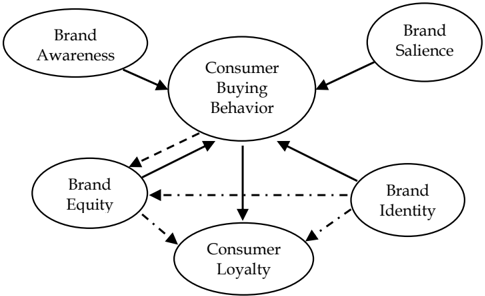
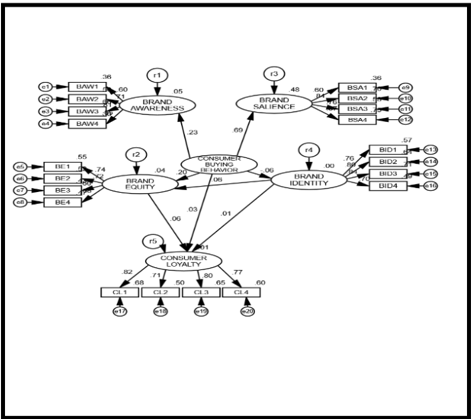
- Brand awareness, brand equity, and brand salience each positively influenced consumer buying behavior: H1 CR = 4.081, H2 CR = 4.387, H3 CR = 6.245 (all above the 1.96 threshold; = 1% significance).
- Brand identity alone did not significantly influence consumer buying behavior (H4 estimate = -0.452, CR = -0.757, rejected), and consumer buying behavior did not directly affect consumer loyalty (H5 estimate = 0.252, CR = 0.442, rejected).
- Brand equity significantly mediated consumer buying behavior → consumer loyalty (H6 estimate = 0.187, CR = 2.163*), while brand identity alone did not mediate (H7 estimate = 0.011, CR = 0.834, rejected); combined brand identity and brand equity mediation was supported (H8 estimate = 1.272, CR = 1.953*).
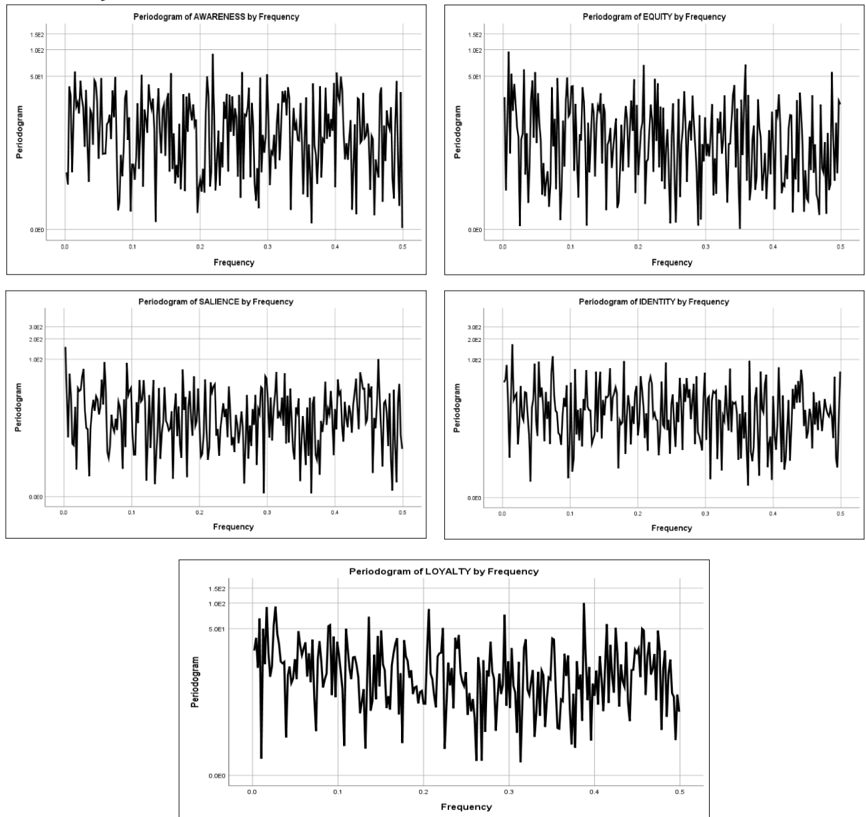
- Spectral analysis indicated brand awareness was volatile and sensitive to frequent promotions, brand equity was more stable and reflected long-term attachment/superior loyalty, and brand salience showed short-term, less consistent responses.
Methods
- Cross-sectional survey of rural FMCG consumers in Tamil Nadu, India; population unknown, convenience sampling used; 485 valid questionnaires collected directly and by e-mail from retail outlets.
- Self-administered questionnaire with 5 dimensions (4 independent, 1 dependent) and 20 items measured on a five-point Likert scale; pilot study with 50 local customers yielded Cronbach’s alpha = 0.834.
- Analysis included structural equation modeling/path analysis (Chi-square = 1.868; RMSEA = 0.042; GFI = 0.942; AGFI = 0.925; CFI = 0.962; IFI = 0.962), reliability/validity checks, compare mean tests (paired sample t-test and one-way ANOVA), and Tukey-Hamming spectral analysis.
Limitations
- Stated: the study is context-specific to rural customers only, so results cannot be generalized to all FMCG customers; non-probability sampling and a single geographic area limit validity; future research should use a larger sample, cross-sectional design, other locations, and other tools.
- Evident: the paper reports AVE values below the 0.5 threshold for Brand Awareness (0.46) and Brand Equity (0.49), although composite reliability values were above 0.70; the paper itself notes these AVE values.
Model-written summary. Check it against the paper before relying on it.
Integrity signals
Registry
Cites
Statistics
Figures
Verification
Claims the paper makes
1 Valid · 2 Not valid · 16 Not checked · 37 Own results and interpretations
The cited sources support only part of this claim — read each source’s verdict below.
In the paper
“Also, brand equity significantly and positively mediates consumer buying behavior and consumer loyalty, which corroborated the outcome of (Raut et al., 2019) who identified the role of brand equity in brand trust and brand satisfaction in the mobile industry.”
- Also stated in: § 4. Discussion · plain
“brand equity significantly and positively mediates consumer buying behavior and consumer loyalty”
§ Which Mediates Consumer buying Behavior in FMCG Sector? -Brand Identity or Brand Equity-A Rural Consumer Perspective in Tamilnadu, India O que media o comportamento de compra do consumidor no setor de bens de consumo de movimento rápido? -Identidade da marca ou valor da marca -Uma perspectiva do consumidor > 4. Discussion
What the sources say
- Partly supportedcites Raut et al., 2019 matched to “Mediating model of brand equity and its application” (2019) sourceExperimental — accuracy not yet measured
The Abstract describes a survey of cell-phone users and says the model identifies the roles of brand trust and brand satisfaction in brand equity. The discussion under RA2 identifies trust and satisfaction—not brand equity—as mediators between brand equity antecedents and outcomes. It does not establish that brand equity positively and significantly mediates between consumer buying behavior and loyalty. (LLM, conf=0.88)
plainstates a cause- Asserted: passes — The authors put it forward as true.
- Checkable: passes — It can be checked against evidence.
- Load-bearing: passes — The paper’s conclusions depend on it.
- Based: passes — The paper gives a reason why it holds.
- Also stated in: § 4. Discussion · plain
A result the paper reports from its own data — it cites no other source for it, so there is none to check. The quote shows it is in the paper.
In the paper
“The one-way ANOVA result showed a noteworthy relationship between academic qualification and all the factors and loyalty except for the brand identity”
§ Which Mediates Consumer buying Behavior in FMCG Sector? -Brand Identity or Brand Equity-A Rural Consumer Perspective in Tamilnadu, India O que media o comportamento de compra do consumidor no setor de bens de consumo de movimento rápido? -Identidade da marca ou valor da marca -Uma perspectiva do consumidor > 3.4. Compare mean analysis
plainstates an association- Asserted: passes — The authors put it forward as true.
- Checkable: passes — It can be checked against evidence.
- Load-bearing: unclear — It is unclear whether the paper’s conclusions depend on it.
- Based: passes — The paper gives a reason why it holds.
A result the paper reports from its own data — it cites no other source for it, so there is none to check. The quote shows it is in the paper.
In the paper
“This study result showed that there is a strong and positive association between this one and consumer buying behavior”
- Also stated in: § 3.2. Structural Equation Modeling · plain
“Hence, the hypotheses H1, H2, H3, H6, and H8 were accepted.”
§ Which Mediates Consumer buying Behavior in FMCG Sector? -Brand Identity or Brand Equity-A Rural Consumer Perspective in Tamilnadu, India O que media o comportamento de compra do consumidor no setor de bens de consumo de movimento rápido? -Identidade da marca ou valor da marca -Uma perspectiva do consumidor > 4. Discussion
boostedstates a cause- Asserted: passes — The authors put it forward as true.
- Checkable: passes — It can be checked against evidence.
- Load-bearing: passes — The paper’s conclusions depend on it.
- Based: passes — The paper gives a reason why it holds.
- Also stated in: § 3.2. Structural Equation Modeling · plain
A result the paper reports from its own data — it cites no other source for it, so there is none to check. The quote shows it is in the paper.
In the paper
“Also, there witnessed a significant association between consumer buying behavior and consumer loyalty through brand equity and brand identity as the values are statistically significant at a 5% level of significance.”
- Also stated in: § 3.2. Structural Equation Modeling · plain
“Hence, the hypotheses H1, H2, H3, H6, and H8 were accepted.”
§ Which Mediates Consumer buying Behavior in FMCG Sector? -Brand Identity or Brand Equity-A Rural Consumer Perspective in Tamilnadu, India O que media o comportamento de compra do consumidor no setor de bens de consumo de movimento rápido? -Identidade da marca ou valor da marca -Uma perspectiva do consumidor > 3.2. Structural Equation Modeling
plainstates a cause- Asserted: passes — The authors put it forward as true.
- Checkable: passes — It can be checked against evidence.
- Load-bearing: passes — The paper’s conclusions depend on it.
- Based: passes — The paper gives a reason why it holds.
- Rests on an assumption not shown here.
- Also stated in: § 3.2. Structural Equation Modeling · plain
A result the paper reports from its own data — it cites no other source for it, so there is none to check. The quote shows it is in the paper.
In the paper
“followed by monthly income with brand awareness, brand equity, and brand identity along with the age and brand equity, brand loyalty at a 5% level of significance.”
§ Which Mediates Consumer buying Behavior in FMCG Sector? -Brand Identity or Brand Equity-A Rural Consumer Perspective in Tamilnadu, India O que media o comportamento de compra do consumidor no setor de bens de consumo de movimento rápido? -Identidade da marca ou valor da marca -Uma perspectiva do consumidor > 3.4. Compare mean analysis
plainstates an association- Asserted: passes — The authors put it forward as true.
- Checkable: passes — It can be checked against evidence.
- Load-bearing: unclear — It is unclear whether the paper’s conclusions depend on it.
- Based: passes — The paper gives a reason why it holds.
23 more claims
Create a free account to see all 56 claims and to verify the 6 references still open.
- The quote only partly states this claim. 3
- It may state two separate claims as one. 12
- Probably not a substantial claim. 16
Self-check
Percentages, sums and reported differences re-computed from the paper’s own numbers.
Each contradiction between two passages listed here was confirmed by an independent check.
Rated major: it would touch a result — a value a result rests on, reported and recomputed p-values on opposite sides of the significance level, two passages that conflict with no sign which is right, or a cited work retracted before this paper was published.
In the paper
§ Which Mediates Consumer buying Behavior in FMCG Sector? -Brand Identity or Brand Equity-A Rural Consumer Perspective in Tamilnadu, India O que media o comportamento de compra do consumidor no setor de bens de consumo de movimento rápido? -Identidade da marca ou valor da marca -Uma perspectiva do consumidor > 6. Limitations and extent of further research
“| H8 | Consumer Buying Behavior → Consumer Loyalty | 1.272 | 1.953* | Supported |”
§ Which Mediates Consumer buying Behavior in FMCG Sector? -Brand Identity or Brand Equity-A Rural Consumer Perspective in Tamilnadu, India O que media o comportamento de compra do consumidor no setor de bens de consumo de movimento rápido? -Identidade da marca ou valor da marca -Uma perspectiva do consumidor > 6. Limitations and extent of further research
“CR≥ 1.96 supported”
Rated major: it would touch a result — a value a result rests on, reported and recomputed p-values on opposite sides of the significance level, two passages that conflict with no sign which is right, or a cited work retracted before this paper was published.
In the paper
§ Which Mediates Consumer buying Behavior in FMCG Sector? -Brand Identity or Brand Equity-A Rural Consumer Perspective in Tamilnadu, India O que media o comportamento de compra do consumidor no setor de bens de consumo de movimento rápido? -Identidade da marca ou valor da marca -Uma perspectiva do consumidor > 5. Managerial Implications
“On the other hand, brand identity and brand equity have a significant impact on consumer buying behavior and loyalty”
§ Which Mediates Consumer buying Behavior in FMCG Sector? -Brand Identity or Brand Equity-A Rural Consumer Perspective in Tamilnadu, India O que media o comportamento de compra do consumidor no setor de bens de consumo de movimento rápido? -Identidade da marca ou valor da marca -Uma perspectiva do consumidor > 6. Limitations and extent of further research
“| H4 | Brand Identity → Consumer Buying Behavior | -0.452 | -0.757 | Rejected |”
Rated minor: it would not touch a result — a value no result rests on, a p-value that stays on the same side of the significance level, or a conflict that is clerical, resolved elsewhere in the paper, or outside its own findings.
In the paper
§ Which Mediates Consumer buying Behavior in FMCG Sector? -Brand Identity or Brand Equity-A Rural Consumer Perspective in Tamilnadu, India O que media o comportamento de compra do consumidor no setor de bens de consumo de movimento rápido? -Identidade da marca ou valor da marca -Uma perspectiva do consumidor > 6. Limitations and extent of further research
“| 02. | | 21-50 years | 202 | 41.65 |”
§ Which Mediates Consumer buying Behavior in FMCG Sector? -Brand Identity or Brand Equity-A Rural Consumer Perspective in Tamilnadu, India O que media o comportamento de compra do consumidor no setor de bens de consumo de movimento rápido? -Identidade da marca ou valor da marca -Uma perspectiva do consumidor > 6. Limitations and extent of further research
“| | | 41-50 years | 193 | 39.79 |”
Rated minor: it would not touch a result — a value no result rests on, a p-value that stays on the same side of the significance level, or a conflict that is clerical, resolved elsewhere in the paper, or outside its own findings.
In the paper
§ Which Mediates Consumer buying Behavior in FMCG Sector? -Brand Identity or Brand Equity-A Rural Consumer Perspective in Tamilnadu, India O que media o comportamento de compra do consumidor no setor de bens de consumo de movimento rápido? -Identidade da marca ou valor da marca -Uma perspectiva do consumidor > 2.2.3. Brand equity and Consumer Buying Behavior
“H3 Brand equity positively influencing the Consumer Buying Behavior in FMCG sector”
§ Which Mediates Consumer buying Behavior in FMCG Sector? -Brand Identity or Brand Equity-A Rural Consumer Perspective in Tamilnadu, India O que media o comportamento de compra do consumidor no setor de bens de consumo de movimento rápido? -Identidade da marca ou valor da marca -Uma perspectiva do consumidor > 6. Limitations and extent of further research
“| H3 | Brand Salience →Consumer Buying Behavior | 3.676 | 6.245** | Supported |”
Rated minor: it would not touch a result — a value no result rests on, a p-value that stays on the same side of the significance level, or a conflict that is clerical, resolved elsewhere in the paper, or outside its own findings.
In the paper
§ Which Mediates Consumer buying Behavior in FMCG Sector? -Brand Identity or Brand Equity-A Rural Consumer Perspective in Tamilnadu, India O que media o comportamento de compra do consumidor no setor de bens de consumo de movimento rápido? -Identidade da marca ou valor da marca -Uma perspectiva do consumidor > 2.2.1. Brand Awareness and Consumer Buying Behavior
“H2 Brand Salience positively influencing the Consumer Buying Behavior in FMCG sector.”
§ Which Mediates Consumer buying Behavior in FMCG Sector? -Brand Identity or Brand Equity-A Rural Consumer Perspective in Tamilnadu, India O que media o comportamento de compra do consumidor no setor de bens de consumo de movimento rápido? -Identidade da marca ou valor da marca -Uma perspectiva do consumidor > 6. Limitations and extent of further research
“| H2 | Brand Equity → Consumer Buying Behavior | 0.042 | 4.387** | Supported |”
Citations
Cites
Evaluating Structural Equation Models with Unobservable Variables and Measurement Error
Fornell, C., & Larcker, D. F. (1981) · Journal of Marketing Research · doi:10.2307/3151312 · Cited by 109,314
Evaluating structural equation models with unobservable variables and measurement error
Fornell, C., & Larcker, D. F. (1981) · Journal of Marketing Research · doi:10.1177/002224378101800104 · Cited by 109,190
Dimensions of Brand Personality
Aaker, J. L. (1997) · Journal of Marketing Research · doi:10.1177/002224379703400304 · Cited by 4,033
Developing and validating a multidimensional consumer-based brand equity scale
Yoo, B., & Donthu, N. (2001) · Journal of Business Research · doi:10.1016/s0148-2963(99)00098-3 · Cited by 2,975
Cheung, G. W., Cooper-Thomas, H. D., Lau, R. S., & Wang, L. C. (2024) · Asia Pacific Journal of Management · doi:10.1007/s10490-023-09871-y · Cited by 2,262
Shams, S. M. R., Chatterjee, S., & Chaudhuri, R. (2024) · Journal of Business Research · doi:10.1016/j.jbusres.2024.114689 · Cited by 227
Conceptualizing and measuring brand salience
Romaniuk, J., & Sharp, B. (2004) · Marketing Theory · doi:10.1177/1470593104047643 · Cited by 213
Acar, A., Büyükdağ, N., Türten, B., Diker, E., & ÇALIŞIR, G. (2024) · Humanities and Social Sciences Communications · doi:10.1057/s41599-024-03618-w · Cited by 126
Sohaib, M., Mlynarski, J., & Wu, R. T. (2022) · Sustainability · doi:10.3390/su15010746 · Cited by 115
How does consumer engagement evolve when brands post across multiple social media?
Unnava, V., & Aravindakshan, A. (2021) · Journal of the Academy of Marketing Science · doi:10.1007/s11747-021-00785-z · Cited by 110
Research works printed but not linked: 17
- 3. Ahada, R., Dhahri, I., & Shreifeen, A.A.I. (2025). Brand Equity on Consumer Purchasing Decisions. International Journal of Economic Literature, 3(4), 185-196.
- 5. Akhtar, M., Ain, U. A., Siddiqi, I. U., Ashraf, A., & Latif, M. (2016). Impact of a Brand Equity on Consumer Purchase Decision in L'Oreal Skincare Products. International Review of Management and Business Research, 5(3), 808-816.
- 7. Ali, W., & Mehmood, A. (2023). Consumer Behavior and Brand Loyalty in the Fast Moving Consumer Goods Industry. Competitive Research Journal Archives, 1(1), 119-128.
- 10. Chauhan, S. J. (2018). Brand Loyalty and Its Impact on Repeat Purchase Behaviour of Customers: A Cross-Sectional Study in the FMCG Context. Psychology and Education, 55(1), 684-692.
- 17. Hair, J. F., Black, W. C., Babin, B. J., & Anderson, R. E. (2009). Multivariate data analysis. (7th ed.). Prentice-Hall.
- 279-296. https://doi.org/10.1108/JPBM-07-2023-4600 · DOI
- 21. Jeyalakshmi, R., Kengatharan, N., Gopalakrishnan., & Manikandan. (2020). Influence Of Brand Awareness On Customers Buying Behaviour. Ilkogretim Online -Elementary Education Online, 19(2), 2133-2143. https://doi.org/10.17051/ilkonline.2020.02.696797 · doi:10.17051/ilkonline.2020.02.696797
- 22. Jha, M. (2013). Brand Awareness and Consumer Preference with Reference To FMCG Sector In Rural Bihar. International Journal of Advanced Research in Management and Social Sciences, 2(11), 75-85.
- 28. Lunawat, D., & Antony, R. (2024). Impact of Consumer behavior on Brand Loyalty: A Study on select FMCG brands in the Rural Region of Cochin, Kerala. Academy of Marketing Studies Journal, 28(1), 1-9.
- 33. Naeini, B. A., Mosayebi, A., & Hamidi, A. (2017). A study of brand identity and its impact on brand loyalty and brand equity. International Journal of Contemporary Applied Sciences, 4(3), 90-104.
- 35. Nibsaiya, S., Sumithra, C. G., & Kumar, M. (2021). Impact of Brand Awareness and Brand Loyalty on Consumer Purchase decision: A study on FMCG products. IUJ Journal of Management, 9(1), 174-186. https://eoi.citefactor.org/10.11224/IUJ.09.01.12 · doi:10.11224/iuj.09.01.12
- 38. Prakash, V., & Raunaque, N. (2025). A Study on Consumer Behaviour Towards FMCG Products in Rural Areas of Patna District. Journal of Marketing & Social Research, 2(5), 236-243.
- 39. Prakash, V., & Raunaque, N. (2025). Key Behavioural Factors Influencing Buying Decisions of the Rural Consumers towards FMCG Products: Insights from the Literature. International Journal of Science, Engineering and Management, 12(6), 12-14.
- 43. Safiih, L. M., & Azreen, M. A. N. (2016). "Confirmatory Factor Analysis Approach: A Case Study of Mathematics Students' Achievement in TIMSS". Malaysian Journal of Mathematical Sciences, 10(S), 46.
- 46. Shakeel, S. & Nedumaran, G. (2024). Influence of Brand Name on Customer Buying Decision towards an Emerging Mobile Phone Market in Hyderabad. International journal of Emerging Knowledge Studies, 3(2), 73-79.
- 49. Ullah, M. M., Jan, F. M., & Jan, F. M. (2018). Elements of Brand Salience and Its Impacts on Buying Behavior and Sales. Abasyn Journal of Social Sciences, 4(2), 381-395.
- 54. Washington, M., Barquet-Arenas, G., & Jazmín, A. Y. (2024). Brand equity and purchase decision of fast-moving consumer goods. Tec Empresarial, 18(2), 97-114. https://dx.doi.org/10.18845/te.v18i2.7142 · DOI
Metadata
- Authors
- Selvarani, M., & Selvalakshmi, G.
- Affiliations
- SASTRA University (IN)
- ORCID
- Selvalakshmi, G.
- Venue
- European Public & Social Innovation Review
- Publisher
- Forum XXI
- Published
- 2026-02-20
- Volume
- 11
- Pages
- 1-21
- ISSN
- 2529-9824 (ISSN-L)
- OpenAlex
- W7130691675
- Semantic Scholar
- dd7cb3fcacfe0e685b70ac8adb23f40c142935b9
- Cited by
- 0
- References
- 39
- FWCI
- 0.00
- Type
- journal article
- Language
- en
- Open access
- diamond
- doi.org
- Licence
- Locations
- European Public & Social Innovation Review (publishedVersion, cc-by-nc-nd)
- Topics
- Social Sciences › Business, Management and Accounting › Marketing › Consumer Behavior in Brand Consumption and Identification
- Social Sciences › Business, Management and Accounting › Marketing › Consumer Behavior and Marketing Influence
- Social Sciences › Business, Management and Accounting › Marketing › Marketing and Advertising Strategies
- Keywords
- consumer buying behavior, brand identity, brand equity, fast-moving consumer goods, rural consumers, customer loyalty, brand awareness, brand salience, brand positioning, Tamil Nadu
About these checks
Registry, retraction, Cites and statistics results are computed, not judged, with one exception: a printed reference that no index lists is read once by a model before it counts as a citation error. Claims are extracted by a model and kept only when their quote appears verbatim in the text; each cited source is then checked, with a model’s help, for whether it says what the claim relies on. Those verdicts can be wrong — read the claim’s quote and the cited source before relying on one.
The claim verdicts this report counts are experimental: their accuracy is not yet measured.
A language model drew the claims from the paper on 2026-10-10, under version 3 of the claim definition (model deepseek-v4.1-flash, prompt extract-v3).
A second model labelled each claim on 2026-10-10 (model jev-1.13-20260917, definition revision gold-guideline-v0.2).
Cited sources are checked with a language model’s help (gpt-6-sol).
Statistics and arithmetic are recomputed, not judged.
Confidence bands are shown only for fields calibrated on our annotated test set. None is calibrated yet, so no band is shown.
What counts as a claim ›How we measure confidence ›How we check this ›
Are you an author, or do you see a problem with this page? Request a review
How to cite
Cite CoChat for the checks on this page, and the paper for its own findings.
- This page
- CoChat. (2026). Citation check: Which Mediates Consumer buying Behavior in FMCG Sector? - Brand Identity or Brand Equity - A Rural Consumer Perspective in Tamilnadu, India. https://app.cochat.ai/papers/10.31637/epsir-2026-2468
- The paper
- Selvarani, M., & Selvalakshmi, G. (2026). Which Mediates Consumer buying Behavior in FMCG Sector? - Brand Identity or Brand Equity - A Rural Consumer Perspective in Tamilnadu, India. European Public & Social Innovation Review. https://doi.org/10.31637/epsir-2026-2468
Data sources
Bibliographic data: Semantic Scholar, OpenAlex, Crossref.
Contains information from the Semantic Scholar Academic Graph Datasets, made available under the ODC Attribution License (ODC-BY 1.0).
Semantic Scholar’s data is described in: Kinney, R., et al. (2023). The Semantic Scholar Open Data Platform. arXiv:2301.10140.
