

The DOI matches its Crossref record; 89 of the 89 references it cites were found in a registry or an index.
On the role of corticotropin-releasing hormone receptors in anxiety and depression
Open accessAbstract
On the basis of extensive basic and clinical studies, corticotropin-releasing hormone (CRH) and its related family members are considered to play a pivotal role in stress-related disorders, such as anxiety and depression. CRH is regarded as the principal mediator in the brain of the stress response, as it mediates neuroendocrine, autonomic, and behavioral responses to stressful challenges. Recently, this neuropeptide family has expanded due to the discovery of two new members, urocortin II (also termed stresscopin-related peptide) and urocortin III (also termed stresscopin), which are selective agonists for the CRH receptor type 2. They show a discrete neuroanatomical localization and are involved in stress-coping responses, such as anxiolysis. Here, on the basis of recent developments, we suggest that CRH, the urocortins, and their receptors form a complex system in the brain, which is recruited during both the acute and the recovery phases of the stress response.
Overview
The claims and statistics of this paper haven’t been checked yet.
Run the check — free, no account needed. It reads the open-access text and checks the sources it cites.
Integrity signals
Registry
Cites
Statistics
Figures
Verification
Claims the paper makes
The claims and statistics of this paper haven’t been checked yet.
Run the check — free, no account needed. It reads the open-access text and checks the sources it cites.
Claims other papers make about this one
Each is checked against this paper’s own text: does it say what the citing paper says it does?
The cited source says what the claim attributes to it.
In the citing paper
“The neuropeptide corticotropin-releasing factor (CRF) mediates behavioral and endocrine responses to stress and acts on CRF type 1 (CRF1) and CRF type 2 (CRF2) receptors [168].”
From The Neurobiology of Love and Pair Bonding from Human and Animal Perspectives (2023) · cites this paper as [168]
Self-check
Percentages, sums and reported differences re-computed from the paper’s own numbers.
The self-check needs the paper’s full text.
Citations
Cites
Vale, W., Spiess, J., Rivier, C., & Rivier, J. (1981) · Science · doi:10.1126/science.6267699 · Cited by 3,965
Brain corticosteroid receptor balance in health and disease
de Kloet, E. R., Vreugdenhil, E., Oitzl, M. S., & Joëls, M. (1998) · Endocrine Reviews · doi:10.1210/edrv.19.3.0331 · Cited by 2,614 · cited 4×
“The cause for the aberrant—in most cases, hyperactive—HPA axis is presumably a hyperactive central CRH system (for review, see references 24, 30, and 69 to 71) and defunct brain and pituitary corticosteroid receptor systems.(66,72,73) Although it was more than a decade ago that a reduced CRH receptor density was found…”
BackgroundInfluentialTwo receptor systems for corticosterone in rat brain: Microdistribution and differential occupation
REUL, J. M. H. M., & KLOET, E. R. D. (1985) · Endocrinology · doi:10.1210/endo-117-6-2505 · Cited by 2,580 · cited 4×
“They can be distinguished in two types of glucocorticoid-binding receptors: the mineralocorticoid receptor (MR or type I) and the glucocorticoid receptor (GR or type II).(83) MRs are mainly localized in the hippocampus, whereas GRs have a widespread distribution in the CNS.”
BackgroundInfluentialThe Corticosteroid Receptor Hypothesis of Depression
Holsboer, F. (2000) · Neuropsychopharmacology · doi:10.1016/s0893-133x(00)00159-7 · Cited by 2,181
Hypothalamic integration: organization of the paraventricular and supraoptic nuclei
Swanson, L. W., & Sawchenko, P. E. (1983) · Annual Review of Neuroscience · doi:10.1146/annurev.ne.06.030183.001413 · Cited by 1,991
Swanson, L. W., Sawchenko, P. E., Rivier, J., & Vale, W. W. (2008) · Neuroendocrinology · doi:10.1159/000123454 · Cited by 1,953
Nemeroff, C. B., Widerlöv, E., Bissette, G., Walléus, H., Karlsson, I., Eklund, K., Kilts, C. D., Loosen, P. T., & Vale, W. (1984) · Science · doi:10.1126/science.6334362 · Cited by 1,485
Vaughan, J. M., Donaldson, C. J., Bittencourt, J. C., Perrin, M. H., Lewis, K., Sutton, S. W., Chan, R. K. W., Turnbull, A. V., Lovejoy, D. A., RIVIER, C. L., et al. (1995) · Nature · doi:10.1038/378287a0 · Cited by 1,479
Physiology and pharmacology of corticotropin-releasing factor.
Owens, M. J., & Nemeroff, C. B. (1991) · Pharmacological Reviews · doi:10.1016/s0031-6997(25)06673-6 · Cited by 1,147 · cited 1×
“CRH is highly implicated in the regulation of anxietyrelated behavior and is thought to play a pivotal role in anxiety and depressive disorders.(24,30,31) Several lines of evidence point to the participation of CRHR1 in the effects of CRH.”
BackgroundChalmers, D., Lovenberg, T. W., & Souza, E. D. (1995) · Journal of Neuroscience · doi:10.1523/jneurosci.15-10-06340.1995 · Cited by 925 · cited 3×
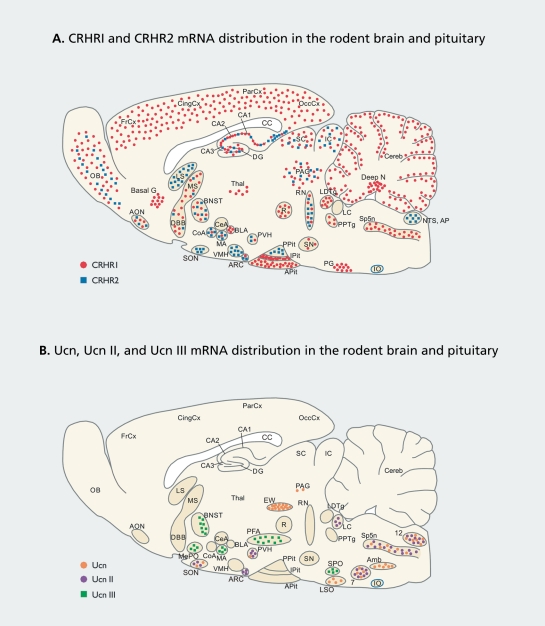
“The presented mRNA distribution is based on in situ hybridization studies.(12,14,16,20-23) The drawn sagittal sections are only 2D schematic representations and, therefore, cannot be neuroanatomically exact.”
Background
Research works printed but not linked: 11
- Holsboer F., 1984, N Engl J Med., 311, 1127
- Lederis K., 1982, Proc West Pharmacol Soc., 25, 223
- Owens MJ., 1991, Pharmacol Rev., 43, 425
- Okuyama S., 1999, J Pharmacol Exp Then., 289, 926
- Heinrichs SC., 2000, Soc Neurosci Abst., 26, 2149
- Fiorino DF., 2000, Soc Neurosci Abst., 26, 2265
- Valdez GR., 2001, Soc Neurosci Abst., 27.Abstract num
- Held K., 2001, J Psychiatr Res. in press
- Steckler T., 1999, Baillieres Clin Endocrinol Metab., 13, 107
- Davis M., 1992, The Amygdala. New York, NY: Wiley-Liss;, 255
- Gray TS., 1990, Corticotropin-releasing Factor: Basic and Clinical studies of a Neuropeptide. Boca Raton, Fia: CRC Press;, 53
Cited by
Sorted by citations
The neurobiology and control of anxious states
Millan, M. J. (2003) · Progress in Neurobiology · doi:10.1016/s0301-0082(03)00087-x · Cited by 978
Sex differences in anxiety and depression: Role of testosterone
McHenry, J. A., Carrier, N., Hull, E. M., & Kabbaj, M. (2013) · Frontiers in Neuroendocrinology · doi:10.1016/j.yfrne.2013.09.001 · Cited by 526
Pathophysiology of depression and mechanisms of treatment
Brigitta, B. (2002) · Dialogues in Clinical Neuroscience · doi:10.31887/dcns.2002.4.1/bbondy · Cited by 286
Pharmacological Treatment of Anxiety Disorders: The Role of the HPA Axis
Tafet, G. E., & Nemeroff, C. B. (2020) · Frontiers in Psychiatry · doi:10.3389/fpsyt.2020.00443 · Cited by 216
“These steroid hormones exert their effects through binding to mineralocorticoid receptors (MRs or type I) and glucocorticoid receptors (GRs or type II), constituting a hormone-receptor complex, which in turn may interact with specific DNA sequences located in the promoter region of target genes, termed glucocorticoid…”
BackgroundInfluentialSculpting the hippocampus from within: stress, spines, and CRH
Maras, P. M., & Baram, T. Z. (2012) · Trends in Neurosciences · doi:10.1016/j.tins.2012.01.005 · Cited by 183
“CRHR1 and CRHR2 differ in their distribution [37,43,44], as well as their role in mediating behavioral and endocrine responses to stress [45,46].”
Background
Metadata
- Authors
- Reul, J. M. H. M., & Holsboer, F.
- Affiliations
- Max Planck Institute of Psychiatry (DE)
- Corresponding author
- Reul, Johannes M. H. M.
- Venue
- Dialogues in Clinical Neuroscience
- Publisher
- Informa UK Limited
- Published
- 2002-03-31
- Volume
- 4
- Issue
- 1
- Pages
- 31-46
- ISSN
- 1294-8322 (ISSN-L)
- 1958-5969
- PMC
- PMC3181666
- OpenAlex
- W4294249858
- Cited by
- 103
- References
- 85
- Citations by year
- 2026: 3 · 2025: 8 · 2024: 16 · 2023: 8 · 2022: 5 · 2021: 8 · 2020: 5 · 2019: 9 · 2018: 8 · 2017: 6 · 2016: 4 · 2015: 7 · 2014: 5 · 2013: 3 · 2012: 6
- FWCI
- 0.28
- Type
- journal article
- Language
- en
- Open access
- diamond
- doi.org
- Licence
- Locations
- Dialogues in Clinical Neuroscience (publishedVersion, cc-by-nc-nd)
- Europe PMC (PubMed Central) (publishedVersion, cc-by-nc-nd)
- PubMed Central (publishedVersion, cc-by-nc-nd)
- PubMed (publishedVersion)
- Bristol Research (University of Bristol) (publishedVersion)
- PubMed
- Topics
- Life Sciences › Neuroscience › Behavioral Neuroscience › Stress Responses and Cortisol
- Life Sciences › Neuroscience › Cellular and Molecular Neuroscience › Neuropeptides and Animal Physiology
- Life Sciences › Neuroscience › Endocrine and Autonomic Systems › Neuroendocrine regulation and behavior
- Keywords
- corticotropin-releasing factor, CRH receptors, urocortin II, stress response, anxiety, depression, stress coping, anxiolysis, neuroendocrine stress response, neuropeptides
About these checks
Registry, retraction, Cites and statistics results are computed, not judged, with one exception: a printed reference that no index lists is read once by a model before it counts as a citation error. Claims are extracted by a model and kept only when their quote appears verbatim in the text; each cited source is then checked, with a model’s help, for whether it says what the claim relies on. Those verdicts can be wrong — read the claim’s quote and the cited source before relying on one.
Statistics and arithmetic are recomputed, not judged.
Confidence bands are shown only for fields calibrated on our annotated test set. None is calibrated yet, so no band is shown.
What counts as a claim ›How we measure confidence ›How we check this ›
Are you an author, or do you see a problem with this page? Request a review
