

The DOI matches its Crossref record; 125 of the 125 references it cites were found in a registry or an index.
Cellular and molecular mechanisms in the long-term action of antidepressants.
Open accessAbstract
The hypotheses on the pathophysiology of depression/mood disorders and on antidepressant mechanisms have greatly changed in recent years. The classical monoamine hypothesis was revealed to be simplistic, in that it could not explain the temporal delay in the therapeutic action of antidepressants. Converging lines of evidence have shown that adaptive changes in the several mechanisms of neuroplasticity are likely to be the cellular and molecular correlates of therapeutic effect. In this article, several mechanisms of neuroplasticity are analyzed in relation to the mechanism of antidepressants, ranging from changes in gene expression (including neurotrophic mechanisms), to synaptic transmission and plasticity, and neurogenesis. We propose that the current version of the hypothesis of antidepressant mechanism simply be called the "hypothesis of neuroplasticity". In the final section, we also briefly review the main current novel strategies in the pharmacology of depression and the new putative targets for antidepressants, with particular emphasis on nonmonoaminergic mechanisms.
Overview
The claims and statistics of this paper haven’t been checked yet.
Run the check — free, no account needed. It reads the open-access text and checks the sources it cites.
Integrity signals
Registry
Cites
Statistics
Figures
Verification
Claims the paper makes
The claims and statistics of this paper haven’t been checked yet.
Run the check — free, no account needed. It reads the open-access text and checks the sources it cites.
Claims other papers make about this one
Each is checked against this paper’s own text: does it say what the citing paper says it does?
The source backs part of the claim, not all of it — or backs it for a different population, condition or comparison.
In the citing paper
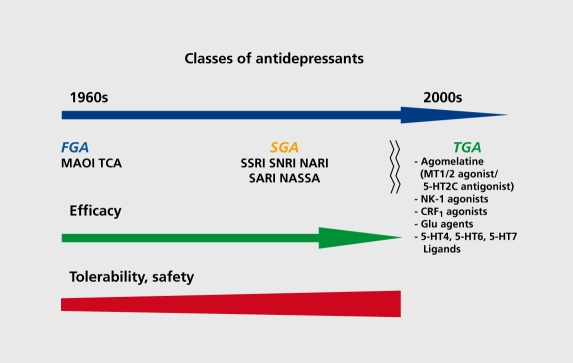
“Tricyclics, MAO inhibitors, and SSRIs all increase synaptic levels of monoamines in the brain within minutes, while it takes weeks before the antidepressant effects become apparent (Figure 1) (4, 9).”
From Psychedelics and Other Psychoplastogens for Treating Mental Illness. (2021) · cites this paper as [4]
Experimental — accuracy not yet measuredThe cited source says what the claim attributes to it.
In the citing paper
“the primary issue with the monoamine hypothesis of depression lies in the temporal discrepancy between the acute effects of traditional antidepressants and their delayed therapeutic responses”
From Psychedelics and Other Psychoplastogens for Treating Mental Illness. (2021) · cites this paper as [4]
Self-check
Percentages, sums and reported differences re-computed from the paper’s own numbers.
The self-check needs the paper’s full text.
Citations
Cites
Influence of life stress on depression: moderation by a polymorphism in the 5-HTT gene
Caspi, A., Sugden, K., Moffitt, T. E., Taylor, A., Craig, I. W., Harrington, H., McClay, J., Mill, J., Martin, J., Braithwaite, A., et al. (2003) · Science · doi:10.1126/science.1083968 · Cited by 8,120
Gage, F. H. (2000) · Science · doi:10.1126/science.287.5457.1433 · Cited by 4,786
Requirement of hippocampal neurogenesis for the behavioral effects of antidepressants
Santarelli, L., Saxe, M., Gross, C., Surget, A., Battaglia, F., Dulawa, S., Weisstaub, N., Lee, J., Duman, R., Arancio, O., et al. (2003) · Science · doi:10.1126/science.1083328 · Cited by 4,321
Antidepressant effects of ketamine in depressed patients
Berman, R. M., Cappiello, A., Anand, A., Oren, D. A., Heninger, G. R., Charney, D. S., & Krystal, J. H. (2000) · Biological Psychiatry · doi:10.1016/s0006-3223(99)00230-9 · Cited by 3,856
A randomized trial of an N-methyl-D-aspartate antagonist in treatment-resistant major depression.
Zarate, C. A., Singh, J. B., Carlson, P. J., Brutsche, N. E., Ameli, R., Luckenbaugh, D. A., Charney, D. S., & Manji, H. K. (2006) · Archives of General Psychiatry · doi:10.1001/archpsyc.63.8.856 · Cited by 3,766
A Neurotrophic Model for Stress-Related Mood Disorders
Duman, R. S., & Monteggia, L. M. (2006) · Biological Psychiatry · doi:10.1016/j.biopsych.2006.02.013 · Cited by 3,375
Subgenual prefrontal cortex abnormalities in mood disorders
Drevets, W. C., Price, J. L., Simpson, J. R., Todd, R. D., Reich, T., Vannier, M., & Raichle, M. E. (1997) · Nature · doi:10.1038/386824a0 · Cited by 2,693
Transcriptional regulation by the phosphorylation-dependent factor CREB
Mayr, B., & Montminy, M. (2001) · Nature Reviews Molecular Cell Biology · doi:10.1038/35085068 · Cited by 2,587
Synaptic Plasticity: Multiple Forms, Functions, and Mechanisms
Citri, A., & Malenka, R. C. (2008) · Neuropsychopharmacology · doi:10.1038/sj.npp.1301559 · Cited by 2,323
Essential role of BDNF in the mesolimbic dopamine pathway in social defeat stress
Berton, O., McClung, C. A., DiLeone, R. J., Krishnan, V., Renthal, W., Russo, S. J., Graham, D., Tsankova, N. M., Bolanos, C. A., Rios, M., et al. (2006) · Science · doi:10.1126/science.1120972 · Cited by 2,129
Research works printed but not linked: 10
- Olesen J., 2006, J Neurol Neurosurg Psychiatry., 77, i1
- Stahl SM., 1998, J Clin Psychiatry., 59, 5
- 10.1016/j.tips.2005.10.005 · DOI
- Ryan B., 2008, Int J Neuropsychopharmacol., 31, 1
- Qi H., 2008, Neuropharmacol.
- Popoli M., 2006, .
- Campbell S., 2004, J Psychiatry Neurosci., 29, 417
- Sahay A., 2007, Neurosci., 10, 1110
- 0lié JP., 2007, int J Neuropsychopharmacol., 10, 661
- Quera Salva MA., 2007, Int J Neuropsychopharmacol., 10, 691
Cited by
Sorted by citations
Towards a glutamate hypothesis of depression
Sanacora, G., Treccani, G., & Popoli, M. (2012) · Neuropharmacology · doi:10.1016/j.neuropharm.2011.07.036 · Cited by 1,036
Self-citationThe Role of BDNF on Neural Plasticity in Depression
Yang, T., Nie, Z., Shu, H., Kuang, Y., Chen, X., Cheng, J., Yu, S., & Liu, H. (2020) · Frontiers in Cellular Neuroscience · doi:10.3389/fncel.2020.00082 · Cited by 435
Neural basis of major depressive disorder: Beyond monoamine hypothesis
Boku, S., Nakagawa, S., Toda, H., & Hishimoto, A. (2018) · Psychiatry and Clinical Neurosciences · doi:10.1111/pcn.12604 · Cited by 402
Epigenetic regulation of RAC1 induces synaptic remodeling in stress disorders and depression
Golden, S. A., Christoffel, D. J., Heshmati, M., Hodes, G. E., Magida, J., Davis, K., Cahill, M. E., Dias, C., Ribeiro, E., Ables, J. L., et al. (2013) · Nature Medicine · doi:10.1038/nm.3090 · Cited by 322
From Serotonin to Neuroplasticity: Evolvement of Theories for Major Depressive Disorder
Liu, B., Liu, J., Wang, M., Zhang, Y., & Li, L. (2017) · Frontiers in Cellular Neuroscience · doi:10.3389/fncel.2017.00305 · Cited by 249
Metadata
- Authors
- Racagni, G., & Popoli, M.
- Affiliations
- University of Milan (IT)
- Corresponding author
- Popoli, Maurizio
- Venue
- Dialogues in Clinical Neuroscience
- Publisher
- Informa UK Limited
- Published
- 2008-12-31
- Volume
- 10
- Issue
- 4
- Pages
- 385-400
- ISSN
- 1294-8322 (ISSN-L)
- 1958-5969
- PMC
- PMC3181899
- OpenAlex
- W2095618681
- Cited by
- 192
- References
- 125
- Citations by year
- 2026: 6 · 2025: 26 · 2024: 12 · 2023: 5 · 2022: 14 · 2021: 13 · 2020: 7 · 2019: 7 · 2018: 5 · 2017: 10 · 2016: 13 · 2015: 8 · 2014: 16 · 2013: 10 · 2012: 10
- FWCI
- 7.03
- Type
- journal article
- Language
- en
- Open access
- diamond
- doi.org
- Licence
- Locations
- Dialogues in Clinical Neuroscience (publishedVersion, cc-by-nc-nd)
- Europe PMC (PubMed Central) (publishedVersion, cc-by-nc-nd)
- PubMed Central (publishedVersion, cc-by-nc-nd)
- PubMed (publishedVersion)
- Topics
- Health Sciences › Medicine › Pharmacology (medical) › Treatment of Major Depression
- Life Sciences › Neuroscience › Cellular and Molecular Neuroscience › Neuroscience and Neuropharmacology Research
- Life Sciences › Neuroscience › Cellular and Molecular Neuroscience › Neurotransmitter Receptor Influence on Behavior
- Keywords
- antidepressants, depression, mood disorders, neuroplasticity, antidepressant mechanism, monoamine hypothesis, gene expression, neurotrophic factors, synaptic plasticity, synaptic transmission, neurogenesis
- MeSH terms
- Animals, Antidepressive Agents, Depressive Disorder, Humans, Synaptic Transmission, Neuronal Plasticity, Neurons, Biogenic Monoamines, Brain-Derived Neurotrophic Factor, Cell Proliferation
About these checks
Registry, retraction, Cites and statistics results are computed, not judged, with one exception: a printed reference that no index lists is read once by a model before it counts as a citation error. Claims are extracted by a model and kept only when their quote appears verbatim in the text; each cited source is then checked, with a model’s help, for whether it says what the claim relies on. Those verdicts can be wrong — read the claim’s quote and the cited source before relying on one.
Statistics and arithmetic are recomputed, not judged.
Confidence bands are shown only for fields calibrated on our annotated test set. None is calibrated yet, so no band is shown.
What counts as a claim ›How we measure confidence ›How we check this ›
Are you an author, or do you see a problem with this page? Request a review
