

The DOI matches its Crossref record; 251 of the 251 references it cites were found in a registry or an index.
Neural systems underlying approach and avoidance in anxiety disorders
Open accessAbstract
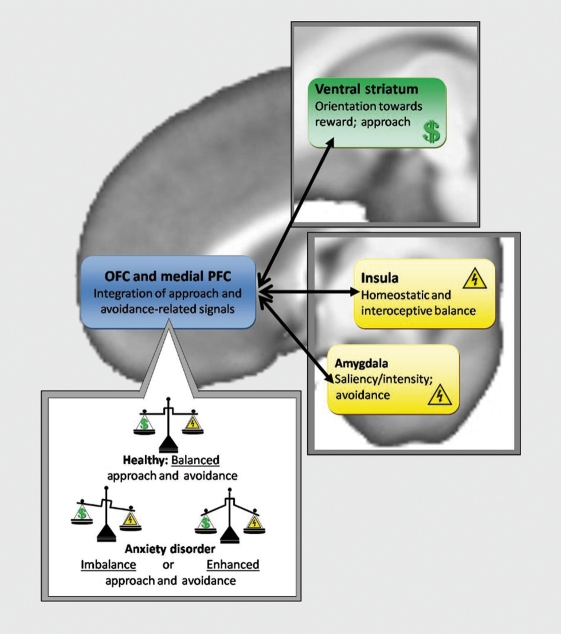
Approach-avoidance conflict is an important psychological concept that has been used extensively to better understand cognition and emotion. This review focuses on neural systems involved in approach, avoidance, and conflict decision making, and how these systems overlap with implicated neural substrates of anxiety disorders. In particular, the role of amygdala, insula, ventral striatal, and prefrontal regions are discussed with respect to approach and avoidance behaviors. Three specific hypotheses underlying the dysfunction in anxiety disorders are proposed, including: (i) over-representation of avoidance valuation related to limbic overactivation; (ii) under- or over-representation of approach valuation related to attenuated or exaggerated striatal activation respectively; and (iii) insufficient integration and arbitration of approach and avoidance valuations related to attenuated orbitofrontal cortex activation. These dysfunctions can be examined experimentally using versions of existing decision-making paradigms, but may also require new translational and innovative approaches to probe approach-avoidance conflict and related neural systems in anxiety disorders.
Overview
The claims and statistics of this paper haven’t been checked yet.
Run the check — free, no account needed. It reads the open-access text and checks the sources it cites.
Integrity signals
Registry
Cites
Statistics
Figures
Verification
Claims the paper makes
The claims and statistics of this paper haven’t been checked yet.
Run the check — free, no account needed. It reads the open-access text and checks the sources it cites.
Claims other papers make about this one
Each is checked against this paper’s own text: does it say what the citing paper says it does?
The source backs part of the claim, not all of it — or backs it for a different population, condition or comparison.
In the citing paper
“The PFC likely regulates play in a multifactorial manner, contributing to expression of the behavior through its roles in suppressing aggression, monitoring approach/avoid conflict, and modulating the stress response via its projections to the MeA and other stress-modulatory nodes (Aupperle & Paulus, 2010; McEwen & Morrison, 2013; Takahashi et al., 2014).”
From Developmental origins of sex differences in the neural circuitry of play (2020) · cites this paper as Aupperle & Paulus, 2010
Experimental — accuracy not yet measuredIn the citing paper
“For example, anxiety disorders and mood disorders share hyperactive amygdala responses to negatively valenced stimuli [2,3]”
From Reward circuitry dysfunction in psychiatric and neurodevelopmental disorders and genetic syndromes: animal models and clinical findings (2012) · cites this paper as [2]
Self-check
Percentages, sums and reported differences re-computed from the paper’s own numbers.
The self-check needs the paper’s full text.
Citations
Cites
LeDoux, J. E. (2000) · Annual Review of Neuroscience · doi:10.1146/annurev.neuro.23.1.155 · Cited by 8,444
Carver, C. S., & White, T. L. (1994) · Journal of Personality and Social Psychology · doi:10.1037/0022-3514.67.2.319 · Cited by 7,306 · cited 1×
“have been developed in attempts to further characterize animal and human conflict behavior and its relationship to psychopathology.(3,9-12) Avoidance has been implicated as a cardinal symptom of anxiety disorders(13) and is thought to be an underlying mechanism maintaining anxiety.”
How do you feel — now? The anterior insula and human awareness
(Bud) Craig, A. D. (2009) · Nature Reviews Neuroscience · doi:10.1038/nrn2555 · Cited by 6,657
How do you feel? Interoception: The sense of the physiological condition of the body
Craig, A. D. (2002) · Nature Reviews Neuroscience · doi:10.1038/nrn894 · Cited by 6,006
Emotional processing of fear: Exposure to corrective information.
Foa, E. B., & Kozak, M. J. (1986) · Psychological Bulletin · doi:10.1037/0033-2909.99.1.20 · Cited by 5,396 · cited 1×
“The majority of psychotherapies used to treat anxiety (eg, cognitive-behavioral and exposure-based therapies) aim to decrease such avoidance behavior.(14,15) Importantly, avoidance is an active choice process, ie, a decision that is made to sacrifice potential rewards in order to avoid potential negative outcomes.”
Meeting of minds: the medial frontal cortex and social cognition
Amodio, D. M., & Frith, C. D. (2006) · Nature Reviews Neuroscience · doi:10.1038/nrn1884 · Cited by 3,782
The reward circuit: linking primate anatomy and human imaging
Haber, S. N., & Knutson, B. (2010) · Neuropsychopharmacology · doi:10.1038/npp.2009.129 · Cited by 3,718
Functional neuroanatomy of emotion: A meta-analysis of emotion activation studies in PET and fMRI
Phan, K. L., Wager, T., Taylor, S. F., & Liberzon, I. (2002) · NeuroImage · doi:10.1006/nimg.2002.1087 · Cited by 3,502
Neural systems supporting interoceptive awareness
Critchley, H. D., Wiens, S., Rotshtein, P., Öhman, A., & Dolan, R. J. (2004) · Nature Neuroscience · doi:10.1038/nn1176 · Cited by 3,406
Etkin, A., & Wager, T. D. (2007) · American Journal of Psychiatry · doi:10.1176/appi.ajp.2007.07030504 · Cited by 3,391 · cited 5×
“The anxiety disorders literature provides evidence that the amygdala may be dysfunctional in signaling fear-related stimuli, but there is also initial evidence that this dysfunction may extend to salient stimuli in general.(47,79) Although the amygdala has not been the focus of neuroimaging research related to decisio…”
Influential
Research works printed but not linked: 4
- American Psychiatric Association.Diagnostic and Statistical Manual of Mental Disorders. 4th ed, Text Revision. Washington, DC: American Psychiatric Association;2000
- BarlowDH.Anxiety and its Disorders: the Nature and Treatment of Anxiety and Panic. New York, NY: Guilford Press; 2002
- SavageCR.The role of emotion in strategic behavior: insights from psychopathology. In: Barrett LF, Salovey P, Mayer J, eds.The Wisdom in Feeling: Psychological Processes in Emotional Intelligence. New York, NY: Guilford Press; 2002211236
- 10.1002/1520-6394(2000)12:1 <69::AID-DA9>3.0.CO;2-K · DOI
Cited by
Sorted by citations
Uncertainty and anticipation in anxiety: an integrated neurobiological and psychological perspective
Grupe, D. W., & Nitschke, J. B. (2013) · Nature Reviews Neuroscience · doi:10.1038/nrn3524 · Cited by 2,007
Emotion Regulation and Psychopathology
Sheppes, G., Suri, G., & Gross, J. J. (2015) · Annual Review of Clinical Psychology · doi:10.1146/annurev-clinpsy-032814-112739 · Cited by 1,214
Executive function and PTSD: disengaging from trauma.
Aupperle, R. L., Melrose, A. J., Stein, M. B., & Paulus, M. P. (2012) · Neuropharmacology · doi:10.1016/j.neuropharm.2011.02.008 · Cited by 657
“digms therefore offer a useful framework for teasing apart PFC dysfunction in PTSD and other anxiety disorders (Aupperle and Paulus, 2010).”
Self-citationThe GABA system in anxiety and depression and its therapeutic potential
Möhler, H. (2011) · Neuropharmacology · doi:10.1016/j.neuropharm.2011.08.040 · Cited by 627
“An enhanced amygdala activation and a hypoactivation of the orbitofrontal (OFC) and medial prefrontal cortex (mPFC) was frequently reported in patients during processing of negative emotional stimuli, in particular in SAD and PTSD but also in GAD (Aupperle and Paulus, 2010; Elman et al., 2009; Goldin et al., 2009; New…”
A Corticostriatal Path Targeting Striosomes Controls Decision-Making under Conflict
Friedman, A., Homma, D., Gibb, L. G., Amemori, K.-I., Rubin, S. J., Hood, A. S., Riad, M. H., & Graybiel, A. M. (2015) · Cell · doi:10.1016/j.cell.2015.04.049 · Cited by 309
“A uthor M anuscript A uthor M anuscript A uthor M anuscript A uthor M anuscript function remain largely unknown (Aupperle and Paulus, 2010).”
Metadata
- Authors
- Robin L., A., & Martin, P. P.
- Affiliations
- Department of Psychiatry, University of California, San Diego (UCSD), California, USA
- Psychiatry Service, Veterans Affairs San Diego Health Care System, San Diego, California, USA
- Venue
- Dialogues in Clinical Neuroscience
- Publisher
- Informa UK Limited
- Published
- 2010-12-31
- Volume
- 12
- Issue
- 4
- Pages
- 517-531
- ISSN
- 1294-8322 (ISSN-L)
- 1958-5969
- PMC
- PMC3181993
- OpenAlex
- W1574357942
- Cited by
- 227
- References
- 251
- Citations by year
- 2026: 17 · 2025: 18 · 2024: 18 · 2023: 22 · 2022: 25 · 2021: 18 · 2020: 21 · 2019: 8 · 2018: 7 · 2017: 11 · 2016: 15 · 2015: 12 · 2014: 14 · 2013: 8 · 2012: 7
- FWCI
- 8.66
- Type
- journal article
- Language
- en
- Open access
- diamond
- doi.org
- Licence
- Locations
- Dialogues in Clinical Neuroscience (publishedVersion, cc-by-nc-nd)
- Europe PMC (PubMed Central) (publishedVersion, cc-by-nc-nd)
- PubMed Central (publishedVersion, cc-by-nc-nd)
- PubMed (publishedVersion)
- Topics
- Social Sciences › Psychology › Experimental and Cognitive Psychology › Anxiety, Depression, Psychometrics, Treatment, Cognitive Processes
- Life Sciences › Neuroscience › Cognitive Neuroscience › Neural and Behavioral Psychology Studies
- Life Sciences › Neuroscience › Cognitive Neuroscience › Memory and Neural Mechanisms
- Keywords
- approach-avoidance conflict, anxiety disorders, decision-making, amygdala, insula, ventral striatum, orbitofrontal cortex
- MeSH terms
- Anxiety Disorders, Avoidance Learning, Brain, Decision Making, Emotions, Humans, Models, Biological, Social Behavior
About these checks
Registry, retraction, Cites and statistics results are computed, not judged, with one exception: a printed reference that no index lists is read once by a model before it counts as a citation error. Claims are extracted by a model and kept only when their quote appears verbatim in the text; each cited source is then checked, with a model’s help, for whether it says what the claim relies on. Those verdicts can be wrong — read the claim’s quote and the cited source before relying on one.
Statistics and arithmetic are recomputed, not judged.
Confidence bands are shown only for fields calibrated on our annotated test set. None is calibrated yet, so no band is shown.
What counts as a claim ›How we measure confidence ›How we check this ›
Are you an author, or do you see a problem with this page? Request a review
