

Environmental transmission of generalized anxiety disorder from parents to children: worries, experiential avoidance, and intolerance of uncertainty
Open accessThe DOI matches its Crossref record; 74 of the 74 references it cites were found in a registry or an index.
Abstract
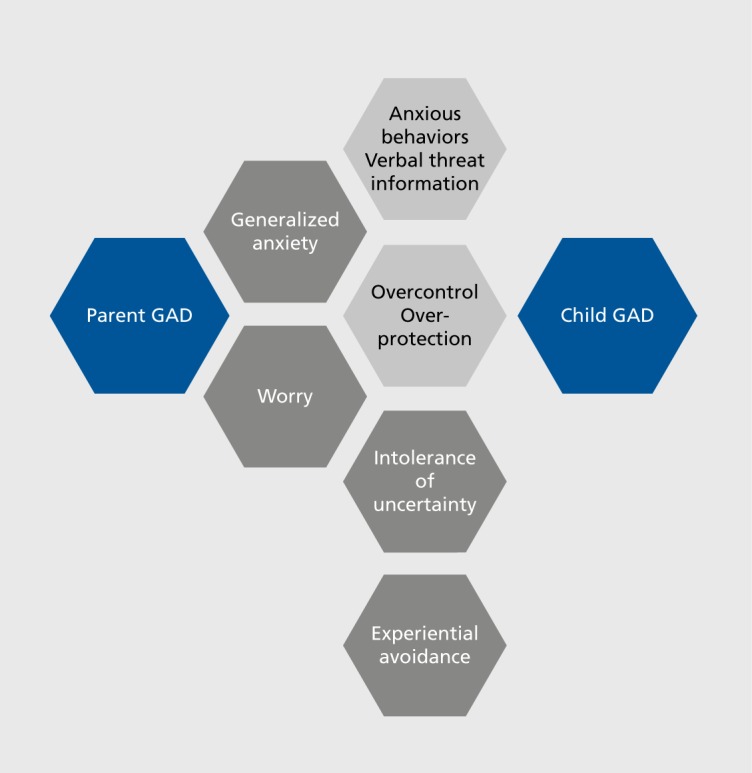
Generalized anxiety disorder (GAD) runs in families. Building on recent theoretical approaches, this review focuses on potential environmental pathways for parent-to-child transmission of GAD. First, we address child acquisition of a generalized pattern of fearful/anxious and avoidant responding to potential threat from parents via verbal information and via modeling. Next, we address how parenting behaviors may contribute to maintenance of fearful/anxious and avoidant reactions in children. Finally, we consider intergenerational transmission of worries as a way of coping with experiential avoidance of strong negative emotions and with intolerance of uncertainty. We conclude that parents with GAD may bias their children's processing of potential threats in the environment by conveying the message that the world is not safe, that uncertainty is intolerable, that strong emotions should be avoided, and that worry helps to cope with uncertainty, thereby transmitting cognitive styles that characterize GAD. Our review highlights the need for research on specific pathways for parent-to-child transmission of GAD.
Overview
The claims and statistics of this paper haven’t been checked yet.
Free: it reads the open-access text and checks the first 5 claims that cite a source we can check. Create a free account to check every claim.
Integrity signals
Registry
Cites
Statistics
Figures
Verification
Claims the paper makes
The claims and statistics of this paper haven’t been checked yet.
Free: it reads the open-access text and checks the first 5 claims that cite a source we can check. Create a free account to check every claim.
Claims other papers make about this one
Each is checked against this paper’s own text: does it say what the citing paper says it does?
The source backs part of the claim, not all of it — or backs it for a different population, condition or comparison.
In the citing paper
“During the perinatal period, IU may be a particularly salient familial risk factor as evidence suggests that high IU in pregnancy is associated with pregnancy-related anxiety (Treleaven, 2020), predicts increased psychological symptoms postpartum (Furtado et al., 2019), and is implicated in parent–infant transmission of mental illness as a cognitive bias learned nonverbally through social Referenc”
From The Indirect Effect of Parental Intolerance of Uncertainty on Perinatal Mental Health via Mindfulness During COVID-19 (2021) · cites this paper as Aktar et al., 2017
Experimental — accuracy not yet measuredThe cited source says what the claim attributes to it.
In the citing paper
“Generalised worry is differentiated from fearspeci fi c worry, as generalised worry is based on the future potential for threat, whereas fear-speci fi c worry is primarily based on actual occurrences of threat (Aktar et al., 2017).”
From Specific Phobia in Young Children: Associations between the Origins of Fear and Clinical Expression of Phobia Symptoms. (2025) · cites this paper as Aktar et al., 2017
The cited source says what the claim attributes to it.
In the citing paper
“Furthermore, worry is seen as a cognitive avoidance coping strategy that is central to generalised anxiety (Aktar et al., 2017).”
From Specific Phobia in Young Children: Associations between the Origins of Fear and Clinical Expression of Phobia Symptoms. (2025) · cites this paper as Aktar et al., 2017
Self-check
Percentages, sums and reported differences re-computed from the paper’s own numbers.
The self-check needs the paper’s full text.
Citations
Cites
Diagnostic and Statistical Manual of Mental Disorders
American Psychiatric Association (2013) · doi:10.1176/appi.books.9780890425596 · Cited by 116,369
Kessler, R. C., Berglund, P., Demler, O., Jin, R., Merikangas, K. R., & Walters, E. E. (2005) · Archives of General Psychiatry · doi:10.1001/archpsyc.62.6.593 · Cited by 20,391
Human agency in social cognitive theory.
Bandura, A. (1989) · American Psychologist · doi:10.1037/0003-066x.44.9.1175 · Cited by 8,263
Merikangas, K. R., He, J.-P., Burstein, M., Swanson, S. A., Avenevoli, S., Cui, L., Benjet, C., Georgiades, K., & Swendsen, J. (2010) · Journal of the American Academy of Child & Adolescent Psychiatry · doi:10.1016/j.jaac.2010.05.017 · Cited by 6,278
A Review and Meta-Analysis of the Genetic Epidemiology of Anxiety Disorders
Hettema, J. M., Neale, M. C., & Kendler, K. S. (2001) · American Journal of Psychiatry · doi:10.1176/appi.ajp.158.10.1568 · Cited by 1,563
Bijl, R. V., Ravelli, A., & van Zessen, G. (1998) · Social Psychiatry and Psychiatric Epidemiology · doi:10.1007/s001270050098 · Cited by 1,216
The conditioning theory of fearacquisition: A critical examination
Rachman, S. (1977) · Behaviour Research and Therapy · doi:10.1016/0005-7967(77)90041-9 · Cited by 1,191
Maternal emotional signaling: Its effect on the visual cliff behavior of 1-year-olds.
Sorce, J. F., Emde, R. N., Campos, J. J., & Klinnert, M. D. (1985) · Developmental Psychology · doi:10.1037/0012-1649.21.1.195 · Cited by 885
Why worry? The cognitive function of anxiety
Mathews, A. (1990) · Behaviour Research and Therapy · doi:10.1016/0005-7967(90)90132-3 · Cited by 827
Family enhancement of cognitive style in anxious and aggressive children
Barrett, P. M., Rapee, R. M., Dadds, M. M., & Ryan, S. M. (1996) · Journal of Abnormal Child Psychology · doi:10.1007/bf01441484 · Cited by 784
Research works printed but not linked: 11
- Sanderson WC. Wetzler S. Chronic anxiety and generalized anxiety disorder: Issues in comorbidity. In: Rapee RM, Barlow DH, eds. Chronic Anxiety: Generalized Anxiety Disorder and Mixed Anxiety-Depression. New York, NY: Guilford Press. 1991 119 135
- Hudson JL. Rapee RM. From anxious temperament to disorder. An etiological model. In: Heimberg RG, Turk CL, Mennin DS, eds. Generalized Anxiety Disorder Advances in Research and Practice. New York, NY: Guilford Press; 2004 51 74
- Feinman S. Social referencing in infancy. Merrill Palmer Q. 1982 28 4 445 470
- Feinman S. Emotional expression, social referencing, and preparedness for learning — Mother knows best, but sometimes I know better. In: Zivin G, ed. The Development of Expressive Behaviour: Biology-Environment Interactions. New York, NY: Academic Press. 1985 291 318
- Borkovec TD. Shadick RN. Hopkins M. The nature of normal and pathological worry. In: Rapee RM, Barlow DH, eds. Chronic Anxiety: Generalized Anxiety Disorder and Mixed Anxiety Depression. New York, NY: Guilford Press. 1991 29 51
- Pasarelu C. Dobrean A. Predescu E. Sipos R. Lupu V. Intergenerational transmission of worry a transdiagnostic factor in child internalizing symptomatology. Rom J Child Adolesc Psychiatry. 2015 3 1 1 7
- Dugas MJ. Buhr K. Ladouceur R. The role of intolerance of uncertainty in etiology and maintenance. In: Heimberg RG, Turk C, Mennin D, eds. Generalized Anxiety Disorder: Advances in Research and Practice. New York, NY: Guilford Press. 2004 143 163
- Creswell C. Cooper P. Murray L. Intergenerational transmission of anxious information processing biases. In: Hadwin JA, Field AP, eds. Information Processing Biases and Anxiety: A Developmental Perspective. Hoboken, NJ: John Wiley and Sons. 2010 280 295
- Field AP. Lester KJ. Learning of information processing biases in anxious children and adolescents. In: Information Processing Biases and Anxiety: A Developmental Perspective. Hobroken, NJ: John Wiley and Sons. 2010 253 278
- Degnan KA. Almas AN. Fox NA. Temperament and the environment in the etiology of childhood anxiety. J Child Psychol Psychiatry Allied Discip. 2010 51 4 497 517 PMC2884043 20158575 · DOI · Paper page
- Rapee RM. The development and modification of temperamental risk for anxiety disorders: prevention of a lifetime of anxiety? Biol Psychiatry. 2002 52 10 947 957 12437936 · DOI · Paper page
Cited by
Wang, S., Chen, L., Ran, H., Che, Y., Fang, D., Sun, H., Peng, J., Liang, X., & Xiao, Y. (2022) · Frontiers in Psychiatry · doi:10.3389/fpsyt.2022.917552 · Cited by 94
Ahmadzadeh, Y. I., Eley, T. C., Leve, L. D., Shaw, D. S., Natsuaki, M. N., Reiss, D., Neiderhiser, J. M., & McAdams, T. A. (2019) · Journal of Child Psychology and Psychiatry · doi:10.1111/jcpp.13068 · Cited by 94
A Cognitive Model of Pathological Worry in Children and Adolescents: A Systematic Review
Songco, A., Hudson, J. L., & Fox, E. (2020) · Clinical Child and Family Psychology Review · doi:10.1007/s10567-020-00311-7 · Cited by 44
Telman, L. G. E., van Steensel, F. J. A., Marić, M., & Bögels, S. M. (2017) · European Child & Adolescent Psychiatry · doi:10.1007/s00787-017-1076-x · Cited by 57
Self-citationLi, X., & Zhou, S. (2021) · Psychological Trauma Theory Research Practice and Policy · doi:10.1037/tra0000932 · Cited by 44
Metadata
- Authors
- Aktar, E., Nikolić, M., & Bögels, S. M.
- Affiliations
- Leiden University (NL)
- University of Amsterdam (NL)
- Corresponding author
- Aktar, Evin
- Venue
- Dialogues in Clinical Neuroscience
- Publisher
- Informa UK Limited
- Published
- 2017-06-30
- Volume
- 19
- Issue
- 2
- Pages
- 137-147
- ISSN
- 1294-8322 (ISSN-L)
- 1958-5969
- PMC
- PMC5573558
- OpenAlex
- W2811263635
- Cited by
- 91
- References
- 73
- Citations by year
- 2026: 7 · 2025: 16 · 2024: 11 · 2023: 15 · 2022: 16 · 2021: 7 · 2020: 9 · 2019: 7 · 2018: 2 · 2017: 1
- FWCI
- 6.77
- Type
- journal article
- Language
- en
- Open access
- diamond
- doi.org
- Licence
- Locations
- Dialogues in Clinical Neuroscience (publishedVersion, cc-by-nc-nd)
- UvA-DARE (University of Amsterdam) (publishedVersion, other-oa)
- PubMed Central (publishedVersion, cc-by-nc-nd)
- PubMed (publishedVersion)
- Leiden Repository (Leiden University) (submittedVersion)
- Data Archiving and Networked Services (DANS) (submittedVersion, other-oa)
- Funders
- Nederlandse Organisatie voor Wetenschappelijk Onderzoek (453‐09‐001)
- Topics
- Social Sciences › Psychology › Experimental and Cognitive Psychology › Anxiety, Depression, Psychometrics, Treatment, Cognitive Processes
- Social Sciences › Psychology › Clinical Psychology › Child and Adolescent Psychosocial and Emotional Development
- Health Sciences › Medicine › Public Health, Environmental and Occupational Health › Maternal Mental Health During Pregnancy and Postpartum
- Keywords
- generalized anxiety disorder, parent-to-child transmission, intergenerational transmission, worry, experiential avoidance, intolerance of uncertainty, parental behavior, threat processing, cognitive style, family transmission
- MeSH terms
- Adaptation, Psychological, Adult, Anxiety Disorders, Child, Emotions, Humans, Parents, Parenting, Uncertainty
About these checks
Registry, retraction, Cites and statistics results are computed, not judged, with one exception: a printed reference that no index lists is read once by a model before it counts as a citation error. Claims are extracted by a model and kept only when their quote appears verbatim in the text; each cited source is then checked, with a model’s help, for whether it says what the claim relies on. Those verdicts can be wrong — read the claim’s quote and the cited source before relying on one.
Statistics and arithmetic are recomputed, not judged.
Confidence bands are shown only for fields calibrated on our annotated test set. None is calibrated yet, so no band is shown.
What counts as a claim ›How we measure confidence ›How we check this ›
Are you an author, or do you see a problem with this page? Request a review
Data sources
Bibliographic data: Semantic Scholar, OpenAlex, Crossref.
Contains information from the Semantic Scholar Academic Graph Datasets, made available under the ODC Attribution License (ODC-BY 1.0).
Semantic Scholar’s data is described in: Kinney, R., et al. (2023). The Semantic Scholar Open Data Platform. arXiv:2301.10140.
