

The DOI matches its Crossref record; 33 of the 33 references it cites were found in a registry or an index.
Effects of Regular and Long-Acting Insulin on Cognition and Alzheimer’s Disease Biomarkers: A Pilot Clinical Trial
Open accessAbstract
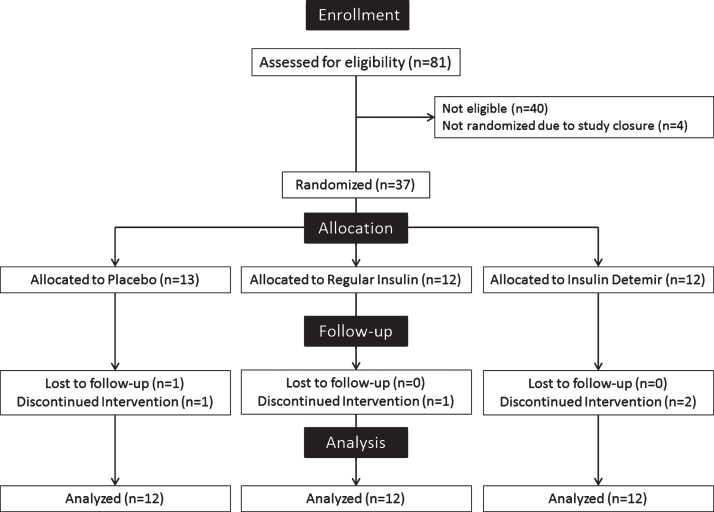
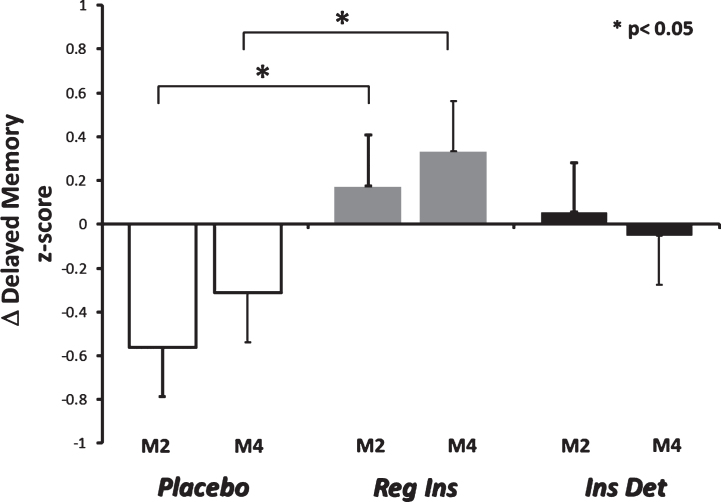
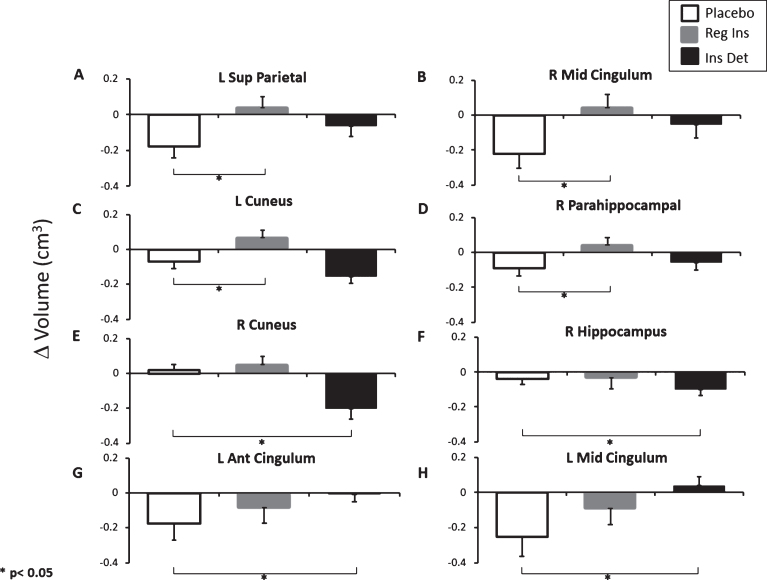
Background: Long acting insulin detemir administered intranasally for three weeks enhanced memory for adults with Alzheimer’s disease dementia (AD) or amnestic mild cognitive impairment (MCI). The investigation of longer-term administration is necessary to determine whether benefits persist, whether they are similar to benefits provided by regular insulin, and whether either form of insulin therapy affects AD biomarkers. Objective: The present study aimed to determine whether four months of treatment with intranasal insulin detemir or regular insulin improves cognition, daily functioning, and AD biomarkers for adults with MCI or AD. Methods: This randomized, double-blind, placebo-controlled trial included an intent-to-treat sample consisting of 36 adults diagnosed with MCI or mild to moderate AD. Participants received placebo ( n = 12), 40 IU of insulin detemir ( n = 12), or 40 IU of regular insulin ( n = 12) daily for four months, administered with a nasal delivery device. A cognitive battery was administered at baseline and after two and four months of treatment. MRI was administered for all participants and lumbar puncture for a subset ( n = 20) at baseline and four months. The primary outcome was change from baseline to four months on a memory composite (sum of Z scores for delayed list and story recall). Secondary outcomes included: global cognition (Alzheimer’s Disease Assessment Scale-Cognition), daily functioning (Dementia Severity Rating Scale), MRI volume changes in AD-related regions of interest, and cerebrospinal fluid AD markers. Results: The regular insulin treated group had better memory after two and four months compared with placebo ( p < 0.03). No significant effects were observed for the detemir-assigned group compared with the placebo group, or for daily functioning for either group. Regular insulin treatment was associated with preserved volume on MRI. Regular insulin treatment was also associated with reduction in the tau-P181/Aβ 42 ratio. Conclusion: Future research is warranted to examine the mechanistic basis of treatment differences, and to further assess the efficacy and safety of intranasal insulin.
Overview
The claims and statistics of this paper haven’t been checked yet.
Run the check — free, no account needed. It reads the open-access text and checks the sources it cites.
Integrity signals
Registry
Cites
Statistics
Figures
Verification
Claims the paper makes
The claims and statistics of this paper haven’t been checked yet.
Run the check — free, no account needed. It reads the open-access text and checks the sources it cites.
Claims other papers make about this one
Each is checked against this paper’s own text: does it say what the citing paper says it does?
In the citing paper
“A device for IN delivery that had been successfully used in previous studies 75,76,107 proved unreliable in the first 49 participants because of malfunctions of a newly added electronic timer.”
From Intranasal insulin (2021) · cites this paper as [75]
Self-check
Percentages, sums and reported differences re-computed from the paper’s own numbers.
The self-check needs the paper’s full text.
Citations
Cites
McKhann, G., Drachman, D., Folstein, M., Katzman, R., Price, D., & Stadlan, E. M. (1984) · Neurology · doi:10.1212/wnl.34.7.939 · Cited by 27,915
Kok, J. S., Berg, I. J., & Scherder, E. J. A. (2013) · Dementia and Geriatric Cognitive Disorders Extra · doi:10.1159/000353441 · Cited by 20,589
Voxel-Based Morphometry—The Methods
Ashburner, J., & Friston, K. J. (2000) · NeuroImage · doi:10.1006/nimg.2000.0582 · Cited by 8,676
A new rating scale for Alzheimer's disease
(1984) · American Journal of Psychiatry · doi:10.1176/ajp.141.11.1356 · Cited by 4,175
Sniffing neuropeptides: A transnasal approach to the human brain
Born, J., Lange, T., Kern, W., McGregor, G. P., Bickel, U., & Fehm, H. L. (2002) · Nature Neuroscience · doi:10.1038/nn0602-849 · Cited by 1,356
Craft, S. (2012) · Archives of Neurology · doi:10.1001/archneurol.2011.233 · Cited by 1,253
Self-citationIntranasal insulin improves cognition and modulates β-amyloid in early AD
Reger, M. A., Watson, G. S., Green, P. S., Wilkinson, C. W., Baker, L. D., Cholerton, B., Fishel, M. A., Plymate, S. R., Breitner, J. C. S., DeGroodt, W., et al. (2008) · Neurology · doi:10.1212/01.wnl.0000265401.62434.36 · Cited by 830
Self-citationRoberts, R. O., Geda, Y. E., Knopman, D. S., Cha, R. H., Pankratz, V. S., Boeve, B. F., Ivnik, R. J., Tangalos, E. G., Petersen, R. C., & Rocca, W. A. (2008) · Neuroepidemiology · doi:10.1159/000115751 · Cited by 797
De Felice, F. G., Vieira, M. N. N., Bomfim, T. R., Decker, H., Velasco, P. T., Lambert, M. P., Viola, K. L., Zhao, W.-Q., Ferreira, S. T., & Klein, W. L. (2009) · Proceedings of the National Academy of Sciences · doi:10.1073/pnas.0809158106 · Cited by 657 · cited 1×
“phorylation in preclinical models [4].”
Craft, S., Peskind, E., Schwartz, M. W., Schellenberg, G. D., Raskind, M., & Porte, D. (1998) · Neurology · doi:10.1212/wnl.50.1.164 · Cited by 560
Self-citationGasparini, L., Gouras, G. K., Wang, R., Gross, R. S., Beal, M. F., Greengard, P., & Xu, H. (2001) · Journal of Neuroscience · doi:10.1523/jneurosci.21-08-02561.2001 · Cited by 492
Claxton, A., Baker, L. D., Hanson, A., Trittschuh, E. H., Cholerton, B., Morgan, A., Callaghan, M., Arbuckle, M., Behl, C., & Craft, S. (2015) · Journal of Alzheimer's Disease · doi:10.3233/jad-141791 · Cited by 467
Self-citationIntranasal Insulin Improves Memory in Humans: Superiority of Insulin Aspart
Benedict, C., Hallschmid, M., Schmitz, K., Schultes, B., Ratter, F., Fehm, H. L., Born, J., & Kern, W. (2007) · Neuropsychopharmacology · doi:10.1038/sj.npp.1301193 · Cited by 302
Lochhead, J. J., Wolak, D. J., Pizzo, M. E., & Thorne, R. G. (2014) · Journal of Cerebral Blood Flow & Metabolism · doi:10.1038/jcbfm.2014.215 · Cited by 262
Clark, C., & Ewbank, D. C. (1996) · Alzheimer Disease & Associated Disorders · doi:10.1097/00002093-199601010-00006 · Cited by 225
Claxton, A., Baker, L. D., Wilkinson, C. W., Trittschuh, E. H., Chapman, D., Watson, G. S., Cholerton, B., Plymate, S. R., Arbuckle, M., & Craft, S. (2013) · Journal of Alzheimer’s Disease · doi:10.3233/jad-122308 · Cited by 215
Self-citationYarchoan, M. M., Toledo, J. B., Lee, E. B., Arvanitakis, Z., Kazi, H., Han, L.-Y., Louneva, N., Lee, V. M. ‐., Kim, S. F., Trojanowski, J. Q., et al. (2014) · Acta Neuropathologica · doi:10.1007/s00401-014-1328-5 · Cited by 215
Leeuw, I. D., Vague, P., Selam, J. L., Skeie, S., Lang, H., Draeger, E., & Elte, J. W. F. (2004) · Diabetes Obesity and Metabolism · doi:10.1111/j.1463-1326.2004.00363.x · Cited by 179
Human Serum Albumin Can Regulate Amyloid-β Peptide Fiber Growth in the Brain Interstitium
Stanyon, H. F., & Viles, J. H. (2012) · Journal of Biological Chemistry · doi:10.1074/jbc.c112.360800 · Cited by 164
Insulin analogues differently activate insulin receptor isoforms and post-receptor signalling
Sciacca, L., Cassarino, M. F., Genua, M., Pandini, G., Moli, R. L., Squatrito, S., & Vigneri, R. (2010) · Diabetologia · doi:10.1007/s00125-010-1760-6 · Cited by 142
Voxel-based meta-analysis of grey matter changes in Alzheimer’s disease
Wang, W., Yu, J., Liu, Y., Yin, R., Wang, H.-F., Wang, J., Tan, L., Raduà, J., & Tan, L. (2015) · Translational Neurodegeneration · doi:10.1186/s40035-015-0027-z · Cited by 124
Kurtzhals, P. (2004) · International Journal of Obesity · doi:10.1038/sj.ijo.0802746 · Cited by 116
(2015) · Journal of Alzheimer s Disease · doi:10.3233/jad-159002 · Cited by 89
Insulin signalling in Alzheimer′s disease and diabetes: from epidemiology to molecular links
Ribé, E. M., & Lovestone, S. (2016) · Journal of Internal Medicine · doi:10.1111/joim.12534 · Cited by 88
Maimaiti, S., Anderson, K. L., DeMoll, C., Brewer, L. D., Rauh, B. A., Gant, J. C., Blalock, E. M., Porter, N. M., & Thibault, O. (2015) · The Journals of Gerontology Series A · doi:10.1093/gerona/glu314 · Cited by 86
Harari, O., Cruchaga, C., Kauwe, J. S. K., Ainscough, B. J., Bales, K., Pickering, E. H., Bertelsen, S., Fagan, A. M., Holtzman, D. M., Morris, J. C., et al. (2014) · Biological Psychiatry · doi:10.1016/j.biopsych.2013.11.032 · Cited by 82
Insulin rescues amyloid β-induced impairment of hippocampal long-term potentiation
Lee, C.-C., Kuo, Y.-M., Huang, C.-C., & Hsu, K.-S. (2009) · Neurobiology of Aging · doi:10.1016/j.neurobiolaging.2007.06.014 · Cited by 81
Kumar, N. N., Gautam, M., Lochhead, J. J., Wolak, D. J., Ithapu, V. K., Singh, V., & Thorne, R. G. (2016) · Scientific Reports · doi:10.1038/srep31732 · Cited by 62
Cerebrocortical Beta Activity in Overweight Humans Responds to Insulin Detemir
Tschritter, O., Hennige, A. M., Preissl, H. T., Porubská, K., Schäfer, S., Lutzenberger, W., Machicao, F. E., Birbaumer, N., Fritsche, A., & Häring, H. (2007) · PLoS ONE · doi:10.1371/journal.pone.0001196 · Cited by 52
Pharmacology of Insulin Detemir
Kurtzhals, P. (2007) · Endocrinology and Metabolism Clinics of North America · doi:10.1016/s0889-8529(07)80004-1 · Cited by 50
Intranasal delivery: circumventing the iron curtain to treat neurological disorders
Jiang, Y., Li, Y., & Liu, X. (2015) · Expert Opinion on Drug Delivery · doi:10.1517/17425247.2015.1065812 · Cited by 44
Creating equivalent word lists for the Buschke Selective Reminding Test
Coen, R. F., Kinsella, A., Lambe, R., Kenny, M., & Darragh, A. C. (1990) · Human Psychopharmacology Clinical and Experimental · doi:10.1002/hup.470050107 · Cited by 11
Fully Automated Processing of fMRI Data in SPM: from MRI Scanner to PACS
Maldjian, J. A., Baer, A. H., Kraft, R., Laurienti, P. J., & Burdette, J. H. (2009) · Neuroinformatics · doi:10.1007/s12021-008-9040-z · Cited by 8
Self-citation
Cited by
Sorted by citations
Brain insulin resistance in type 2 diabetes and Alzheimer disease: concepts and conundrums
Arnold, S. E., Arvanitakis, Z., Macauley-Rambach, S. L., Koenig, A. M., Wang, H.-Y., Ahima, R. S., Craft, S., Gandy, S., Buettner, C., Stoeckel, L. E., et al. (2018) · Nature Reviews Neurology · doi:10.1038/nrneurol.2017.185 · Cited by 1,597
Self-citationBrain energy rescue: an emerging therapeutic concept for neurodegenerative disorders of ageing
Cunnane, S. C., Trushina, E., Morland, C., Prigione, A., Casadesus, G., Andrews, Z. B., Beal, M. F., Bergersen, L. H., Brinton, R. D., de la Monte, S., et al. (2020) · Nature Reviews Drug Discovery · doi:10.1038/s41573-020-0072-x · Cited by 1,003
A critical appraisal of amyloid-β-targeting therapies for Alzheimer disease
Panza, F., Lozupone, M., Logroscino, G., & Imbimbo, B. P. (2019) · Nature Reviews Neurology · doi:10.1038/s41582-018-0116-6 · Cited by 965
Kellar, D., & Craft, S. (2020) · The Lancet Neurology · doi:10.1016/s1474-4422(20)30231-3 · Cited by 832
Self-citationNagpal, R., Neth, B. J., Wang, S., Craft, S., & Yadav, H. (2019) · EBioMedicine · doi:10.1016/j.ebiom.2019.08.032 · Cited by 653
Self-citation
Metadata
- Authors
- Craft, S., Claxton, A., Baker, L. D., Hanson, A. J., Cholerton, B., Trittschuh, E. H., Dahl, D., Caulder, E., Neth, B., Montine, T. J., Jung, Y., Maldjian, J., Whitlow, C., & Friedman, S.
- Affiliations
- Wake Forest University Health Sciences (US)
- Alkermes (United States) (US)
- University of Washington (US)
- Stanford Medicine (US)
- The University of Texas Southwestern Medical Center (US)
- Seattle Children's Hospital (US)
- Corresponding author
- Craft, Suzanne
- ORCID
- Venue
- Journal of Alzheimer’s Disease
- Publisher
- SAGE Publications
- Published
- 2017-03-29
- Volume
- 57
- Issue
- 4
- Pages
- 1325-1334
- ISSN
- 1387-2877 (ISSN-L)
- 1875-8908
- PMC
- PMC5409050
- OpenAlex
- W2600568015
- Cited by
- 335
- References
- 33
- Citations by year
- 2026: 13 · 2025: 40 · 2024: 25 · 2023: 47 · 2022: 32 · 2021: 46 · 2020: 49 · 2019: 46 · 2018: 29 · 2017: 8
- FWCI
- 26.70
- Type
- journal article
- Language
- en
- Open access
- bronze
- doi.org
- Locations
- Journal of Alzheimer s Disease (publishedVersion)
- PubMed Central (publishedVersion, cc-by-nc)
- PubMed (publishedVersion)
- eScholarship (California Digital Library) (submittedVersion, cc-by-nc)
- eScholarship (California Digital Library) (submittedVersion)
- Funders
- Alzheimer's Association (ZEN-10-173646)
- National Institute on Aging (P30AG049638)
- Topics
- Life Sciences › Neuroscience › Cellular and Molecular Neuroscience › Alzheimer's disease research and treatments
- Health Sciences › Medicine › Psychiatry and Mental health › Dementia and Cognitive Impairment Research
- Health Sciences › Medicine › Pharmacology (medical) › Cholinesterase and Neurodegenerative Diseases
- Keywords
- intranasal insulin, insulin detemir
- MeSH terms
- Activities of Daily Living, Aged, Alzheimer Disease, Brain, Cognition, Double-Blind Method, Female, Humans, Magnetic Resonance Imaging, Male, Organ Size, Peptide Fragments, Biomarkers, Amyloid beta-Peptides, tau Proteins, Treatment Outcome, Nootropic Agents, Insulins
About these checks
Registry, retraction, Cites and statistics results are computed, not judged, with one exception: a printed reference that no index lists is read once by a model before it counts as a citation error. Claims are extracted by a model and kept only when their quote appears verbatim in the text; each cited source is then checked, with a model’s help, for whether it says what the claim relies on. Those verdicts can be wrong — read the claim’s quote and the cited source before relying on one.
Statistics and arithmetic are recomputed, not judged.
Confidence bands are shown only for fields calibrated on our annotated test set. None is calibrated yet, so no band is shown.
What counts as a claim ›How we measure confidence ›How we check this ›
Are you an author, or do you see a problem with this page? Request a review
