

Clinical Management of Neuropsychiatric Symptoms of Huntington Disease: Expert-Based Consensus Guidelines on Agitation, Anxiety, Apathy, Psychosis and Sleep Disorders
Open accessThe DOI matches its Crossref record; 37 of the 37 references it cites were found in a registry or an index.
Abstract
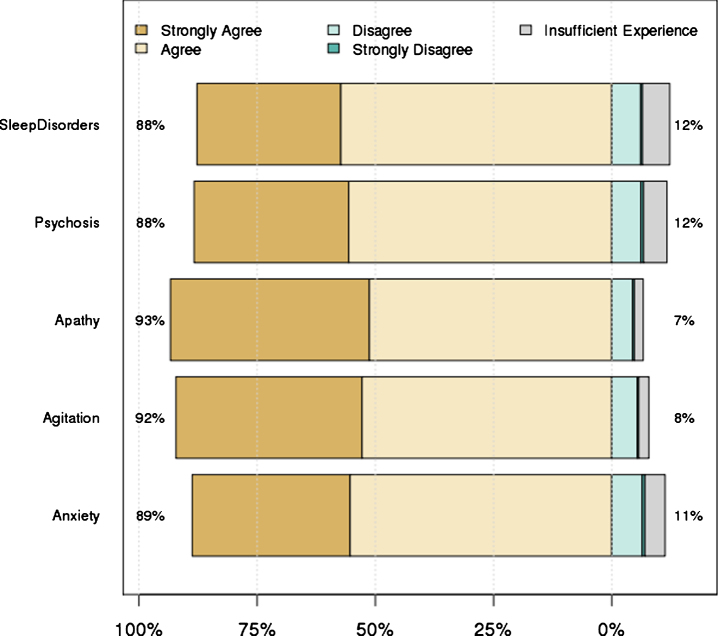
BACKGROUND: In clinical practice, several strategies and pharmacological options are available to treat neuropsychiatric symptoms of Huntington disease (HD). However, there is currently insufficient data for evidence-based guidelines on the management of these common symptoms. OBJECTIVE: We aimed to develop expert-based recommendations regarding the management of agitation, anxiety, apathy, psychosis, and sleep disorders. METHODS: Guideline development was based on a modified Institute of Medicine guideline process that accounted for a lack of evidence base. An international committee of 11 multidisciplinary experts proposed a series of statements regarding the description and management of each symptom. Statement assessment and validation was performed using a web-based survey tool and 84 international HD experts (neurologists and psychiatrists) who assessed the statements and indicated their level of agreement. RESULTS: High-level agreement (≥85% experts strongly agreed or agreed) was reached for 107 of the 110 statements that have been incorporated into the expert-based clinical recommendations presented herein. CONCLUSIONS: Clinical statements to guide the routine management of agitation, anxiety, apathy, psychosis, and sleep disorders in HD have been developed. Although not specifically tested in the HD population, clinical experience has shown that most of the neuropsychiatric symptoms discussed, when considered in isolation are treatable using pharmacologic and non-pharmacologic strategies developed for use in other populations. However, the management of neuropsychiatric symptoms in HD can be complex because neuropsychiatric symptoms often co-exist and treatment decisions should be adapted to cover all symptoms while limiting polypharmacy.
Overview
The claims and statistics of this paper haven’t been checked yet.
Free: it reads the open-access text and checks the first 5 claims that cite a source we can check. Create a free account to check every claim.
Integrity signals
Registry
Cites
Statistics
Figures
Verification
Claims the paper makes
The claims and statistics of this paper haven’t been checked yet.
Free: it reads the open-access text and checks the first 5 claims that cite a source we can check. Create a free account to check every claim.
Claims other papers make about this one
Each is checked against this paper’s own text: does it say what the citing paper says it does?
The cited source says what the claim attributes to it.
In the citing paper
“recent expert guidelines have recommended psychological therapy as the first treatment offered to people experiencing anxiety in early-stage HD [19].”
Self-check
Percentages, sums and reported differences re-computed from the paper’s own numbers.
The self-check needs the paper’s full text.
Citations
Cites
Clinical Practice Guidelines We Can Trust
Committee on Standards for Developing Trustworthy Clinical Practice Guidelines, Board on Health Care Services, & Institute of Medicine (2011) · National Academies Press eBooks · doi:10.17226/13058 · Cited by 3,081 · cited 6×
“Guideline development was based on a modified Institute of Medicine (IOM) guideline process [14] that accounted for a lack of a robust evidence base for these symptoms as they present in HD.”
BackgroundMethodInfluentialPractice Guideline for the Treatment of Patients With Obsessive-Compulsive Disorder
(2008) · APA Practice Guidelines for the Treatment of Psychiatric Disorders: Comprehensive Guidelines and Guideline Watches · doi:10.1176/appi.books.9780890423363.149114 · Cited by 1,028
Levy, M. L., Cummings, J. L., Fairbanks, L. A., Masterman, D., Miller, B. L., Craig, A. H., Paulsen, J. S., & Litvan, I. (1998) · The Journal of Neuropsychiatry and Clinical Neurosciences · doi:10.1176/jnp.10.3.314 · Cited by 678 · cited 1×
“In general, it can be distinguished from depression by the lack of sadness and negative or suicidal thoughts [20].”
BackgroundMiyasaki, J. M., Shannon, K., Voon, V., Ravina, B., Kleiner-Fisman, G., Anderson, K., Shulman, L. M., Gronseth, G., & Weiner, W. J. (2006) · Neurology · doi:10.1212/01.wnl.0000215428.46057.3d · Cited by 487
Self-citationNeuropsychiatric aspects of Huntington’s disease.
Paulsen, J. S. (2001) · Journal of Neurology, Neurosurgery & Psychiatry · doi:10.1136/jnnp.71.3.310 · Cited by 486 · cited 2×
“The neuropsychiatric and behavioral signs and symptoms of HD (henceforth referred to as neuropsychiatric symptoms for ease of reading) encompass the full spectrum of psychiatric illness [4, 5], and most people with HD will experience multiple neuropsychiatric symptoms or disorders during the course of their illness [2…”
BackgroundBehavioral changes in Huntington Disease.
Craufurd, D., Thompson, J. C., & Snowden, J. S. (2001) · PubMed · Cited by 397
Self-citationRate of functional decline in Huntington’s disease
Marder, K., Zhao, H., Myers, R. H., Cudkowicz, M., Kayson, E., Kieburtz, K., Orme, C., Paulsen, J., Penney, J. B., Siemers, E., et al. (2000) · Neurology · doi:10.1212/wnl.54.2.452 · Cited by 362 · cited 1×
“While some studies describe psychotic symptoms in early stages of disease [28], others report a more common occurrence in individuals with advancing stage of disease [29, 30].”
BackgroundNeuropsychiatric symptoms in a European Huntington's disease cohort (REGISTRY)
van Duijn, E., Craufurd, D., Hubers, A. A. M., Giltay, E. J., Bonelli, R., Rickards, H., Anderson, K. E., van Walsem, M. R., van der Mast, R. C., Orth, M., et al. (2014) · Journal of Neurology, Neurosurgery & Psychiatry · doi:10.1136/jnnp-2013-307343 · Cited by 299 · cited 1×
“While some studies describe psychotic symptoms in early stages of disease [28], others report a more common occurrence in individuals with advancing stage of disease [29, 30].”
BackgroundSelf-citationTreatment of patients with substance use disorders, second edition. American Psychiatic Association.
Kleber, H. D., Weiss, R. D., Anton, R. F., George, T. P., Greenfield, S. F., Kosten, T. R., O’Brien, C. P., Rounsaville, B. J., Strain, E. C., Ziedonis, D. M., et al. (2006) · PubMed · Cited by 265
Psychiatric syndromes in Huntington’s disease.
(1983) · American Journal of Psychiatry · doi:10.1176/ajp.140.6.728 · Cited by 255 · cited 1×
“Likewise, although more consistently associated with disease progression [9, 22, 31], the reported prevalence of apathy has ranged from 32% to 76% [1, 2, 9, 32, 33].”
Background
Research works printed but not linked: 1
- APA Work Group on Alzheimer’s Disease and other Dementias, Rabins PV, Blacker D, Rovner BW, Rummans T, Schneider LS, et al., American Psychiatric Association practice guideline for the treatment of patients with Alzheimer’s disease and other dementias. Second edition. Am J Psychiatry. 2007; 164: 5– 56. 18340692
Cited by
Items 101–108 of 108
Cervantes‐Arriaga, A., Torres, A. X. B., Romero-García, D., & Rodríguez‐Violante, M. (2026) · Revista de investigaci�n Cl�nica · doi:10.1016/j.ric.2026.100047 · Cited by 2
Psychosis in Huntington's disease: A case supporting multidisciplinary and early palliative care
Le, V., Sigler, E., Liu, J., Abualama, H., & Surineni, K. (2026) · Journal of Huntington s Disease · doi:10.1177/18796397261472525
Psychosocial determinants of exercise behavior in Parkinson’s disease: a mini-review
Zhang, G. (2026) · Frontiers in Public Health · doi:10.3389/fpubh.2026.1942675
Malakar, V. K., Malakar, C. C., Mali, P. C., & Poddar, N. K. (2026) · Biochimica et Biophysica Acta (BBA) - Proteins and Proteomics · doi:10.1016/j.bbapap.2026.141177
Gene therapy in Huntington’s disease (HD)
Tirgar, F., Hosseini, M., Alijanpour, S., Aghanoori, M.-R., Alijanpour, S., & Mahdavinataj, H. (2026) · Elsevier eBooks · doi:10.1016/b978-0-443-40467-2.00011-7
Escaldi, S., & Markos, S. (2026) · Elsevier eBooks · doi:10.1016/b978-0-443-23516-0.00130-6
Ollivier, M., Xia, S., Cankar, N., Qvist, F. L., Pelaz, S. G., Neupane, C., Hull, V. L., Kawaguchi, R., Skotte, N. H., Al‐Dalahmah, O., et al. (2026) · Neuron · doi:10.1016/j.neuron.2026.08.027
He, Z., Zeng, J., Wang, G., Li, Y., & Zhang, F. (2026) · MedComm · doi:10.1002/mco2.71090 · Cited by 1
“However, the evidence supporting their use is weaker than that for VMAT2 inhibitors [ 376 ].”
Metadata
- Authors
- Anderson, K. E., van Duijn, E., Craufurd, D., Drazinic, C., Edmondson, M., Goodman, N., van Kammen, D., Loy, C., Priller, J., & Goodman, L. V.
- Affiliations
- Georgetown University (US)
- Department of Psychiatry, Leiden University Medical Centre, Leiden; and Mental Health Care Centre Delfland, Delft, The Netherlands
- Manchester Academic Health Science Centre (GB)
- Florida Department of Children and Families (US)
- HD Reach, Raleigh, NC, USA
- Huntington’s Disease Drug Works, Seattle, WA, USA
- Consultant for CNS drug development, Professor emeritus University of Pittsburgh, Pittsburgh, PA, USA
- The University of Sydney (AU)
- Charité – Universitätsmedizin Berlin (DE)
- Corresponding author
- Anderson, Karen E.
- Venue
- Journal of Huntington's Disease
- Publisher
- SAGE Publications
- Published
- 2018-11-24
- Volume
- 7
- Issue
- 4
- Pages
- 355-366
- ISSN
- 1879-6397 (ISSN-L)
- 1879-6400
- PMC
- PMC6294590
- OpenAlex
- W2884386732
- Cited by
- 108
- References
- 37
- Citations by year
- 2026: 15 · 2025: 19 · 2024: 14 · 2023: 12 · 2022: 20 · 2021: 11 · 2020: 9 · 2019: 8
- FWCI
- 3.16
- Type
- journal article
- Language
- en
- Open access
- hybrid
- doi.org
- Licence
- Locations
- Journal of Huntington s Disease (publishedVersion, cc-by-nc)
- Europe PMC (PubMed Central) (publishedVersion, cc-by-nc)
- PubMed Central (publishedVersion, cc-by-nc)
- PubMed (publishedVersion)
- Edinburgh Research Explorer (University of Edinburgh) (publishedVersion, cc-by)
- Funders
- Medical Research Council (MC_PC_16031)
- Topics
- Life Sciences › Neuroscience › Cellular and Molecular Neuroscience › Genetic Neurodegenerative Diseases
- Health Sciences › Medicine › Clinical Neurology › Deep Brain Stimulation and Movement Disorders
- Health Sciences › Medicine › Clinical Neurology › Parkinson's Disease Mechanisms and Treatments
- Keywords
- Huntington's disease, neuropsychiatric symptoms, agitation, anxiety, apathy, psychosis, sleep disorders, clinical management, pharmacotherapy, non-pharmacological treatment, polypharmacy, expert consensus recommendations
- MeSH terms
- Anxiety, Humans, Huntington Disease, Psychomotor Agitation, Psychotic Disorders, Sleep Wake Disorders, Prevalence, Practice Guidelines as Topic, Disease Management
About these checks
Registry, retraction, Cites and statistics results are computed, not judged, with one exception: a printed reference that no index lists is read once by a model before it counts as a citation error. Claims are extracted by a model and kept only when their quote appears verbatim in the text; each cited source is then checked, with a model’s help, for whether it says what the claim relies on. Those verdicts can be wrong — read the claim’s quote and the cited source before relying on one.
Statistics and arithmetic are recomputed, not judged.
Confidence bands are shown only for fields calibrated on our annotated test set. None is calibrated yet, so no band is shown.
What counts as a claim ›How we measure confidence ›How we check this ›
Are you an author, or do you see a problem with this page? Request a review
Data sources
Bibliographic data: Semantic Scholar, OpenAlex, Crossref.
Contains information from the Semantic Scholar Academic Graph Datasets, made available under the ODC Attribution License (ODC-BY 1.0).
Semantic Scholar’s data is described in: Kinney, R., et al. (2023). The Semantic Scholar Open Data Platform. arXiv:2301.10140.
