

Faecal immunochemical tests versus colonoscopy for post-polypectomy surveillance: an accuracy, acceptability and economic study
Open accessThe DOI matches its Crossref record; 105 of the 107 references it cites were found in a registry or an index.
Abstract
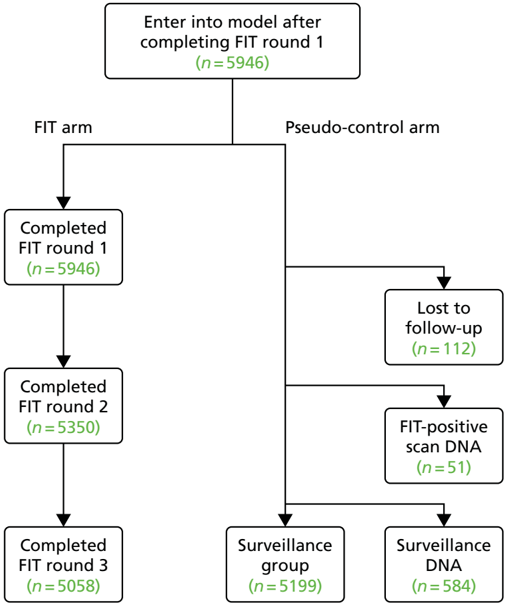
Background: In the UK, patients with one or two adenomas, of which at least one is ≥ 10 mm in size, or three or four small adenomas, are deemed to be at intermediate risk of colorectal cancer (CRC) and referred for surveillance colonoscopy 3 years post polypectomy. However, colonoscopy is costly, can cause discomfort and carries a small risk of complications. Objectives: To determine whether or not annual faecal immunochemical tests (FITs) are effective, acceptable and cost saving compared with colonoscopy surveillance for detecting CRC and advanced adenomas (AAs). Design: Diagnostic accuracy study with health psychology assessment and economic evaluation. Setting: Participants were recruited from 30 January 2012 to 30 December 2013 within the Bowel Cancer Screening Programme in England. Participants: Men and women, aged 60–72 years, deemed to be at intermediate risk of CRC following adenoma removal after a positive guaiac faecal occult blood test were invited to participate. Invitees who consented and returned an analysable FIT were included. Intervention: We offered participants quantitative FITs at 1, 2 and 3 years post polypectomy. Participants testing positive with any FIT were referred for colonoscopy and not offered further FITs. Participants testing negative were offered colonoscopy at 3 years post polypectomy. Acceptibility of FIT was assessed using discussion groups, questionnaires and interviews. Main outcome measures: The primary outcome was 3-year sensitivity of an annual FIT versus colonoscopy at 3 years for detecting advanced colorectal neoplasia (ACN) (CRC and/or AA). Secondary outcomes included participants’ surveillance preferences, and the incremental costs and cost-effectiveness of FIT versus colonoscopy surveillance. Results: Of 8008 invitees, 5946 (74.3%) consented and returned a round 1 FIT. FIT uptake in rounds 2 and 3 was 97.2% and 96.9%, respectively. With a threshold of 40 µg of haemoglobin (Hb)/g faeces (hereafter referred to as µg/g), positivity was 5.8% in round 1, declining to 4.1% in round 3. Over three rounds, 69.2% (18/26) of participants with CRC, 34.3% (152/443) with AAs and 35.6% (165/463) with ACN tested positive at 40 µg/g. Sensitivity for CRC and AAs increased, whereas specificity decreased, with lower thresholds and multiple rounds. At 40 µg/g, sensitivity and specificity of the first FIT for CRC were 30.8% and 93.9%, respectively. The programme sensitivity and specificity of three rounds at 10 µg/g were 84.6% and 70.8%, respectively. Participants’ preferred surveillance strategy was 3-yearly colonoscopy plus annual FITs (57.9%), followed by annual FITs with colonoscopy in positive cases (31.5%). FIT with colonoscopy in positive cases was cheaper than 3-yearly colonoscopy (£2,633,382), varying from £485,236 (40 µg/g) to £956,602 (10 µg/g). Over 3 years, FIT surveillance could miss 291 AAs and eight CRCs using a threshold of 40 µg/g, or 189 AAs and four CRCs using a threshold of 10 µg/g. Conclusions: Annual low-threshold FIT with colonoscopy in positive cases achieved high sensitivity for CRC and would be cost saving compared with 3-yearly colonoscopy. However, at higher thresholds, this strategy could miss 15–30% of CRCs and 40–70% of AAs. Most participants preferred annual FITs plus 3-yearly colonoscopy. Further research is needed to define a clear role for FITs in surveillance. Future work: Evaluate the impact of ACN missed by FITs on quality-adjusted life-years. Trial registration: Current Controlled Trials ISRCTN18040196. Funding: National Institute for Health Research (NIHR) Health Technology Assessment programme, NIHR Imperial Biomedical Research Centre and the Bobby Moore Fund for Cancer Research UK. MAST Group Ltd provided FIT kits.
Overview
The claims and statistics of this paper haven’t been checked yet.
Free: it reads the open-access text and checks the first 5 claims that cite a source we can check. Create a free account to check every claim.
Integrity signals
Registry
Cites
Statistics
Figures



Verification
Claims the paper makes
The claims and statistics of this paper haven’t been checked yet.
Free: it reads the open-access text and checks the first 5 claims that cite a source we can check. Create a free account to check every claim.
Claims other papers make about this one
Each is checked against this paper’s own text: does it say what the citing paper says it does?
The check wasn’t confident either way, so it gives no verdict — never disputed.
In the citing paper
“However, in the ACTIB trial, health economic analysis suggested web-based CBT was the more cost-effective option.244”
From British Society of Gastroenterology guidelines on the management of irritable bowel syndrome (2021) · cites this paper as [244]
Experimental — accuracy not yet measured
Self-check
Percentages, sums and reported differences re-computed from the paper’s own numbers.
The self-check needs the paper’s full text.
Citations
Cites
Using thematic analysis in psychology
Braun, V., & Clarke, V. (2006) · Qualitative Research in Psychology · doi:10.1191/1478088706qp063oa · Cited by 194,414
Genetic Alterations during Colorectal-Tumor Development
Vogelstein, B., Fearon, E. R., Hamilton, S. R., Kern, S. E., Preisinger, A. C., Leppert, M., Smits, A. M. M., & Bos, J. L. (1988) · New England Journal of Medicine · doi:10.1056/nejm198809013190901 · Cited by 6,728
Marteau, T. M., & Bekker, H. (1992) · British Journal of Clinical Psychology · doi:10.1111/j.2044-8260.1992.tb00997.x · Cited by 3,238
Colonoscopic Polypectomy and Long-Term Prevention of Colorectal-Cancer Deaths
Zauber, A. G., Winawer, S. J., O'Brien, M. J., Lansdorp-Vogelaar, I., van Ballegooijen, M., Hankey, B. F., Shi, W., Bond, J. H., Schapiro, M., Panish, J. F., et al. (2012) · New England Journal of Medicine · doi:10.1056/nejmoa1100370 · Cited by 3,185
Decision Modelling For Health Economic Evaluation
Briggs, A., Claxton, K., & Sculpher, M. (2006) · doi:10.1093/oso/9780198526629.001.0001 · Cited by 3,153
Brenner, H., Kloor, M., & Pox, C. P. (2014) · The Lancet · doi:10.1016/s0140-6736(13)61649-9 · Cited by 2,762
The evolution of cancer of the colon and rectum
Muto, T., Bussey, H. J. R., & Morson, B. C. (1975) · Cancer · doi:10.1002/cncr.2820360944 · Cited by 2,118
Lieberman, D. A., Rex, D. K., Winawer, S. J., Giardiello, F. M., Johnson, D. A., & Levin, T. R. (2012) · Gastroenterology · doi:10.1053/j.gastro.2012.06.001 · Cited by 1,892
Use of Colonoscopy to Screen Asymptomatic Adults for Colorectal Cancer
Lieberman, D. A., Weiss, D. G., Bond, J. H., Ahnen, D. J., Garewal, H., Harford, W. V., Provenzale, D., Sontag, S., Schnell, T., Durbin, T. E., et al. (2000) · New England Journal of Medicine · doi:10.1056/nejm200007203430301 · Cited by 1,815
Atkin, W. S., Edwards, R., Kralj-Hans, I., Wooldrage, K., Hart, A. R., Northover, J. M., Parkin, D. M., Wardle, J., Duffy, S. W., & Cuzick, J. (2010) · The Lancet · doi:10.1016/s0140-6736(10)60551-x · Cited by 1,623
Self-citation
Research works printed but not linked: 14
- 1. 4 Health psychology assessment T his chapter is partly reproduced from Bowyer et al. 67 Patient attitudes towards faecal immunochemical testing for haemoglobin as an alternative to colonoscopic surveillance of groups at increased risk of colorectal cancer. Journal of Medical Screening vol. 20, iss. 3, pp. 149-56. 2013 . , Ltd. , publish, transmit, participate in the transfer or sale of, reproduce, create derivative works (including course packsfrom, distribute, perform, display, or in any way exploit any of the content of the file(s) in whole or in part. Permission may be sought for ., Rights & Permissions Department, 1, Oliver's Yar, 55, City Road, London EC1Y 1SP, Email: permissions@sagepub.co.uk. By accessing the file(s), the User acknowledges and agrees to these terms. URL: www.sagepub.co.uk. Public Health England
- 6. Wendy Atkin, Amanda J Cross, Ines Kralj-Hans, Eilidh MacRae, Carolyn Piggott, Sheena Pearson, Kate Wooldrage, Jeremy Brown, Fiona Lucas, Aaron Prendergast, Natalie Marchevsky, Bhavita Patel, Kevin Pack, Rosemary Howe, Hanna Skrobanski, Robert Kerrison, Nicholas Swart, Julia Snowball, Stephen W Duffy, Stephen Morris, Christian von Wagner and Stephen Halloran reviewed and edited the report. Jeremy Brown and Fiona Lucas drafted the final report. Hanna Skrobanski, Robert Kerrison and Christian von Wagner were responsible for the psychological analyses. Nicholas Swart and Stephen Morris were responsible for the economic analysis. Publications
- 7. Bowyer HL, Vart G, Kralj-Hans I, Atkin W, Halloran SP, Seaman H, et al. Patient attitudes towards faecal immunochemical testing for haemoglobin as an alternative to colonoscopic surveillance of groups at increased risk of colorectal cancer. J Med Screen 2013;20:149-56.
- 8. Bonello B, Ghanouni A, Bowyer HL, MacRae E, Atkin W, Halloran SP, et al. Using a hypothetical scenario to assess public preferences for colorectal surveillance following screening-detected, intermediate-risk adenomas: annual home-based stool test vs. triennial colonoscopy. BMC Gastroenterol 2016;16:113.
- 10. Cancer Research UK. Bowel Cancer Survival Statistics. London: Cancer Research UK; 2014.
- 32. National Institute for Health and Care Excellence (NICE). Colonoscopic Surveillance for Prevention of Colorectal Cancer in People with Ulcerative Colitis, Crohn's Disease or Adenomas. NICE Clinical Guidelines. London: NICE; 2011.
- 70. Symonds EL, Osborne J, Young GP, Bampton PA, Fraser RJ, Cole SR. Significance of a positive faecal immunochemical test in a colonoscopic surveillance program. J Gastroenterol Hepatol 2013;28:22.
- 73. Carroll M, Piggott C, Pearson S, Seaman H, Halloran S. Evaluation of Quantitative Faecal Immunochemical Tests for Haemoglobin. Guildford: Guildford Medical Device Evaluation Centre (GMEC); 2013 (revised 2014). URL: www.worldendo.org/assets/downloads/pdf/activities/ fit_reports/gmec_fit_evaluation_report.pdf (accessed 31 July 2017).
- 74. Cancer Screening and Prevention Research Group (CSPRG), Imperial College London. FIT for Follow-Up Study. URL: www.fit4followup.org.uk/ (accessed 31 July 2017).
- 95. Spielberger CD. State-Trait Anxiety Inventory: Bibliography. Palo Alto, CA: Consulting Psychologists Press; 1989.
- 100. Curtis L, Burns A. Unit Costs of Health and Social Care. University of Kent: Personal Social Services Research Unit; 2015.
- 101. Murphy J, Gray A. The Cost-effectiveness of Immunochemical Faecal Occult Blood Testing vs. Guaiac Faecal Occult Blood Testing for Colorectal Cancer Screening in the NHS Bowel Cancer Screening Programme: Report to the UK National Screening Committee. Oxford: University of Oxford, Health Economics Research Centre; 2015.
- 102. Department of Health and Social Care (DHSC). NHS Reference Costs 2014 to 2015. London: DHSC; 2015.
- Seaman, NHS Bowel Cancer Screening Programme Southern Programme Hub. Annual Report, 2014/15
Cited by
British Society of Gastroenterology guidelines on the management of irritable bowel syndrome
Vasant, D. H., Paine, P. A., Black, C. J., Houghton, L. A., Everitt, H. A., Corsetti, M., Agrawal, A., Aziz, I., Farmer, A. D., Eugenicos, M. P., et al. (2021) · Gut · doi:10.1136/gutjnl-2021-324598 · Cited by 592
Hassan, C., Antonelli, G., Dumonceau, J.-M., Regula, J., Bretthauer, M., Chaussade, S., Dekker, E., Ferlitsch, M., Gimeno-Garcia, A., Jover, R., et al. (2020) · Endoscopy · doi:10.1055/a-1185-3109 · Cited by 515
“A recent study [111] detailing 5946 post-polypectomy “intermediate-risk” patients (3–4 adenomas <10mm, or 1–2 adenomas with one ≥10mm) aimed to assess the efficacy of three annual rounds of FIT versus colonoscopy surveillance at 3 years for detection of CRC and advanced adenoma.”
BackgroundMerzon, E., Tworowski, D., Gorohovski, A., Vinker, S., Golan Cohen, A., Green, I., & Frenkel‐Morgenstern, M. (2020) · The FEBS Journal · doi:10.1111/febs.15495 · Cited by 432
EULAR points to consider for the management of difficult-to-treat rheumatoid arthritis
Nagy, G., Roodenrijs, N. M. T., Welsing, P. M. J., Kedves, M., Hamar, A., van der Goes, M. C., Kent, A., Bakkers, M., Pchelnikova, P., Blaas, E., et al. (2022) · Annals of the Rheumatic Diseases · doi:10.1136/annrheumdis-2021-220973 · Cited by 287
Rimola, J., Torres, J., Kumar, S., Taylor, S. A., & Kucharzik, T. F. (2022) · Gut · doi:10.1136/gutjnl-2021-326562 · Cited by 166
Metadata
- Authors
- Atkin, W., Cross, A. J., Kralj-Hans, I., MacRae, E., Piggott, C., Pearson, S., Wooldrage, K., Brown, J., Lucas, F., Prendergast, A., Marchevsky, N., Patel, B., Pack, K., Howe, R., Skrobanski, H., Kerrison, R., Swart, N., Snowball, J., Duffy, S. W., Morris, S., von Wagner, C., & Halloran, S.
- Affiliations
- Imperial College London (GB)
- Cancer Screening and Prevention Research Group, Department of Surgery and Cancer, Imperial College London, London, UK
- Bowel Cancer Screening Programme Southern Hub, Guildford, UK
- University College London (GB)
- Queen Mary University of London (GB)
- Department of Applied Health Research, University College London, London, UK
- Research Department of Behavioural Science and Health, University College London, London, UK
- Corresponding author
- Atkin, Wendy
- ORCID
- Atkin, Wendy
- Cross, Amanda J
- Kralj-Hans, Ines
- MacRae, Eilidh
- Piggott, Carolyn
- Pearson, Sheena
- Wooldrage, Kate
- Brown, Jeremy
- Lucas, Fiona
- Prendergast, Aaron
- Marchevsky, Natalie
- Patel, Bhavita
- Pack, Kevin
- Howe, Rosemary
- Skrobanski, Hanna
- Kerrison, Robert
- Swart, Nicholas
- Snowball, Julia
- Duffy, Stephen W
- Morris, Stephen
- von Wagner, Christian
- Halloran, Stephen
- Venue
- Health Technology Assessment
- Published
- 2019-01
- Volume
- 23
- Issue
- 1
- Pages
- 1-84
- ISSN
- 1366-5278 (ISSN-L)
- 2046-4924
- PMC
- PMC6340104
- OpenAlex
- W2909978367
- Cited by
- 129
- References
- 107
- Citations by year
- 2026: 8 · 2025: 17 · 2024: 16 · 2023: 19 · 2022: 13 · 2021: 29 · 2020: 22 · 2019: 5
- FWCI
- 7.21
- Type
- journal article
- Language
- en
- Open access
- diamond
- doi.org
- Locations
- Health Technology Assessment (publishedVersion, cc-by)
- PubMed Central (publishedVersion)
- PubMed (publishedVersion)
- DOAJ (DOAJ: Directory of Open Access Journals) (submittedVersion, cc-by-sa)
- UCL Discovery (University College London) (submittedVersion)
- Surrey Research Insight Open Access (The University of Surrey) (submittedVersion)
- Spiral (Imperial College London) (submittedVersion)
- Funders
- Health Technology Assessment programme (09/22/192)
- NIHR Imperial Biomedical Research Centre
- Bobby Moore Fund for Cancer Research UK
- MAST Group Ltd
- Topics
- Health Sciences › Medicine › Oncology › Colorectal Cancer Screening and Detection
- Health Sciences › Medicine › Oncology › Colorectal Cancer Surgical Treatments
- Health Sciences › Medicine › Pathology and Forensic Medicine › Genetic factors in colorectal cancer
- Keywords
- fecal immunochemical test, surveillance colonoscopy, colorectal cancer screening, advanced colorectal neoplasia, advanced adenoma, post-polypectomy surveillance, intermediate risk, diagnostic accuracy, cost-effectiveness, acceptability, NHS Bowel Cancer Screening Programme, hemoglobin threshold, patient preferences, colorectal cancer prevention, colorectal adenoma recurrence
- MeSH terms
- Aged, Colonoscopy, Cost-Benefit Analysis, Female, United Kingdom, Hemoglobins, Humans, Immunochemistry, Health Knowledge, Attitudes, Practice, Male, Middle Aged, Occult Blood, Sensitivity and Specificity, Colorectal Neoplasms, Early Detection of Cancer, Patient Preference
About these checks
Registry, retraction, Cites and statistics results are computed, not judged, with one exception: a printed reference that no index lists is read once by a model before it counts as a citation error. Claims are extracted by a model and kept only when their quote appears verbatim in the text; each cited source is then checked, with a model’s help, for whether it says what the claim relies on. Those verdicts can be wrong — read the claim’s quote and the cited source before relying on one.
Statistics and arithmetic are recomputed, not judged.
Confidence bands are shown only for fields calibrated on our annotated test set. None is calibrated yet, so no band is shown.
What counts as a claim ›How we measure confidence ›How we check this ›
Are you an author, or do you see a problem with this page? Request a review
Data sources
Bibliographic data: Semantic Scholar, OpenAlex, Crossref.
Contains information from the Semantic Scholar Academic Graph Datasets, made available under the ODC Attribution License (ODC-BY 1.0).
Semantic Scholar’s data is described in: Kinney, R., et al. (2023). The Semantic Scholar Open Data Platform. arXiv:2301.10140.
