

Growth plate closure and therapeutic interventions
Open accessThe DOI matches its Crossref record; 59 of the 59 references it cites were found in a registry or an index; none of the 163 sources its claims cite is checked for support yet.
Abstract
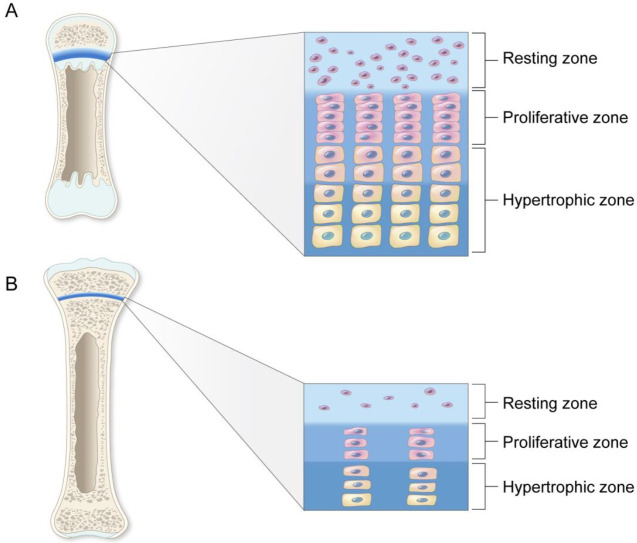
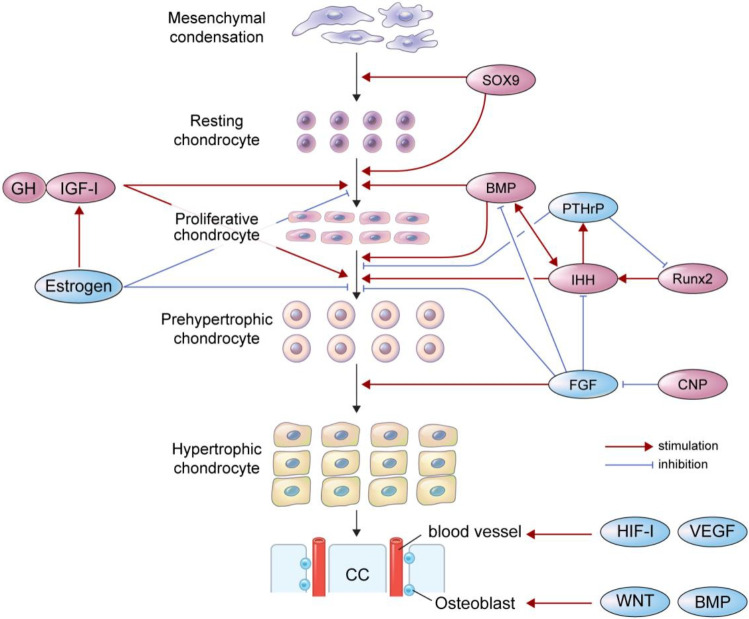
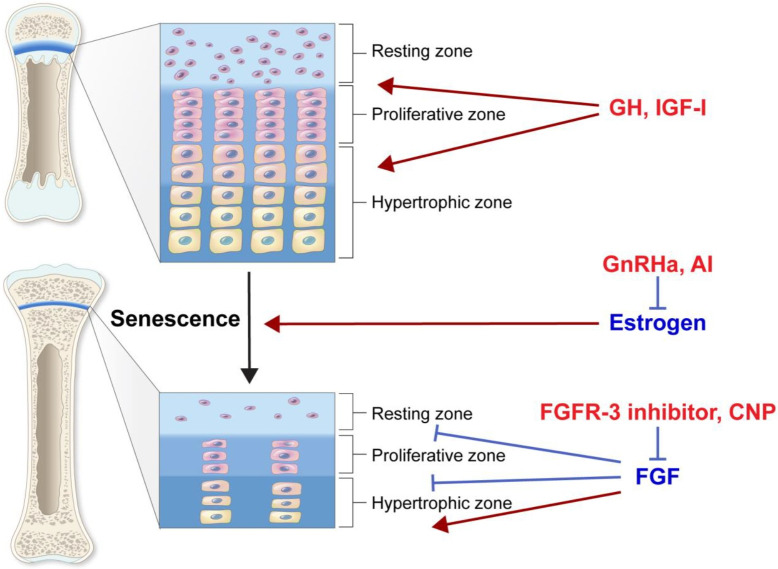
Height gains result from longitudinal bone growth, which is largely dependent on chondrocyte differentiation and proliferation within the growth plates of long bones. The growth plate, that is, the epiphyseal plate, is divided into resting, proliferative, and hypertrophic zones according to chondrocyte characteristics. The differentiation potential of progenitor cells in the resting zone, continuous capacity for chondrocyte differentiation and proliferation within the proliferative zone, timely replacement by osteocytes, and calcification in the hypertrophic zone are the 3 main factors controlling longitudinal bone growth. Upon adequate longitudinal bone growth, growth plate senescence limits human body height. During growth plate senescence, progenitor cells within the resting zone are depleted, proliferative chondrocyte numbers decrease, and hypertrophic chondrocyte number and size decrease. After senescence, hypertrophic chondrocytes are replaced by osteocytes, the extracellular matrix is calcified and vascularized, the growth plate is closed, and longitudinal bone growth is complete. To date, gonadotropin-releasing hormone analogs, aromatase inhibitors, C-type natriuretic peptide analogs, and fibroblast growth factor receptor 3 inhibitors have been studied or used as therapeutic interventions to delay growth plate closure. Complex networks of cellular, genetic, paracrine, and endocrine signals are involved in growth plate closure. However, the detailed mechanisms of this process remain unclear. Further elucidation of these mechanisms will enable the development of new therapeutic modalities for the treatment of short stature, precocious puberty, and skeletal dysplasia.
Overview
CoChat Summary
TL;DR
This review summarizes growth plate structure, senescence, and closure mechanisms and the therapeutic interventions studied or used to delay closure. It highlights GnRHa, aromatase inhibitors, CNP analogs, and FGFR-3 inhibitors, while noting that detailed molecular mechanisms remain unclear.
Key findings
- Growth plate closure involves depletion of resting-zone progenitor cells, decreased proliferative chondrocyte numbers, and decreased hypertrophic chondrocyte number and size; hypertrophic chondrocytes are then replaced by osteocytes, the extracellular matrix is calcified and vascularized, and longitudinal bone growth ends.
- GnRHa treatment increased adult height by 2–10 cm in children with precocious puberty and by 1.7–6.7 cm in adolescents with idiopathic short stature or growth-limiting syndromes, but adverse effects on bone mineral density were reported in adolescents with idiopathic short stature who did not undergo early-onset puberty.
- Aromatase inhibitors have shown positive adult-height effects in a few off-label reports, but general use to increase height is not widely accepted because of possible adverse effects on bone mineral density and vertebral deformity.
- CNP analogs (vosoritide, navepegritide) and FGFR-3 inhibitors (recifercept, vofatamab, infigratinib) are new or studied treatments for achondroplasia that inhibit MAPK/FGFR signaling and stimulate chondrocyte differentiation and proliferation.
Methods
- Design: narrative review of growth plate biology, senescence, closure, and therapeutic interventions.
- Data or sample: published evidence-based reports on growth plate mechanisms and treatments; no primary patient sample or original trial data are presented.
- Main analysis: synthesis of cellular, genetic, paracrine, and endocrine factors and of therapeutic agents including GnRHa, aromatase inhibitors, CNP analogs, and FGFR-3 inhibitors; no systematic search or quantitative synthesis is described.
Limitations
- The paper states that the detailed mechanisms of growth plate closure remain unclear and that further elucidation is needed.
- The paper states that the exact mechanisms by which estrogen accelerates growth plate senescence remain unknown and that interactions among paracrine and genetic factors need further study.
- Evident from the text: this is a narrative review without a described systematic search strategy, quality appraisal, or primary data, so therapeutic efficacy and safety claims are summarized rather than systematically quantified.
Model-written summary. Check it against the paper before relying on it.
Integrity signals
Registry
Cites
Statistics
Figures
Verification
Claims the paper makes
0 Valid · 0 Not valid · 63 Not checked · 5 Own results and interpretations
None of the sources cited for this claim have been checked yet.
In the paper
“Therefore, postnatal skeletal growth appears to be driven by the epiphyseal stem cell niche [13-15].”
§ Growth plate closure and therapeutic interventions > Growth plate structure, function, and closure > 1. Resting zone
What the sources say
- Not checked yetcites [13] Schrier L Ferns SP Barnes KM Emons JA Nilsson O Depletion of resting zone chondrocytes during growth plate senescence J Endocrinol 2006 189 27 36 16614378 source
- Not checked yetcites [14] Chagin AS Newton PT Postnatal skeletal growth is driven by the epiphyseal stem cell niche: potential implications to pediatrics Pediatr Res 2020 87 986 90 31830758 PMC7196937 source
- Not checked yetcites [15] Lui JC Home for a rest: stem cell niche of the postnatal growth plate J Endocrinol 2020 246 R1 11 32240983 PMC7237297 source
hedgedstates a possible cause- Asserted: passes — The authors put it forward as true.
- Checkable: passes — It can be checked against evidence.
- Load-bearing: passes — The paper’s conclusions depend on it.
- Based: passes — The paper gives a reason why it holds.
- Rests on an assumption not shown here.
None of the sources cited for this claim have been checked yet.
In the paper
“However, at the end of puberty, these processes cease and longitudinal bone growth is completed via the growth plate senescence and closure processes [8,9]”
§ Growth plate closure and therapeutic interventions > Growth plate structure, function, and closure
What the sources say
plainstates a cause- Asserted: passes — The authors put it forward as true.
- Checkable: passes — It can be checked against evidence.
- Load-bearing: unclear — It is unclear whether the paper’s conclusions depend on it.
- Based: passes — The paper gives a reason why it holds.
None of the sources cited for this claim have been checked yet.
In the paper
“Longitudinal bone growth results from chondrogenesis at the growth plate and endochondral ossification [1-5].”
§ Growth plate closure and therapeutic interventions > Introduction
What the sources say
- Not matchedcites [1] Maes C Kronenberg HM Bone development and remodeling Robertson RP DeGroot’s endocrinology 8th ed Philadelphia (PA) Elsevier Inc 2023 869 88
Its entry has no title and year that we can search by.
- Not checked yetcites [2] Maes C Kronenberg HM Postnatal bone growth: growth plate biology, bone formation, and remodeling Glorieux FH Pettifor JM Jüppner H Pediatric bone 2nd ed San Diego (CA) Elsevier Inc 2012 55 82 source
- Not checked yetcites [3] Root AW Disorders of mineral metabolism: normal homeostasis Sperling MA Majzoub JA Menon RK Stratakis CA Sperling pediatric endocrinology 5th ed Philadelphia (PA) Elsevier Inc 2021 220 78 source
- Not checked yetcites [4] Shim KS Pubertal growth and epiphyseal fusion Ann Pediatr Endocrinol Metab 2015 20 8 12 25883921 PMC4397276 source
- Not checked yetcites [5] A ırdil Y The growth plate: a physiologic overview EFORT Open Rev 2020 5 498 507 32953135 PMC7484711 source
plainstates a cause- Asserted: passes — The authors put it forward as true.
- Checkable: passes — It can be checked against evidence.
- Load-bearing: passes — The paper’s conclusions depend on it.
- Based: passes — The paper gives a reason why it holds.
- Not matched
None of the sources cited for this claim have been checked yet.
In the paper
“Estrogen also promotes bone formation and remodeling by stimulating osteoblastogenesis and inhibiting osteoclastogenesis [36-39].”
§ Growth plate closure and therapeutic interventions > Growth plate structure, function, and closure > 2. Proliferative zone
What the sources say
- Not checked yetcites [36] Weise M De-Levi S Barnes KM Gafni R Abad V Baron J Effects of estrogen on growth plate senescence and epiphyseal fusion Proc Natl Acad Aci USA 2001 98 6871 6 PMC34445 11381135 source
- Not checked yetcites [37] Börjesson AE Windahl SH Karimian E Eriksson EE Lagerquist MK Engdahl C The role of estrogen receptor-α and its activation function-1 for growth plate closure in female mice Am J Physiol Endocrinol Metab 2012 302 E1381 9 22414805 PMC3378067 source
- Not checked yetcites [38] Börjesson AE Lagerquist MK Liu C Shao R Windahl SH Karlsson C The role of estrogen receptor α in growth plate cartilage for longitudinal bone growth J Bone Miner Res 2010 25 2414 24 20564247 source
- Not checked yetcites [39] Nilsson O Weise M Landman EB Meyers JL Barnes KM Baron J Evidence that estrogen hastens epiphyseal fusion and cessation of longitudinal bone growth by irreversibly depleting the number of resting zone progenitor cells in female rabbits Endocrinology 2014 155 2892 9 24708243 PMC4098010 source
plainstates a cause- Asserted: passes — The authors put it forward as true.
- Checkable: passes — It can be checked against evidence.
- Load-bearing: unclear — It is unclear whether the paper’s conclusions depend on it.
- Based: passes — The paper gives a reason why it holds.
In the paper
“Wingless-type mouse mammary tumor virus integration site/β-catenin signaling, Runx2, Osterix, BMP, IHH, and IGF are the required factors for differentiation [51].”
§ Growth plate closure and therapeutic interventions > Growth plate structure, function, and closure > 3. Hypertrophic zone
What the sources say
- Not checked yetcites [51] Noble BS The osteocyte lineage Arch Biochem Biophys 2008 473 106 11 18424256 source
plainstates a cause- Asserted: passes — The authors put it forward as true.
- Checkable: passes — It can be checked against evidence.
- Load-bearing: unclear — It is unclear whether the paper’s conclusions depend on it.
- Based: passes — The paper gives a reason why it holds.
28 more claims
Create a free account to see all 68 claims and to verify the 157 references still open.
- It may state two separate claims as one. 24
- Probably not a substantial claim. 19
Citations
Cites
Vascular Endothelial Growth Factor: Basic Science and Clinical Progress
Ferrara, N. (2004) · Endocrine Reviews · doi:10.1210/er.2003-0027 · Cited by 3,687
Akiyama, H., Chaboissier, M.-C., Martin, J. F., Schedl, A., & de Crombrugghe, B. (2002) · Genes & Development · doi:10.1101/gad.1017802 · Cited by 1,721
Growth Hormone, Insulin-Like Growth Factors, and the Skeleton
Giustina, A., Mazziotti, G., & Canalis, E. (2008) · Endocrine Reviews · doi:10.1210/er.2007-0036 · Cited by 914
Systemic and Local Regulation of the Growth Plate
van der Eerden, B. C. J., Karperien, M., & Wit, J. M. (2003) · Endocrine Reviews · doi:10.1210/er.2002-0033 · Cited by 558
Estrogen Regulation of Growth Hormone Action
Leung, K.-C., Johannsson, G., Leong, G. M., & Ho, K. K. Y. (2004) · Endocrine Reviews · doi:10.1210/er.2003-0035 · Cited by 542
Minina, E., Kreschel, C., Naski, M. C., Ornitz, D. M., & Vortkamp, A. (2002) · Developmental Cell · doi:10.1016/s1534-5807(02)00261-7 · Cited by 475
Disease states associated with telomerase deficiency appear earlier in mice with short telomeres
Herrera, E., Samper, E., Martín‐Caballero, J., Flores, J. M., Lee, H., & Blasco, M. A. (1999) · The EMBO Journal · doi:10.1093/emboj/18.11.2950 · Cited by 471
Karp, S. J., Schipani, E., St-Jacques*, B., Hunzelman, J., Kronenberg, H., & McMahon, A. P. (2000) · Development · doi:10.1242/dev.127.3.543 · Cited by 458
BMP and Ihh/PTHrP signaling interact to coordinate chondrocyte proliferation and differentiation
Minina, E., Wenzel, H. M., Kreschel, C., Karp, S., Gaffield, W., McMahon, A. P., & Vortkamp, A. (2001) · Development · doi:10.1242/dev.128.22.4523 · Cited by 449
Endocrine Regulation of the Growth Plate
Nilsson, O., Marino, R., De Luca, F., Phillip, M., & Baron, J. (2005) · Hormone Research in Paediatrics · doi:10.1159/000088791 · Cited by 441
Research works printed but not linked: 1
- Maes C Kronenberg HM Bone development and remodeling Robertson RP DeGroot’s endocrinology 8th ed Philadelphia (PA) Elsevier Inc 2023 869 88
Cited by
Lu, Y., Zhang, T., Chen, K., Canavese, F., Huang, C., Yang, H., Shi, J., He, W., Zheng, Y., & Chen, S. (2025) · Bioactive Materials · doi:10.1016/j.bioactmat.2025.04.001 · Cited by 26
“The PCs are adjacent to the reserve zone and undergoe mitosis in columns parallel to the bone growth axis [17].”
Impact of All-trans Retinoic Acid on Skeletal Development: Mechanisms of Growth Plate Closure
Fan, X., Xing, Y., Mei, Z., Zhang, Y., Pi, Y., Wu, X., & Zhang, H. (2025) · Combinatorial Chemistry & High Throughput Screening · doi:10.2174/0113862073424590251103061707 · Cited by 3
Park, S.-H., Park, J., Yoo, J., Kim, H.-S., Lee, M., & Kim, O. (2025) · Journal of Medicinal Food · doi:10.1089/jmf.2025.k.0002 · Cited by 3
Growth Plate Injuries: Advances and Future Directions in Regenerative Medicine
Rasouli, M., & Wenke, J. C. (2025) · Annals of Biomedical Engineering · doi:10.1007/s10439-025-03942-5 · Cited by 1
Abdel-Hameed, R., Abd‐Elhafeez, H. H., Bakry, M., Abdel-Raheem, S. M., Sheikh, A. I. E., Ismail, H., Ameen, F. A., & Soliman, S. A. (2026) · Micron · doi:10.1016/j.micron.2026.104036 · Cited by 1
Metadata
- Authors
- Cho, J. H., Jung, H. W., & Shim, K. S.
- Affiliations
- Kyung Hee University Hospital at Gangdong (KR)
- Kyung Hee University (KR)
- Corresponding author
- Shim, Kye Shik
- Venue
- Clinical and Experimental Pediatrics
- Publisher
- Korean Pediatric Society
- Published
- 2024-11-15
- Volume
- 67
- Issue
- 11
- Pages
- 553-559
- ISSN
- 1738-1061 (ISSN-L)
- 2713-4148
- PMC
- PMC11551597
- OpenAlex
- W4403845175
- Semantic Scholar
- ac240686cc0fafa841c55c924d44b5b55cf74321
- Cited by
- 19
- References
- 59
- Citations by year
- 2026: 12 · 2025: 7
- FWCI
- 4.14
- Type
- journal article
- Language
- en
- Open access
- diamond
- doi.org
- Licence
- cc-by-nc
- creativecommons.org/licenses/by-nc/4.0/ (tdm)
- Locations
- Korean Journal of Pediatrics (publishedVersion, cc-by-nc)
- PubMed Central (publishedVersion, cc-by-nc)
- PubMed (publishedVersion)
- DOAJ (DOAJ: Directory of Open Access Journals) (submittedVersion)
- Topics
- Health Sciences › Medicine › Endocrinology, Diabetes and Metabolism › Growth Hormone and Insulin-like Growth Factors
- Health Sciences › Medicine › Rheumatology › Osteoarthritis Treatment and Mechanisms
- Health Sciences › Medicine › Reproductive Medicine › Hypothalamic control of reproductive hormones
- Keywords
- growth plate closure, longitudinal bone growth, chondrogenic differentiation, chondrocyte proliferation, osteocytes, growth hormone therapy, short stature, precocious puberty, skeletal dysplasia, GnRH analogues, aromatase inhibitors
About these checks
Registry, retraction, Cites and statistics results are computed, not judged, with one exception: a printed reference that no index lists is read once by a model before it counts as a citation error. Claims are extracted by a model and kept only when their quote appears verbatim in the text; each cited source is then checked, with a model’s help, for whether it says what the claim relies on. Those verdicts can be wrong — read the claim’s quote and the cited source before relying on one.
A language model drew the claims from the paper on 2026-11-28, under version 3 of the claim definition (model deepseek-v4.1-flash, prompt extract-v3).
A second model labelled each claim on 2026-11-28 (model jev-1.13-20260917, definition revision gold-guideline-v0.2).
Statistics and arithmetic are recomputed, not judged.
Confidence bands are shown only for fields calibrated on our annotated test set. None is calibrated yet, so no band is shown.
What counts as a claim ›How we measure confidence ›How we check this ›
Are you an author, or do you see a problem with this page? Request a review
How to cite
Cite CoChat for the checks on this page, and the paper for its own findings.
- This page
- CoChat. (2026). Citation check: Growth plate closure and therapeutic interventions. https://app.cochat.ai/papers/10.3345/cep.2023.00346
- The paper
- Cho, J. H., Jung, H. W., & Shim, K. S. (2024). Growth plate closure and therapeutic interventions. Clinical and Experimental Pediatrics. https://doi.org/10.3345/cep.2023.00346
Data sources
Bibliographic data: Semantic Scholar, OpenAlex, Crossref.
Contains information from the Semantic Scholar Academic Graph Datasets, made available under the ODC Attribution License (ODC-BY 1.0).
Semantic Scholar’s data is described in: Kinney, R., et al. (2023). The Semantic Scholar Open Data Platform. arXiv:2301.10140.
