

Organoids-on-a-chip: microfluidic technology enables culture of organoids with enhanced tissue function and potential for disease modeling
Open accessThe DOI matches its Crossref record; 138 of the 138 references it cites were found in a registry or an index.
Abstract
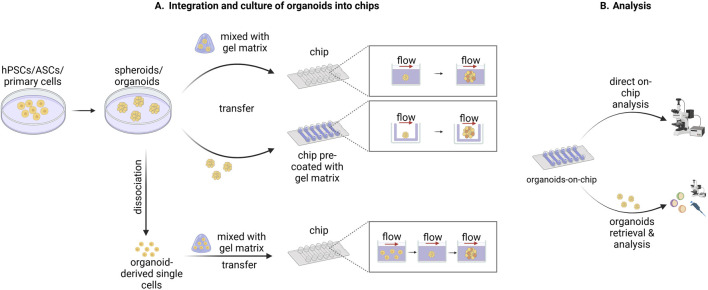
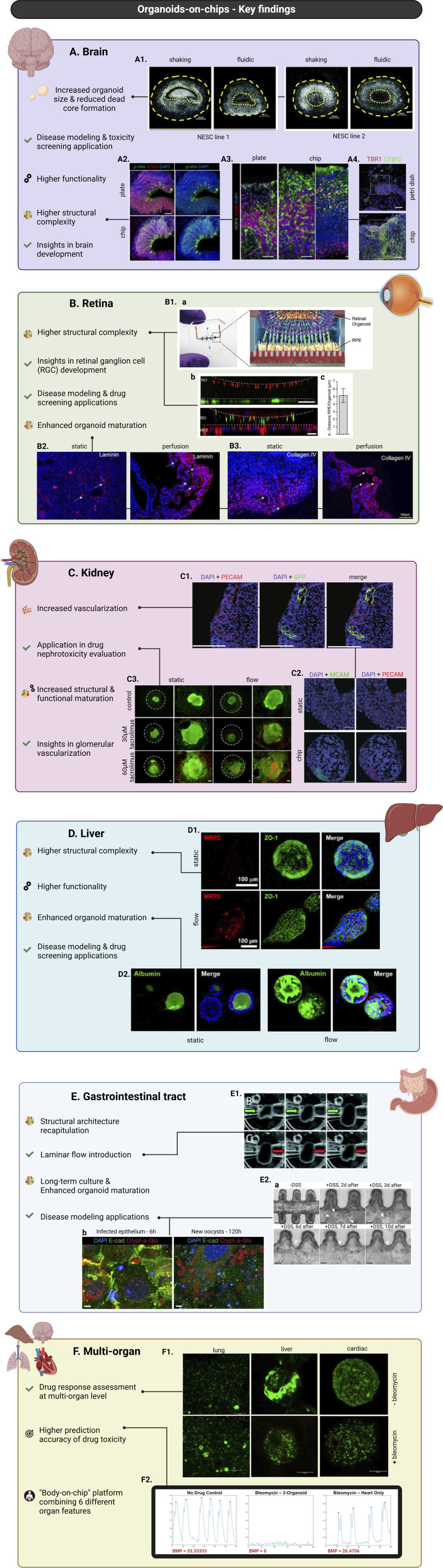
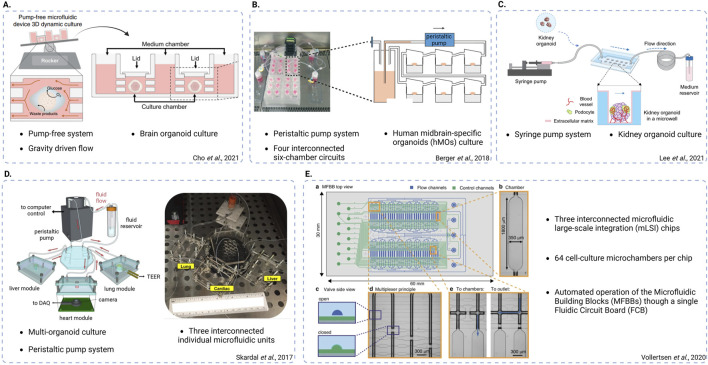
Organoids are stem-cell derived tissue structures mimicking specific structural and functional characteristics of human organs. Despite significant advancements in the field over the last decade, challenges like limited long-term functional culture and lack of maturation are hampering the implementation of organoids in biomedical research. Culture of organoids in microfluidic chips is being used to tackle these challenges through dynamic and precise control over the organoid microenvironment. This review highlights the significant breakthroughs that have been made in the innovative field of “organoids-on-chip,” demonstrating how these have contributed to advancing organoid models. We focus on the incorporation of organoids representative for various tissues into chips and discuss the latest findings in multi-organoids-on-chip approaches. Additionally, we examine current limitations and challenges of the field towards the development of reproducible organoids-on-chip systems. Finally, we discuss the potential of organoids-on-chip technology for both in vitro and in vivo applications.
Overview
The claims and statistics of this paper haven’t been checked yet.
Free: it reads the open-access text and checks the first 5 claims that cite a source we can check. Create a free account to check every claim.
Integrity signals
Registry
Cites
Statistics
Figures
Verification
Claims the paper makes
The claims and statistics of this paper haven’t been checked yet.
Free: it reads the open-access text and checks the first 5 claims that cite a source we can check. Create a free account to check every claim.
Self-check
Percentages, sums and reported differences re-computed from the paper’s own numbers.
The self-check needs the paper’s full text.
Citations
Cites
Cerebral organoids model human brain development and microcephaly
Lancaster, M. A., Renner, M., Martin, C.-A., Wenzel, D., Bicknell, L. S., Hurles, M. E., Homfray, T., Penninger, J. M., Jackson, A. P., & Knoblich, J. A. (2013) · Nature · doi:10.1038/nature12517 · Cited by 5,372
Reconstituting organ-level lung functions on a chip
Huh, D., Matthews, B. D., Mammoto, A., Montoya-Zavala, M., Hsin, H. Y., & Ingber, D. E. (2010) · Science · doi:10.1126/science.1188302 · Cited by 4,250 · cited 1×
“The complex and dynamic microenvironment involved in in vivo organ development, homeostasis and disease can be recapitulated through the incorporation of relevant biochemical and biomechanical cues (Schepers et al., 2016; Huh et al., 2010).”
Bhatia, S. N., & Ingber, D. E. (2014) · Nature Biotechnology · doi:10.1038/nbt.2989 · Cited by 3,305
Modeling Development and Disease with Organoids
Clevers, H. (2016) · Cell · doi:10.1016/j.cell.2016.05.082 · Cited by 3,196 · cited 1×
“They exhibit structural, morphological, and functional characteristics that resemble human organs (Clevers, 2016; Lancaster and Knoblich, 2014b), enabling their use in fundamental and applied Despite the advancements that have been made in organoid culture throughout the last years, there are…”
Organogenesis in a dish: Modeling development and disease using organoid technologies
Lancaster, M. A., & Knoblich, J. A. (2014) · Science · doi:10.1126/science.1247125 · Cited by 2,931 · cited 1×
“They exhibit structural, morphological, and functional characteristics that resemble human organs (Clevers, 2016; Lancaster and Knoblich, 2014b), enabling their use in fundamental and applied Despite the advancements that have been made in organoid culture throughout the last years, there are…”
Brain-Region-Specific Organoids Using Mini-bioreactors for Modeling ZIKV Exposure
Qian, X., Nguyen, H. N., Song, M. M., Hadiono, C., Ogden, S. C., Hammack, C., Yao, B., Hamersky, G. R., Jacob, F., Zhong, C., et al. (2016) · Cell · doi:10.1016/j.cell.2016.04.032 · Cited by 2,127
Generation of cerebral organoids from human pluripotent stem cells
Lancaster, M. A., & Knoblich, J. A. (2014) · Nature Protocols · doi:10.1038/nprot.2014.158 · Cited by 1,823 · cited 1×
“However, the extended cultivation and maturation of cerebral organoids is hindered due to insuf fi cient nutrient and oxygen supply often resulting in necrotic core formation (Qian et al., 2016; Lancaster et al., 2013; Lancaster and Knoblich, 2014a).”
Mechanical forces direct stem cell behaviour in development and regeneration
Vining, K. H., & Mooney, D. J. (2017) · Nature Reviews Molecular Cell Biology · doi:10.1038/nrm.2017.108 · Cited by 1,656 · cited 1×
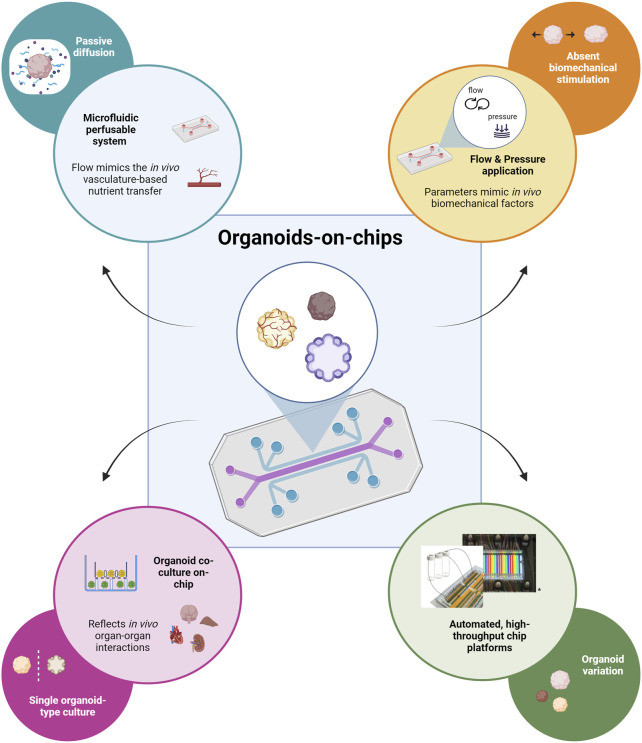
“Mechanical forces hold a crucial role in developmental and physiological processes and can be recapitulated by chip platforms through application of fl ow and pressure (Figure 2, top right; Vining and Mooney, 2017).”
Kidney organoids from human iPS cells contain multiple lineages and model human nephrogenesis
Takasato, M., Er, P. X., Chiu, H. S., Maier, B., Baillie, G. J., Ferguson, C., Parton, R. G., Wolvetang, E. J., Roost, M. S., Chuva de Sousa Lopes, S. M., et al. (2015) · Nature · doi:10.1038/nature15695 · Cited by 1,627
Three-dimensional bioprinting of thick vascularized tissues
Kolesky, D. B., Homan, K. A., Skylar-Scott, M. A., & Lewis, J. A. (2016) · Proceedings of the National Academy of Sciences · doi:10.1073/pnas.1521342113 · Cited by 1,492 · cited 1×
“The integration of a perfusable micro fl uidic system to mimic vasculature function can overcome the diffusion limitations (Figure 2, top left; Kim et al., 2013; Kolesky et al., 2016).”
Cited by
Items 101–125 of 125
A modular microfluidic chip unit for multiple-organ-on-chip platform integration and drug screening
Hao, Y.-J., Chen, J.-W., Ke, Y.-W., Zhao, R.-Y., Peng, H.-C., Chu, C.-Y., Yao, B.-Y., Hsiao, W., Hung, M., & Tseng, F. (2026) · The Analyst · doi:10.1039/d6an00510a
Follicle-stimulating hormone and cancer
Li, Y. Q., Liu, Y., Guo, Y., Guo, M., Li, Z., Zheng, M., & Liu, G. (2026) · Cellular Signalling · doi:10.1016/j.cellsig.2026.112738
Microtechnologies for biological research: From cell culture to drug screening
Fernandes, T., Fernandes, P., & Marques, M. P. C. (2026) · Elsevier eBooks · doi:10.1016/b978-0-443-36330-6.00005-9
The Application of 3D Cell Culture in Thyroid Cancer
Jiang, H., Zhou, D., Li, Z., Jiang, H., Zhu, G., Xu, K., & Sun, J. (2026) · Annals of Biomedical Engineering · doi:10.1007/s10439-026-04299-z
Terlizzi, C., Ferrara, Y., & Sarnella, A. (2026) · Cancers · doi:10.3390/cancers18152469
“Microfluidic tumor models, vascularized organoids, and patient-derived platforms provide complementary systems for investigating metastatic dissemination and TME interactions across different biological scales [88].”
Zuo, T., Liao, C., Guo, Y.-S., Yang, X.-M., Cheng, X., Xu, F.-G., Hu, K., & Lin, Y.-Q. (2026) · Pharmacological Research · doi:10.1016/j.phrs.2026.108364
Maduna, T., Pancho, A., Ilgaz, Y., Hakani, M., Guedan-Duran, A., Morin, A., Sepulveda-Diaz, J. E., Virtuoso, A., Luca, C. D., Cirillo, G., et al. (2026) · Lab on a Chip · doi:10.1039/d6lc00266h
Gazerani, P., Pereira, N. S., & DosSantos, M. F. H. (2026) · Neuroglia · doi:10.3390/neuroglia7030028
“Recent advances in induced pluripotent stem cell (iPSC) technology, brain organoids, assembloids, organ-on-chip platforms, and spatial transcriptomics provide increasingly sophisticated opportunities to investigate human glial biology under physiologically relevant conditions [90–92].”
Nanotechnology in Pediatric Neurology: Applications and Innovations
Teleanu, R. I., Lungescu, I. A., Niculescu, A.-G., Cojocaru, A.-M., Perjoc, R., Chenescu, B. T., Roza, E., Vladâcenco, O. A., Grumezescu, A. M., & Teleanu, D. M. (2026) · Pharmaceutics · doi:10.3390/pharmaceutics18080999
Flow-dependent drug response of breast Cancer organoids in an organ-on-Chip platform
Kocamaz, E., Aslan, D., Özbolat, V., Köşeci, T., & Canpolat, Ç. (2026) · Microchemical Journal · doi:10.1016/j.microc.2026.119414
Tao, Y., Wang, Y., Wang, P., Wang, B., Lv, X., & Feng, Y. (2026) · Bone Research · doi:10.1038/s41413-026-00579-5 · Cited by 1
“177,178 Intraosseous pressure in micro fl uidic VBO systems In the early stage of SONFH, bone marrow edema and elevated intraosseous pressure are commonly observed.”
Advances in microfluidics for organ culture
Sharma, S. (2026) · Progress in molecular biology and translational science · doi:10.1016/bs.pmbts.2026.08.017
Modeling inflammation and inflammatory diseases in organoids
Moor, A. D., Vankelecom, H. E. J., & Arnauts, K. (2026) · British Medical Bulletin · doi:10.1093/bmb/ldag028
Wu, M., Shi, M., Chen, L., Yao, D., Yuan, Y., Purup, S., Chen, L., & Shi, H. (2026) · Animal Nutriomics · doi:10.1017/anr.2026.10062
Human iPSC‐Derived Brain Organoids: A Disease‐Oriented Evaluation of Modeling Fidelity
Pokharel, B. R., Dickerson, A., Shenoy, S. G., Ramasamy, M. S., Majumdar, N., Cook, P. P., & Akula, S. M. (2026) · European Journal of Neuroscience · doi:10.1111/ejn.70687
“These approaches offer regulated perfusion, improved oxygen and nutrient circulation, and more efficient waste elimination, consequently increasing organoid maturation and viability (Papamichail et al. 2025).”
Organ-on-a-chip platforms for disease modeling and in vitro diagnostic applications
Hao, P., Jingrong, D., & Xu, J. (2026) · Frontiers in Bioengineering and Biotechnology · doi:10.3389/fbioe.2026.1956618
Smart organoid-on-chip systems: From microfluidics to sensors, control, and AI
Wajid, H., & Begum, S. (2026) · The International Journal of Artificial Organs · doi:10.1177/03913988261479040
El‐Sehrawy, A. A. M. A., Khaleel, Z. T., Refatovich, G. R., Koka, N. A., Baig, M. R., Srivastav, S. K., abdullah, S. S., Jabir, M. S., Bainsal, N., & Smerat, A. (2026) · Artificial Organs · doi:10.1111/aor.70242
Gong, L., Su, L., Gao, H., Cao, L., Huang, P., Yang, J., Zhang, W., Zhang, Y., Fan, J., Zhang, X., et al. (2026) · Journal of Pharmaceutical Analysis · doi:10.1016/j.jpha.2026.101803
Systematic Evaluation of Organoid Fidelity for ADME and Toxicity Assessment
RuoXuan, X. I. A. O., Zheng, Y., Huang, S., Liang, J., Fang, W., Li, J., Wang, Y., & Chen, L. (2026) · Drug Metabolism and Disposition · doi:10.1016/j.dmd.2026.100422
Frascogna, C., Panzetta, V., & Ventre, M. (2026) · Frontiers in Biophysics · doi:10.3389/frbis.2026.1943541
García-Moll, L., García-Moll, M. P., Oliver, M., Casado-Carmona, F. A., Carrasco‐Correa, E. J., & Miró, M. (2026) · Microchimica Acta · doi:10.1007/s00604-026-08469-7
“Although step [#8] could not be unambiguously interpreted by FTIR-ATR due to the need to keep the liposome/PC-laden material wet with PBS, the spectrum showed several bands compatible with the presence of phosphatidylcholine.”
Liu, K., Yang, F., Lyu, X., He, H., & Wen, W. (2026) · Journal of Translational Internal Medicine · doi:10.1515/jtim-2026-0060
Vitreous Transcriptomics in Diabetic Retinopathy: Current Research and Future Prospects
Bober, E. A., Thomas, M. N., Woronkowicz, M., & Ramsden, C. M. (2026) · Biology · doi:10.3390/biology15211997
Microfluidic engineering for organoid formation, cultivation, and sensing
Kushnir, I. A., Salina, K. O., Bogolubova, Y. A., Mushegian, T. M., Dragun, M. A., Volegova, D. D., Polynkin, L. Y., Kopylova, A. A., Salmina, A. B., & Yurchenko, S. O. (2026) · Frontiers in Bioengineering and Biotechnology · doi:10.3389/fbioe.2026.1994650
Metadata
- Authors
- Papamichail, L., Koch, L. S., Veerman, D., Broersen, K., & van der Meer, A. D.
- Affiliations
- Erasmus MC (NL)
- University of Twente (NL)
- Corresponding author
- Koch, Lena S.
- Broersen, Kerensa
- Venue
- Frontiers in Bioengineering and Biotechnology
- Publisher
- Frontiers Media SA
- Published
- 2025-03-11
- Volume
- 13
- Pages
- 1515340-1515340
- ISSN
- 2296-4185 (ISSN-L)
- PMC
- PMC11933005
- OpenAlex
- W4408314573
- Cited by
- 120
- References
- 137
- Citations by year
- 2026: 90 · 2025: 30
- FWCI
- 9.66
- Type
- journal article
- Language
- en
- Open access
- gold
- doi.org
- Licence
- Locations
- Frontiers in Bioengineering and Biotechnology (publishedVersion, cc-by)
- Europe PMC (PubMed Central) (publishedVersion, cc-by)
- PubMed Central (publishedVersion, cc-by)
- PubMed (publishedVersion)
- University of Twente Research Information (publishedVersion, cc-by)
- DOAJ (DOAJ: Directory of Open Access Journals) (submittedVersion, cc-by-sa)
- Funders
- Nederlandse Organisatie voor Wetenschappelijk Onderzoek (024.003.001 19424 18958)
- ZonMw
- Topics
- Physical Sciences › Engineering › Biomedical Engineering › 3D Printing in Biomedical Research
- Physical Sciences › Engineering › Biomedical Engineering › Microfluidic and Capillary Electrophoresis Applications
- Health Sciences › Medicine › Surgery › Tissue Engineering and Regenerative Medicine
- Keywords
- microfluidic organoids, organoid culture, organoid maturation
About these checks
Registry, retraction, Cites and statistics results are computed, not judged, with one exception: a printed reference that no index lists is read once by a model before it counts as a citation error. Claims are extracted by a model and kept only when their quote appears verbatim in the text; each cited source is then checked, with a model’s help, for whether it says what the claim relies on. Those verdicts can be wrong — read the claim’s quote and the cited source before relying on one.
Statistics and arithmetic are recomputed, not judged.
Confidence bands are shown only for fields calibrated on our annotated test set. None is calibrated yet, so no band is shown.
What counts as a claim ›How we measure confidence ›How we check this ›
Are you an author, or do you see a problem with this page? Request a review
Data sources
Bibliographic data: Semantic Scholar, OpenAlex, Crossref.
Contains information from the Semantic Scholar Academic Graph Datasets, made available under the ODC Attribution License (ODC-BY 1.0).
Semantic Scholar’s data is described in: Kinney, R., et al. (2023). The Semantic Scholar Open Data Platform. arXiv:2301.10140.
