

The effects of acute exercise on long-term episodic memory: a systematic review and meta-analysis
Open accessThe DOI matches its Crossref record; 139 of the 139 references it cites were found in a registry or an index; none of the 60 sources its claims cite is checked for support yet.
Abstract
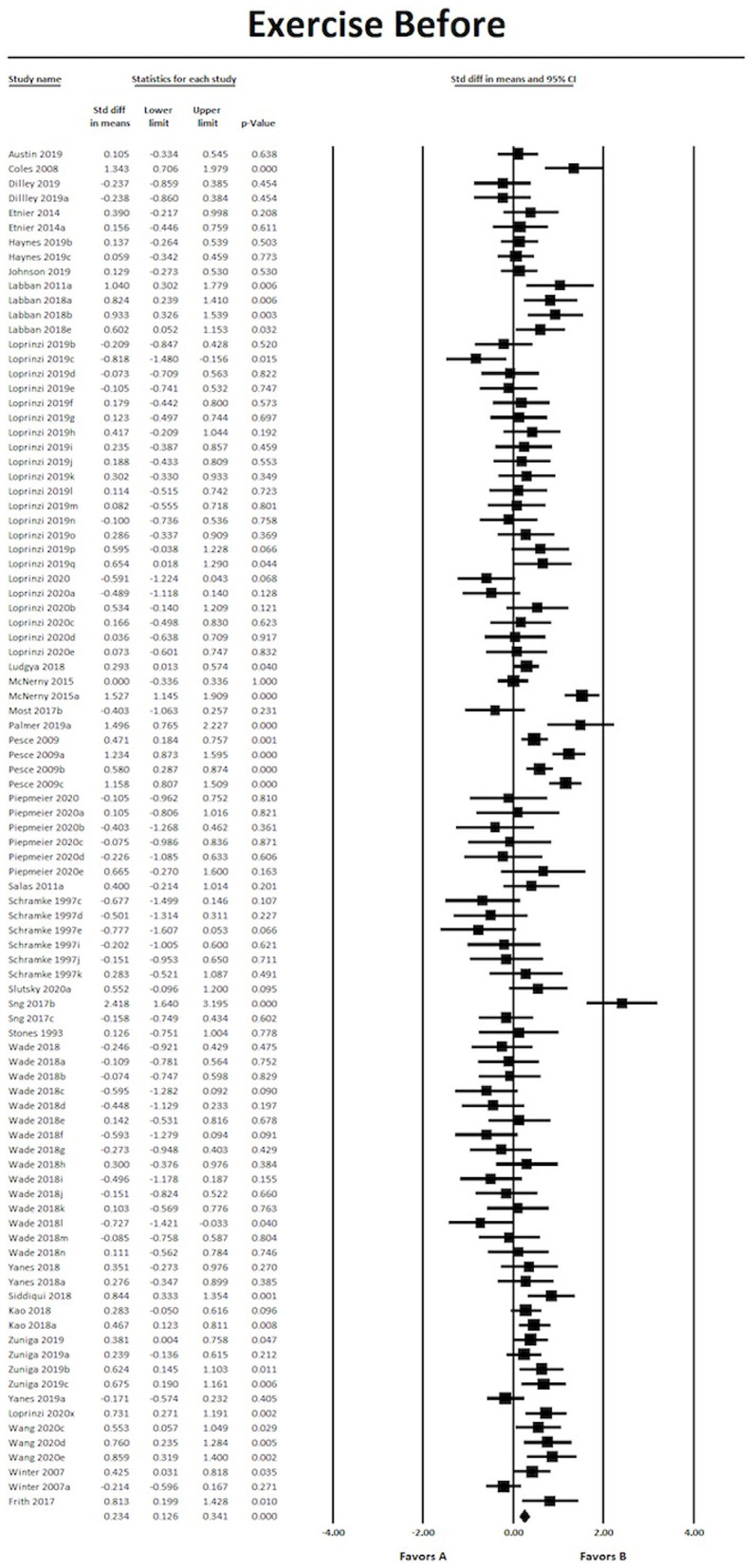
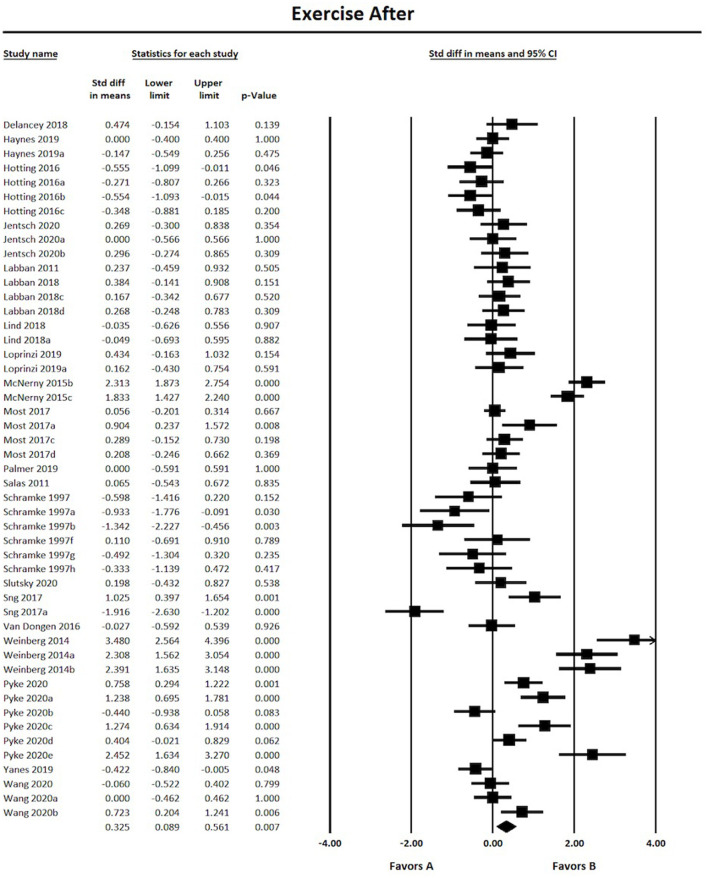
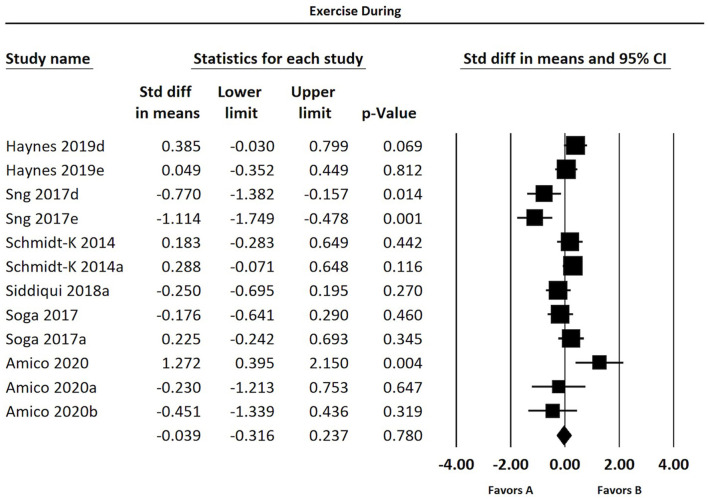
Research findings reveal a relationship between acute bouts of exercise and procedural/declarative memory. Prior systematic reviews report small/moderate effects of acute exercise on episodic long-term declarative memory. A somewhat overlooked issue is the influence of exercise on specific types of episodic memory processing. The primary focus of this systematic review and meta-analysis was to evaluate the effects of acute bouts of exercise prior to, during, and following encoding on free-, cued-recall, and recognition episodic memory. PubMed, Scopus, and EBSCO databases were entered, and 42 experiments were subject to meta-analysis. Exercise prior to encoding improved memory (d = 0.23) and affected free-recall (d = 0.40) tests of memory more than cued-recall (d = 0.08) or recognition (d = −0.06) memory. Exercise following encoding improved memory (d = 0.33) and affected recognition (d = 0.62) memory more than free- (d = 0.19) or cued-recall (d = 0.14) memory. Exercise during encoding did not influence memory (d = −0.04). Moderator analyses revealed that exercise before encoding impacted memory differentially on the basis of age, exercise type, and test-timing. When exercise occurred after encoding, age and exercise type, but not timing of the test influenced memory performance. Exercise before and after encoding has selective effects on episodic memory. Additional experiments that evaluate how bouts of exercise influence memory encoding are warranted. Systematic review registration: PROSPERO, identifier CRD42020202784.
Overview
CoChat Summary
TL;DR
This systematic review and meta-analysis of 42 experiments found that acute exercise before encoding improved episodic memory (d = 0.23), especially free recall, while exercise after encoding improved memory (d = 0.33), especially recognition; exercise during encoding had no effect (d = −0.04). Effects were selective by memory type and moderated by age, exercise type, and test timing.
Key findings
- Exercise before encoding improved memory overall (d = 0.23, 95% CI [0.13, 0.34], p < 0.001) and affected free recall (d = 0.40, 95% CI [0.27, 0.53], p < 0.001) more than cued recall (d = 0.08, ns) or recognition (d = −0.06, ns). Moderators included elementary children (d = 0.70), young adults (d = 0.19), older adults (d = −0.47), aerobic exercise (d = 0.24), cycling (d = 0.61), medium duration (d = 0.64), moderate intensity (d = 0.56), and same-day testing (d = 0.30); Egger’s test indicated publication bias (intercept 1.90, p = 0.002).
- Exercise after encoding improved memory overall (d = 0.33, p = 0.007) and affected recognition (d = 0.62, 95% CI [0.12, 1.13], p = 0.015) more than free recall (d = 0.19, ns) or cued recall (d = 0.14, ns). Moderators included young adults (d = 0.43), older adults (d = −0.94), predominantly female samples (d = 1.15), resistance exercise (d = 2.68), long duration (d = 2.68), and moderate intensity (d = 0.81); Egger’s test showed no evidence of publication bias (intercept 0.71, p = 0.67).
- Exercise during encoding did not influence memory overall (d = −0.04, 95% CI [−0.31, 0.24], p = 0.78); the only significant moderator was elementary-aged children (d = 1.27, CI [0.40, 2.15], p = 0.004). Egger’s test showed no evidence of publication bias (intercept −1.62, p = 0.40).
- A secondary narrative review reinforced the before-encoding findings; the paper also notes that Loprinzi (2019) found null results and Zabriskie and Heath (2019) found exercise during encoding benefited free recall more than exercise before encoding.
Methods
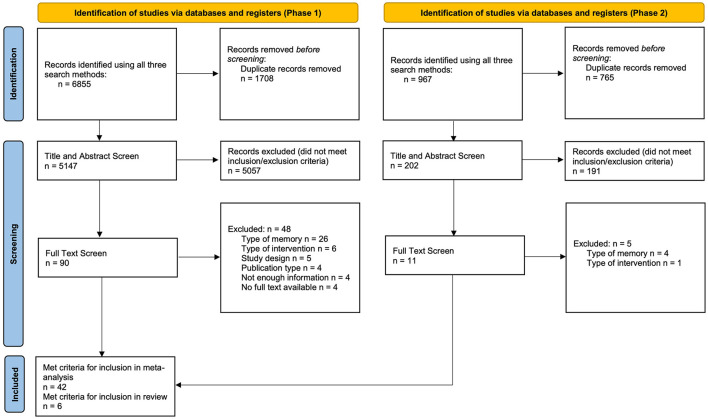
- Systematic review and meta-analysis registered with PROSPERO (CRD42020202784) and reported per PRISMA-P. Searches covered PubMed, Scopus, and EBSCO (six databases: CINAHL Complete, ERIC, MEDLINE, APA PsycArticles, APA PsycInfo, SPORTDiscus with Full Text) in March 2020 and November 2020, plus a follow-up search in February 2023 and manual reference-list searches.
- Inclusion criteria specified human participants aged 5 years or older, acute exercise before, during, or after an encoding task, and memory outcomes including free recall, cued recall, and recognition; excluded designs included cross-sectional, longitudinal, and chronic exercise studies. Forty-two experiments met criteria and were meta-analyzed.
- Three separate meta-analyses were conducted by encoding paradigm (before, during, after). Cohen’s d was calculated or estimated, using Comprehensive Meta-Analysis software; heterogeneity was assessed with Cochran’s Q and I², publication bias with Egger’s regression, and a priori categorical moderators were tested with mixed-effects analyses.
Limitations
- The paper states that results are restricted to episodic long-term memory only; that selecting a single theory (Atkinson and Shiffrin) as the framework is a limitation; that the majority of included experiments were rated poor or fair; that publication bias was evident for exercise prior to encoding; that few studies reported cardiorespiratory fitness; and that varied exercise-intensity metrics made standard thresholds difficult to apply.
- The paper also notes that heterogeneity among exercise protocols may introduce variability, and that analyses for children were based on a limited sample of experiments.
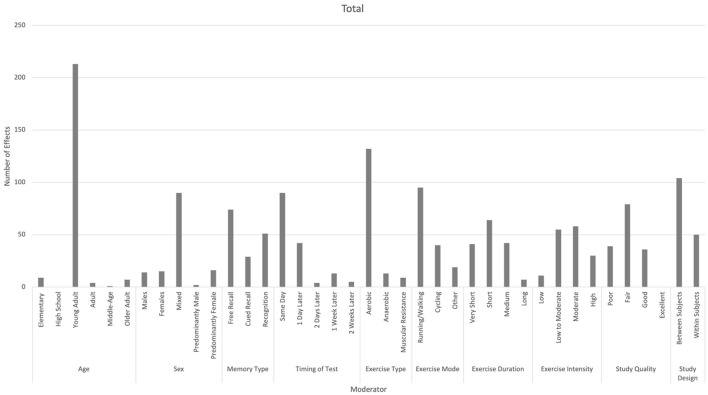
- Evident from the reported tables: heterogeneity was high (I² = 70.81 before encoding, 89.10 after encoding, 69.62 during encoding), and several moderator cells had very few effect-size contributions (e.g., older adults 3–4 effects; resistance exercise 3 effects; no high-school, middle-age, or excellent-quality subgroups).
Model-written summary. Check it against the paper before relying on it.
Integrity signals
Registry
Cites
Statistics
Figures
Verification
Claims the paper makes
0 Valid · 2 Not valid · 44 Not checked · 112 Own results and interpretations
A result the paper reports from its own data — it cites no other source for it, so there is none to check. The quote shows it is in the paper.
In the paper
“Exercise prior to encoding improved memory (d = 0.23)”
§ The effects of acute exercise on long-term episodic memory: a systematic review and meta-analysis > Abstract
plainstates a causen = 42- Asserted: passes — The authors put it forward as true.
- Checkable: passes — It can be checked against evidence.
- Load-bearing: passes — The paper’s conclusions depend on it.
- Based: passes — The paper gives a reason why it holds.
A result the paper reports from its own data — it cites no other source for it, so there is none to check. The quote shows it is in the paper.
In the paper
“Exercise prior to encoding improved memory (d = 0.23) and affected free-recall (d = 0.40) tests of memory more than cued-recall (d = 0.08) or recognition (d = −0.06) memory.”
§ The effects of acute exercise on long-term episodic memory: a systematic review and meta-analysis > Abstract
plainstates a causen = 42- Asserted: passes — The authors put it forward as true.
- Checkable: passes — It can be checked against evidence.
- Load-bearing: passes — The paper’s conclusions depend on it.
- Based: passes — The paper gives a reason why it holds.
A result the paper reports from its own data — it cites no other source for it, so there is none to check. The quote shows it is in the paper.
In the paper
“When exercise occurred after encoding, age and exercise type, but not timing of the test influenced memory performance.”
§ The effects of acute exercise on long-term episodic memory: a systematic review and meta-analysis > Abstract
plain- Asserted: passes — The authors put it forward as true.
- Checkable: passes — It can be checked against evidence.
- Load-bearing: passes — The paper’s conclusions depend on it.
- Based: passes — The paper gives a reason why it holds.
A result the paper reports from its own data — it cites no other source for it, so there is none to check. The quote shows it is in the paper.
In the paper
“Moderator analyses revealed that exercise before encoding impacted memory differentially on the basis of age, exercise type, and test-timing.”
§ The effects of acute exercise on long-term episodic memory: a systematic review and meta-analysis > Abstract
plainstates a cause- Asserted: passes — The authors put it forward as true.
- Checkable: passes — It can be checked against evidence.
- Load-bearing: passes — The paper’s conclusions depend on it.
- Based: passes — The paper gives a reason why it holds.
81 more claims
Create a free account to see all 158 claims and to verify the 55 references still open.
- Probably not a substantial claim. 57
- The quote only partly states this claim. 3
- It may state two separate claims as one. 23
Self-check
Percentages, sums and reported differences re-computed from the paper’s own numbers.
Each contradiction between two passages listed here was confirmed by an independent check.
Rated major: it would touch a result — a value a result rests on, reported and recomputed p-values on opposite sides of the significance level, two passages that conflict with no sign which is right, or a cited work retracted before this paper was published.
In the paper
§ The effects of acute exercise on long-term episodic memory: a systematic review and meta-analysis > Abstract
“exercise before encoding impacted memory differentially on the basis of age, exercise type, and test-timing.”
§ The effects of acute exercise on long-term episodic memory: a systematic review and meta-analysis > 3 Results > 3.2 Quantitative analyses
“| Exercise type | Exercise type | Exercise type | Exercise type | Exercise type | Exercise type | 3.479 | 0.176 |”
Rated major: it would touch a result — a value a result rests on, reported and recomputed p-values on opposite sides of the significance level, two passages that conflict with no sign which is right, or a cited work retracted before this paper was published.
In the paper
§ The effects of acute exercise on long-term episodic memory: a systematic review and meta-analysis > Abstract
“Moderator analyses revealed that exercise before encoding impacted memory differentially on the basis of age, exercise type, and test-timing. When exercise occurred after encoding, age and exercise type, but not timing of the test influenced memory performance.”
§ The effects of acute exercise on long-term episodic memory: a systematic review and meta-analysis > 3 Results > 3.2 Quantitative analyses
“| Timing of test | Timing of test | Timing of test | Timing of test | Timing of test | Timing of test | 8.137 | 0.043 |”
Rated minor: it would not touch a result — a value no result rests on, a p-value that stays on the same side of the significance level, or a conflict that is clerical, resolved elsewhere in the paper, or outside its own findings.
In the paper
§ The effects of acute exercise on long-term episodic memory: a systematic review and meta-analysis > Abstract
“d = 0.33”
§ The effects of acute exercise on long-term episodic memory: a systematic review and meta-analysis > 3 Results > 3.2 Quantitative analyses
“95% CI [0.89, 0.56]”
Rated minor: it would not touch a result — a value no result rests on, a p-value that stays on the same side of the significance level, or a conflict that is clerical, resolved elsewhere in the paper, or outside its own findings.
In the paper
§ The effects of acute exercise on long-term episodic memory: a systematic review and meta-analysis > 4 Discussion
“When exercise preceded encoding, there was a significant improvement in memory performance (d = 0.29)”
§ The effects of acute exercise on long-term episodic memory: a systematic review and meta-analysis > 3 Results > 3.2 Quantitative analyses
“The overall effect size for exercise before memory encoding compared to control conditions was d = 0.23”
Rated minor: it would not touch a result — a value no result rests on, a p-value that stays on the same side of the significance level, or a conflict that is clerical, resolved elsewhere in the paper, or outside its own findings.
In the paper
§ The effects of acute exercise on long-term episodic memory: a systematic review and meta-analysis > 4 Discussion > 4.1 Analyses of moderators of secondary interest
“Exercise intensity performed at low- and moderate-levels resulted in larger positive effects than high intensity exercise”
§ The effects of acute exercise on long-term episodic memory: a systematic review and meta-analysis > 3 Results > 3.2 Quantitative analyses
“| Low | 2 | −0.450* | −0.829 | −0.071 | 0.020 | | |”
2 more findings
Create a free account to see every finding of this check.
Citations
Cites
Measuring inconsistency in meta-analyses
Higgins, J. P. T., Thompson, S. G., Deeks, J. J., & Altman, D. G. (2003) · BMJ · doi:10.1136/bmj.327.7414.557 · Cited by 63,139
Levels of processing: A framework for memory research
Craik, F. I. M., & Lockhart, R. S. (1972) · Journal of Verbal Learning and Verbal Behavior · doi:10.1016/s0022-5371(72)80001-x · Cited by 9,566
Garber, C. E., Blissmer, B., Deschenes, M. R., Franklin, B. A., Lamonte, M. J., Lee, I.-M., Nieman, D. C., & Swain, D. P. (2011) · Medicine & Science in Sports & Exercise · doi:10.1249/mss.0b013e318213fefb · Cited by 9,319
Signal detection theory and psychophysics
Ingleby, J. D. (1967) · Journal of Sound and Vibration · doi:10.1016/0022-460x(67)90197-6 · Cited by 8,509
Downs, S. H., & Black, N. (1998) · Journal of Epidemiology and Community Health · doi:10.1136/jech.52.6.377 · Cited by 8,252
Human Memory: A Proposed System and its Control Processes
Atkinson, R. C., & Shiffrin, R. M. (1968) · Psychology of Learning and Motivation · doi:10.1016/s0079-7421(08)60422-3 · Cited by 7,216
The relation of strength of stimulus to rapidity of habit formation
Yerkes, R. M., & Dodson, J. D. (1908) · Journal of Comparative Neurology and Psychology · doi:10.1002/cne.920180503 · Cited by 6,911
Assessing heterogeneity in meta-analysis: Q statistic or I² index?
Huedo-Medina, T. B., Sánchez-Meca, J., Marín-Martínez, F., & Botella, J. (2006) · Psychological Methods · doi:10.1037/1082-989x.11.2.193 · Cited by 4,256
Memory - A century of consolidation
McGaugh, J. L. (2000) · Science · doi:10.1126/science.287.5451.248 · Cited by 4,250
Be smart, exercise your heart: Exercise effects on brain and cognition
Hillman, C. H., Erickson, K. I., & Kramer, A. F. (2008) · Nature Reviews Neuroscience · doi:10.1038/nrn2298 · Cited by 3,563
Research works printed but not linked: 1
- Kahneman D. (1973). Attention and Effort. Hoboken, NJ: Prentice-Hall.
Cited by
Physical activity and children's episodic memory: a meta-analysis
Schmid, D. G., Scott, N. M., & Tomporowski, P. D. (2024) · Pediatric Exercise Science · doi:10.1123/pes.2023-0020 · Cited by 2
Self-citationPatrick, Z., Jung, M., McMorris, T., & Loprinzi, P. D. (2025) · Psychological Research · doi:10.1007/s00426-025-02120-5 · Cited by 6
Schmid, D. G., Qazi, A. S., Scott, N. M., & Tomporowski, P. D. (2022) · Psychology of sport and exercise · doi:10.1016/j.psychsport.2022.102332 · Cited by 3
Self-citationAI-Driven Real-Time Exercise Repetition Counting System
Lal, R., Koirala, R., Thota, S. S., & Shaik, K. N. R. (2025) · doi:10.1109/icsc64553.2025.10967723 · Cited by 3
Cognitive-motor entrainment enhances long-term episodic memory retention
Schmid, D. G. (2025) · Acta Psychologica · doi:10.1016/j.actpsy.2025.105470 · Cited by 2
Self-citation
Metadata
- Authors
- Qazi, A. S., Schmid, D., Gridley, N., Lambourne, K., Daly-Smith, A. J., & Tomporowski, P. D.
- Affiliations
- University of Georgia (US)
- Leeds Beckett University (GB)
- ICF International (United States) (US)
- Corresponding author
- Qazi, Ahmed S.
- Venue
- Frontiers in Cognition
- Publisher
- Frontiers Media SA
- Published
- 2024-04-04
- Volume
- 3
- Pages
- 1367569-1367569
- ISSN
- 2813-4532 (ISSN-L)
- PMC
- PMC13281107
- OpenAlex
- W4393946535
- Cited by
- 22
- References
- 138
- Citations by year
- 2026: 11 · 2025: 7 · 2024: 2
- FWCI
- 0.81
- Type
- journal article
- Language
- en
- Open access
- gold
- doi.org
- Licence
- Locations
- Frontiers in Cognition (publishedVersion, cc-by)
- PubMed Central (publishedVersion, cc-by)
- PubMed (publishedVersion)
- Leeds Beckett Repository (Leeds Beckett University) (submittedVersion, cc-by)
- DOAJ (DOAJ: Directory of Open Access Journals) (submittedVersion)
- Zenodo (CERN European Organization for Nuclear Research) (submittedVersion, cc-by)
- Zenodo (CERN European Organization for Nuclear Research) (cc-by)
- Topics
- Life Sciences › Neuroscience › Cognitive Neuroscience › Memory Processes and Influences
- Social Sciences › Psychology › Experimental and Cognitive Psychology › Cognitive Functions and Memory
- Life Sciences › Neuroscience › Cognitive Neuroscience › Memory and Neural Mechanisms
- Keywords
- acute exercise, episodic memory, long-term memory, free recall, cued recall, recognition memory, memory encoding, exercise timing, age differences, exercise type, test timing
About these checks
Registry, retraction, Cites and statistics results are computed, not judged, with one exception: a printed reference that no index lists is read once by a model before it counts as a citation error. Claims are extracted by a model and kept only when their quote appears verbatim in the text; each cited source is then checked, with a model’s help, for whether it says what the claim relies on. Those verdicts can be wrong — read the claim’s quote and the cited source before relying on one.
A language model drew the claims from the paper on 2026-11-24, under version 3 of the claim definition (model deepseek-v4.1-flash, prompt extract-v3).
A second model labelled each claim on 2026-11-24 (model jev-1.13-20260917, definition revision gold-guideline-v0.2).
Statistics and arithmetic are recomputed, not judged.
Confidence bands are shown only for fields calibrated on our annotated test set. None is calibrated yet, so no band is shown.
What counts as a claim ›How we measure confidence ›How we check this ›
Are you an author, or do you see a problem with this page? Request a review
Data sources
Bibliographic data: Semantic Scholar, OpenAlex, Crossref.
Contains information from the Semantic Scholar Academic Graph Datasets, made available under the ODC Attribution License (ODC-BY 1.0).
Semantic Scholar’s data is described in: Kinney, R., et al. (2023). The Semantic Scholar Open Data Platform. arXiv:2301.10140.
