

Of shrub, cactus, vine and toad: psychedelic species of conservation concern
Open accessThe DOI matches its Crossref record; 135 of the 135 references it cites were found in a registry or an index; none of the 196 sources its claims cite is checked for support yet.
Abstract
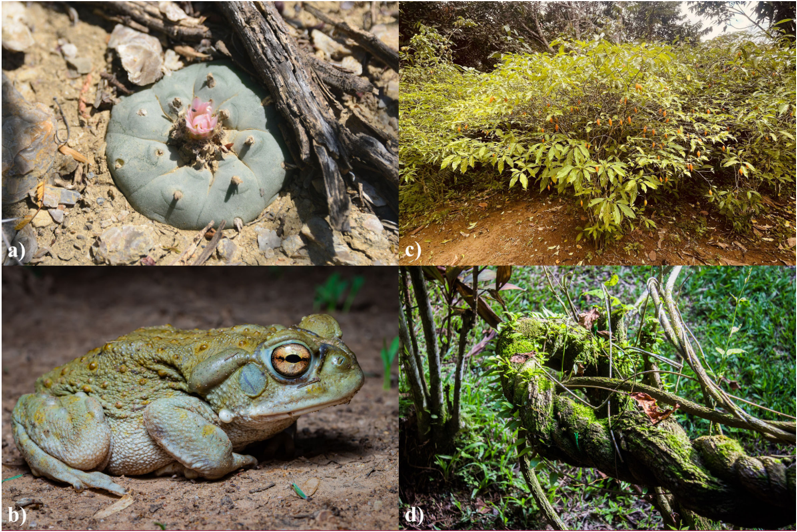
Psychedelics have a profound potential to catalyze psychological transformation and support traditional cultures and ways of life. However, many naturally occurring psychoactive plants and animals are facing threats from climate change, habitat loss and other anthropogenic pressures like overharvesting. In this narrative review we examine the conservation issues pertaining to some of the most well-known naturally occurring psychedelics: peyote (Lophophora williamsii), ayahuasca vine (Banisteriopsis caapi), iboga (Tabernanthe iboga) and the Sonoran Desert toad (Incilius alvarius). For each of the four species we aim to: review their conservation status; assess the sustainability of current sourcing practices; discuss pathways for sustainability of access; examine the efforts underway to preserve these medicines by Indigenous people and local communities; and propose how these efforts could be supported or expanded. This review focuses on an urgent issue of conservation of naturally occurring psychedelic plant and animal species and draws attention to their conservation needs. We conclude that despite biological and ecological differences, all four species face similar knowledge gaps limiting evidence-based conservation. Priorities across species include: long-term ecological and demographic monitoring; genetic and chemical diversity studies; sustainable harvest and management research; integration of Indigenous knowledge and socio-cultural research into conservation frameworks.
Overview
CoChat Summary
TL;DR
This narrative review examines conservation issues for peyote, ayahuasca vine, iboga, and the Sonoran Desert toad amid rising global psychedelic demand. It concludes that all four species face similar knowledge gaps limiting evidence-based conservation and need long-term monitoring, genetic and chemical diversity studies, sustainable harvest research, and integration of Indigenous knowledge into conservation frameworks.
Key findings
- All four species face threats from overharvesting, habitat loss, climate change, and cultural commodification, but ecological research lags behind chemical, pharmacological, and anthropological research. For ayahuasca vine, one Peruvian Amazon study found low-harvest populations projected to grow by 3.2% long-term while high-harvest populations decline by 1.3%; short-term declines were 20.4% and 26% annually, respectively. Iboga is IUCN “least concern” but lacks detailed wild population assessments, and its price in Gabon rose 800% over the previous decade. The Sonoran Desert toad is IUCN “least concern” based on a 2004 assessment, with its range forecast to shrink by 23% from climate change and a sampled chytrid infection rate of ~6%. Peyote is IUCN “vulnerable” and “imperiled/threatened” in Texas; Texas sales fell from ~2 million crowns/year in 1986–2000 to ~1 million/year by 2016.
- The review reports substantial extraction and market pressure. Over 4 million people worldwide are reported to have consumed ayahuasca in their lifetime, with only about 10% representing Indigenous communities; in 2019, an estimated 820,000 people used ayahuasca, consuming around 5.5 million servings. Ibogaine levels in iboga root bark vary from 0.27%–10% by weight; a 20–30-year-old plant may yield 1–2 kg of root bark versus 250 g from a five-year-old plant. Sonoran Desert toad secretions contain 5-MeO-DMT at 15–45% of dry weight; a milking session yields about 0.25–0.50 g dried secretion, or about 75 mg 5-MeO-DMT. Peyote crowns contain 1–6% mescaline, with a typical dose of 4–12 crowns.
- Consumer surveys suggest openness to alternatives. In a survey of mescaline consumers (n=284), 56.7% had consumed San Pedro-based mescaline, 22.9% peyote-based mescaline, and 16.6% synthetic mescaline; 20.0% reported consuming peyote collected from native habitats. In the Global Drug Survey, 56% of 6,379 respondents preferred mescaline-containing cacti, 9% preferred synthetic mescaline, and 21% had no preference; 67.7% of mescaline-cacti consumers (n=3,691) said they were conscious of environmental impact and would switch to synthetic substances. The highest preference for synthetic sources among five naturally occurring psychedelics was for 5-MeO-DMT.
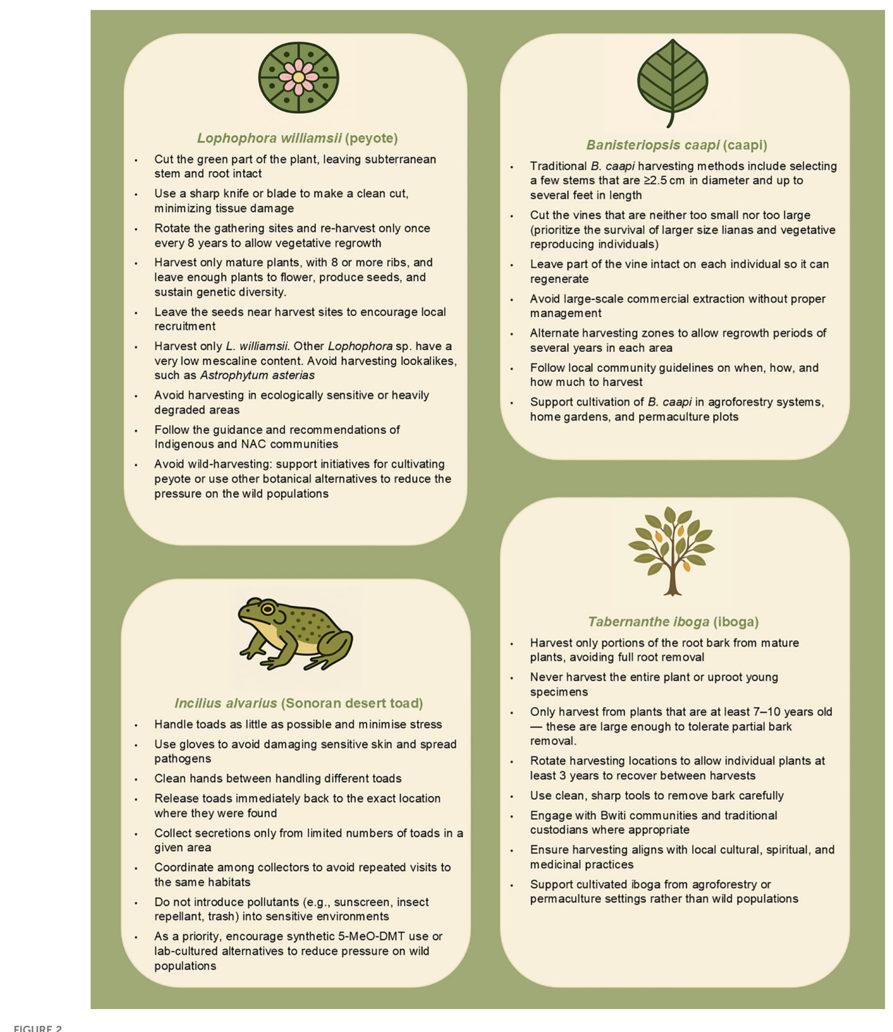
- The paper identifies priority research needs across species: long-term ecological and demographic monitoring; genetic and chemical diversity studies; sustainable harvest and management research; and integration of Indigenous knowledge and socio-cultural research into conservation frameworks. It notes there are no sustainable harvesting guidelines for any of the four species, and that alternative alkaloid sources, cultivation, regenerative agroforestry, and Indigenous-led conservation initiatives are potential pathways.
Methods
- Narrative review. The authors searched Google Scholar and PubMed for publications from January 1965 to December 2024 using current Latin and colloquial names for the four species; papers in English or Spanish were included.
- The search was supplemented by bibliographies, relevant books, news articles, and other grey literature, with grey literature marked by an asterisk to distinguish anecdotal from empirical evidence. References were selected for relevance to biology, ecology, and conservation of the four species.
- The authors also searched biodiversity databases (GBIF, IUCN Red List, NatureServe, AmphibiaWeb) and ethnobotanical databases (Dr Duke’s Phytochemical and Ethnobotanical Databases).
Limitations
- The paper states that its main limitation is being a narrative review, with a higher risk of bias due to the subjective nature of study selection and interpretation. It also states that in many cases no peer-reviewed studies were identified through publicly available databases, so it relied on reports, journalistic investigations, and other grey literature.
- Evident from the text: the review presents no new primary data and no systematic review protocol; many conservation and harvesting claims depend on grey literature, anecdotal reports, or limited studies. It also notes missing quantitative data on the extent of Sonoran Desert toad harvesting and demand, and no sustainable harvesting guidelines for any of the species.
Model-written summary. Check it against the paper before relying on it.
Integrity signals
Registry
Cites
Statistics
Figures

Verification
Claims the paper makes
0 Valid · 7 Not valid · 154 Not checked · 31 Own results and interpretations
In the paper
“A reduction in iboga availability is evidenced by an 800% increase in the price of iboga in Gabon over the previous decade (Nuwer, 2023).”
§ Of shrub, cactus, vine and toad: psychedelic species of conservation concern > Conservation of iboga
What the sources say
- Not matchedcites Nuwer, 2023
An author–year citation the paper’s reference list doesn’t settle. We don’t search these by name.
plainstates a cause- Asserted: passes — The authors put it forward as true.
- Checkable: passes — It can be checked against evidence.
- Load-bearing: passes — The paper’s conclusions depend on it.
- Based: passes — The paper gives a reason why it holds.
- Not matched
In the paper
“Under high harvest pressure, smaller lianas had better survival rates than those in low harvest pressure populations.”
§ Of shrub, cactus, vine and toad: psychedelic species of conservation concern > Conservation of ayahuasca
What the sources say
- Not checked yetcites Coe and Gaoue (2023) matched to “Increased clonal growth in heavily harvested ecosystems failed to rescue ayahuasca lianas from decline in the Peruvian Amazon rainforest” (2023) source
plainstates an association- Asserted: passes — The authors put it forward as true.
- Checkable: passes — It can be checked against evidence.
- Load-bearing: passes — The paper’s conclusions depend on it.
- Based: passes — The paper gives a reason why it holds.
In the paper
“They found that harvesting negatively affected size-dependent survival, with larger lianas experiencing higher mortality under high harvest pressure compared to smaller lianas.”
§ Of shrub, cactus, vine and toad: psychedelic species of conservation concern > Conservation of ayahuasca
What the sources say
- Not checked yetcites Coe and Gaoue (2023) matched to “Increased clonal growth in heavily harvested ecosystems failed to rescue ayahuasca lianas from decline in the Peruvian Amazon rainforest” (2023) source
plainstates a cause- Asserted: passes — The authors put it forward as true.
- Checkable: passes — It can be checked against evidence.
- Load-bearing: passes — The paper’s conclusions depend on it.
- Based: passes — The paper gives a reason why it holds.
In the paper
“as already happened in at least one location in Sonora (Villa, 2023)”
§ Of shrub, cactus, vine and toad: psychedelic species of conservation concern > Conservation
What the sources say
- Not checked yetcites Villa, 2023 matched to “Toad in the road: Biocultural history and conservation challenges of the Sonoran Desert Toad” (2023) source
plainSingle case- Asserted: passes — The authors put it forward as true.
- Checkable: passes — It can be checked against evidence.
- Load-bearing: unclear — It is unclear whether the paper’s conclusions depend on it.
- Based: passes — The paper gives a reason why it holds.
None of the sources cited for this claim have been checked yet.
In the paper
“even if the harvesting has been done correctly, i.e. leaving subterranean stem and root intact, it takes about 8 years for the re-growth to reach the same size as the originally harvested crown.”
§ Of shrub, cactus, vine and toad: psychedelic species of conservation concern > Peyote biology and ecology
What the sources say
- Not checked yetcites Terry et al., 2011
- Not checked yetcites Terry et al., 2012 matched to “LIMITATIONS TO NATURAL PRODUCTION OF LOPHOPHORA WILLIAMSII (CACTACEAE) II. EFFECTS OF REPEATED HARVESTING AT TWO-YEAR INTERVALS IN A SOUTH TEXAS POPULATION” (2012) source
- Not matchedcites Terry et al., 2014
An author–year citation the paper’s reference list doesn’t settle. We don’t search these by name.
plainstates a cause- Asserted: passes — The authors put it forward as true.
- Checkable: passes — It can be checked against evidence.
- Load-bearing: passes — The paper’s conclusions depend on it.
- Based: passes — The paper gives a reason why it holds.
76 more claims
Create a free account to see all 192 claims and to verify the 113 references still open.
- It may state two separate claims as one. 84
- Probably not a substantial claim. 45
Self-check
Percentages, sums and reported differences re-computed from the paper’s own numbers.
Each contradiction between two passages listed here was confirmed by an independent check.
Rated minor: it would not touch a result — a value no result rests on, a p-value that stays on the same side of the significance level, or a conflict that is clerical, resolved elsewhere in the paper, or outside its own findings.
In the paper
§ Of shrub, cactus, vine and toad: psychedelic species of conservation concern > History and ethnography
“Archaeological evidence of use dating back to 3,200CE, based on the findings in Shumla cave, Texas.”
§ Of shrub, cactus, vine and toad: psychedelic species of conservation concern > Cultural history/Indigenous use
“The ritual use of peyote in the Americas dates back over 5,000 years to prehistoric times.”
Citations
Cites
IUCN Red List of Threatened Species
(2012) · Choice Reviews Online · doi:10.5860/choice.49-6872 · Cited by 12,728
Nichols, D. E. (2016) · Pharmacological Reviews · doi:10.1124/pr.115.011478 · Cited by 1,762
ENVIRONMENTAL CONCERN: CONCEPTUAL DEFINITIONS, MEASUREMENT METHODS, AND RESEARCH FINDINGS
FRANSSON, N., & GÄRLING, T. (1999) · Journal of Environmental Psychology · doi:10.1006/jevp.1999.0141 · Cited by 1,149
The ecology of lianas and their role in forests
Schnitzer, S. (2002) · Trends in Ecology & Evolution · doi:10.1016/s0169-5347(02)02491-6 · Cited by 1,017
Martin, L., White, M. P., Hunt, A., Richardson, M., Pahl, S., & Burt, J. (2020) · Journal of Environmental Psychology · doi:10.1016/j.jenvp.2020.101389 · Cited by 928
Amphibian Declines: The Conservation Status of United States Species
Lannoo, M. J. (2005) · Project Muse (Johns Hopkins University) · Cited by 788
Meta‐analysis of human connection to nature and proenvironmental behavior
Whitburn, J., Linklater, W., & Abrahamse, W. (2020) · Conservation Biology · doi:10.1111/cobi.13381 · Cited by 696
Cultural Keystone Species: Implications for Ecological Conservation and Restoration
Garibaldi, A., & Turner, N. (2004) · Ecology and Society · doi:10.5751/es-00669-090301 · Cited by 684
Do people who feel connected to nature do more to protect it? A meta-analysis
Mackay, C. M. L., & Schmitt, M. T. (2019) · Journal of Environmental Psychology · doi:10.1016/j.jenvp.2019.101323 · Cited by 538
Plants of the Gods: Their Sacred, Healing and Hallucinogenic Powers
Hofmann, A., & Schultes, R. E. (1992) · Medical Entomology and Zoology · Cited by 463
Zylstra, M. J., Knight, A. T., Esler, K. J., & Le Grange, L. L. L. (2014) · Springer Science Reviews · doi:10.1007/s40362-014-0021-3 · Cited by 414
Suitability of Amphibians and Reptiles for Translocation
GERMANO, J. M., & BISHOP, P. J. (2009) · Conservation Biology · doi:10.1111/j.1523-1739.2008.01123.x · Cited by 395
High proportion of cactus species threatened with extinction
Goettsch, B., Hilton-Taylor, C., Cruz-Piñón, G., Duffy, J. P., Frances, A., Hernández, H. M., Inger, R., Pollock, C., Schipper, J., Superina, M., et al. (2015) · Nature Plants · doi:10.1038/nplants.2015.142 · Cited by 369
The Botany and Chemistry of Hallucinogens
Schultes, R. E., & Hofmann, A. (1980) · Cited by 232
Uthaug, M. V., Lancelotta, R., van Oorsouw, K., Kuypers, K. P. C., Mason, N., Rak, J., Šuláková, A., Jurok, R., Maryška, M., Kuchař, M., et al. (2019) · Psychopharmacology · doi:10.1007/s00213-019-05236-w · Cited by 197
The Botany and Chemistry of Hallucinogens.
Lipp, F. J., Schultes, R. E., & Hofmann, A. (1981) · Brittonia · doi:10.2307/2806315 · Cited by 193
Applying the pathways to nature connectedness at a societal scale: a leverage points perspective
Richardson, M., Dobson, J., Abson, D. J., Lumber, R., Hunt, A., Young, R., & Moorhouse, B. (2020) · Ecosystems and People · doi:10.1080/26395916.2020.1844296 · Cited by 185
Effects of wild coffee management on species diversity in the Afromontane rainforests of Ethiopia
Senbeta, F., & Denich, M. (2006) · Forest Ecology and Management · doi:10.1016/j.foreco.2006.05.064 · Cited by 185
Ayahuasca Shamanism in the Amazon and Beyond
(2014) · Oxford University Press eBooks · doi:10.1093/acprof:oso/9780199341191.001.0001 · Cited by 170
El-Seedi, H. R., Smet, P. A. G. M. D., Beck, O., Possnert, G., & Bruhn, J. G. (2005) · Journal of Ethnopharmacology · doi:10.1016/j.jep.2005.04.022 · Cited by 163
The concept of plants as teachers among four mestizo shamans of iquitos, Northeastern Peru
Luna, L. E. (1984) · Journal of Ethnopharmacology · doi:10.1016/0378-8741(84)90036-9 · Cited by 162
Treatment of opioid use disorder with ibogaine: detoxification and drug use outcomes
Brown, T. K., & Alper, K. (2018) · The American Journal of Drug and Alcohol Abuse · doi:10.1080/00952990.2017.1320802 · Cited by 159
Kettner, H., Gandy, S., Haijen, E. C. H. M., & Carhart-Harris, R. L. (2019) · International Journal of Environmental Research and Public Health · doi:10.3390/ijerph16245147 · Cited by 157
Self-citationDrug Tourism or Spiritual Healing? Ayahuasca Seekers in Amazonia
Winkelman, M. (2005) · Journal of Psychoactive Drugs · doi:10.1080/02791072.2005.10399803 · Cited by 157
Forstmann, M., & Sagioglou, C. (2017) · Journal of Psychopharmacology · doi:10.1177/0269881117714049 · Cited by 156
MEDICINAL PROPERTIES IN THE DIET OF GORILLAS: AN ETHNO-PHARMACOLOGICAL EVALUATION
Cousins, D., & Huffman, M. A. (2002) · African study monographs · doi:10.14989/68214 · Cited by 153
Davis, A. K., So, S., Lancelotta, R., Barsuglia, J. P., & Griffiths, R. R. (2019) · The American Journal of Drug and Alcohol Abuse · doi:10.1080/00952990.2018.1545024 · Cited by 142
Celidwen, Y., Redvers, N., Githaiga, C., Calambás, J., Añaños, K., Chindoy, M. E., Vitale, R., Rojas, J. N., Mondragón, D., Rosalío, Y. V., et al. (2023) · The Lancet Regional Health - Americas · doi:10.1016/j.lana.2022.100410 · Cited by 142
Pollan, M. (2018) · Cited by 142
Davis, A. K., Barsuglia, J. P., Lancelotta, R., Grant, R. M., & Renn, E. (2018) · Journal of Psychopharmacology · doi:10.1177/0269881118769063 · Cited by 140
The Globalization of Ayahuasca Shamanism and the Erasure of Indigenous Shamanism
Fotiou, E. (2016) · Anthropology of Consciousness · doi:10.1111/anoc.12056 · Cited by 138
The Internationalization of Ayahuasca
Macrae, E. (2012) · Journal of Contemporary Religion · doi:10.1080/13537903.2012.722324 · Cited by 124
Milne, N., Thomsen, P., Knudsen, N., Rubaszka, P., Kristensen, M., & Borodina, I. (2020) · Metabolic Engineering · doi:10.1016/j.ymben.2019.12.007 · Cited by 122
MUMFORD, E. L., Martinez, D. J., Hassell, K. T., Cook, A. J. C., Hansen, G. R., Labonté, R., Mazet, J. A. K., Mumford, E. C., Rizzo, D. M., Togami, E., et al. (2023) · Frontiers in Public Health · doi:10.3389/fpubh.2022.1056459 · Cited by 116
Reckweg, J. T., Uthaug, M. V., Szabo, A., Davis, A. K., Lancelotta, R., Mason, N. L., & Ramaekers, J. G. (2022) · Journal of Neurochemistry · doi:10.1111/jnc.15587 · Cited by 110
Glick, S. D., Kuehne, M. E., Maisonneuve, I. M., Bandarage, U. K., & Molinari, H. H. (1996) · Brain Research · doi:10.1016/0006-8993(96)00056-x · Cited by 109
The role of Indigenous knowledges in psychedelic science
Fotiou, E. (2019) · Journal of Psychedelic Studies · doi:10.1556/2054.2019.031 · Cited by 104
Banisteriopsis, Diplopterys (Malpighiaceae)
Gates, B. (1982) · Cited by 103
Dinis-Oliveira, R. J., Pereira, C. L., & da Silva, D. D. (2019) · Current Molecular Pharmacology · doi:10.2174/1874467211666181010154139 · Cited by 100
Magnesium–ibogaine therapy in veterans with traumatic brain injuries
Cherian, K. N., Keynan, J. N., Anker, L. A., Faerman, A., Brown, R. E., Shamma, A., Keynan, O., Coetzee, J. P., Batail, J.-M. V., Phillips, A., et al. (2024) · Nature Medicine · doi:10.1038/s41591-023-02705-w · Cited by 99
People of the Peyote: Huichol Indian History, Religion, and Survival
Hutcheson, M. (1997) · American Anthropologist · doi:10.1525/aa.1997.99.3.678.1 · Cited by 93
Mescaline: A Global History of the First Psychedelic
Jay, M. (2019) · Yale University Press eBooks · doi:10.12987/9780300245080 · Cited by 93
A systematic literature review of clinical trials and therapeutic applications of ibogaine
Köck, P., Froelich, K., Walter, M., Lang, U. E., & Dürsteler, K. M. (2021) · Journal of Substance Abuse Treatment · doi:10.1016/j.jsat.2021.108717 · Cited by 88
A narrative synthesis of research with 5-MeO-DMT
Ermakova, A. O., Dunbar, F., Rucker, J., & Johnson, M. W. (2022) · Journal of Psychopharmacology · doi:10.1177/02698811211050543 · Cited by 86
Self-citationThe iboga enigma: the chemistry and neuropharmacology of iboga alkaloids and related analogs
Iyer, R. N., Favela, D., Zhang, G., & Olson, D. E. (2021) · Natural Product Reports · doi:10.1039/d0np00033g · Cited by 86
Syntropy and innovation in agriculture
Andrade, D., Pasini, F., & Scarano, F. R. (2020) · Current Opinion in Environmental Sustainability · doi:10.1016/j.cosust.2020.08.003 · Cited by 79
Tabernanthe iboga: an African narcotic plant of social importance
Pope, H. G. (1969) · Economic Botany · doi:10.1007/bf02860623 · Cited by 77
Ayahuasca: A review of historical, pharmacological, and therapeutic aspects
Ruffell, S., Crosland‐Wood, M., Palmer, R., Netzband, N., Tsang, W., Weiss, B., Gandy, S., Cowley‐Court, T., Halman, A., McHerron, D., et al. (2023) · Psychiatry and Clinical Neurosciences Reports · doi:10.1002/pcn5.146 · Cited by 76
Self-citationAyahuasca reader: encounters with the Amazon's sacred vine
Luna, L. E. (2000) · Cited by 72
Hampton, C. M., & Stewart, O. C. (1988) · Journal of American History · doi:10.2307/1901548 · Cited by 69
The internationalization of ayahuasca
Labate, B. C. (2011) · Cited by 66
Hemmateenejad, B., Abbaspour, A., Maghami, H., Miri, R., & Panjehshahin, M. R. (2006) · Analytica Chimica Acta · doi:10.1016/j.aca.2006.05.093 · Cited by 62
Chemical composition of traditional and analog Ayahuasca
Kaasik, H., Souza, R. C. Z., Zandonadi, F. S., Tófoli, L. F., & Sussulini, A. (2021) · Journal of Psychoactive Drugs · doi:10.1080/02791072.2020.1815911 · Cited by 59
Hallucinogenic drugs in pre-Columbian Mesoamerican cultures
Carod-Artal, F. J. (2015) · Neurología (English Edition) · doi:10.1016/j.nrleng.2011.07.010 · Cited by 53
Volume, value and floristic diversity of Gabon's medicinal plant markets
Towns, A. M., Quiroz, D., Guinee, L., de Boer, H., & van Andel, T. (2014) · Journal of Ethnopharmacology · doi:10.1016/j.jep.2014.06.052 · Cited by 52
Egger, K., Aicher, H., Cumming, P. D., & Scheidegger, M. (2024) · Cellular and Molecular Life Sciences · doi:10.1007/s00018-024-05353-6 · Cited by 47
Down to Earth: Planetary Health and Biophilosophy in the Symbiocene Epoch
Prescott, S., & Logan, A. (2017) · Challenges · doi:10.3390/challe8020019 · Cited by 47
5-Methoxy-and 5-Hydroxyindoles in the skin of Bufo alvarius
Erspamer, V., Vitali, T., Roseghini, M., & Cei, J. M. (1967) · Biochemical Pharmacology · doi:10.1016/0006-2952(67)90147-5 · Cited by 46
Lower Pecos and Coahuila peyote: new radiocarbon dates
Terry, M., Steelman, K. L., Guilderson, T., Dering, P., & Rowe, M. W. (2006) · Journal of Archaeological Science · doi:10.1016/j.jas.2005.11.008 · Cited by 45
The Peyote road: religious freedom and the Native American Church
(2011) · Choice Reviews Online · doi:10.5860/choice.48-4068 · Cited by 44
Extraction Studies of Tabernanthe Iboga and Voacanga Africana
Jenks, C. (2002) · Natural Product Letters · doi:10.1080/1057563029001/4881 · Cited by 43
Agroforestry in the Amazon Region: A Pathway for Balancing Conservation and Development
Porro, R., Miller, R. P., Tito, M. R., Donovan, J. A., Vivan, J. L., Trancoso, R., Van Kanten, R. F., Grijalva, J. E., Ramirez, B. L., & Gonçalves, A. L. (2012) · Advances in Agroforestry · doi:10.1007/978-94-007-4676-3_20 · Cited by 42
Integrating behavior and physiology into strategies for amphibian conservation
Walls, S. C., & Gabor, C. R. (2019) · Frontiers in Ecology and Evolution · doi:10.3389/fevo.2019.00234 · Cited by 39
Anderson, E. F. (1996) · doi:10.2307/j.ctv1qwwk26 · Cited by 38
McIntyre, R. S., Kwan, A. T. H., Mansur, R. B., Oliveira-Maia, A. J., Teopiz, K. M., Maletic, V., Suppes, T. M., Stahl, S. M., & Rosenblat, J. D. (2025) · American Journal of Psychiatry · doi:10.1176/appi.ajp.20230902 · Cited by 37
Davis, A. K., Xin, Y., Sepeda, N., & Averill, L. A. (2023) · The American Journal of Drug and Alcohol Abuse · doi:10.1080/00952990.2023.2220874 · Cited by 36
Fernández, J. W., & Fernandez, R. L. (2001) · The Alkaloids. Chemistry and biology/The alkaloids. Chemistry and biology · doi:10.1016/s0099-9598(01)56017-4 · Cited by 34
Santos, B. W. L., Oliveira, R. C. D., Sonsin-Oliveira, J., Fagg, C. W., Barbosa, J. B. F., & Caldas, E. D. (2020) · Plants · doi:10.3390/plants9070870 · Cited by 33
Nutt, D. J., Hunt, P., Schlag, A. K., & Fitzgerald, P. B. (2024) · British Journal of Pharmacology · doi:10.1111/bph.17398 · Cited by 27
Friedberg, L. M., Sen, A. K., Nguyen, Q., Tonucci, G. P., Hellwarth, E. B., Gibbons, W. J., & Jones, J. A. (2023) · Metabolic Engineering · doi:10.1016/j.ymben.2023.05.006 · Cited by 26
Efficient and modular synthesis of ibogaine and related alkaloids
Iyer, R. N., Favela, D., Domokos, A., Zhang, G., Avanes, A. A., Carter, S. J., Basargin, A. G., Davis, A. R., Tantillo, D. J., & Olson, D. E. (2025) · Nature Chemistry · doi:10.1038/s41557-024-01714-7 · Cited by 24
The Cultural Importance of Plants in Western African Religions
Quiroz, D., & van Andel, T. (2018) · Economic Botany · doi:10.1007/s12231-018-9410-x · Cited by 23
Death related to consumption of Rauvolfia sp. powder mislabeled as Tabernanthe iboga
Gicquel, T., Hugbart, C., Le Devehat, F., Lepage, S., Baert, A., Bouvet, R., & Morel, I. (2016) · Forensic Science International · doi:10.1016/j.forsciint.2016.06.014 · Cited by 21
The ayahuasca tourism boom: An undervalued demand driver for jaguar body parts?
Braczkowski, A., Ruzo, A., Sanchez, F., Castagnino, R., Brown, C., Guynup, S., Winter, S., Gandy, D., & O'Bryan, C. (2019) · Conservation Science and Practice · doi:10.1111/csp2.126 · Cited by 19
The dark web trades wildlife, but mostly for use as drugs
Stringham, O. C., Maher, J., Lassaline, C. R., Wood, L., Moncayo, S., Toomes, A., Heinrich, S., Watters, F., Drake, C., Chekunov, S., et al. (2023) · People and Nature · doi:10.1002/pan3.10469 · Cited by 18
Amphibians at risk: Effects of climate change in the southwestern North American drylands
de Albuquerque, F. S., Bateman, H. L., & Johnson, J. L. (2024) · Global Ecology and Conservation · doi:10.1016/j.gecco.2024.e02944 · Cited by 18
Bouso, J. C., Fornís, I., Ventura, M., LOENEN, B. D., Sainz-Cort, A., Jiménez-Garrido, D. F., SANTOS, R. G. D., Hallak, J. E. C., Alcázar‐Córcoles, M. Á., & Jenks, C. (2020) · Archives of Clinical Psychiatry (São Paulo) · doi:10.1590/0101-60830000000231 · Cited by 18
Souto, L. S., & Oliveira, D. M. T. (2012) · Acta Botanica Brasilica · doi:10.1590/s0102-33062012000300003 · Cited by 18
Magic of the Mushrooms: Effects of Psilocybin Decriminalization
Bhave, A. (2024) · Journal of Psychoactive Drugs · doi:10.1080/02791072.2024.2376755 · Cited by 15
Krengel, F., Mijangos, M. V., Reyes‐Lezama, M., & Reyes‐Chilpa, R. (2019) · Chemistry & Biodiversity · doi:10.1002/cbdv.201900175 · Cited by 15
Bwiti, iboga, trance and healing in Gabon
Ndoua, P. D. N., & Vaghar, K. (2018) · Mental Health Religion & Culture · doi:10.1080/13674676.2018.1504012 · Cited by 15
Further notes on the nomenclature of Middle American toads (Bufonidae)
Frost, D. R., Mendelson, J. R., & Pramuk, J. (2009) · Copeia · doi:10.1643/ch-08-204 · Cited by 15
Sullivan (1994) · doi:10.1007/bf00690963 · Cited by 14
Psychedelics: from cave art to 21st-century medicine for addiction
Vamvakopoulou, I. A., & Nutt, D. J. (2024) · European Addiction Research · doi:10.1159/000540062 · Cited by 13
The Alkaloids from Lophophora diffusa and Other “False Peyotes”
Chan, C. B., Poulie, C. B. M., Wismann, S. S., Soelberg, J., & Kristensen, J. L. (2021) · Journal of Natural Products · doi:10.1021/acs.jnatprod.1c00381 · Cited by 13
Schwelm, H. M., Zimmermann, N., Scholl, T., Penner, J., Autret, A., Auwärter, V., & Neukamm, M. A. (2021) · Journal of Analytical Toxicology · doi:10.1093/jat/bkab038 · Cited by 13
Kombian, S. B., Saleh, T. M., Fiagbe, N. I. Y., Chen, X., Akabutu, J. J., Buolamwini, J. K., & Pittman, Q. J. (1997) · Brain Research Bulletin · doi:10.1016/s0361-9230(97)00284-0 · Cited by 12
Klein, M. T., Kalam, M., Trout, K., Fowler, N., & Terry, M. (2015) · Haseltonia · doi:10.2985/026.020.0107 · Cited by 11
Kim, V., Wilson, S. M., & Woesner, M. E. (2024) · Journal of Clinical Psychopharmacology · doi:10.1097/jcp.0000000000001941 · Cited by 11
Terry, M., & Trout, K. (2017) · Journal of the Botanical Research Institute of Texas · doi:10.17348/jbrit.v11.i1.1146 · Cited by 11
Bufo alvarius: evidencias literarias y controversias en torno a su uso tradicional
Horák, M., Segovia, E. M., & Bello, A. C. (2019) · Medicina naturista · Cited by 10
Explaining Toad Bones in Southern Appalachian Archaeological Deposits
Whyte, T. R., & Compton, J. M. (2020) · American Antiquity · doi:10.1017/aaq.2019.104 · Cited by 10
Luz, T. Z., Cunha-Machado, A. S., & Batista, J. D. S. (2022) · Genetic Resources and Crop Evolution · doi:10.1007/s10722-022-01522-3 · Cited by 10
Briseño-Sánchez, M. I., Martínez-Peralta, C., & Mandujano, M. C. (2020) · The Journal of the Torrey Botanical Society · doi:10.3159/torrey-d-18-00055.1 · Cited by 10
Incilius alvarius Cell-Based Synthesis of 5-Methoxy-N,N-Dimethyltryptamine
Lerer, L. B., Reynolds, E., Varia, J. C., Blakolmer, K., & Lerer, B. (2023) · Psychedelic Medicine · doi:10.1089/psymed.2022.0001 · Cited by 9
Outlook for Sustainable Forest Bioeconomy in Gabon, Kenya, Nigeria, South Africa and Tanzania
Hetemäki, L., Tegegne, Y. T., & Ochieng, R. M. (2023) · doi:10.62164/20241 · Cited by 9
El ritual de la Ayahuasca: patrimonio cultural nacional de Perú
Giove, R. (2022) · Cultura y Droga · doi:10.17151/culdr.2022.27.33.2 · Cited by 9
de Oliveira, R. C., Behrens, C. S. B., Nagamine-Pinheiro, N., Fagg, C. W., e Silva, M. S., Martins-Silva, T., & Sonsin-Oliveira, J. (2023) · Economic Botany · doi:10.1007/s12231-023-09567-w · Cited by 9
The 'enigma' of Richard Schultes, Amazonian hallucinogenic plants, and the limits of ethnobotany
Sheldrake, M. (2020) · Social Studies of Science · doi:10.1177/0306312720920362 · Cited by 9
Krengel, F., Chevalier, Q., Dickinson, J., Herrera Santoyo, J., & Reyes Chilpa, R. (2019) · Chemistry & Biodiversity · doi:10.1002/cbdv.201800506 · Cited by 9
Schwertner-Charão, L., Delgado-Martínez, R., Treviño-Carreón, J., Jiménez-Sierra, C. L., Astudillo-Sánchez, C. C., & Osorio-Hernández, E. (2022) · Journal of Arid Environments · doi:10.1016/j.jaridenv.2022.104824 · Cited by 9
In Vitro and In Vivo Evaluation of Pellotine: A Hypnotic Lophophora Alkaloid
Poulie, C. B. M., Chan, C. B., Parka, A., Lettorp, M., Vos, J., Raaschou, A., Pottie, E., Bundgaard, M. S., Sørensen, L. M. E., Cecchi, C. R., et al. (2023) · ACS Pharmacology & Translational Science · doi:10.1021/acsptsci.3c00142 · Cited by 8
Blais, B. R., Shaw, C. J., Brocka, C. W., Johnson, S. L., & Lauger, K. K. (2024) · Royal Society Open Science · doi:10.1098/rsos.240439 · Cited by 8
Mescaline, Peyote and San Pedro: Is sustainability important for cacti consumers?
Engel, L., Barratt, M., Ferris, J., Puljevic, C., & Winstock, A. (2023) · Journal of Psychedelic Studies · doi:10.1556/2054.2023.00252 · Cited by 8
Ermakova, A. O., Terry, M., & Trout, K. (2022) · Bradleya · doi:10.25223/brad.sp40.2022.a8 · Cited by 7
Self-citationChavarro‐Mesa, E., Almeida, J. V. D. A., Silva, S. R., Lopes, S. S., Barbosa, J. B. F., de Oliveira, D. R., Corrêa, M. A., Moraes, A. P., Miranda, V. F. O., Prosdocimi, F., et al. (2024) · Genetics and Molecular Biology · doi:10.1590/1678-4685-gmb-2023-0301 · Cited by 7
de Oliveira, R. C., Sonsin‐Oliveira, J., dos Santos, T. A. C., Silva, M. S. E., Fagg, C. W., & Sebastiani, R. (2020) · Taxon · doi:10.1002/tax.12407 · Cited by 7
Archaeology of psychotropic substances: The problem of analytical detection of ayahuasca
Greco, E., Rivier, L., Samorini, G., & D’Arienzo, A. (2024) · Archaeometry · doi:10.1111/arcm.12965 · Cited by 7
Thévenin, J. M. R. (2017) · Americanae (AECID Library) · doi:10.13140/rg.2.2.18911.87209 · Cited by 7
Batrachochytrium dendrobatidis in the arid and thermally extreme Sonoran Desert
Roth, S. A., Griffis-Kyle, K. L., & Barnes, M. A. (2023) · EcoHealth · doi:10.1007/s10393-023-01668-1 · Cited by 7
Syed, O. A., Petranker, R., Fewster, E. C., Sobolenko, V., Beidas, Z., Husain, M. I., Lake, S., & Lucas, P. (2026) · Journal of Psychoactive Drugs · doi:10.1080/02791072.2024.2446445 · Cited by 6
An overview of cacti and the controversial peyote
Rojas-Areéchiga, M., & Flores, J. (2016) · Peyote · doi:10.5040/9798400696572.ch-002 · Cited by 6
Ermakova, A., Whiting, C. V., Trout, K., Clubbe, C., Terry, M. K., & Fowler, N. (2021) · Journal of the Botanical Research Institute of Texas · doi:10.17348/jbrit.v15.i1.1057 · Cited by 6
Self-citationToad in the road: Biocultural history and conservation challenges of the Sonoran Desert Toad
Villa, R. A. (2023) · Journal of Psychedelic Studies · doi:10.1556/2054.2023.00269 · Cited by 5
Coe, M. A., & Gaoue, O. G. (2023) · Journal of Applied Ecology · doi:10.1111/1365-2664.14488 · Cited by 5
Reflexiones sobre la expansioń y legalidad del campo peyotero en Mexico
Genet Guzmán, M., & Labate, B. (2019) · Frontera Norte · doi:10.33679/rfn.v1i1.2060 · Cited by 4
Paradoxes of peyote regulation in Mexico: drug conventions and environmental laws
Caiuby Labate, B., & Feeney, K. (2016) · Peyote · doi:10.5040/9798400696572.ch-011 · Cited by 4
Diet and chemical defenses of the Sonoran Desert toad
Luccioni, M. D., Wyman, J. T., Espinoza, E. O., & O’Connell, L. A. (2025) · PLoS ONE · doi:10.1371/journal.pone.0335661 · Cited by 4
Griffin, C., & Knight, A. (2024) · Journal of Psychedelic Studies · doi:10.1556/2054.2024.00333 · Cited by 3
Palumbo, S. (2024) · SSRN Electronic Journal · doi:10.2139/ssrn.4879787 · Cited by 3
Mandujano, M. C., García Naranjo, A., Rojas-Aréchiga, M., & Golubov, J. (2020) · Cuatro Ciénegas Basin: An Endangered Hyperdiverse Oasis · doi:10.1007/978-3-030-44963-6_14 · Cited by 3
New age tourism in Wirikuta: conflicts and rituals
Basset, V. (2016) · Peyote · doi:10.5040/9798400696572.ch-010 · Cited by 3
Thevenin, J. M. R., & Sambuichi, R. H. R. (2020) · Raega - O Espaço Geográfico em Análise · doi:10.5380/raega.v49i0.67208 · Cited by 3
Peyote, conservation, and Indian rights in the United States
Feeney, K. (2016) · Peyote · doi:10.5040/9798400696572.ch-006 · Cited by 2
LeBlanc, R., Silva, S. D., & Terry, M. (2021) · Journal of the Botanical Research Institute of Texas · doi:10.17348/jbrit.v15.i1.1055 · Cited by 2
Lophophora williamsii: Terry, M.
Terry, M. (2009) · IUCN Red List of Threatened Species · doi:10.2305/iucn.uk.2017-3.rlts.t151962a121515326.en · Cited by 2
Newbold, R., De Silva, S., & Terry, M. (2020) · Journal of the Botanical Research Institute of Texas · doi:10.17348/jbrit.v14.i1.901 · Cited by 1
Malka, S., Schlaepfer, M., & Andrès, C. (2023) · doi:10.13140/rg.2.2.19750.80961 · Cited by 1
The Wixárika community’s thirteen-year legal battle to stop mining in their sacred territory
Arellano, A. (2024) · doi:10.66709/news-283977 · Cited by 1
Diet and chemical defenses of the Sonoran Desert toads
Luccioni, M. D., Wyman, J. T., Espinoza, E. O., & O’Connell, L. A. (2023) · doi:10.1101/2023.10.06.561297 · Cited by 1
Terry, M., & Mauseth, J. D. (2006) · W. F. Mahler, etc.] · doi:10.5281/zenodo.16170694
Terry, M., Trout, K., Williams, B., Herrera, T., & Fowler, N. (2012) · Botanical Research Institute of Texas · doi:10.5281/zenodo.16077459
(2011) · Biodiversity Heritage Library (Smithsonian Institution)
(2021)
(2020) · American Indian Law Journal
Research works printed but not linked: 39
- A ́lvarez, C. S., and Mazarrasa, J. (2023). Ayahuasca, Global Consumption & Reported Deaths in the Media (Barcelona, Catalonia, Spain: ICEERS).
- Anaya, D. M., and Rubio, O. R. G. (2010). Anaĺisis espacial por ıńdices de distancia (sadie) de Lophophora williamsii en tres parcelas con diferente grado de perturbacioń en San Luis Potosı. VII Simposio Internacional sobre la Flora Silvestre en Zonas A ́ridas. Universidad de Sonora (Sonora, Mexico: Universidad de Sonora Hermosillo).
- Bello, E. A. C. (2021). "Medicinas ancestrales" en la Ciudad de Mexico. Reesemantización de sus usos en el siglo XXI (Mexico City: UAM, Unidad Cuajimalpa, Divisioń de Ciencias Sociales y Humanidades).
- Bernal, A. M. O. (2024). 5-MeO-DMT as a Mental Health Tool: Exploring Possible Mechanisms of Action, the Reactivation Phenomenon, and Historical-Cultural Perspectives on Its Use (Madison, Wis: University of Wisconsin-Madison).
- Cei, J. M., Erspamer, V., and Roseghini, M. (1972). "Biogenic amines," in Evolution in the genus Bufo. Ed. F. W. Blair (University of Texas Press, Austin).
- Dickinson, J. (2016). Iboga root: dynamics of Iboga's African origins and modern medical use. HerbalGram 109, 48-57.
- Dinechin, P. (2024). Murder, drought and peyote: the deadly struggle for Mexico's water (Kings Place, London: The Guardian).
- Faura, R., and Langlois, A. (2019). Visions on iboga/ine from the international community. Phase I report (Barcelona, Catalonia, Spain: International Center for Ethnobotanical Education, Research and Service (ICEERS).
- Faura, R., and Langlois, A. (2020). The future of iboga: perspectives from Central Africa. Phase II report (Barcelona, Catalonia, Spain: International Center for Ethnobotanical Education, Research and Service (ICEERS).
- Faura, R., and Langlois, A. (2021). Charting a path forward for iboga: conclusions and recommendations. Phase III report (Barcelona, Catalonia, Spain: International Center for Ethnobotanical Education, Research and Service (ICEERS).
- Girard in Baird, S. F. (1859). "Reptiles of the boundary, with notes by the naturalists of the survey," in Report of the United States and Mexican Boundary Survey, Under the Order of Lieut. Col. W.H. Emory, Major First Cavalry, and United States Commissioner. Volume 2, Part II, Reptiles: 1-35. (Washington, D. C.: Department of the Interior).
- Golden, H. (2022). Inside the battle to save the sacred peyote ceremony: 'We're in dire straits.'. Guardian.
- Greef, K. (2022). The Pied Piper of Psychedelic Toads (New York City, New York: The New Yorker).
- Gutieŕrez-Gonzaĺez, C. E., Goḿez-Ramıŕez, M. A., Gutierrez-Garcia, D., Valenzuela, J., Rorabaugh, J. C., et al. (2006). Interactions between Sonoran Desert Toads (Incilius alvarius) and Mammalian Predators at the Northern Jaguar Reserve, Sonora, Mexico. Sonoran Herpetologist 2, 26-27.
- Holycross, A., Brennan, T., and Babb, R. (2022). A Field Guide to Amphibians and Reptiles in Arizona (Arizona Game and Fish Department, Phoenix, Arizona: AZG&F).
- Jaeger, K. (2021). Indigenous groups object to proposed peyote decriminalization. FIlter Magazine.
- Kamin, D. (2021). The Rise of Psychedelic Retreats -The New York Times (New York City, New York: The New York Times).
- Londoño, E. (2024). Drugs, sacraments or medicine? Psychedelic churches blur the line. New York Times.
- Lorinc, J. (2024). Magic mushroom boom in Vancouver, Toronto is a challenge for police. Bloomberg News.
- Metzner, R. (2013). Toad and the Jaguar a Field Report of Underground Research on a Visionary Medicine: Bufo Alvarius And 5-Methoxy-Dimethyltryptamine (Berkeley, California: Regent Press).
- Morris, H. (2021). Synthetic Toad Venom Machine, season 3, episode 1. Hamilton's
- Nelson) AM (Ken (1984). Bufo alvarius: The psychedelic toad of the Sonoran Desert (Denton: Venom Press).
- Nuwer, R. (2023). The psychoactive drug ibogaine could save lives-and everyone wants to cash in. Natl. Geographic.
- Ortıź-Bernal, A. (2024). 5-MeO-DMT as a mental health tool: Exploring possible mechanisms of action, the reactivation phenomenon, and some ethical considerations regarding the Sonoran Desert Toad. Doctoral dissertation. University of Wisconsin, Madison.
- Ott, J. (1999). Ayahuasca analogues (Xalapa, Veracruz, Mexico: Natural Products Company).
- Peterson, K. (2023). The Sonoran Desert toad can get you high. Poachers have taken notice. Natl. Geographic.
- Ravalec, V., and Mallendi, A. P. (2007). Iboga: the Visionary Root of African Shamanism (Rochester, Vermont: Inner traditions/Bear).
- Romero, S. (2022). Demand for This Toad's Psychedelic Toxin Is Booming. Some Warn That's Bad for the Toad (New York City, New York: The New York Times).
- Sahaguń, L. (2020). Why are some Native Americans fighting efforts to decriminalize peyote? The Los Angeles Times, Los Angeles, California.
- Schultes, R. E. (1986). Recognition of variability in wild plants by Indians of the Northwest Amazon: An enigma. J. Ethnobiol 6, 229-238.
- Spruce, R. (1873). On some remarkable narcotics of the Amazon Valley and Orinoco. Geogr. Rev. 1, 184-193.
- Stebbins, R. C. (2003). A Field Guide to Western Reptiles and Amphibians (Peterson Field Guide Series) (Boston, Massachusetts: Houghton Mifflin Harcourt).
- Stefanick, E. R., and Miles, D. B. (2023). The effects of environment on the Sonoran Desert Toad (Incilius alvarius) in a changing climate. Student expo poster. Biological Sciences Department (Athens: Ohio University).
- Terry, M., Williams, B., Trout, K., Herrera, T., and Fowler, N. (2014). Limitations to natural production of Lophophora williamsii (Cactaceae) III. Regrowth and survivorship two years post harvest in a South Texas population. J. JBRIT 2, 541-550.
- Thompson, R. C., Wright, A. N., and Shafffer, B. H. (2016). "California amphibian and reptile species of special concern," in Sonoran Desert Toad Species Account (University of California Press, Oakland, California).
- Tonye, M. M., Asaha, S., Ndam, N., and Blackmore, P. (2000). State of knowledge study on Tabernanthe iboga: A report for the Central African regional program for the Environment (Washington, DC: United States Agency for International Development (USAID).
- Trout, K. (2005). Trout's Notes on San Pedro & Related Trichocereus Species (Austin, Texas: Mydriatic Productions).
- USDA (2014). Field Guide for Managing African Rue in the Southwest (Washington, D.C., Washington: United States Department of Agriculture).
- Wright, J. W. (1966). Predation on the Colorado River toad, Bufo alvarius. Herpetologica 22 (2), 127-128.
Cited by
Out of Sight, Out of Mind: Shedding Light on Two Blind Spots in Harm Reduction Discourse
Clay, S., & Hall, W. (2026) · Drug and Alcohol Review · doi:10.1111/dar.70259
Metadata
- Authors
- Ermakova, A. O., & Gandy, S.
- Corresponding author
- Ermakova, Anna O.
- Venue
- Frontiers in Conservation Science
- Publisher
- Frontiers Media SA
- Published
- 2025-09-29
- Volume
- 6
- Pages
- 1569528
- ISSN
- 2673-611X (ISSN-L)
- OpenAlex
- W4414606986
- Cited by
- 1
- References
- 135
- Citations by year
- 2026: 1
- FWCI
- 0.36
- Type
- journal article
- Language
- en
- Open access
- gold
- doi.org
- Licence
- Locations
- Frontiers in Conservation Science (publishedVersion, cc-by)
- DOAJ (DOAJ: Directory of Open Access Journals) (submittedVersion)
- Topics
- Life Sciences › Agricultural and Biological Sciences › Plant Science › Ethnobotanical and Medicinal Plants Studies
- Social Sciences › Psychology › Clinical Psychology › Psychedelics and Drug Studies
- Physical Sciences › Environmental Science › Ecology › Environmental and Cultural Studies in Latin America and Beyond
- Keywords
- psychedelics, conservation status, peyote, Lophophora williamsii, Banisteriopsis caapi, iboga, Tabernanthe iboga, Incilius alvarius, sustainable harvesting, overharvesting, indigenous knowledge, traditional medicine, plant genetic diversity, chemical diversity, climate change threats, habitat loss
About these checks
Registry, retraction, Cites and statistics results are computed, not judged, with one exception: a printed reference that no index lists is read once by a model before it counts as a citation error. Claims are extracted by a model and kept only when their quote appears verbatim in the text; each cited source is then checked, with a model’s help, for whether it says what the claim relies on. Those verdicts can be wrong — read the claim’s quote and the cited source before relying on one.
A language model drew the claims from the paper on 2026-11-24, under version 3 of the claim definition (model deepseek-v4.1-flash, prompt extract-v3).
A second model labelled each claim on 2026-11-24 (model jev-1.13-20260917, definition revision gold-guideline-v0.2).
Statistics and arithmetic are recomputed, not judged.
Confidence bands are shown only for fields calibrated on our annotated test set. None is calibrated yet, so no band is shown.
What counts as a claim ›How we measure confidence ›How we check this ›
Are you an author, or do you see a problem with this page? Request a review
Data sources
Bibliographic data: Semantic Scholar, OpenAlex, Crossref.
Contains information from the Semantic Scholar Academic Graph Datasets, made available under the ODC Attribution License (ODC-BY 1.0).
Semantic Scholar’s data is described in: Kinney, R., et al. (2023). The Semantic Scholar Open Data Platform. arXiv:2301.10140.
