

Reducing classification risk in developmental performance assessment using fuzzy logic: evidence from preservice mathematics teacher education
Open accessThe DOI matches its Crossref record; 31 of the 33 references it cites were found in a registry or an index; 9 of the 49 sources its claims cite were checked for support.
Abstract
Performance assessment in professional education often relies on weighted score aggregation and rigid thresholds, even in developmental contexts where such approaches can increase misclassification risk and obscure emerging competence. This study investigates whether a fuzzy logic-based assessment framework can support more interpretable and defensible classification decisions than traditional statistical evaluation in preservice mathematics teacher education.
Overview
CoChat Summary
## TL;DR
The paper tests whether fuzzy logic assessment can reduce misclassification in preservice mathematics teacher education compared with traditional weighted-score aggregation. In a randomized study of 66 preservice teachers across two semesters, the fuzzy approach produced more differentiated classifications, less boundary compression, and better alignment with observation-based judgments.
## Key findings
- At Semester 2, classification distributions differed significantly between groups: χ²(1, N = 66) = 3.88, p = .049, with a small-to-moderate association (Cramer's V = .24).
- Under fuzzy logic assessment, 63.6% of participants were classified as Expert, compared with 39.4% in the traditional aggregation model; 36.4% were Proficient under fuzzy logic versus 60.6% under traditional aggregation.
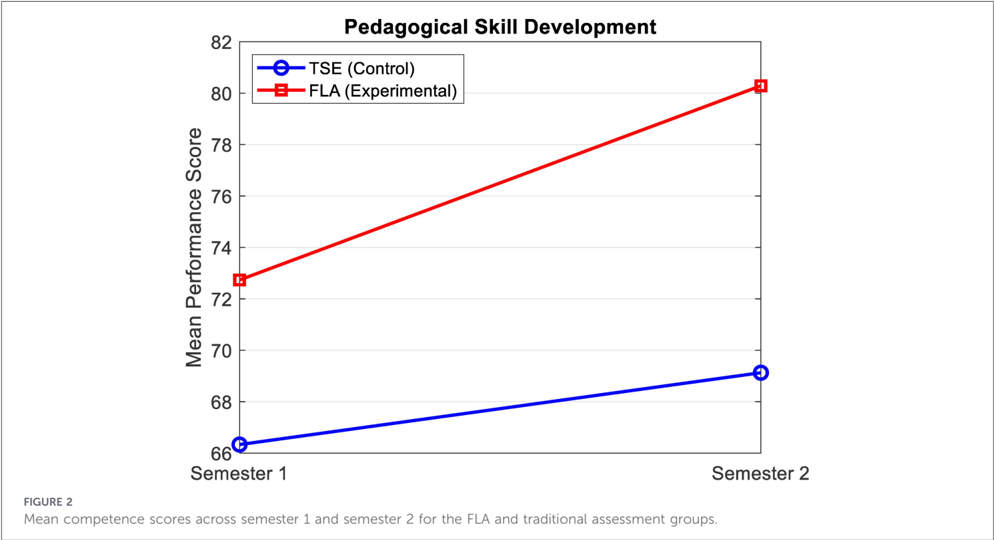
- Students assessed using fuzzy logic achieved higher Semester 2 competence scores than those in the traditional group: t(64) = 2.75, p = .008, d = .68. Mean scores were 73.44 (SD = 11.35) for FLA and 66.33 (SD = 9.55) for traditional aggregation.
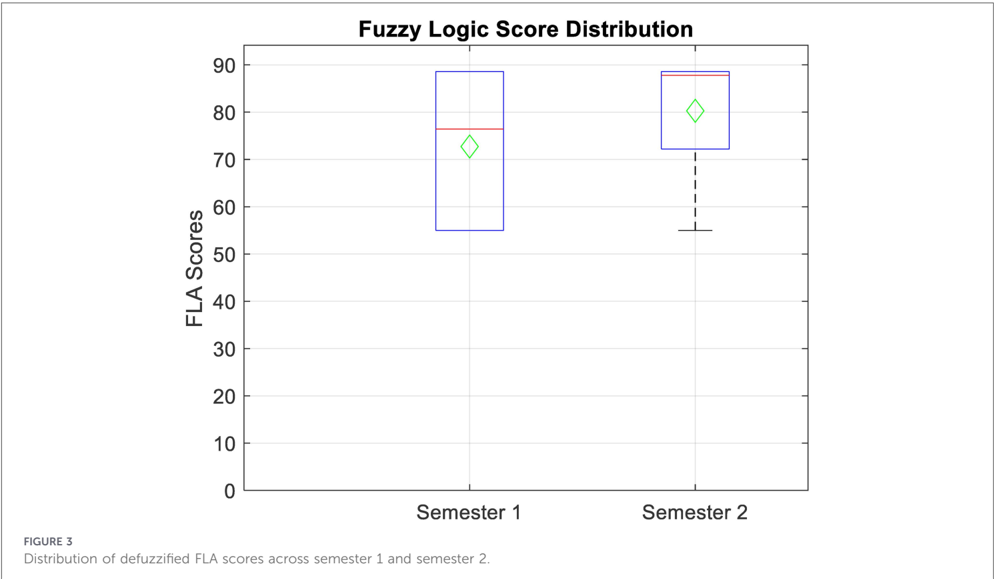
- The fuzzy framework showed stronger developmental differentiation over time, including increased spread in scores from Semester 1 to Semester 2 and qualitative evidence of more specific feedback and less binary pass/fail interpretation.
## Methods
- Randomized controlled experimental design in a mathematics teaching methodology course; 66 preservice mathematics teachers were stratified by GPA and randomly assigned to FLA (n = 33) or traditional aggregation (n = 33), over two academic semesters.
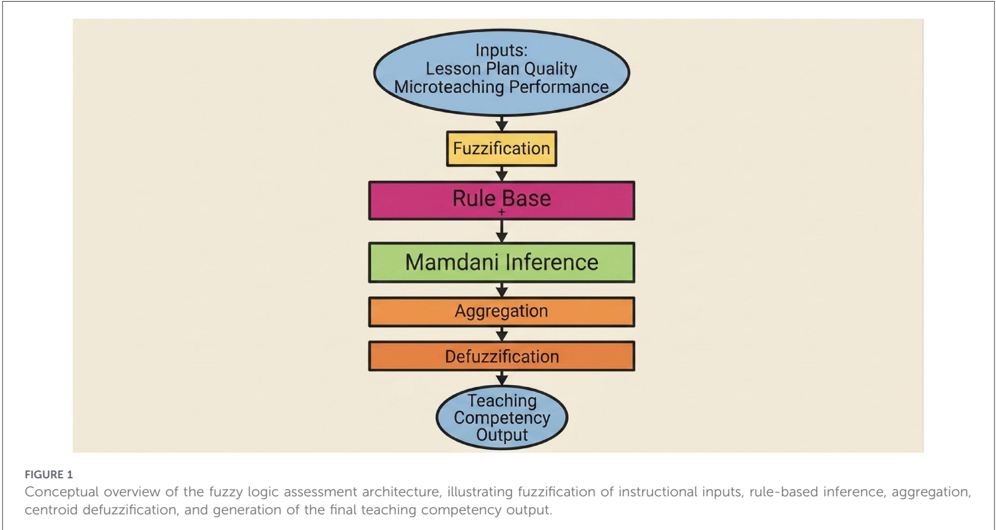
- The fuzzy model used two inputs: lesson plan quality and microteaching performance, with Mamdani-type fuzzy inference, nine IF-THEN rules, trapezoidal membership functions, and centroid defuzzification.
- Analyses included independent-samples t-tests, effect sizes (Cohen's d), chi-square test of independence, qualitative thematic analysis of reflective journals and observation notes, and independent blinded observation-based evaluations.
## Limitations
- The paper states that membership function design and rule construction relied on expert judgment, introducing subjectivity.
- The paper states that replication across institutional, programmatic, and cultural contexts is needed to establish generalizability and scalability.
- Evident from the text: the analytic sample excluded male candidates because they were fewer than 2% of the cohort, so the findings may not generalize to mixed-gender cohorts.
Model-written summary. Check it against the paper before relying on it.
Integrity signals
Registry
Cites
Statistics
Figures
Verification
Claims the paper makes
5 Valid · 7 Not valid · 25 Not checked · 126 Own results and interpretations
The cited sources support only part of this claim — read each source’s verdict below.
In the paper
“Studies on preservice teachers' beliefs, assessment preferences, and formative assessment in mathematics education suggest that conventional grading practices often fail to capture subtle but meaningful differences in learning and professional growth”
What the sources say
- Could not verifycites Maskos et al., 2025 sourceExperimental — accuracy not yet measured
Our copy of Maskos et al. (2025) is a systematic review of formative assessment (FA) effects in mathematics education; it does include studies with preservice teachers and their beliefs (5.2.2, peer assessment improving preservice teachers' feedback provision skills 'at the level of their self-regulation and beliefs', Alqassab et al., 2018) and defines FA against summative assessment (1 Introduction: 'Unlike summative assessment, which assesses learning outcomes after the completion of a certain learning phase, FA uses evidence of student achievement to shape further teaching and learning'; FA provides 'qualitative insights into student achievement'). However, no passage states or implies that conventional grading practices fail to capture subtle but meaningful differences in learning or professional growth, and nothing addresses preservice teachers' 'assessment preferences'. Searches run: 'conventional grading practices fail to capture differences in learning', 'preservice teachers beliefs assessment preferences', 'summative assessment traditional grading limitations', 'definition of formative assessment distinction from summative assessment grading', 'grades and test scores do not reveal individual learning processes'. The cited review therefore neither supports nor contradicts the attributed point. (LLM, conf=0.62)
- Could not verifycites Tran et al., 2026 sourceExperimental — accuracy not yet measured
Our copy of Tran et al. is a psychometric evaluation of the TEDS-M beliefs scale with 760 Australian preservice teachers (Abstract, Conclusion; Results, Discussion); it addresses preservice teachers' mathematics-related beliefs but nothing on assessment preferences, formative assessment, or conventional grading practices. Searches for 'formative assessment / grading / marks', 'assessment preferences', and 'capturing change in learning and professional growth' returned only passages about survey instruments (e.g., Role of beliefs section: rating scales vs. stimulated recall and stated vs. enacted beliefs; Future research: social desirability in endorsing inquiry views; Discussion: the LS subscale being uninterpretable). Notably, the paper's own conclusion runs the other way for its instrument — that the adapted 27-item survey 'may provide a useful tool to examine changes in beliefs' (Conclusion) — but that concerns a belief questionnaire, not grading, so it neither supports nor contradicts the attributed claim. (LLM, conf=0.72)
- Partly supportedcites Wellberg, 2024 sourceExperimental — accuracy not yet measured
Wellberg (2025) does carry the 'learning' half of the claim loosely: the Forms of assessment review (Abstract) says written tests are dominated by computation items and make up at least half of course grades, and that alternative formats (projects, writing) 'are more likely to require a greater depth of conceptual understanding from students' (Discussion), i.e. conventional testing centres on correctness over process. However, the paper's own studies report relationships between PSTs' course-taking, beliefs and preferred assessment formats — not any finding that conventional grading fails to capture differences in learning. Nothing in our copy addresses 'professional growth' of teachers being captured or missed by grading, and the paper's framing of assessment limitations is about item wording and single-item survey measures (Conclusion), not about grading's insensitivity. The 'professional growth' element and the assertion of failure are therefore unsupported by this source. (LLM, conf=0.65)
hedged- Asserted: passes — The authors put it forward as true.
- Checkable: passes — It can be checked against evidence.
- Load-bearing: passes — The paper’s conclusions depend on it.
- Based: passes — The paper gives a reason why it holds.
- Could not verify
The cited sources support only part of this claim — read each source’s verdict below.
In the paper
“composite scores often conceal meaningful variation across performance dimensions (Brookhart, 2018; Sadler, 2009).”
What the sources say
- Partly supportedcites Brookhart, 2018 sourceExperimental — accuracy not yet measured
The paper explains that analytic rubrics assess each criterion separately and are better for feedback, while holistic rubrics make one decision across all criteria (section labeled Abstract; Type and Quality of Rubrics). This supports the concern that an overall rating lacks dimension-specific information, but the paper does not establish that composite scores often conceal meaningful variation. (LLM, conf=0.82)
- Not checked — no full text of the sourcecites Sadler, 2009 source
plainstates a cause- Asserted: passes — The authors put it forward as true.
- Checkable: passes — It can be checked against evidence.
- Load-bearing: passes — The paper’s conclusions depend on it.
- Based: passes — The paper gives a reason why it holds.
- Partly supported
A result the paper states — it cites no source for it, so there is none to check. The quote shows it is in the paper.
In the paper
“was supported by independent observation-based judgment”
plainstates an association- Asserted: passes — The authors put it forward as true.
- Checkable: passes — It can be checked against evidence.
- Load-bearing: passes — The paper’s conclusions depend on it.
- Based: passes — The paper gives a reason why it holds.
A result the paper reports from its own data — it cites no other source for it, so there is none to check. The quote shows it is in the paper.
In the paper
“Compared with the Traditional Aggregation Model, fuzzy logic assessment produced greater differentiation across competence profiles”
plainstates a cause- Asserted: passes — The authors put it forward as true.
- Checkable: passes — It can be checked against evidence.
- Load-bearing: passes — The paper’s conclusions depend on it.
- Based: passes — The paper gives a reason why it holds.
A result the paper reports from its own data — it cites no other source for it, so there is none to check. The quote shows it is in the paper.
In the paper
“Longitudinal analyses across two semesters further suggested that the profile-oriented, differentiated feedback enabled by fuzzy classifications which distinguished between planning-side and enactment-side developmental needs was associated with stronger gains in both microteaching performance and lesson planning quality.”
hedgedstates an association- Asserted: passes — The authors put it forward as true.
- Checkable: passes — It can be checked against evidence.
- Load-bearing: passes — The paper’s conclusions depend on it.
- Based: passes — The paper gives a reason why it holds.
61 more claims
Create a free account to see all 163 claims and to verify the 3 references still open.
- Probably not a substantial claim. 65
- It may state two separate claims as one. 46
- The quote only partly states this claim. 1
Statistics recomputed
Every reported test result, recomputed from its test statistic and degrees of freedom. A result shows as not adding up only once an independent check has confirmed it.
- Consistentχ²(1) = 3.88reported p = .049 · recomputed p = .049
“χ 2 (1, N = 66) = 3.88, p = .049”
Self-check
Percentages, sums and reported differences re-computed from the paper’s own numbers.
Self-check results appear here once an independent check has confirmed them.
Citations
Cites
Using thematic analysis in psychology
Braun, V., & Clarke, V. (2006) · Qualitative Research in Psychology · doi:10.1191/1478088706qp063oa · Cited by 194,414
Zadeh, L. A. (1965) · Information and Control · doi:10.1016/s0019-9958(65)90241-x · Cited by 67,855
A guideline of selecting and reporting intraclass correlation coefficients for reliability research
Koo, T. K., & Li, M. Y. (2016) · Journal of Chiropractic Medicine · doi:10.1016/j.jcm.2016.02.012 · Cited by 31,709
ANFIS: adaptive-network-based fuzzy inference system
Jang, J.-S. R. (1993) · IEEE Transactions on Systems, Man, and Cybernetics · doi:10.1109/21.256541 · Cited by 16,254
Polit, D. F., & Beck, C. T. (2006) · Research in Nursing & Health · doi:10.1002/nur.20147 · Cited by 7,510
Determination and Quantification Of Content Validity
LYNN, M. R. (1986) · Nursing Research · doi:10.1097/00006199-198611000-00017 · Cited by 6,775
Content Knowledge for Teaching: What Makes It Special?
Loewenberg Ball, D., Thames, M. H., & Phelps, G. (2008) · Journal of Teacher Education · doi:10.1177/0022487108324554 · Cited by 5,388
Messick, S. (1995) · American Psychologist · doi:10.1037/0003-066x.50.9.741 · Cited by 4,198
Implications for educational practice of the science of learning and development
Darling-Hammond, L., Flook, L., Cook-Harvey, C., Barron, B., & Osher, D. (2020) · Applied Developmental Science · doi:10.1080/10888691.2018.1537791 · Cited by 2,733
Validating the interpretations and uses of test scores
Kane, M. T. (2013) · Journal of Educational Measurement · doi:10.1111/jedm.12000 · Cited by 2,110
Research works printed but not linked: 9
- 2014, Standards for Educational and Psychological Testing
- Darling-Hammond, 2019, Preparing Teachers for Deeper Learning
- Lingard, 2020, National testing, accountability, and education policy, J. Educ. Policy, 35, 1, 10.1080/02680939.2018.1551276 · doi:10.1080/02680939.2018.1551276
- Linsell, 2012, Diagnostic assessment of pre-service teachers’ mathematical content knowledge, Math. Teach. Educ. Dev., 14, 4
- Newton, 2021, Validity in Educational and Psychological Assessment
- Nunnally, 1994, Psychometric Theory
- Popham, 2019, Classroom Assessment: What Teachers Need to Know
- Ruiz-Primo, 2021, Informal formative assessment: the role of instructional dialogues in assessing student learning, Educ. Assess., 26, 1, 10.1080/10627197.2020.1864384 · doi:10.1080/10627197.2020.1864384
- Yen, 1999, Fuzzy Logic: Intelligence, Control, and Information
Metadata
- Authors
- Naccache, H., & Hleiss, R.
- Affiliations
- Qatar University (QA)
- Centre d'Etudes Superieures Industrielles (FR)
- Corresponding author
- Naccache, Hiba
- Hleiss, Rima
- ORCID
- Naccache, Hiba
- Venue
- Frontiers in Education
- Publisher
- Frontiers Media SA
- Published
- 2026-07-08
- Volume
- 11
- ISSN
- 2504-284X (ISSN-L)
- OpenAlex
- W7167735165
- Cited by
- 0
- References
- 30
- FWCI
- 0.00
- Type
- journal article
- Language
- en
- Open access
- gold
- doi.org
- Licence
- Locations
- Frontiers in Education (publishedVersion, cc-by)
- DOAJ (DOAJ: Directory of Open Access Journals) (submittedVersion)
- Figshare (submittedVersion, cc-by)
- Funders
- Qatar National Library
- Topics
- Social Sciences › Education › Teacher Education and Assessments
- Social Sciences › Education › Student Assessment and Feedback
- Physical Sciences › Computer Science › Information Systems › Educational Technology and Assessment
- Keywords
- pre-service mathematics teachers, teacher professional development, misclassification risk, cut-off values, microteaching, competency profile, feedback
About these checks
Registry, retraction, Cites and statistics results are computed, not judged, with one exception: a printed reference that no index lists is read once by a model before it counts as a citation error. Claims are extracted by a model and kept only when their quote appears verbatim in the text; each cited source is then checked, with a model’s help, for whether it says what the claim relies on. Those verdicts can be wrong — read the claim’s quote and the cited source before relying on one.
The claim verdicts this report counts are experimental: their accuracy is not yet measured.
A language model drew the claims from the paper on 2026-10-10, under version 3 of the claim definition (model deepseek-v4.1-flash, prompt extract-v3).
A second model labelled each claim on 2026-10-10 (model jev-1.13-20260917, definition revision gold-guideline-v0.2).
Cited sources are checked with a language model’s help (qwen3.8-omni-flash and gpt-6-sol).
Statistics and arithmetic are recomputed, not judged.
Confidence bands are shown only for fields calibrated on our annotated test set. None is calibrated yet, so no band is shown.
What counts as a claim ›How we measure confidence ›How we check this ›
Are you an author, or do you see a problem with this page? Request a review
How to cite
Cite CoChat for the checks on this page, and the paper for its own findings.
- This page
- CoChat. (2026). Citation check: Reducing classification risk in developmental performance assessment using fuzzy logic: evidence from preservice mathematics teacher education. https://app.cochat.ai/papers/10.3389/feduc.2026.1840093
- The paper
- Naccache, H., & Hleiss, R. (2026). Reducing classification risk in developmental performance assessment using fuzzy logic: evidence from preservice mathematics teacher education. Frontiers in Education. https://doi.org/10.3389/feduc.2026.1840093
Data sources
Bibliographic data: Semantic Scholar, OpenAlex, Crossref.
Contains information from the Semantic Scholar Academic Graph Datasets, made available under the ODC Attribution License (ODC-BY 1.0).
Semantic Scholar’s data is described in: Kinney, R., et al. (2023). The Semantic Scholar Open Data Platform. arXiv:2301.10140.
