

The DOI matches its Crossref record; 181 of the 183 references it cites were found in a registry or an index, and 2 are not checked yet.
Leptin and Obesity: Role and clinical implication.
Open accessAbstract
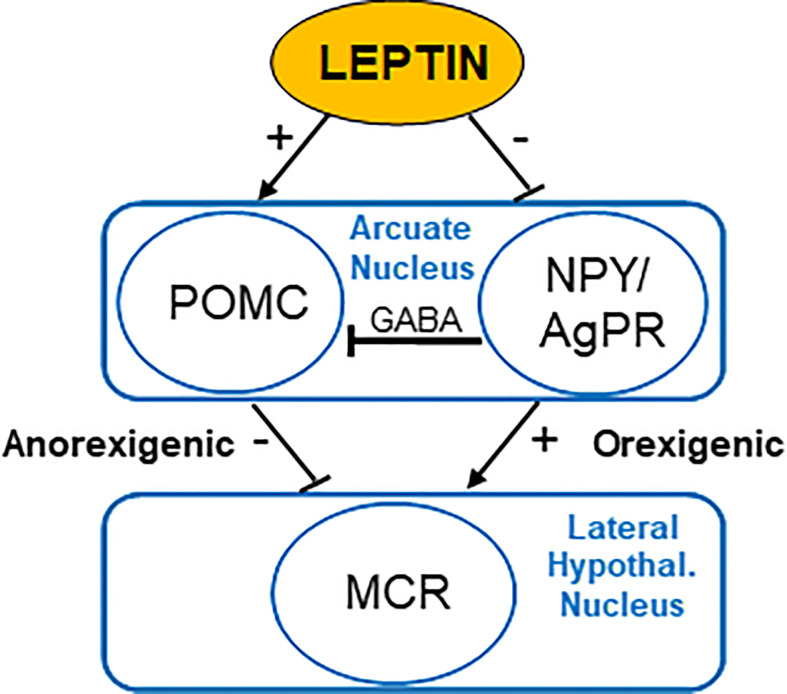
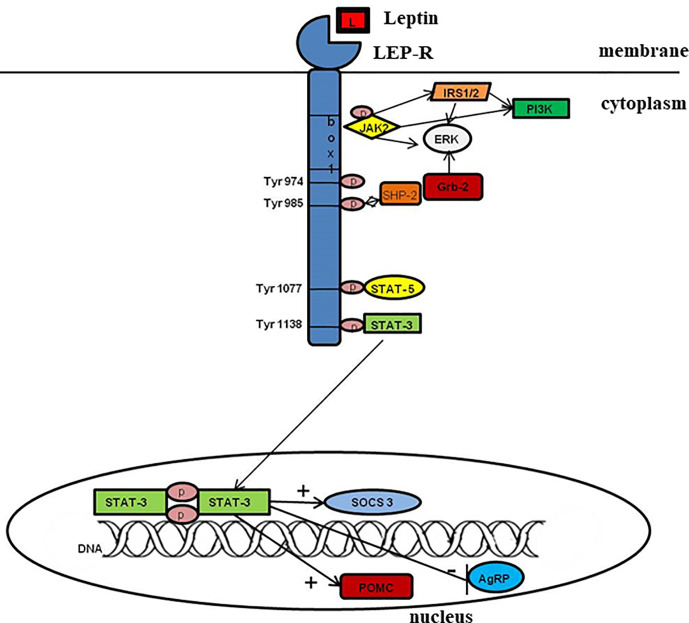
The peptide hormone leptin regulates food intake, body mass, and reproductive function and plays a role in fetal growth, proinflammatory immune responses, angiogenesis and lipolysis. Leptin is a product of the obese ( ob ) gene and, following synthesis and secretion from fat cells in white adipose tissue, binds to and activates its cognate receptor, the leptin receptor (LEP-R). LEP-R distribution facilitates leptin’s pleiotropic effects, playing a crucial role in regulating body mass via a negative feedback mechanism between adipose tissue and the hypothalamus. Leptin resistance is characterized by reduced satiety, over-consumption of nutrients, and increased total body mass. Often this leads to obesity, which reduces the effectiveness of using exogenous leptin as a therapeutic agent. Thus, combining leptin therapies with leptin sensitizers may help overcome such resistance and, consequently, obesity. This review examines recent data obtained from human and animal studies related to leptin, its role in obesity, and its usefulness in obesity treatment.
Overview
The claims and statistics of this paper haven’t been checked yet.
Run the check — free, no account needed. It reads the open-access text and checks the sources it cites.
Integrity signals
Registry
Cites
Statistics
Figures
Verification
Claims the paper makes
The claims and statistics of this paper haven’t been checked yet.
Run the check — free, no account needed. It reads the open-access text and checks the sources it cites.
Claims other papers make about this one
Each is checked against this paper’s own text: does it say what the citing paper says it does?
The source backs part of the claim, not all of it — or backs it for a different population, condition or comparison.
In the citing paper
“Elevated leptin and cholesterol levels are characteristic of obesity, and therefore these results further demonstrate the extent of the obese phenotype observed in Abi3–/– mice (Klop et al., 2013; Obradovic et al., 2021).”
From Deletion of the Alzheimer’s disease risk gene Abi3 locus results in obesity and systemic metabolic disruption in mice (2022) · cites this paper as Obradovic et al., 2021
Experimental — accuracy not yet measured
Self-check
Percentages, sums and reported differences re-computed from the paper’s own numbers.
The self-check needs the paper’s full text.
Citations
Cites
Positional cloning of the mouse obese gene and its human homologue
Zhang, Y., Proenca, R., Maffei, M., Barone, M., Leopold, L., & Friedman, J. M. (1994) · Nature · doi:10.1038/372425a0 · Cited by 13,419
Obesity is associated with macrophage accumulation in adipose tissue
Weisberg, S. P., McCann, D., Desai, M., Rosenbaum, M., Leibel, R. L., & Ferrante, A. W. (2003) · Journal of Clinical Investigation · doi:10.1172/jci200319246 · Cited by 10,041
Xu, H., Barnes, G. T., Yang, Q., Tan, G., Yang, D., Chou, C. J., Sole, J., Nichols, A., Ross, J. S., Tartaglia, L. A., et al. (2003) · Journal of Clinical Investigation · doi:10.1172/jci200319451 · Cited by 6,760
Serum Immunoreactive-Leptin Concentrations in Normal-Weight and Obese Humans
Considine, R. V., Sinha, M. K., Heiman, M. L., Kriauciunas, A., Stephens, T. W., Nyce, M. R., Ohannesian, J. P., Marco, C. C., McKee, L. J., Bauer, T. L., et al. (1996) · New England Journal of Medicine · doi:10.1056/nejm199602013340503 · Cited by 6,326
Inflammation, stress, and diabetes
Wellen, K. E., & Hotamisligil, G. S. (2005) · Journal of Clinical Investigation · doi:10.1172/jci25102 · Cited by 4,143
Overweight, obesity and cancer: epidemiological evidence and proposed mechanisms
Calle, E. E., & Kaaks, R. (2004) · Nature reviews. Cancer · doi:10.1038/nrc1408 · Cited by 3,613
Identification and expression cloning of a leptin receptor, OB-R.
Tartaglia, L. A., Dembski, M., Weng, X., Deng, N., Culpepper, J., Devos, R., Richards, G. J., Campfield, L. A., Clark, F. T., Deeds, J., et al. (1995) · Cell · doi:10.1016/0092-8674(95)90151-5 · Cited by 3,496
Watterson, K. R., Bestow, D., Gallagher, J. R., Hamilton, D. L., Ashford, F. B., Meakin, P. J., & Ashford, M. L. J. (2012) · Neurosignals · doi:10.1159/000334144 · Cited by 3,395
Principles of interleukin (IL)-6-type cytokine signalling and its regulation
HEINRICH, P. C., BEHRMANN, I., HAAN, S., HERMANNS, H. M., MÜLLER-NEWEN, G., & SCHAPER, F. (2003) · Biochemical Journal · doi:10.1042/bj20030407 · Cited by 3,272
Kim, H. J., Park, S. Y., Choi, Y. J., Han, S. J., Lee, K. W., & Kim, D. J. (2013) · Hormone Research in Paediatrics · doi:10.1159/000348848 · Cited by 3,061
Research works printed but not linked: 2
- 2019, World Health Statistics Overview 2019: Monitoring Health for the SDGs, Sustainable Development Goals.
- 2008, Worldwide Prevalence of Anaemia 1993-2005
Cited by
Sorted by citations
Metabolic Syndrome: Updates on Pathophysiology and Management in 2021
Fahed, G., Aoun, L., Bou Zerdan, M., Allam, S., Bou Zerdan, M., Bouferraa, Y., & Assi, H. I. (2022) · International Journal of Molecular Sciences · doi:10.3390/ijms23020786 · Cited by 1,441
Pathophysiology of obesity and its associated diseases
Jin, X., Qiu, T., Li, L., Yu, R., Chen, X., Li, C., Proud, C. G., & Jiang, T. (2023) · Acta Pharmaceutica Sinica B · doi:10.1016/j.apsb.2023.01.012 · Cited by 603
Signaling pathways in obesity: mechanisms and therapeutic interventions
Wen, X., Zhang, B., Wu, B., Xiao, H., Li, Z., Li, R., Xu, X., & Li, T. (2022) · Signal Transduction and Targeted Therapy · doi:10.1038/s41392-022-01149-x · Cited by 490
Cell death and inflammation during obesity: “Know my methods, WAT(son)”
Hildebrandt, X., Ibrahim, M. A., & Peltzer, N. (2022) · Cell Death and Differentiation · doi:10.1038/s41418-022-01062-4 · Cited by 307
Ren, Y., Zhao, H., Yin, C., Lan, X., Wu, L., Du, X., Griffiths, H. R., & Gao, D. (2022) · Frontiers in Endocrinology · doi:10.3389/fendo.2022.873699 · Cited by 276
Metadata
- Authors
- Obradovic, M., Sudar-Milovanovic, E., Soskic, S., Essack, M., Arya, S., Stewart, A. J., Gojobori, T., & Isenovic, E. R.
- Affiliations
- University of Belgrade (RS)
- King Abdullah University of Science and Technology (SA)
- University of St Andrews (GB)
- ORCID
- Venue
- Frontiers in Endocrinology
- Publisher
- Frontiers Media SA
- Published
- 2021-05-18
- Volume
- 12
- Pages
- 585887-585887
- ISSN
- 1664-2392 (ISSN-L)
- PMC
- PMC8167040
- OpenAlex
- W3161404038
- Cited by
- 1,121
- References
- 182
- Citations by year
- 2026: 168 · 2025: 299 · 2024: 264 · 2023: 246 · 2022: 129 · 2021: 15
- FWCI
- 20.86
- Type
- journal article
- Language
- en
- Open access
- gold
- doi.org
- Licence
- Locations
- Frontiers in Endocrinology (publishedVersion, cc-by)
- PubMed Central (publishedVersion, cc-by)
- PubMed (publishedVersion)
- DOAJ (DOAJ: Directory of Open Access Journals) (submittedVersion, cc-by-sa)
- King Abdullah University of Science and Technology Repository (King Abdullah University of Science and Technology) (submittedVersion, other-oa)
- St Andrews Research Repository (St Andrews Research Repository) (submittedVersion, cc-by)
- VinaR (Institute of Nuclear Sciences "Vinča") (submittedVersion, cc-by)
- Funders
- King Abdullah University of Science and Technology
- Ministarstvo Prosvete, Nauke i Tehnološkog Razvoja
- Topics
- Life Sciences › Neuroscience › Endocrine and Autonomic Systems › Regulation of Appetite and Obesity
- Health Sciences › Medicine › Endocrinology, Diabetes and Metabolism › Adipokines, Inflammation, and Metabolic Diseases
- Health Sciences › Medicine › Pharmacology (medical) › Pharmacology and Obesity Treatment
- Keywords
- leptin, obesity, leptin resistance, leptin receptor, ob gene, white adipose tissue, hypothalamic regulation of appetite, satiety, leptin therapy, food intake regulation, body weight regulation, reproductive function, fetal growth, inflammation, angiogenesis, lipolysis
- MeSH terms
- Animals, Energy Metabolism, Humans, Hypothalamus, Obesity, Risk Factors, Satiety Response, Signal Transduction, Leptin
About these checks
Registry, retraction, Cites and statistics results are computed, not judged, with one exception: a printed reference that no index lists is read once by a model before it counts as a citation error. Claims are extracted by a model and kept only when their quote appears verbatim in the text; each cited source is then checked, with a model’s help, for whether it says what the claim relies on. Those verdicts can be wrong — read the claim’s quote and the cited source before relying on one.
Statistics and arithmetic are recomputed, not judged.
Confidence bands are shown only for fields calibrated on our annotated test set. None is calibrated yet, so no band is shown.
What counts as a claim ›How we measure confidence ›How we check this ›
Are you an author, or do you see a problem with this page? Request a review
