

The mechanism and efficacy of GLP-1 receptor agonists in the treatment of Alzheimer’s disease
Open accessThe DOI matches its Crossref record; 245 of the 245 references it cites were found in a registry or an index.
Abstract
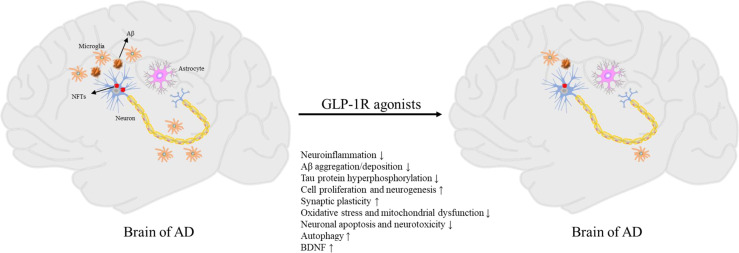
Since type 2 diabetes mellitus (T2DM) is a risk factor for Alzheimer’s disease (AD) and both have the same pathogenesis (e.g., insulin resistance), drugs used to treat T2DM have been gradually found to reduce the progression of AD in AD models. Of these drugs, glucagon-like peptide 1 receptor (GLP-1R) agonists are more effective and have fewer side effects. GLP-1R agonists have reducing neuroinflammation and oxidative stress, neurotrophic effects, decreasing Aβ deposition and tau hyperphosphorylation in AD models, which may be a potential drug for the treatment of AD. However, this needs to be verified by further clinical trials. This study aims to summarize the current information on the mechanisms and effects of GLP-1R agonists in AD.
Overview
The claims and statistics of this paper haven’t been checked yet.
Free: it reads the open-access text and checks the first 5 claims that cite a source we can check. Create a free account to check every claim.
Integrity signals
Registry
Cites
Statistics
Figures
Verification
Claims the paper makes
The claims and statistics of this paper haven’t been checked yet.
Free: it reads the open-access text and checks the first 5 claims that cite a source we can check. Create a free account to check every claim.
Claims other papers make about this one
Each is checked against this paper’s own text: does it say what the citing paper says it does?
The source backs part of the claim, not all of it — or backs it for a different population, condition or comparison.
In the citing paper
“in the treatment of Alzheimer’s diseases (AD) and Parkinson’s diseases (PD), GLP-1RAs have shown potential in slowing disease progression”
From Glucagon-like peptide-1 receptor: mechanisms and advances in therapy (2024) · cites this paper as [13]
Experimental — accuracy not yet measuredThe source backs part of the claim, not all of it — or backs it for a different population, condition or comparison.
In the citing paper
“while their anti-inflammatory properties offer new hope for conditions such as osteoarthritis (OA), rheumatoid arthritis (RA) and cardiovascular diseases.13–15”
From Glucagon-like peptide-1 receptor: mechanisms and advances in therapy (2024) · cites this paper as [13]
Experimental — accuracy not yet measuredThe cited source says what the claim attributes to it.
In the citing paper
“GLP-1RAs also enhance autophagy, a process of cellular clearance of damaged and outdated components.13,312”
From Glucagon-like peptide-1 receptor: mechanisms and advances in therapy (2024) · cites this paper as [13]
Self-check
Percentages, sums and reported differences re-computed from the paper’s own numbers.
The self-check needs the paper’s full text.
Citations
Cites
1 retracted
Items 201–245 of 245
Liu, X.-Y., Wang, L.-X., Chen, Z., & Liu, L.-B. (2016) · Neurological Research · doi:10.1080/01616412.2016.1145914 · Cited by 46
Diabetes Mellitus Increases Risk of Incident Dementia in APOE ɛ 4 Carriers: A Meta-Analysis
Li, L., Cavuoto, M. G., Biddiscombe, K. J., & Pike, K. E. (2020) · Journal of Alzheimer s Disease · doi:10.3233/jad-191068 · Cited by 46
Chen, S., Yin, L., Zheng, X., An, F.-M., Liu, A., Wang, Y., Yao, W., & Gao, X. (2015) · Neuroscience Letters · doi:10.1016/j.neulet.2015.12.007 · Cited by 45
GLP-1 as a target for therapeutic intervention
Rajeev, S. P., & Wilding, J. P. H. (2016) · Current Opinion in Pharmacology · doi:10.1016/j.coph.2016.08.005 · Cited by 45
Early Alzheimer-type lesions in cognitively normal subjects
Tsartsalis, S., Xekardaki, A., Hof, P. R., Kövari, E., & Bouras, C. (2018) · Neurobiology of Aging · doi:10.1016/j.neurobiolaging.2017.10.002 · Cited by 42
Zheng, C., Zhou, M., Sun, J., Xiong, H., Peng, P., Gu, Z., & Deng, Y. (2019) · Chemico-Biological Interactions · doi:10.1016/j.cbi.2019.06.001 · Cited by 42
Panagaki, T., Gengler, S., & Hölscher, C. (2018) · Journal of Alzheimer’s Disease · doi:10.3233/jad-180584 · Cited by 41
Martín‐Segura, A., Ahmed, T., Casadomé‐Perales, Á., Palomares‐Perez, I., Palomer, E., Kerstens, A., Munck, S., Balschun, D., & Dotti, C. G. (2019) · Aging Cell · doi:10.1111/acel.12932 · Cited by 41
Formulary Forum: Exenatide: A New Option for the Treatment of Type 2 Diabetes
Yoo, B. K., Triller, D. M., & Yoo, D. J. (2006) · Annals of Pharmacotherapy · doi:10.1345/aph.1h060 · Cited by 39
Exendin-4 antagonizes Aβ1-42-induced attenuation of spatial learning and memory ability
Wang, X., Wang, L., Jiang, R., Xu, Y., Zhao, X., & Li, Y. (2016) · Experimental and Therapeutic Medicine · doi:10.3892/etm.2016.3742 · Cited by 39
Jia, X.-T., Ye-Tian, Yuanli, Zhang, G., Liu, Z., Di, Z., Ying, X., Yan, F., Song, E., Qi, J., et al. (2016) · Physiology & Behavior · doi:10.1016/j.physbeh.2016.03.016 · Cited by 38
Tramutola, A., Arena, A., Cini, C., Butterfield, D. A., & Barone, E. (2017) · Expert Review of Neurotherapeutics · doi:10.1080/14737175.2017.1246183 · Cited by 38
Advances in Drug Therapy for Alzheimer’s Disease
Zhu, C.-C., Fu, S., Chen, Y., Li, L., Mao, R., Wang, J., Liu, R., Liu, Y., & Wang, X. (2020) · Current Medical Science · doi:10.1007/s11596-020-2281-2 · Cited by 38
Contemporary Classification of Glucagon-Like Peptide 1 Receptor Agonists (GLP1RAs)
Kalra, S., Bhattacharya, S., & Kapoor, N. (2021) · Diabetes Therapy · doi:10.1007/s13300-021-01113-y · Cited by 38
Robinson, A., Lubitz, I., Atrakchi-Baranes, D., Licht-Murava, A., Katsel, P., Leroith, D., Liraz-Zaltsman, S., Haroutunian, V., & Beeri, M. S. (2019) · Journal of Molecular Neuroscience · doi:10.1007/s12031-019-1257-9 · Cited by 37
Qi, L., Chen, Z., Wang, Y., Liu, X., Liu, X., Ke, L., Zheng, Z., Lin, X., Zhou, Y., Liu, L., et al. (2017) · Europe PMC (PubMed Central) · Cited by 37
Yoshino, Y., Ishisaka, M., Tsujii, S., Shimazawa, M., & Hara, H. (2015) · Biochemical and Biophysical Research Communications · doi:10.1016/j.bbrc.2015.01.098 · Cited by 36
Li, T., Jiao, J.-J., Su, Q., Hölscher, C., Zhang, J., Yan, X.-D., Zhao, H.-M., Cai, H.-Y., & Qi, J.-S. (2020) · Neuropharmacology · doi:10.1016/j.neuropharm.2020.108042 · Cited by 36
Alzheimer’s Disease: The Alternative Serotonergic Hypothesis of Cognitive Decline
Vakalopoulos, C. (2017) · Journal of Alzheimer's Disease · doi:10.3233/jad-170364 · Cited by 34
Cai, H.-Y., Yang, D., Qiao, J., Yang, J.-T., Wang, Z.-J., Wu, M.-N., Qi, J.-S., & Hölscher, C. (2021) · Journal of Alzheimer's Disease · doi:10.3233/jad-210256 · Cited by 34
Genovese, S., Mannucci, E., & Ceriello, A. (2017) · Advances in Therapy · doi:10.1007/s12325-017-0499-6 · Cited by 33
Wang, X., Yang, W., Hölscher, C., Wang, Z., Cai, H., Li, Q., & Qi, J. (2013) · Journal of Neuroscience Research · doi:10.1002/jnr.23181 · Cited by 32
Yang, Y., Ma, D., Xu, W., Chen, F., Du, T., Yue, W., Shao, S., & Yuan, G. (2015) · Molecular and Cellular Neuroscience · doi:10.1016/j.mcn.2015.10.005 · Cited by 32
Wang, X., Wang, L., Xu, Y., Yu, Q., Li, L., & Guo, Y. (2016) · Aging Clinical and Experimental Research · doi:10.1007/s40520-016-0548-z · Cited by 31
el‐Rady, N. M. A., Ahmed, A., Abdel‐Rady, M. M., & Ismail, O. I. (2020) · Physiological Reports · doi:10.14814/phy2.14651 · Cited by 31
The major proglucagon fragment: An abundant islet protein and secretory product
Patzelt, C., & Schug, G. (1981) · FEBS Letters · doi:10.1016/0014-5793(81)80772-7 · Cited by 29
Mitochondrial dysfunction and Alzheimer's disease: prospects for therapeutic intervention
Lim, J. W., Lee, J., & Pae, A. N. (2020) · BMB Reports · doi:10.5483/bmbrep.2020.53.1.279 · Cited by 28
Cooper, O., Hallett, P. J., & Isacson, O. (2022) · FEBS Journal · doi:10.1111/febs.16638 · Cited by 28
Lixisenatide: A Review of Its Use in Patients with Type 2 Diabetes Mellitus
Scott, L. J. (2013) · BioDrugs · doi:10.1007/s40259-013-0057-y · Cited by 27
Wang, X., Wang, L., Jiang, R., Yuan, Y., Yu, Q., & Li, Y. (2015) · Brain Research · doi:10.1016/j.brainres.2015.09.015 · Cited by 27
Lixisenatide: A New Daily GLP-1 Agonist for Type 2 Diabetes Management
McCarty, D., Coleman, M., & Boland, C. L. (2017) · Annals of Pharmacotherapy · doi:10.1177/1060028017689878 · Cited by 27
Gümüşlü, E., Çine, N., Ertan, M., Mutlu, O., Celikyurt, I. K., & Ulak, G. (2017) · Fundamental and Clinical Pharmacology · doi:10.1111/fcp.12329 · Cited by 27
Diabetes Promotes Development of Alzheimer’s Disease Through Suppression of Autophagy
Miao, Y., Guo, D., Li, W., & Zhong, Y. (2019) · Journal of Alzheimer s Disease · doi:10.3233/jad-190156 · Cited by 27
Exendin-4 protects Aβ(1-42) oligomer-induced PC12 cell apoptosis.
Qiu, C., Wang, Y.-P., Pan, X., Liu, X., Chen, Z., & Liu, L. (2016) · Europe PMC (PubMed Central) · Cited by 25
Li, H., Cao, L., Ren, Y., Jiang, Y., Xie, W., & Li, D. (2017) · Bioscience Reports · doi:10.1042/bsr20171284 · Cited by 23
Wang, Z.-J., Han, Y., Zhao, F., Yang, G., Yuan, L., Cai, H.-Y., Yang, J., Hölscher, C., Qi, J., & Wu, M. (2019) · Hormones and Behavior · doi:10.1016/j.yhbeh.2019.104640 · Cited by 23
Mitochondrial dysfunction: A potential target for Alzheimer’s disease intervention and treatment
Ke, J., Tian, Q., Xu, Q., Fu, Z., & Fu, Q. (2021) · Drug Discovery Today · doi:10.1016/j.drudis.2021.04.025 · Cited by 23
The connection between MCI and Alzheimer disease: neurocognitive clues
Batum, K., Çınar, N., Şahin, Ş., Ünsal, M. A., & Karşıdağ, S. (2015) · TURKISH JOURNAL OF MEDICAL SCIENCES · doi:10.3906/sag-1404-179 · Cited by 21
The efficacy and safety of exenatide once weekly in patients with type 2 diabetes
Heimbürger, S. M. N., Brønden, A., Johansen, N. J., Dejgaard, T. F., Vilsbøll, T., & Knop, F. K. (2019) · Expert Opinion on Pharmacotherapy · doi:10.1080/14656566.2019.1571040 · Cited by 20
King, M. R., Anderson, N. J., Deciu, M., Guernsey, L. S., Cundiff, M., Hajizadeh, S., & Jolivalt, C. G. (2020) · Journal of Neuroscience Research · doi:10.1002/jnr.24706 · Cited by 19
Liraglutide Treatment Ameliorates Neurotoxicity Induced by Stable Silencing of Pin1
Bianchi, M., Doria, V., Braghini, M. R., Petrini, S., & Manco, M. (2019) · International Journal of Molecular Sciences · doi:10.3390/ijms20205064 · Cited by 17
Liraglutide Attenuates Aβ42 Generation in APPswe/SH-SY5Y Cells Through the Regulation of Autophagy
Kong, J., Wan, L., Wang, Y., Zhang, H., & Zhang, W. (2020) · Neuropsychiatric Disease and Treatment · doi:10.2147/ndt.s260160 · Cited by 17
Potential new therapeutic target for Alzheimer's disease: Glucagon‐like peptide‐1
Liu, X., Zhang, N., Zhang, S., & Xu, P. (2021) · European Journal of Neuroscience · doi:10.1111/ejn.15502 · Cited by 17
Zhang, S., Cai, H.-Y., Ma, X., Li, Y., Zhang, J., Wang, Z., Li, Y., & Qi, J. (2017) · Behavioural Brain Research · doi:10.1016/j.bbr.2017.03.018 · Cited by 14
Zhang, H., Song, B., Zhu, W., Liu, L., He, X., Wang, Z., An, K., Cao, W., Shi, J., & Wang, S. (2021) · Aging · doi:10.18632/aging.203351 · Cited by 14
Cited by
Glucagon-like peptide-1 receptor: mechanisms and advances in therapy
Zheng, Z., Zong, Y., Ma, Y., Tian, Y., Pang, Y., Zhang, C., & Gao, J. (2024) · Signal Transduction and Targeted Therapy · doi:10.1038/s41392-024-01931-z · Cited by 1,036
Mapping the effectiveness and risks of GLP-1 receptor agonists
Xie, Y., Choi, T., & Al-Aly, Z. (2025) · Nature Medicine · doi:10.1038/s41591-024-03412-w · Cited by 300
McIntyre, R. S., Mansur, R. B., Rosenblat, J. D., & Kwan, A. T. H. (2024) · Expert Opinion on Drug Safety · doi:10.1080/14740338.2023.2295397 · Cited by 126
GLP-1RA and SGLT2i Medications for Type 2 Diabetes and Alzheimer Disease and Related Dementias
Tang, H., Donahoo, W. T., DeKosky, S. T., Lee, Y. A., Kotecha, P., Svensson, M., Bian, J., & Guo, J. S. (2025) · JAMA Neurology · doi:10.1001/jamaneurol.2025.0353 · Cited by 118
Clinical Evidence for GLP-1 Receptor Agonists in Alzheimer’s Disease: A Systematic Review
Liang, Y., Doré, V., Rowe, C. C., & Krishnadas, N. (2024) · Journal of Alzheimer s Disease Reports · doi:10.3233/adr-230181 · Cited by 80
Metadata
- Authors
- Du, H., Meng, X., Yao, Y., & Xu, J.
- Affiliations
- Harbin Medical University (CN)
- Tongji Hospital (CN)
- Corresponding author
- Xu, Jun
- Venue
- Frontiers in Endocrinology
- Publisher
- Frontiers Media SA
- Published
- 2022-11-17
- Volume
- 13
- Pages
- 1033479-1033479
- ISSN
- 1664-2392 (ISSN-L)
- PMC
- PMC9714676
- OpenAlex
- W4309614066
- Cited by
- 125
- References
- 245
- Citations by year
- 2026: 28 · 2025: 54 · 2024: 33 · 2023: 10
- FWCI
- 3.34
- Type
- journal article
- Language
- en
- Open access
- gold
- doi.org
- Licence
- Locations
- Frontiers in Endocrinology (publishedVersion, cc-by)
- PubMed Central (publishedVersion, cc-by)
- PubMed (publishedVersion)
- DOAJ (DOAJ: Directory of Open Access Journals) (submittedVersion, cc-by-sa)
- Funders
- Ministry of Education of the People's Republic of China
- Topics
- Life Sciences › Neuroscience › Cellular and Molecular Neuroscience › Alzheimer's disease research and treatments
- Health Sciences › Medicine › Psychiatry and Mental health › Dementia and Cognitive Impairment Research
- Health Sciences › Medicine › Endocrinology, Diabetes and Metabolism › Diabetes Treatment and Management
- Keywords
- Alzheimer's disease, GLP-1 receptor agonists, glucagon-like peptide-1, type 2 diabetes, insulin resistance, neuroinflammation, oxidative stress, neurotrophic effects, amyloid-beta deposition, tau hyperphosphorylation, drug repurposing
- MeSH terms
- Glucagon-Like Peptide-1 Receptor, Alzheimer Disease, Diabetes Mellitus, Type 2, Humans, Insulin Resistance, Drug-Related Side Effects and Adverse Reactions
About these checks
Registry, retraction, Cites and statistics results are computed, not judged, with one exception: a printed reference that no index lists is read once by a model before it counts as a citation error. Claims are extracted by a model and kept only when their quote appears verbatim in the text; each cited source is then checked, with a model’s help, for whether it says what the claim relies on. Those verdicts can be wrong — read the claim’s quote and the cited source before relying on one.
Statistics and arithmetic are recomputed, not judged.
Confidence bands are shown only for fields calibrated on our annotated test set. None is calibrated yet, so no band is shown.
What counts as a claim ›How we measure confidence ›How we check this ›
Are you an author, or do you see a problem with this page? Request a review
Data sources
Bibliographic data: Semantic Scholar, OpenAlex, Crossref.
Contains information from the Semantic Scholar Academic Graph Datasets, made available under the ODC Attribution License (ODC-BY 1.0).
Semantic Scholar’s data is described in: Kinney, R., et al. (2023). The Semantic Scholar Open Data Platform. arXiv:2301.10140.
