

The DOI matches its Crossref record; 271 of the 272 references it cites were found in a registry or an index.
Short-chain fatty acids, secondary bile acids and indoles: gut microbial metabolites with effects on enteroendocrine cell function and their potential as therapies for metabolic disease
Open accessAbstract
The gastrointestinal tract hosts the largest ecosystem of microorganisms in the body. The metabolism of ingested nutrients by gut bacteria produces novel chemical mediators that can influence chemosensory cells lining the gastrointestinal tract. Specifically, hormone-releasing enteroendocrine cells which express a host of receptors activated by these bacterial metabolites. This review will focus on the activation mechanisms of glucagon-like peptide-1 releasing enteroendocrine cells by the three main bacterial metabolites produced in the gut: short-chain fatty acids, secondary bile acids and indoles. Given the importance of enteroendocrine cells in regulating glucose homeostasis and food intake, we will also discuss therapies based on these bacterial metabolites used in the treatment of metabolic diseases such as diabetes and obesity. Elucidating the mechanisms gut bacteria can influence cellular function in the host will advance our understanding of this fundamental symbiotic relationship and unlock the potential of harnessing these pathways to improve human health.
Overview
The claims and statistics of this paper haven’t been checked yet.
Run the check — free, no account needed. It reads the open-access text and checks the sources it cites.
Integrity signals
Registry
Cites
Statistics
Figures
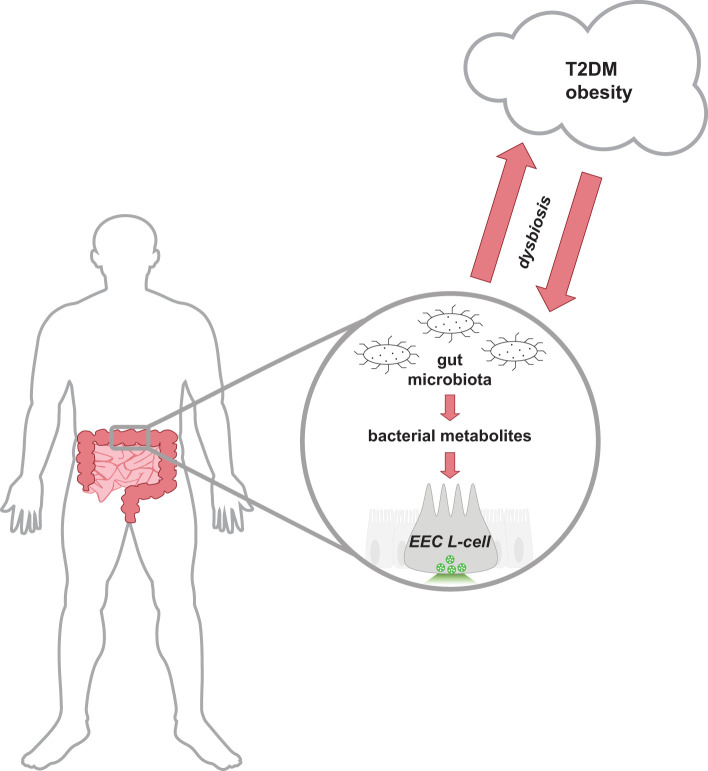
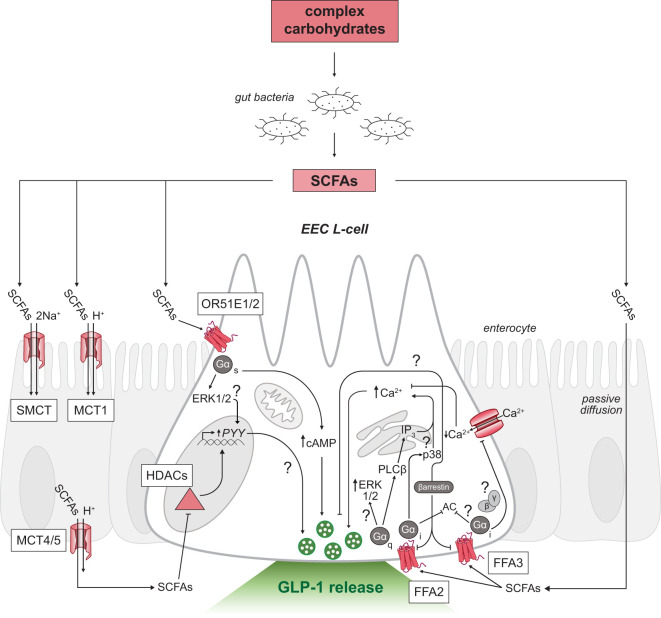
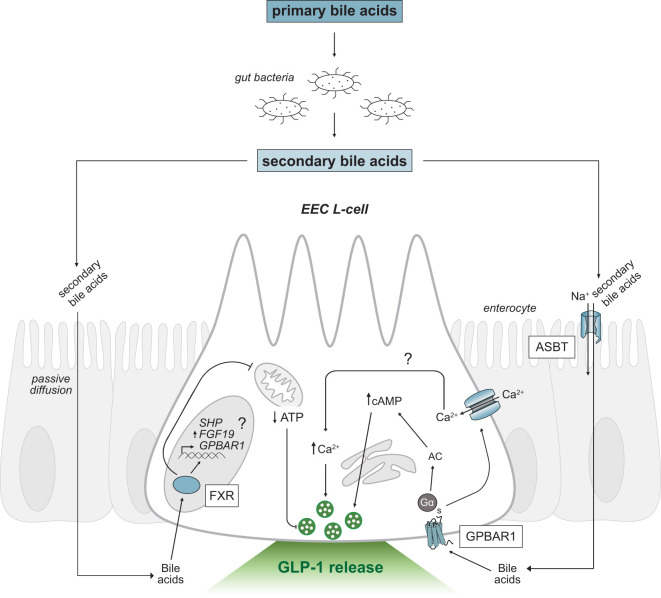
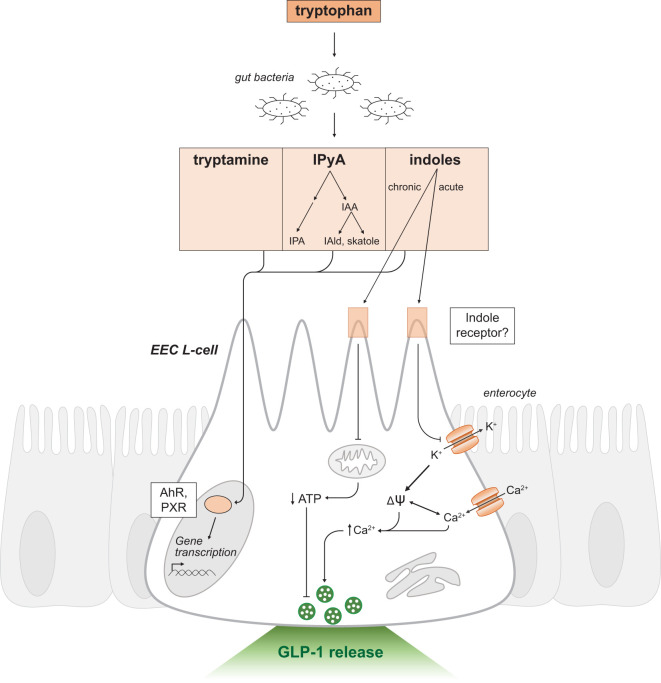
Verification
Claims the paper makes
The claims and statistics of this paper haven’t been checked yet.
Run the check — free, no account needed. It reads the open-access text and checks the sources it cites.
Claims other papers make about this one
Each is checked against this paper’s own text: does it say what the citing paper says it does?
In the citing paper
“the gut microbiota-derived metabolites, including SCFAs, secondary BAs, and indoles, have been demonstrated to modulate gut hormone secretion from EECs.”
From Microbiota–gut–brain axis and its therapeutic applications in neurodegenerative diseases (2024) · cites this paper as [547]
Self-check
Percentages, sums and reported differences re-computed from the paper’s own numbers.
The self-check needs the paper’s full text.
Citations
Cites
An obesity-associated gut microbiome with increased capacity for energy harvest
Turnbaugh, P. J., Ley, R. E., Mahowald, M. A., Magrini, V., Mardis, E. R., & Gordon, J. I. (2006) · Nature · doi:10.1038/nature05414 · Cited by 12,444
Human gut microbes associated with obesity
Ley, R. E., Turnbaugh, P. J., Klein, S., & Gordon, J. I. (2006) · Nature · doi:10.1038/4441022a · Cited by 8,785
Changes of Intestinal Functions in Liver Cirrhosis
Fukui, H., & Wiest, R. (2016) · Inflammatory Intestinal Diseases · doi:10.1159/000444436 · Cited by 6,820
A metagenome-wide association study of gut microbiota in type 2 diabetes
Qin, J., Li, Y., Cai, Z., Li, S., Zhu, J., Zhang, F., Liang, S., Zhang, W., Guan, Y., Shen, D., et al. (2012) · Nature · doi:10.1038/nature11450 · Cited by 6,762 · cited 1×
“In earlier studies, obesity and insulin resistance were associated with an increased abundance of Bacillota and concomitant decrease of Bacteroidota in both animal (7, 168), and human studies (6, 167, 169).”
BackgroundThe gut microbiota as an environmental factor that regulates fat storage
Bäckhed, F., Ding, H., Wang, T., Hooper, L. V., Koh, G. Y., Nagy, A., Semenkovich, C. F., & Gordon, J. I. (2004) · Proceedings of the National Academy of Sciences · doi:10.1073/pnas.0407076101 · Cited by 6,245 · cited 1×
“Dysbiosis of host-gut microbiota equilibrium may precede metabolic disease as similar shifts in intestinal gut bacteria composition can disrupt nutrient and energy metabolism (9).”
BackgroundObesity alters gut microbial ecology
Ley, R. E., Bäckhed, F., Turnbaugh, P., Lozupone, C. A., Knight, R. D., & Gordon, J. I. (2005) · Proceedings of the National Academy of Sciences · doi:10.1073/pnas.0504978102 · Cited by 6,176 · cited 1×
“In earlier studies, obesity and insulin resistance were associated with an increased abundance of Bacillota and concomitant decrease of Bacteroidota in both animal (7, 168), and human studies (6, 167, 169).”
BackgroundRevised Estimates for the Number of Human and Bacteria Cells in the Body
Sender, R., Fuchs, S., & Milo, R. (2016) · PLOS Biology · doi:10.1371/journal.pbio.1002533 · Cited by 5,425 · cited 1×
“Interestingly, the distal small intestine and colon harbor the greatest density of PYY and GLP-1 releasing L-cells (41), paralleling the distribution of gut bacteria (42).”
BackgroundHost-Bacterial Mutualism in the Human Intestine
Bäckhed, F., Ley, R. E., Sonnenburg, J. L., Peterson, D. A., & Gordon, J. I. (2005) · Science · doi:10.1126/science.1104816 · Cited by 5,277 · cited 1×
“In earlier studies, obesity and insulin resistance were associated with an increased abundance of Bacillota and concomitant decrease of Bacteroidota in both animal (7, 168), and human studies (6, 167, 169).”
Backgroundden Besten, G., van Eunen, K., Groen, A. K., Venema, K., Reijngoud, D.-J., & Bakker, B. M. (2013) · Journal of Lipid Research · doi:10.1194/jlr.r036012 · Cited by 5,048 · cited 2×
“The absorbed butyrate is largely utilized by colonocytes for energy, and the remaining absorbed SCFAs are transported through portal blood circulation back to the liver where SCFAs are primarily converted to glucose stores (4).”
BackgroundBiology of Incretins: GLP-1 and GIP
Baggio, L. L., & Drucker, D. J. (2007) · Gastroenterology · doi:10.1053/j.gastro.2007.03.054 · Cited by 3,639
Cited by
Sorted by citations
Items 101–120 of 120
Bajić, D., Todorović, N., Lalic-Popovic, M. N., Vučković, J., Mihajlović, A., Slavić, D., Tapavički, B., Stojsic, M., & Milosevic, N. P. (2026) · Medical Sciences · doi:10.3390/medsci14040438
“Emerging evidence suggests that butyrate may influence Nrf2-linked cytoprotective responses, support mitochondrial efficiency, and redirect inflammatory metabolism away from oxidative injury toward adaptive resilience [6,20,31].”
Gao, R., Zhang, Y., Zhang, Z., Zhao, C., & Zhao, M. (2026) · Biomedical Chromatography · doi:10.1002/bmc.70559
Sheng, Y., Chaosheng, Y., Yin, Y., Zeng, Z., Pei, X., Ma, C., Rao, J., haowen, S., & Xue, Y. (2026) · Journal of Translational Medicine · doi:10.1186/s12967-026-08730-w
“…in health may include microbiota-associated short-chain fatty acids, such as butyrate and propionate, whereas pathological states may involve microbial metabolic changes together with host-or reflux-related metabolic inputs; however, gastric IM-specific metabolomic evidence remains limited [90].”
Chambers, P. W. (2026) · Qeios · doi:10.32388/u5jtwn.3
Sarma, A. D., Devi, M., Kumar, D., & Choudhary, N. (2026) · International Immunopharmacology · doi:10.1016/j.intimp.2026.117240
Ren, Y., Hu, D., Li, L., Wang, L., & Meng, X. (2026) · Frontiers in Endocrinology · doi:10.3389/fendo.2026.1911290
“SCFAs, particularly butyrate, support colonocyte energy metabolism, epithelial integrity, and context-dependent immune regulation (26, 27).”
Qiao, X., Han, D., Bai, Y., Wang, R., Xue, X., Wang, Z. X., Jin, M. H., & Tao, R. (2026) · Pharmacological Research · doi:10.1016/j.phrs.2026.108390
Bi, Y., Song, W., Glymenaki, M., Hu, J., Li, X., Huang, H., Peng, Y., Ni, S., Haonon, O., Liu, Z., et al. (2026) · iMeta · doi:10.1002/imt2.70144 · Cited by 1
Shukla, N., Das, R., Arthur, D. E., Serdaroğlu, G., Dangi, H., Altunoluk, O. C., & Özbek, O. (2026) · Bioorganic Chemistry · doi:10.1016/j.bioorg.2026.110426
The Gut Microbiome as a Mechanistic Link Between the Planetary Health Diet and Healthy Aging
Jarecsny, T., Ceglédi, A., Csípő, T., Fazekas‐Pongor, V., Mózes, N., Csík, B., Zábó, V., Lipécz, Á., Nyáry, D., & Fekete, M. (2026) · Nutrients · doi:10.3390/nu18172864
“SCFAs promote glucagon-like peptide-1 (GLP-1) secretion, thereby linking microbial metabolism with improved glycemic regulation, insulin sensitivity, and appetite control [88–96].”
Kalafati, I. P., Krongauz, D. L., Bosco, A., Noto, A., Piras, C., Kafyra, M., Dessì, A., Mauri, M., Atzori, L., Weinberger, A., et al. (2026) · Obesity Reviews · doi:10.1111/obr.70220
Szabó, J., Maróti, G., Solymosi, N., Andrásofszky, E., Tuboly, T., Bersényi, A., Bruckner, G. G., & Fébel, H. (2026) · Nutrients · doi:10.3390/nu18172875
“Members of this phylum play important roles in the fermentation of complex dietary substrates and include major producers of short-chain fatty acids (SCFAs), particularly butyrate, which contributes to intestinal barrier integrity, immune homeostasis, and host energy metabolism [27,28].”
Shakri, A. R., Mishra, S. P., Lawless, S., Pani, S., Mishra, P., Page, C. L., Dutta, G., & Sharma, C. (2026) · Vaccines · doi:10.3390/vaccines14090791
“Some postbiotics can also act as safe, microbe-derived adjuvants [22,23].”
Gut microbiota as a modulator of HDAC: insights into Alzheimer’s disease treatment
Verma, E., Mishra, S., Chellammal, H. S. J., Khandige, P. S., & Gasmi, A. (2026) · Pharmacological Reports · doi:10.1007/s43440-026-00897-9 · Cited by 1
Laperrousaz, B., Reygner, J., Seilhac, M. D., Sabourin, A., Bompard, C., Gasc, C., Prestat, E., Levast, B., Petitjean, C., Declomesnil, S., et al. (2026) · Frontiers in Microbiology · doi:10.3389/fmicb.2026.1920614
Šantić, R., Kumrić, M., Kurir, T. T., Rušić, D., & Božić, J. (2026) · Molecules · doi:10.3390/molecules31193375
“Reviews that group short-chain fatty acids, bile acids, and indoles as signalling between the microbiome and GLP-1 risk obscuring their opposing actions and dependence on molecular structure [88].”
Neuroendocrine regulation of appetite and energy balance in metabolic disorders
Khatun, M. M., Sarker, M. N. A., Biswas, M. S., Podder, M. K., & Akter, S. (2026) · IBRO Neuroscience Reports · doi:10.1016/j.ibneur.2026.09.017
Murakami, H., & Kobayashi, S. (2026) · iScience · doi:10.1016/j.isci.2026.117683
Gut microbiota - γδT cells axis: mechanisms of immunoregulation and therapeutic opportunities.
Wang, M.-L., He, Y.-L., Zhuo, F.-R., & Xu, J.-L. (2026) · International Immunopharmacology · doi:10.1016/j.intimp.2026.117509
Ondrak, K. S., Seicshnaydre, E. A., Duffy, S., Rodriguez, C. L., Scott, C., Gladish, S., & Byerley, L. O. (2026) · Nutrients · doi:10.3390/nu18193300
“Regulate muscle metabolism through FXR and TGR5 signaling pathways, influence energy expenditure, mitochondrial activity, and maintenance of muscle mass and function [27,28].”
Metadata
- Authors
- Masse, K. E., & Lu, V. B.
- Affiliations
- Western University (CA)
- Corresponding author
- Lu, Van B.
- ORCID
- Lu, Van B.
- Venue
- Frontiers in Endocrinology
- Publisher
- Frontiers Media SA
- Published
- 2023-07-25
- Volume
- 14
- Pages
- 1169624-1169624
- ISSN
- 1664-2392 (ISSN-L)
- PMC
- PMC10407565
- OpenAlex
- W4385251361
- Cited by
- 120
- References
- 272
- Citations by year
- 2026: 66 · 2025: 23 · 2024: 29 · 2023: 2
- FWCI
- 3.16
- Type
- journal article
- Language
- en
- Open access
- gold
- doi.org
- Licence
- Locations
- Frontiers in Endocrinology (publishedVersion, cc-by)
- PubMed Central (publishedVersion, cc-by)
- PubMed (publishedVersion)
- DOAJ (DOAJ: Directory of Open Access Journals) (submittedVersion, cc-by-sa)
- Funders
- Natural Sciences and Engineering Research Council of Canada
- Topics
- Life Sciences › Biochemistry, Genetics and Molecular Biology › Molecular Biology › Gut microbiota and health
- Health Sciences › Medicine › Gastroenterology › Gastrointestinal motility and disorders
- Health Sciences › Medicine › Endocrinology, Diabetes and Metabolism › Diabetes Treatment and Management
- Keywords
- short-chain fatty acids, secondary bile acids, indole, gut microbiota metabolites, enteroendocrine cells, glucagon-like peptide-1, glucose homeostasis, food intake regulation, diabetes mellitus, obesity, metabolic disease treatment, gut microbiota, host-microbe symbiosis
- MeSH terms
- Gastrointestinal Microbiome, Bacteria, Bile Acids and Salts, Fatty Acids, Volatile, Humans, Indoles, Metabolic Diseases, Ecosystem, Enteroendocrine Cells
About these checks
Registry, retraction, Cites and statistics results are computed, not judged, with one exception: a printed reference that no index lists is read once by a model before it counts as a citation error. Claims are extracted by a model and kept only when their quote appears verbatim in the text; each cited source is then checked, with a model’s help, for whether it says what the claim relies on. Those verdicts can be wrong — read the claim’s quote and the cited source before relying on one.
Statistics and arithmetic are recomputed, not judged.
Confidence bands are shown only for fields calibrated on our annotated test set. None is calibrated yet, so no band is shown.
What counts as a claim ›How we measure confidence ›How we check this ›
Are you an author, or do you see a problem with this page? Request a review
