

Short-term use of CGM in youth onset type 2 diabetes is associated with behavioral modifications
Open accessThe DOI matches its Crossref record; 33 of the 33 references it cites were found in a registry or an index.
Abstract
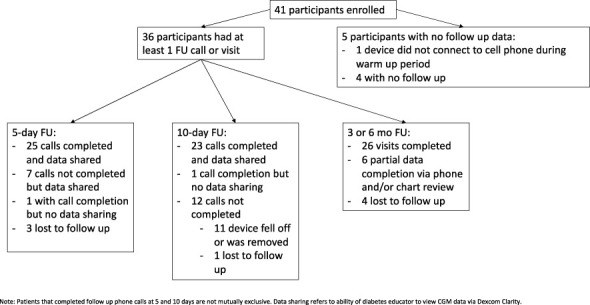
Background: Continuous glucose monitoring (CGM) is beneficial to glycemic control in youth with type 1 diabetes (T1D) and adults with type 2 diabetes (T2D); however, studies in youth with T2D are limited. Objective: Determine if 10-day trial CGM use in youth with T2D improves glycemic control and behavioral modifications. Methods: Youth with T2D > 3 months, on insulin, with no prior CGM use were enrolled. Staff placed CGM and provided education. Participants received 5-day and 10-day follow-up phone calls to review CGM data, behavioral modifications, and adjust insulin doses as needed. We compared 5-day to 10-day TIR, and baseline to 3-6 month HbA1c via paired t-test. Results: Participants (n=41) had median age of 16.2 y, were 61% female, 81% NH Black, median diabetes duration of 0.8 y, and baseline HbA1c of 10.3%. A majority had household income<$50,000 (81%) and parental education level of HS or less (73%). Average 5-day TIR 49% was similar to 10-day TIR 51% (p=0.62). There was no change in HbA1c after 3-6 months (10.2% v 10.3%, p=0.89). Nineteen participants completed full 10-day CGM use; of those, 84% wanted a CGM long-term. Adolescents reported behavioral changes including increased blood sugar checks, increased insulin administration and overall improved diabetes management. Conclusion: Although 10-day CGM use did not impact short-term or long-term glycemic control in youth with T2D, most participants reported behavioral changes and wanted to continue using CGM. Future studies with longer use of CGM may clarify the potential impact of CGM in youth with T2D.
Overview
The claims and statistics of this paper haven’t been checked yet.
Free: it reads the open-access text and checks the first 5 claims that cite a source we can check. Create a free account to check every claim.
Integrity signals
Registry
Cites
Statistics
Figures
Verification
Claims the paper makes
The claims and statistics of this paper haven’t been checked yet.
Free: it reads the open-access text and checks the first 5 claims that cite a source we can check. Create a free account to check every claim.
Claims other papers make about this one
Each is checked against this paper’s own text: does it say what the citing paper says it does?
The source backs part of the claim, not all of it — or backs it for a different population, condition or comparison.
In the citing paper
“Although short-term use of rtCGM in youth with type 2 diabetes did not impact short-term glucose changes or A1C improvement, users reported behavioral changes with increased blood glucose measurements, increased insulin administration, and overall improved diabetes management and quality of life (64,65).”
From 7. Diabetes Technology: Standards of Care in Diabetes—2025 (2025) · cites this paper as [64]
Experimental — accuracy not yet measuredThe cited source says what the claim attributes to it.
In the citing paper
“Recent qualitative work in the United States on outpatient CGM use focused on youth-onset T2DM [ 20-22 ], Hispanic adults [ 23-25 ], federally qualified health centers [ 25 ], or CGM use in combination with other interventions [ 26 ].”
The check wasn’t confident either way, so it gives no verdict — never disputed.
In the citing paper
“The importance of support systems noted in youth-onset T2DM [ 20 ] and in Hispanic adults [ 24 ] holds true for the general primary care population.”
From Continuous Glucose Monitors Among Adults With Type 2 Diabetes Mellitus in the Primary Care Setting: Qualitative Study Informed by Technology Acceptance Model and Health Belief Model (2025) · cites this paper as [20]
Experimental — accuracy not yet measured
Self-check
Percentages, sums and reported differences re-computed from the paper’s own numbers.
The self-check needs the paper’s full text.
Citations
Cites
Harris, P. A., Taylor, R., Thielke, R., Payne, J., Gonzalez, N., & Conde, J. G. (2009) · Journal of Biomedical Informatics · doi:10.1016/j.jbi.2008.08.010 · Cited by 51,384 · cited 6×
“Did you have any severe highs? Yes (14) No (10)”
BackgroundMethodInfluentialThe REDCap consortium: building an international community of software platform partners
Harris, P. A., Taylor, R., Minor, B. L., Elliott, V., Fernandez, M., O'Neal, L., McLeod, L., Delacqua, G., Delacqua, F., Kirby, J., et al. (2019) · Journal of Biomedical Informatics · doi:10.1016/j.jbi.2019.103208 · Cited by 24,013
Assessing Psychosocial Distress in Diabetes
Polonsky, W. H., Fisher, L., Earles, J., Dudl, R. J., Lees, J., Mullan, J., & Jackson, R. A. (2005) · Diabetes Care · doi:10.2337/diacare.28.3.626 · Cited by 1,575
Prevalence of Type 1 and Type 2 Diabetes Among Children and Adolescents From 2001 to 2009
Dabelea, D., Mayer-Davis, E. J., Saydah, S., Imperatore, G., Linder, B., Divers, J., Bell, R., Badaru, A., Talton, J. W., Crume, T., et al. (2014) · JAMA · doi:10.1001/jama.2014.3201 · Cited by 1,412
Beck, R. W., Riddlesworth, T. D., Ruedy, K., Ahmann, A., Haller, S., Kruger, D., McGill, J. B., Polonsky, W., Price, D., Aronoff, S., et al. (2017) · Annals of Internal Medicine · doi:10.7326/m16-2855 · Cited by 635
Martens, T., Beck, R. W., Bailey, R., Ruedy, K. J., Calhoun, P., Peters, A. L., Pop-Busui, R., Philis-Tsimikas, A., Bao, S., Umpierrez, G., et al. (2021) · JAMA · doi:10.1001/jama.2021.7444 · Cited by 543
Copeland, K. C., Zeitler, P., Geffner, M., Guandalini, C., Higgins, J., Hirst, K., Kaufman, F. R., Linder, B., Marcovina, S., McGuigan, P., et al. (2011) · The Journal of Clinical Endocrinology & Metabolism · doi:10.1210/jc.2010-1642 · Cited by 464
Karges, B., Schwandt, A., Heidtmann, B., Kordonouri, O., Binder, E., Schierloh, U., Boettcher, C., Kapellen, T., Rosenbauer, J., & Holl, R. W. (2017) · JAMA · doi:10.1001/jama.2017.13994 · Cited by 452 · cited 2×
“In youth with type 1 diabetes (T1D), the use of continuous glucose monitoring (CGM) has been associated with decreased hemoglobin A1c (HbA1c) levels and increased time in range (TIR), while also improving quality of life (6, 7).”
BackgroundLaffel, L. M., Kanapka, L. G., Beck, R. W., Bergamo, K., Clements, M. A., Criego, A., DeSalvo, D. J., Goland, R., Hood, K., Liljenquist, D., et al. (2020) · JAMA · doi:10.1001/jama.2020.6940 · Cited by 443
Glycemic control in youth with diabetes: the SEARCH for Diabetes in Youth Study
Petitti, D. B., Klingensmith, G. J., Bell, R. A., Andrews, J. S., Dabelea, D., Imperatore, G., Marcovina, S., Pihoker, C., Standiford, D., Waitzfelder, B., et al. (2009) · The Journal of Pediatrics · doi:10.1016/j.jpeds.2009.05.025 · Cited by 397
Cited by
7. Diabetes Technology: Standards of Care in Diabetes—2025
American Diabetes Association Professional Practice Committee, ElSayed, N. A., McCoy, R. G., Aleppo, G., Balapattabi, K., Beverly, E. A., Briggs Early, K., Bruemmer, D., Echouffo-Tcheugui, J. B., Ekhlaspour, L., et al. (2025) · Diabetes Care · doi:10.2337/dc25-s007 · Cited by 348
7. Diabetes Technology: Standards of Care in Diabetes—2026
Bajaj, M. S., McCoy, R. G., Balapattabi, K., Bannuru, R. R., Bellini, N. J., Bennett, A. K., Beverly, E. A., Early, K. B., ChallaSivaKanaka, S., Echouffo-Tcheugui, J. B., et al. (2025) · Diabetes Care · doi:10.2337/dc26-s007 · Cited by 293
Continuous glucose monitoring for the routine care of type 2 diabetes mellitus
Ajjan, R. A., Battelino, T., Cos, X., Del Prato, S., Philips, J.-C., Meyer, L., Seufert, J., & Seidu, S. (2024) · Nature Reviews Endocrinology · doi:10.1038/s41574-024-00973-1 · Cited by 117
“These studies indicated that features of CGM technology, such as visible glucose readings and trend arrows, do influence changes in diabetes mellitus self-management behaviours among these groups 155 , including improved adherence with insulin treatment and avoidance of high-sugar foods.”
ISPAD Clinical Practice Consensus Guidelines 2024: Type 2 Diabetes in Children and Adolescents
SHAH, A. S., Pérez, M. B., CHANG, N. T., Fu, J., Hannon, T. S., Kelsey, M. M., Peña, A. S., Pinhas‐Hamiel, O., Urakami, T., Wicklow, B. A., et al. (2024) · Hormone Research in Paediatrics · doi:10.1159/000543033 · Cited by 105
Tauschmann, M., Cardona‐Hernandez, R., DeSalvo, D. J., Hood, K. K., Лаптев, Д. Н., Olinder, A. L., Wheeler, B. J., & Smart, C. E. (2025) · Hormone Research in Paediatrics · doi:10.1159/000543156 · Cited by 83
Barchiesi, M. A., Calabrese, A., Costa, R. M. D. S., Pillo, F. D., D’Uffizi, A., Tiburzi, L., & Zahid, E. (2025) · International Journal for Quality in Health Care · doi:10.1093/intqhc/mzaf046 · Cited by 42
Approach to the Patient: Youth-Onset Type 2 Diabetes
Hitt, T. A., Hannon, T. S., & Magge, S. N. (2023) · The Journal of Clinical Endocrinology & Metabolism · doi:10.1210/clinem/dgad482 · Cited by 15
Self-citationJang, Y., & Yang, Y. (2025) · Applied Nursing Research · doi:10.1016/j.apnr.2025.151917 · Cited by 12
Bombaci, B., Passanisi, S., Torre, A., Sbilordo, S., Ini’, E., Papa, M., Valenzise, M., Lombardo, F., & Salzano, G. (2025) · Diabetology · doi:10.3390/diabetology6090090 · Cited by 9
Ettestad, T. M., Willis, H. J., Johnson, E. M., Green, C. R., & Bergenstal, R. M. (2025) · Clinical Diabetes · doi:10.2337/cd24-0106 · Cited by 4
Willis, M. S., Nilsson, A., Alshannaq, H. A., Matuoka, J. Y., & Norman, G. J. (2025) · Journal of Comparative Effectiveness Research · doi:10.57264/cer-2025-0125 · Cited by 4
Fériz, K., Rincón, A. R., Tovar, H., Restrepo-Erazo, K., Yepes, C. A., Brito, E. M., Gómez, N. B., Amézquita, Y. C. H., Iriarte-Durán, M. B., Jimenez, L., et al. (2025) · Revista Colombiana de Endocrinología Diabetes & Metabolismo · doi:10.53853/encr.12.3.907 · Cited by 3
Liang, Z. (2024) · doi:10.1145/3662008.3662012 · Cited by 4
“This behavioral impact of CGM has been consistently observed in studies involving diabetic patients [8, 20, 27, 28, 30].”
BackgroundResultKnopp, M. I., Castleman, A. M., Schwarz, A., Belger-Wallace, J., Falciglia, M., Zuzek, A., & Mendonca, E. (2025) · JMIR Diabetes · doi:10.2196/73446 · Cited by 2
“Recent qualitative work in the United States on outpatient CGM use focused on youth-onset T2DM [20-22], Hispanic adults [23-25], federally qualified health centers [25], or CGM use in combination with other interventions [26].”
Shah, S., Tanenbaum, M. L., Loyola, A., Sala, N. G. L., Darji, H., Hanes, S., Bishop, F. K., Hood, K. K., & Maahs, D. M. (2026) · Journal of Diabetes Science and Technology · doi:10.1177/19322968251368366 · Cited by 2
“21,22 Lack of sustained CGM use, clinic visit attendance, and survey completion did not permit more detailed analysis or comparison of CGM use data and glucose metrics, including HbA1c, which is a significant limitation.”
Rädel, C., Wienke, A., & Pliquett, R. U. (2025) · Diabetology & Metabolic Syndrome · doi:10.1186/s13098-025-01976-2 · Cited by 2
“In young type-2 diabetes patients on insulin for at least 3 months, a single-use CGM alone did not improve mid-term or long-term glycemic endpoints [17].”
Woo, H. A., Cho, J. H., Shim, K. S., Kim, D. H., Jung, H. W., & Han, M. Y. (2025) · Annals of Pediatric Endocrinology & Metabolism · doi:10.6065/apem.2550026.013 · Cited by 2
“Evidence suggests that CGM can improve the quality of life and support behavioral changes in AYAs with T2D; however, barriers such as cost, stigma, and limited insurance coverage hinder its widespread adoption [11-13].”
Behavioral interventions for adolescents and young adults with type 2 diabetes or prediabetes
Ko, A. S., Michel, A. A., & Wisk, L. E. (2025) · Current Opinion in Pediatrics · doi:10.1097/mop.0000000000001461 · Cited by 2
dos Santos, L. G. F., Corrêa, V. G. F. L., Paredes, B. D., de Paula, A. C. M. R., Santos, K. C., de Souza, S. L., Fabiano, É. D., Ramos, L. P. M., Simioni, M. D. S., & da Silveira, A. C. Z. (2023) · Revista Eletrônica Acervo Saúde · doi:10.25248/reas.e15090.2023 · Cited by 4
Krnić, N., Šeša, V., Mrzljak, A., & Berković, M. C. (2024) · World Journal of Diabetes · doi:10.4239/wjd.v15.i4.623 · Cited by 2
Gunawan, F., Johnny, B., EASOW, B. S., Mathew, S., McNulty, J. N., Adame, K., Jackson, K., Brown, L. S., Crisologo, P. A., & Gunasekaran, U. (2026) · Journal of Diabetes Science and Technology · doi:10.1177/19322968261469513 · Cited by 1
“10 Because of the limitations of our study design, it was not possible to pinpoint which of these factors (CGM use versus more frequent provider contact versus addressing SDOH concerns) contributed most to improvement in glycemic control.”
Physiological Signal Based Blood Glucose Prediction in Diabetics and Non-Diabetics
Karunarathna, T. S., & Liang, Z. (2024) · IEEE International Conference on e-Health Networking, Applications and Services (Healthcom) · doi:10.1109/healthcom60970.2024.10880800 · Cited by 1
Dervişoğlu, M., Günbaş, M., & Besen, D. B. (2025) · The Science of Diabetes Self-Management and Care · doi:10.1177/26350106251371082
“12 Additionally, CGM usage has been associated with reductions in acute diabetes complications, such as diabetic ketoacidosis, severe hypoglycemia, diabetes-related coma, and hospital admissions due to hypogylcemia and hyperglycemia.”
Continuous Glucose Monitoring Systems: Applications and Integrated Benefits - review study
Goleniewska, K., Miaśnikiewicz, J., Ciechomski, K., Cecuła, W., Rypel-Bośka, J., Siuta, N., Stupecka, A., Migiel, M., & Brynczka, I. (2025) · Quality in Sport · doi:10.12775/qs.2025.48.66899
Johnson, D. J., Buchanan, L., Saner, E. M., Calkins, M. W., & Kirk, J. K. (2026) · Healthcare · doi:10.3390/healthcare14040420
“Early work has suggested that CGM-guided behavioral education and intermittent CGM use may prompt dietary modifications, increase awareness of physiological responses, and facilitate problem solving around glycemic excursions [19–22].”
Fernando, M., PENA, A. S., King, A., & Oxlad, M. (2026) · Diabetic Medicine · doi:10.1111/dme.70430
Continuous Glucose Monitoring in Children and Adolescents With Type 2 Diabetes: A Narrative Review
O'Brien, C., Sethi, K., & Peña, A. S. (2026) · Journal of Paediatrics and Child Health · doi:10.1111/jpc.70525
Thielemann, R., Greifoner, L., Dieke, M., Kuplin, N., Placzek, K., Wienke, A., & Blüher, S. (2026) · Journal of Pediatric Endocrinology and Metabolism · doi:10.1515/jpem-2026-0344
Metadata
- Authors
- Manfredo, J., Lin, T., Gupta, R., Abiola, K., West, M., Busin, K., Tracey, J., Brown, E. A., Magge, S. N., & Wolf, R. M.
- Affiliations
- Johns Hopkins University (US)
- Corresponding author
- Manfredo, Jacquelyn
- Venue
- Frontiers in Endocrinology
- Publisher
- Frontiers Media SA
- Published
- 2023-05-29
- Volume
- 14
- Pages
- 1182260-1182260
- ISSN
- 1664-2392 (ISSN-L)
- PMC
- PMC10258317
- OpenAlex
- W4378717274
- Cited by
- 25
- References
- 33
- Citations by year
- 2026: 4 · 2025: 13 · 2024: 6 · 2023: 2
- FWCI
- 5.13
- Type
- journal article
- Language
- en
- Open access
- gold
- doi.org
- Licence
- Locations
- Frontiers in Endocrinology (publishedVersion, cc-by)
- PubMed Central (publishedVersion, cc-by)
- PubMed (publishedVersion)
- DOAJ (DOAJ: Directory of Open Access Journals) (submittedVersion, cc-by-sa)
- Funders
- Johns Hopkins Children's Center
- Dexcom
- Topics
- Health Sciences › Medicine › Endocrinology, Diabetes and Metabolism › Diabetes Management and Research
- Health Sciences › Medicine › Endocrinology, Diabetes and Metabolism › Diabetes Management and Education
- Health Sciences › Medicine › Endocrinology, Diabetes and Metabolism › Diabetes Treatment and Management
- Keywords
- continuous glucose monitoring, youth-onset type 2 diabetes, adolescents, glycemic control, time in range, HbA1c, insulin dose adjustment, diabetes self-management behavior, diabetes education, insulin therapy
- MeSH terms
- Adolescent, Adult, Blood Glucose, Diabetes Mellitus, Type 2, Female, Glycated Hemoglobin, Humans, Insulin, Male, Blood Glucose Self-Monitoring
About these checks
Registry, retraction, Cites and statistics results are computed, not judged, with one exception: a printed reference that no index lists is read once by a model before it counts as a citation error. Claims are extracted by a model and kept only when their quote appears verbatim in the text; each cited source is then checked, with a model’s help, for whether it says what the claim relies on. Those verdicts can be wrong — read the claim’s quote and the cited source before relying on one.
Statistics and arithmetic are recomputed, not judged.
Confidence bands are shown only for fields calibrated on our annotated test set. None is calibrated yet, so no band is shown.
What counts as a claim ›How we measure confidence ›How we check this ›
Are you an author, or do you see a problem with this page? Request a review
Data sources
Bibliographic data: Semantic Scholar, OpenAlex, Crossref.
Contains information from the Semantic Scholar Academic Graph Datasets, made available under the ODC Attribution License (ODC-BY 1.0).
Semantic Scholar’s data is described in: Kinney, R., et al. (2023). The Semantic Scholar Open Data Platform. arXiv:2301.10140.
