

The DOI matches its Crossref record; 95 of the 96 references it cites were found in a registry or an index.
The AGE-RAGE Axis: Implications for Age-Associated Arterial Diseases
Open accessAbstract
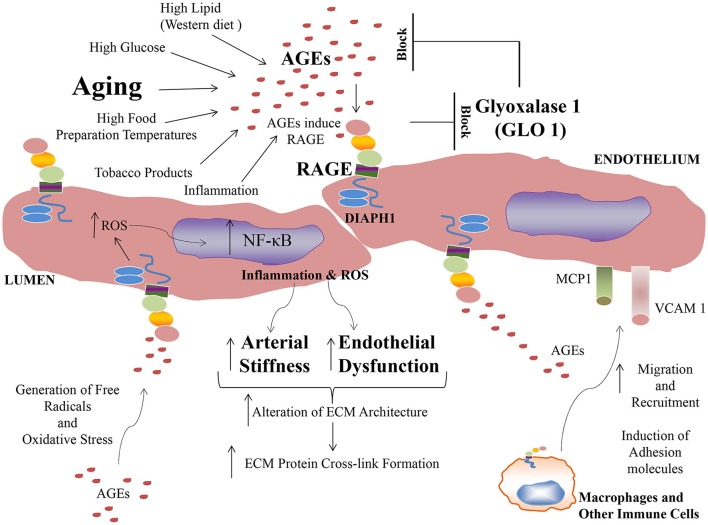
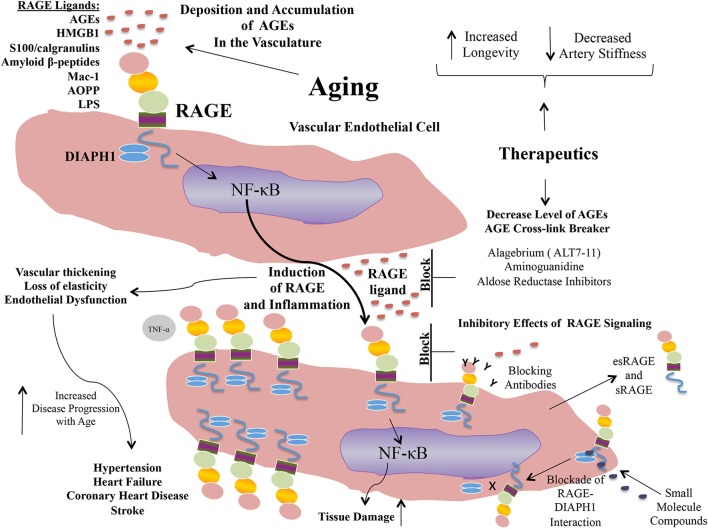
The process of advanced glycation leads to the generation and accumulation of an heterogeneous class of molecules called advanced glycation endproducts, or AGEs. AGEs are produced to accelerated degrees in disorders such as diabetes, renal failure, inflammation, neurodegeneration and in aging. Further, AGEs are present in foods and in tobacco products. Hence, through both endogenous production and exogenous consumption, AGEs perturb vascular homeostasis by a number of means; in the first case, AGEs can cause cross-linking of long-lived molecules in the basement membranes such as collagens, thereby leading to “vascular stiffening” and processes that lead to hyperpermeability and loss of structural integrity. Second, AGEs interaction with their major cell surface signal transduction receptor for AGE or RAGE sets off a cascade of events leading to modulation of gene expression and loss of vascular and tissue homeostasis, processes that contribute to cardiovascular disease. In addition, it has been shown that an enzyme, which plays key roles in the detoxification of pre-AGE species, glyoxalase 1 (GLO1), is reduced in aged and diabetic tissues. In the diabetic kidney devoid of Ager (gene encoding RAGE), higher levels of Glo1 mRNA and GLO1 protein and activity were observed, suggesting that in conditions of high AGE accumulation, natural defenses may be mitigated, at least in part through RAGE. AGEs are a marker of arterial aging and may be detected by both biochemical means, as well as measurement of “skin autofluorescence.” In this review, we will detail the pathobiology of the AGE-RAGE axis and the consequences of its activation in the vasculature and conclude with potential avenues for therapeutic interruption of the AGE-RAGE ligand-RAGE pathways as means to forestall the deleterious consequences of AGE accumulation and signaling via RAGE.
Overview
The claims and statistics of this paper haven’t been checked yet.
Run the check — free, no account needed. It reads the open-access text and checks the sources it cites.
Integrity signals
Registry
Cites
Statistics
Figures
Verification
Claims the paper makes
The claims and statistics of this paper haven’t been checked yet.
Run the check — free, no account needed. It reads the open-access text and checks the sources it cites.
Claims other papers make about this one
Each is checked against this paper’s own text: does it say what the citing paper says it does?
In the citing paper
“RAGE, a member of the immunoglobulin superfamily of pattern recognition receptors, is not known to be related to oxytocin or oxytocin signalling22–33.”
From Vascular RAGE transports oxytocin into the brain to elicit its maternal bonding behaviour in mice (2019) · cites this paper as [22]
In the citing paper
“The interaction of AGE-RAGE triggers intracellular and extracellular signaling pathways through the activation of extracellular signal-regulated kinases 1 and 2 (ERK1/2), mitogen-activated protein kinases (MAPK), phosphoinositide 3-kinase (PI3K), protein kinase B (AKT), NADPH oxidase, and nuclear factor-κB (NF-κB).”
From Advanced glycation end products (AGEs) and other adducts in aging-related diseases and alcohol-mediated tissue injury (2021) · cites this paper as [39]
In the citing paper
“Activation of these proteins usually increases oxidative stress and inflammation that, in turn, promotes RAGE expression in a positive feed-forward loop, contributing to chronic disease development39–41.”
From Advanced glycation end products (AGEs) and other adducts in aging-related diseases and alcohol-mediated tissue injury (2021) · cites this paper as [39]
Self-check
Percentages, sums and reported differences re-computed from the paper’s own numbers.
The self-check needs the paper’s full text.
Citations
Cites
Laurent, S., Boutouyrie, P., Asmar, R., Gautier, I., Laloux, B., Guize, L., Ducimetiere, P., & Benetos, A. (2001) · Hypertension · doi:10.1161/01.hyp.37.5.1236 · Cited by 3,856
Executive Summary: Heart Disease and Stroke Statistics—2016 Update
Mozaffarian, D., Benjamin, E. J., Go, A. S., Arnett, D. K., Blaha, M. J., Cushman, M., Das, S. R., de Ferranti, S. D., Després, J., Fullerton, H. J., et al. (2016) · Circulation · doi:10.1161/cir.0000000000000366 · Cited by 2,563
Advanced Glycation End Products: Sparking the Development of Diabetic Vascular Injury
Goldin, A., Beckman, J. A., Schmidt, A. M., & Creager, M. A. (2006) · Circulation · doi:10.1161/circulationaha.106.621854 · Cited by 2,261
Self-citationLakatta, E. G., & Levy, D. (2003) · Circulation · doi:10.1161/01.cir.0000048892.83521.58 · Cited by 2,244
Arterial Stiffness and Risk of Coronary Heart Disease and Stroke: The Rotterdam Study
Mattace-Raso, F. U. S., van der Cammen, T. J. M., Hofman, A., van Popele, N. M., Bos, M. L., Schalekamp, M. A. D. H., Asmar, R., Reneman, R. S., Hoeks, A. P. G., Breteler, M. M. B., et al. (2006) · Circulation · doi:10.1161/circulationaha.105.555235 · Cited by 1,914 · cited 1×
“Arterial stiffness is associated with greater risk for aging-associated cardio- and cerebrovascular diseases and mortality (Laurent et al., 2001; Mattace-Raso et al., 2006; Kaess et al., 2012).”
BackgroundAdvanced Glycation End Products and Diabetic Complications
Singh, V. P., Bali, A., Singh, N., & Jaggi, A. S. (2014) · The Korean Journal of Physiology & Pharmacology · doi:10.4196/kjpp.2014.18.1.1 · Cited by 1,518
Inflammatory cytokines in vascular dysfunction and vascular disease
Sprague, A. H., & Khalil, R. A. (2009) · Biochemical Pharmacology · doi:10.1016/j.bcp.2009.04.029 · Cited by 1,381
Yan, S. D., Schmidt, A. M., Anderson, G. M., Zhang, J., Brett, J., Zou, Y., Pinsky, D. J., & Stern, D. (1994) · Journal of Biological Chemistry · doi:10.1016/s0021-9258(17)36966-1 · Cited by 1,305
Self-citationSafar, M. E., Levy, B. I., & Struijker-Boudier, H. A. J. (2003) · Circulation · doi:10.1161/01.cir.0000069826.36125.b4 · Cited by 1,195
Park, L., Raman, K. G., Lee, K. J., Lu, Y., Ferran, L. J., Chow, W. S., Stern, D. M., & Schmidt, A. M. (1998) · Nature Medicine · doi:10.1038/2012 · Cited by 1,103
Self-citation
Cited by
Sorted by citations
Rungratanawanich, W., Qu, Y., Wang, X., Essa, M. M., & Song, B.-J. (2021) · Experimental & Molecular Medicine · doi:10.1038/s12276-021-00561-7 · Cited by 411
Understanding the role of the perivascular space in cerebral small vessel disease
Brown, R., Benveniste, H., Black, S. E., Charpak, S., Dichgans, M., Joutel, A., Nedergaard, M., Smith, K. J., Zloković, B. V., & Wardlaw, J. M. (2018) · Cardiovascular Research · doi:10.1093/cvr/cvy113 · Cited by 346
Interaction Between Hypertension and Arterial Stiffness
Safar, M. E., Asmar, R. G., Bénétos, A., Blacher, J., Boutouyrie, P., Lacolley, P. J., Laurent, S., London, G. M., Pannier, B., Protogerou, A. D., et al. (2018) · Hypertension · doi:10.1161/hypertensionaha.118.11212 · Cited by 307
Shen, C., Lu, C., Wu, C.-H., Li, K., Kuo, Y., Hsieh, S., & Yu, C. (2020) · Molecules · doi:10.3390/molecules25235591 · Cited by 316
Chen, Y., Zhao, X., & Wu, H. (2020) · Arteriosclerosis Thrombosis and Vascular Biology · doi:10.1161/atvbaha.120.313131 · Cited by 254
Metadata
- Authors
- Senatus, L. M., & Schmidt, A. M.
- Affiliations
- New York University (US)
- Corresponding author
- Schmidt, Ann Marie
- Venue
- Frontiers in Genetics
- Publisher
- Frontiers Media SA
- Published
- 2017-12-05
- Volume
- 8
- Pages
- 187-187
- ISSN
- 1664-8021 (ISSN-L)
- PMC
- PMC5723304
- OpenAlex
- W2774984051
- Cited by
- 167
- References
- 96
- Citations by year
- 2026: 18 · 2025: 15 · 2024: 17 · 2023: 18 · 2022: 29 · 2021: 23 · 2020: 19 · 2019: 17 · 2018: 10
- FWCI
- 1.64
- Type
- journal article
- Language
- en
- Open access
- gold
- doi.org
- Licence
- cc-by
- Locations
- Frontiers in Genetics (publishedVersion, cc-by)
- Europe PMC (PubMed Central) (publishedVersion, cc-by)
- PubMed Central (publishedVersion, cc-by)
- PubMed (publishedVersion)
- DOAJ (DOAJ: Directory of Open Access Journals) (submittedVersion, cc-by-sa)
- Funders
- U.S. Public Health Service
- Topics
- Life Sciences › Biochemistry, Genetics and Molecular Biology › Clinical Biochemistry › Advanced Glycation End Products research
- Health Sciences › Medicine › Physiology (medical) › Nitric Oxide and Endothelin Effects
- Health Sciences › Medicine › Cardiology and Cardiovascular Medicine › Cardiovascular Health and Disease Prevention
- Keywords
- advanced glycation end products, AGE-RAGE axis, receptor for advanced glycation end products, vascular aging, arterial aging, arterial stiffness, glyoxalase I, diabetes mellitus, diabetic kidney, skin autofluorescence, AGE accumulation, cardiovascular disease, vascular homeostasis
About these checks
Registry, retraction, Cites and statistics results are computed, not judged, with one exception: a printed reference that no index lists is read once by a model before it counts as a citation error. Claims are extracted by a model and kept only when their quote appears verbatim in the text; each cited source is then checked, with a model’s help, for whether it says what the claim relies on. Those verdicts can be wrong — read the claim’s quote and the cited source before relying on one.
Statistics and arithmetic are recomputed, not judged.
Confidence bands are shown only for fields calibrated on our annotated test set. None is calibrated yet, so no band is shown.
What counts as a claim ›How we measure confidence ›How we check this ›
Are you an author, or do you see a problem with this page? Request a review
