

The DOI matches its Crossref record; 233 of the 234 references it cites were found in a registry or an index.
Phthalate Exposure and Long-Term Epigenomic Consequences: A Review
Open accessAbstract
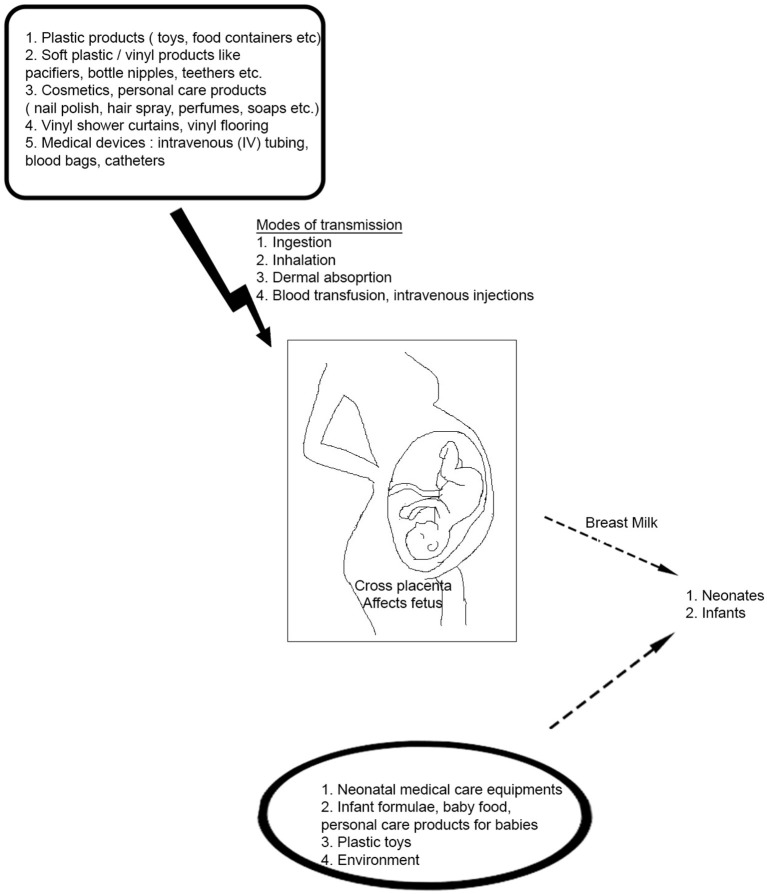
Phthalates are esters of phthalic acid widely used as plasticizers to soften and increase the flexibility in polyvinyl chloride (PVC) plastics. They are also used in cosmetics and other daily personal care products. Phthalates are not covalently bound to plastics and easily leach into the environment and enter the human body by dermal absorption, ingestion or inhalation. Several in vitro and in vivo studies suggest that phthalates can act as endocrine disruptors and cause moderate reproductive and developmental toxicities. Furthermore, phthalates can cross the placental barrier and affect the developing fetus. Thus, phthalates are ubiquitous food and environmental contaminants with potential adverse health effects in humans. This review focusses on studies conducted in the field of toxicogenomics of phthalates and discusses possible transgenerational and multigenerational effects caused by phthalate exposure during any point of the life-cycle.
Overview
The claims and statistics of this paper haven’t been checked yet.
Run the check — free, no account needed. It reads the open-access text and checks the sources it cites.
Integrity signals
Registry
Cites
Statistics
Figures
Verification
Claims the paper makes
The claims and statistics of this paper haven’t been checked yet.
Run the check — free, no account needed. It reads the open-access text and checks the sources it cites.
Claims other papers make about this one
Each is checked against this paper’s own text: does it say what the citing paper says it does?
The cited source says what the claim attributes to it.
In the citing paper
“Moreover, phthalates can influence gene expression patterns, further complicating their effects on the body’s intricate regulatory processes.”
From The dark side of beauty: an in-depth analysis of the health hazards and toxicological impact of synthetic cosmetics and personal care products (2024) · cites this paper as [65]
Self-check
Percentages, sums and reported differences re-computed from the paper’s own numbers.
The self-check needs the paper’s full text.
Citations
Cites
Ng, M., Fleming, T., Robinson, M., Thomson, B., Graetz, N., Margono, C., Mullany, E. C., Biryukov, S., Abbafati, C., Abera, S. F., et al. (2014) · The Lancet · doi:10.1016/s0140-6736(14)60460-8 · Cited by 11,952
The functions of animal microRNAs
Ambros, V. (2004) · Nature · doi:10.1038/nature02871 · Cited by 10,728
Okano, M., Bell, D. W., Haber, D. A., & Li, E. (1999) · Cell · doi:10.1016/s0092-8674(00)81656-6 · Cited by 6,143
Non-coding RNAs and cancer: microRNAs and beyond
Raia, R. M., & Călin, G. A. (2011) · Journal of Nucleic Acids Investigation · doi:10.4081/jnai.2011.e5 · Cited by 3,394
Hormones and endocrine-disrupting chemicals: low-dose effects and nonmonotonic dose responses
Vandenberg, L. N., Colborn, T., Hayes, T. B., Heindel, J. J., Jacobs, D. R., Lee, D.-H., Shioda, T., Soto, A. M., vom Saal, F. S., Welshons, W. V., et al. (2012) · Endocrine Reviews · doi:10.1210/er.2011-1050 · Cited by 3,209
Bird, A. (2007) · Nature · doi:10.1038/nature05913 · Cited by 3,011
The Nuclear DNA Base 5-Hydroxymethylcytosine Is Present in Purkinje Neurons and the Brain
Kriaucionis, S., & Heintz, N. (2009) · Science · doi:10.1126/science.1169786 · Cited by 2,700 · cited 4×
“Tet2 is responsible for the vast majority of 5hmC generation (Lio and Rao, 2019).”
BackgroundInfluentialIto, S., D’Alessio, A. C., Taranova, O., Hong, K., Sowers, L. C., & Zhang, Y. (2010) · Nature · doi:10.1038/nature09303 · Cited by 2,628
Epigenetics: A landscape takes shape
Goldberg, A. D., Allis, C. D., & Bernstein, E. (2007) · Cell · doi:10.1016/j.cell.2007.02.006 · Cited by 2,466
Living with the Past: Evolution, Development, and Patterns of Disease
Gluckman, P. D., & Hanson, M. A. (2004) · Science · doi:10.1126/science.1095292 · Cited by 1,917
Research works printed but not linked: 4
- Bayley, 1993, Bayley Scales of Infant Development, 2nd Edn.
- 2019, Fourth Report on Human Exposures to Environmental Chemicals, Updated Tables, Centers for Disease Control and
- 2019, NTP-CERHR Monograph on the Potential Human Reproductive and Developmental Effects of Di(2-ethylhexyl) Phthalate (DEHP), 06
- Park, 2006, Korean Bayley Scales of Infant Development. Interpretation Manual, 2nd Edn
Cited by
Sorted by citations
Phthalates and their impacts on human health
Wang, Y., & Qian, H. (2021) · Healthcare · doi:10.3390/healthcare9050603 · Cited by 633
The Minderoo-Monaco Commission on Plastics and Human Health
Landrigan, P. J., Raps, H., Cropper, M., Bald, C., Brunner, M., Canonizado, E. M., Charles, D., Chiles, T. C., Donohue, M. J., Enck, J., et al. (2023) · Annals of Global Health · doi:10.5334/aogh.4056 · Cited by 581
Hazards of phthalates (PAEs) exposure: A review of aquatic animal toxicology studies
Zhang, Y., Jiao, Y., Li, Z., Tao, Y., & Yang, Y. (2021) · The Science of The Total Environment · doi:10.1016/j.scitotenv.2021.145418 · Cited by 357
An Overview of Epigenetics in Obesity: The Role of Lifestyle and Therapeutic Interventions
Mahmoud, A. M. (2022) · International Journal of Molecular Sciences · doi:10.3390/ijms23031341 · Cited by 202
Various additive release from microplastics and their toxicity in aquatic environments
Yu, Y., Kumar, M., Bolan, S. S., Padhye, L. P., Bolan, N. S., Li, S., Wang, L., Hou, D., & Li, Y. (2023) · Environmental Pollution · doi:10.1016/j.envpol.2023.123219 · Cited by 177
Metadata
- Authors
- Dutta, S., Haggerty, D. K., Rappolee, D. A., & Ruden, D. M.
- Affiliations
- University of Nebraska Medical Center (US)
- Michigan State University (US)
- Wayne State University (US)
- Corresponding author
- Ruden, Douglas M.
- Venue
- Frontiers in Genetics
- Publisher
- Frontiers Media SA
- Published
- 2020-05-06
- Volume
- 11
- Pages
- 405-405
- ISSN
- 1664-8021 (ISSN-L)
- PMC
- PMC7218126
- OpenAlex
- W3023341510
- Cited by
- 212
- References
- 234
- Citations by year
- 2026: 29 · 2025: 49 · 2024: 35 · 2023: 38 · 2022: 35 · 2021: 25 · 2020: 1
- FWCI
- 2.14
- Type
- journal article
- Language
- en
- Open access
- gold
- doi.org
- Licence
- Locations
- Frontiers in Genetics (publishedVersion, cc-by)
- PubMed Central (publishedVersion, cc-by)
- PubMed (publishedVersion)
- DOAJ (DOAJ: Directory of Open Access Journals) (submittedVersion, cc-by-sa)
- Funders
- Foundation for the National Institutes of Health
- Topics
- Physical Sciences › Environmental Science › Health, Toxicology and Mutagenesis › Effects and risks of endocrine disrupting chemicals
- Life Sciences › Biochemistry, Genetics and Molecular Biology › Molecular Biology › Epigenetics and DNA Methylation
- Health Sciences › Medicine › Pediatrics, Perinatology and Child Health › Birth, Development, and Health
- Keywords
- phthalates, plasticizers, endocrine disruptors, epigenetics, toxicogenomics, transgenerational epigenetic inheritance, multigenerational effects, reproductive toxicity, developmental toxicity, placental transfer, dermal exposure, environmental pollutants, food contaminants
About these checks
Registry, retraction, Cites and statistics results are computed, not judged, with one exception: a printed reference that no index lists is read once by a model before it counts as a citation error. Claims are extracted by a model and kept only when their quote appears verbatim in the text; each cited source is then checked, with a model’s help, for whether it says what the claim relies on. Those verdicts can be wrong — read the claim’s quote and the cited source before relying on one.
Statistics and arithmetic are recomputed, not judged.
Confidence bands are shown only for fields calibrated on our annotated test set. None is calibrated yet, so no band is shown.
What counts as a claim ›How we measure confidence ›How we check this ›
Are you an author, or do you see a problem with this page? Request a review
