

The DOI matches its Crossref record; 182 of the 182 references it cites were found in a registry or an index.
Stress and Non-Stress Roles of Inflammatory Signals during HSC Emergence and Maintenance
Abstract
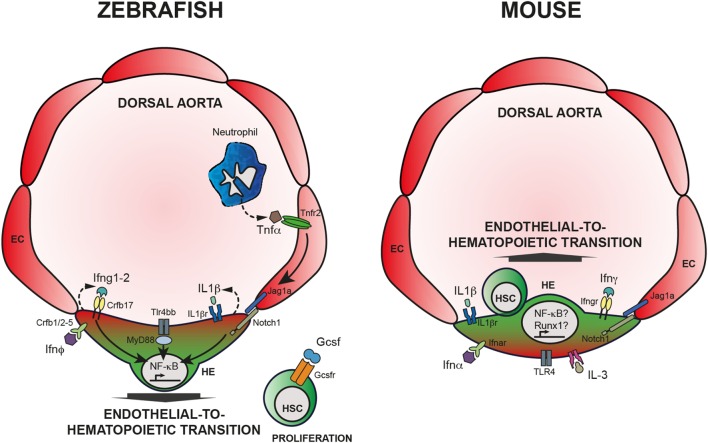
Hematopoietic stem cells (HSCs) are a rare population that gives rise to almost all cells of the hematopoietic system, including immune cells. Until recently, it was thought that immune cells sense inflammatory signaling and HSCs respond only secondarily to these signals. However, it was later shown that adult HSCs could directly sense and respond to inflammatory signals, resulting in a higher output of immune cells. Recent studies demonstrated that inflammatory signaling is also vital for HSC ontogeny. These signals are thought to arise in the absence of pathogens, are active during development, and indispensable for HSC formation. In contrast, during times of stress and disease, inflammatory responses can be activated and can have devastating effects on HSCs. In this review, we summarize the current knowledge about inflammatory signaling in HSC development and maintenance, as well as the endogenous molecular cues that can trigger inflammatory pathway activation. Finally, we comment of the role of inflammatory signaling in hematopoietic diseases.
Overview
The claims and statistics of this paper haven’t been checked yet.
Run the check — free, no account needed. It reads the open-access text and checks the sources it cites.
Integrity signals
Registry
Cites
Statistics
Figures
Verification
Claims the paper makes
The claims and statistics of this paper haven’t been checked yet.
Run the check — free, no account needed. It reads the open-access text and checks the sources it cites.
Claims other papers make about this one
Each is checked against this paper’s own text: does it say what the citing paper says it does?
In the citing paper
“immature hematopoietic stem and progenitor cells also react to inflammatory cues”
From Inflammatory exposure drives long-lived impairment of hematopoietic stem cell self-renewal activity and accelerated aging (2022) · cites this paper as Clapes et al., 2016
Self-check
Percentages, sums and reported differences re-computed from the paper’s own numbers.
The self-check needs the paper’s full text.
Citations
Cites
1 retracted
MAVS, cGAS, and endogenous retroviruses in T-independent B cell responses
Zeng, M., Hu, Z., Shi, X., Li, X., Zhan, X., Li, X.-D., Wang, J., Choi, J. H., Wang, K.-W., Purrington, T., et al. (2014) · Science · doi:10.1126/science.346.6216.1486 · Cited by 116
RetractedMyeloid-derived-suppressor cells as regulators of the immune system
Gabrilovich, D. I., & Nagaraj, S. (2009) · Nature Reviews Immunology · doi:10.1038/nri2506 · Cited by 6,753
An endotoxin-induced serum factor that causes necrosis of tumors
Carswell, E. A., Old, L. J., Kassel, R. L., Green, S., Fiore, N., & Williamson, B. (1975) · Proceedings of the National Academy of Sciences · doi:10.1073/pnas.72.9.3666 · Cited by 4,532
Cancer treatment and survivorship statistics, 2012
Siegel, R. L., Desantis, C. E., Virgo, K. S., Stein, K., Mariotto, A. B., Smith, T. G., Cooper, D. L., Gansler, T. S., Lerro, C. C., Fedewa, S. A., et al. (2012) · CA A Cancer Journal for Clinicians · doi:10.3322/caac.21149 · Cited by 3,010
Hematopoiesis: An Evolving Paradigm for Stem Cell Biology
Orkin, S. H., & Zon, L. I. (2008) · Cell · doi:10.1016/j.cell.2008.01.025 · Cited by 2,570
The bone marrow niche for haematopoietic stem cells
Morrison, S. J., & Scadden, D. T. (2014) · Nature · doi:10.1038/nature12984 · Cited by 2,451
Tumor necrosis factor signaling
Wajant, H., Pfizenmaier, K., & Scheurich, P. (2003) · Cell Death & Differentiation · doi:10.1038/sj.cdd.4401189 · Cited by 2,359
Chiappinelli, K. B., Strissel, P. L., Desrichard, A., Li, H., Henke, C., Akman, B., Hein, A., Rote, N. S., Cope, L. M., Snyder, A., et al. (2015) · Cell · doi:10.1016/j.cell.2015.07.011 · Cited by 2,022
Wilson, A., Laurenti, E., Oser, G., van der Wath, R. C., Blanco-Bose, W., Jaworski, M., Offner, S., Dunant, C. F., Eshkind, L., Bockamp, E., et al. (2008) · Cell · doi:10.1016/j.cell.2008.10.048 · Cited by 1,908
IFN-λs mediate antiviral protection through a distinct class II cytokine receptor complex
Kotenko, S. V., Gallagher, G., Baurin, V. V., Lewis-Antes, A., Shen, M., Shah, N. K., Langer, J. A., Sheikh, F., Dickensheets, H., & Donnelly, R. P. (2003) · Nature Immunology · doi:10.1038/ni875 · Cited by 1,868
Cited by
Bogeska, R., Mikecin, A.-M., Kaschutnig, P., Fawaz, M., Büchler-Schäff, M., Le, D., Ganuza, M., Vollmer, A., Paffenholz, S. V., Asada, N., et al. (2022) · Cell Stem Cell · doi:10.1016/j.stem.2022.06.012 · Cited by 299
Helbling, P. M., Piñeiro-Yáñez, E., Gerosa, R., Boettcher, S., Al-Shahrour, F., Manz, M. G., & Nombela-Arrieta, C. (2019) · Cell Reports · doi:10.1016/j.celrep.2019.11.004 · Cited by 116
Dumetier, B., Sauter, C., Hajmirza, A., Pernon, B., Aucagne, R., Fournier, C., Row, C., Guidez, F., Rossi, C., Lepage, C., et al. (2022) · Biomedicines · doi:10.3390/biomedicines10123101 · Cited by 9
Metadata
- Authors
- Clapes, T., Lefkopoulos, S., & Trompouki, E.
- Venue
- Frontiers in Immunology
- Publisher
- Frontiers Media SA
- Published
- 2016-11-07
- Volume
- 7
- ISSN
- 1664-3224
- PMC
- PMC5098161
- Cited by
- 62
- References
- 182
About these checks
Registry, retraction, Cites and statistics results are computed, not judged, with one exception: a printed reference that no index lists is read once by a model before it counts as a citation error. Claims are extracted by a model and kept only when their quote appears verbatim in the text; each cited source is then checked, with a model’s help, for whether it says what the claim relies on. Those verdicts can be wrong — read the claim’s quote and the cited source before relying on one.
Statistics and arithmetic are recomputed, not judged.
Confidence bands are shown only for fields calibrated on our annotated test set. None is calibrated yet, so no band is shown.
What counts as a claim ›How we measure confidence ›How we check this ›
Are you an author, or do you see a problem with this page? Request a review
Data sources
Bibliographic data: Semantic Scholar, OpenAlex, Crossref.
Contains information from the Semantic Scholar Academic Graph Datasets, made available under the ODC Attribution License (ODC-BY 1.0).
Semantic Scholar’s data is described in: Kinney, R., et al. (2023). The Semantic Scholar Open Data Platform. arXiv:2301.10140.
