

The DOI matches its Crossref record; 133 of the 133 references it cites were found in a registry or an index.
Mother’s Milk: A Purposeful Contribution to the Development of the Infant Microbiota and Immunity
Open accessAbstract
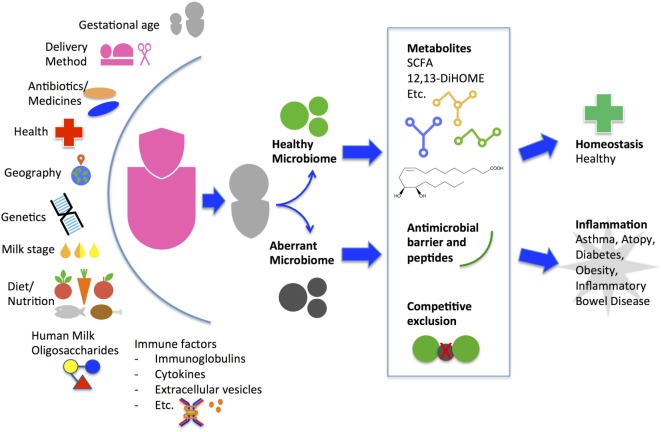
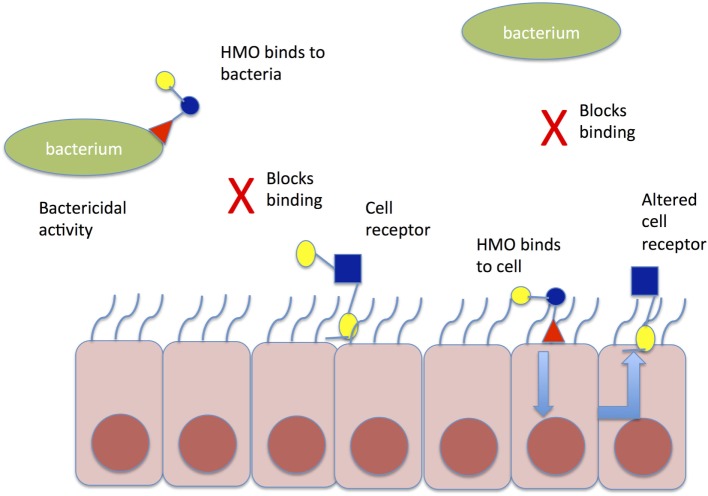
Breast milk is the perfect nutrition for infants, a result of millions of years of evolution. In addition to providing a source of nutrition, breast milk contains a diverse array of microbiota and myriad biologically active components that are thought to guide the infant's developing mucosal immune system. It is believed that bacteria from the mother's intestine may translocate to breast milk and dynamically transfer to the infant. Such interplay between mother and her infant is a key to establishing a healthy infant intestinal microbiome. These intestinal bacteria protect against many respiratory and diarrheal illnesses, but are subject to environmental stresses such as antibiotic use. Orchestrating the development of the microbiota are the human milk oligosaccharides (HMOs), the synthesis of which are partially determined by the maternal genotype. HMOs are thought to play a role in preventing pathogenic bacterial adhesion though multiple mechanisms, while also providing nutrition for the microbiome. Extracellular vesicles (EVs), including exosomes, carry a diverse cargo, including mRNA, miRNA, and cytosolic and membrane-bound proteins, and are readily detectable in human breast milk. Strongly implicated in cell-cell signaling, EVs could therefore may play a further role in the development of the infant microbiome. This review considers the emerging role of breast milk microbiota, bioactive HMOs, and EVs in the establishment of the neonatal microbiome and the consequent potential for modulation of neonatal immune system development.
Overview
The claims and statistics of this paper haven’t been checked yet.
Run the check — free, no account needed. It reads the open-access text and checks the sources it cites.
Integrity signals
Registry
Cites
Statistics
Figures
Verification
Claims the paper makes
The claims and statistics of this paper haven’t been checked yet.
Run the check — free, no account needed. It reads the open-access text and checks the sources it cites.
Claims other papers make about this one
Each is checked against this paper’s own text: does it say what the citing paper says it does?
In the citing paper
“Some of the bacterial species found in human breast milk, such as Lactobacillus spp. (sensu lato) and Bifidobacterium spp., may transfer from the maternal gut via an entero-mammary pathway, a recently discovered form of mother-neonate communication, and are thought to protect against many respiratory and GI infections (Le Doare et al., 2018).”
From Viral Infections, the Microbiome, and Probiotics (2021) · cites this paper as Le Doare et al., 2018
Self-check
Percentages, sums and reported differences re-computed from the paper’s own numbers.
The self-check needs the paper’s full text.
Citations
Cites
Valadi, H., Ekström, K., Bossios, A., Sjöstrand, M., Lee, J. J., & Lötvall, J. O. (2007) · Nature Cell Biology · doi:10.1038/ncb1596 · Cited by 12,834
Breastfeeding in the 21st century: epidemiology, mechanisms, and lifelong effect
Victora, C. G., Bahl, R., Barros, A. J. D., França, G. V. A., Horton, S., Krasevec, J., Murch, S., Sankar, M. J., Walker, N., & Rollins, N. C. (2016) · The Lancet · doi:10.1016/s0140-6736(15)01024-7 · Cited by 8,040
Breastfeeding and the Use of Human Milk
Breastfeeding, S. O. (2005) · PEDIATRICS · doi:10.1542/peds.2004-2491 · Cited by 5,357
Dominguez-Bello, M. G., Costello, E. K., Contreras, M., Magris, M., Hidalgo, G., Fierer, N., & Knight, R. (2010) · Proceedings of the National Academy of Sciences · doi:10.1073/pnas.1002601107 · Cited by 4,774
Breastfeeding and the use of human milk
BREASTFEEDING, S. O., Eidelman, A. I., Schanler, R. J., Johnston, M., Landers, S., Noble, L., Szucs, K., & Viehmann, L. (2012) · Pediatrics · doi:10.1542/peds.2011-3552 · Cited by 4,357
Dynamics and Stabilization of the Human Gut Microbiome during the First Year of Life
Bäckhed, F., Roswall, J., Peng, Y., Feng, Q., Jia, H., Kovatcheva-Datchary, P., Li, Y., Xia, Y., Xie, H., Zhong, H., et al. (2015) · Cell Host & Microbe · doi:10.1016/j.chom.2015.04.004 · Cited by 3,315
An Immunomodulatory Molecule of Symbiotic Bacteria Directs Maturation of the Host Immune System
Mazmanian, S. K., Liu, C. H., Tzianabos, A. O., & Kasper, D. L. (2005) · Cell · doi:10.1016/j.cell.2005.05.007 · Cited by 2,910
Ballard, O., & Morrow, A. L. (2012) · Pediatric Clinics of North America · doi:10.1016/j.pcl.2012.10.002 · Cited by 2,833
Succession of microbial consortia in the developing infant gut microbiome
Koenig, J. E., Spor, A., Scalfone, N., Fricker, A. D., Stombaugh, J., Knight, R., Angenent, L. T., & Ley, R. E. (2011) · Proceedings of the National Academy of Sciences · doi:10.1073/pnas.1000081107 · Cited by 2,540
How colonization by microbiota in early life shapes the immune system
Gensollen, T., Iyer, S. S., Kasper, D. L., & Blumberg, R. S. (2016) · Science · doi:10.1126/science.aad9378 · Cited by 2,044
Cited by
Sorted by citations
A weaning reaction to microbiota is required for resistance to immunopathologies in the adult
Al Nabhani, Z., Dulauroy, S., Marques, R., Cousu, C., Al Bounny, S., Déjardin, F., Sparwasser, T., Bérard, M., Cerf-Bensussan, N., & Eberl, G. (2019) · Immunity · doi:10.1016/j.immuni.2019.02.014 · Cited by 679
Gut Microbiota and Obesity: A Role for Probiotics
Abenavoli, L., Scarpellini, E., Colica, C., Boccuto, L., Salehi, B., Sharifi-Rad, J., Aiello, V., Romano, B., De Lorenzo, A., Izzo, A. A., et al. (2019) · Nutrients · doi:10.3390/nu11112690 · Cited by 615
Breast milk, a source of beneficial microbes and associated benefits for infant health
Lyons, K. E., Ryan, C. A., Dempsey, E. M., Ross, R. P., & Stanton, C. (2020) · Nutrients · doi:10.3390/nu12041039 · Cited by 613
Lawson, M. A., O’Neill, I. J., Kujawska, M., Javvadi, S. G., Wijeyesekera, A., Flegg, Z., Chalklen, L., & Hall, L. J. (2019) · The ISME Journal · doi:10.1038/s41396-019-0553-2 · Cited by 386
Maternal IgA protects against the development of necrotizing enterocolitis in preterm infants
Gopalakrishna, K. P., Macadangdang, B. R., Rogers, M. B., Tometich, J. T., Firek, B., Baker, R. W., Ji, J., Burr, A. B. P., Ma, C., Good, M. L., et al. (2019) · Nature Medicine · doi:10.1038/s41591-019-0480-9 · Cited by 306
Metadata
- Authors
- Le Doare, K., Holder, B., Bassett, A., & Pannaraj, P. S.
- Affiliations
- Imperial College London (GB)
- Children's Hospital Los Angeles (US)
- University of Southern California (US)
- Corresponding author
- Pannaraj, Pia S.
- Venue
- Frontiers in Immunology
- Publisher
- Frontiers Media SA
- Published
- 2018-02-28
- Volume
- 9
- Pages
- 361-361
- ISSN
- 1664-3224 (ISSN-L)
- PMC
- PMC5863526
- OpenAlex
- W2791745812
- Cited by
- 475
- References
- 133
- Citations by year
- 2026: 31 · 2025: 50 · 2024: 51 · 2023: 52 · 2022: 71 · 2021: 98 · 2020: 70 · 2019: 35 · 2018: 17
- FWCI
- 7.04
- Type
- journal article
- Language
- en
- Open access
- gold
- doi.org
- Locations
- Frontiers in Immunology (publishedVersion, cc-by)
- PubMed Central (publishedVersion, cc-by)
- PubMed (publishedVersion)
- St George's Online Research Archive (St George's University of London) (acceptedVersion)
- DOAJ (DOAJ: Directory of Open Access Journals) (submittedVersion, cc-by-sa)
- Spiral (Imperial College London) (submittedVersion, other-oa)
- Funders
- National Institutes of Health (K23 HD072774-02)
- Topics
- Health Sciences › Nursing › Nutrition and Dietetics › Infant Nutrition and Health
- Health Sciences › Medicine › Epidemiology › Breastfeeding Practices and Influences
- Life Sciences › Biochemistry, Genetics and Molecular Biology › Molecular Biology › Gut microbiota and health
- Keywords
- breast milk, infant microbiome, neonatal gut microbiota, human milk oligosaccharides, extracellular vesicles, exosomes, mucosal immunity, maternal genotype, pathogen adhesion, antibiotic exposure, cell-to-cell communication
- MeSH terms
- Gastrointestinal Microbiome, Breast Feeding, Humans, Immunity, Maternally-Acquired, Infant, Infant Nutritional Physiological Phenomena, Milk, Human, Infant Formula, Microbiota
About these checks
Registry, retraction, Cites and statistics results are computed, not judged, with one exception: a printed reference that no index lists is read once by a model before it counts as a citation error. Claims are extracted by a model and kept only when their quote appears verbatim in the text; each cited source is then checked, with a model’s help, for whether it says what the claim relies on. Those verdicts can be wrong — read the claim’s quote and the cited source before relying on one.
Statistics and arithmetic are recomputed, not judged.
Confidence bands are shown only for fields calibrated on our annotated test set. None is calibrated yet, so no band is shown.
What counts as a claim ›How we measure confidence ›How we check this ›
Are you an author, or do you see a problem with this page? Request a review
