

The DOI matches its Crossref record; 221 of the 222 references it cites were found in a registry or an index.
Current Challenges in Vaccinology
Open accessAbstract
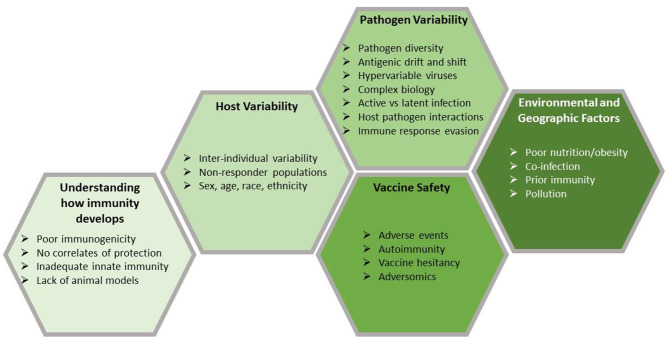
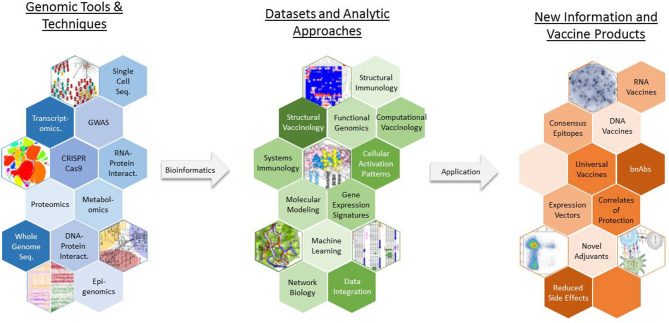
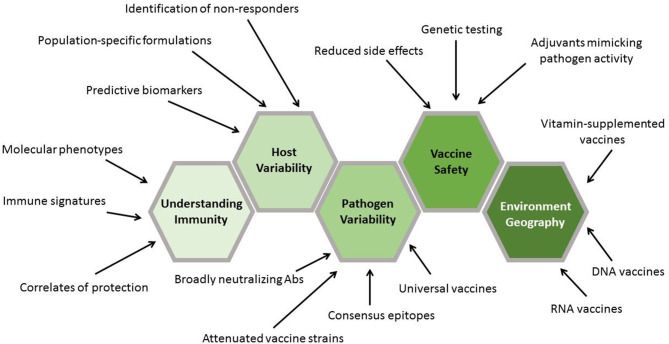
The development of vaccines, which prime the immune system to respond to future infections, has led to global declines in morbidity and mortality from dreadful infectious communicable diseases. However, many pathogens of public health importance are highly complex and/or rapidly evolving, posing unique challenges to vaccine development. Several of these challenges include an incomplete understanding of how immunity develops, host and pathogen genetic variability, and an increased societal skepticism regarding vaccine safety. In particular, new high-dimensional omics technologies, aided by bioinformatics, are driving new vaccine development (vaccinomics). Informed by recent insights into pathogen biology, host genetic diversity, and immunology, the increasing use of genomic approaches is leading to new models and understanding of host immune system responses that may provide solutions in the rapid development of novel vaccine candidates.
Overview
The claims and statistics of this paper haven’t been checked yet.
Run the check — free, no account needed. It reads the open-access text and checks the sources it cites.
Integrity signals
Registry
Cites
Statistics
Figures
Verification
Claims the paper makes
The claims and statistics of this paper haven’t been checked yet.
Run the check — free, no account needed. It reads the open-access text and checks the sources it cites.
Claims other papers make about this one
Each is checked against this paper’s own text: does it say what the citing paper says it does?
In the citing paper
“Despite their evident success, however, conventional vaccines do not effectively tackle pathogens such as the malaria parasite Plasmodium falciparum, hepatitis C and human immunodeficiency virus (HIV), which evade immune surveillance2.”
From mRNA vaccines for infectious diseases: principles, delivery and clinical translation (2021) · cites this paper as [2]
Self-check
Percentages, sums and reported differences re-computed from the paper’s own numbers.
The self-check needs the paper’s full text.
Citations
Cites
Multi-omics approaches to disease
Hasin, Y., Seldin, M., & Lusis, A. (2017) · Genome Biology · doi:10.1186/s13059-017-1215-1 · Cited by 2,953
InnateDB: systems biology of innate immunity and beyond—recent updates and continuing curation
Breuer, K., Foroushani, A. B. K., Laird, M. R., Chen, C. C. L., Sribnaia, A., Lo, R., Winsor, G. L., Hancock, R. E. W., Brinkman, F. S. L., & Lynn, D. J. (2012) · Nucleic Acids Research · doi:10.1093/nar/gks1147 · Cited by 1,253
MicroRNA in Control of Gene Expression: An Overview of Nuclear Functions
Catalanotto, C., Cogoni, C., & Zardo, G. (2016) · International Journal of Molecular Sciences · doi:10.3390/ijms17101712 · Cited by 1,238
Characterization of Peptides Bound to the Class I MHC Molecule HLA-A2.1 by Mass Spectrometry
Hunt, D. F., Henderson, R. A., Shabanowitz, J., Sakaguchi, K., Michel, H., Sevilir, N., Cox, A. L., Appella, E., & Engelhard, V. H. (1992) · Science · doi:10.1126/science.1546328 · Cited by 1,198
Systems biology approach predicts immunogenicity of the yellow fever vaccine in humans
Querec, T. D., Akondy, R. S., Lee, E. K., Cao, W., Nakaya, H. I., Teuwen, D. E., Pirani, A. M., Gernert, K. M., Deng, J., Marzolf, B., et al. (2008) · Nature Immunology · doi:10.1038/ni.1688 · Cited by 1,123
Variation in the Human Immune System Is Largely Driven by Non-Heritable Influences
Brodin, P., Jojic, V., Gao, T., Bhattacharya, S., Angel, C. J. L., Furman, D., Shen-Orr, S., Dekker, C. L., Swan, G. E., Butte, A. J., et al. (2015) · Cell · doi:10.1016/j.cell.2014.12.020 · Cited by 1,065
Centers for Disease Control and Prevention (CDC)
García-Basteiro, A. L. (2011) · Encyclopedia of Disaster Relief · doi:10.4135/9781412994064.n25 · Cited by 1,021
Bhattacharya, S., Dunn, P. J., Thomas, C. G., Smith, B., Schaefer, H., Chen, J., Hu, Z., Zalocusky, K. A., Shankar, R., Shen-Orr, S. S., et al. (2018) · Scientific Data · doi:10.1038/sdata.2018.15 · Cited by 788
Li, S., Rouphael, N., Duraisingham, S., Romero‐Steiner, S., Presnell, S., Davis, C. W., Schmidt, D. S., Johnson, S. E., Milton, A., Rajam, G., et al. (2013) · Nature Immunology · doi:10.1038/ni.2789 · Cited by 772
Adaptive evolution of highly mutable loci in pathogenic bacteria
Moxon, E. R., Rainey, P. B., Nowak, M. A., & Lenski, R. E. (1994) · Current Biology · doi:10.1016/s0960-9822(00)00005-1 · Cited by 755
Cited by
Sorted by citations
mRNA vaccines for infectious diseases: principles, delivery and clinical translation
Chaudhary, N., Weissman, D., & Whitehead, K. A. (2021) · Nature Reviews Drug Discovery · doi:10.1038/s41573-021-00283-5 · Cited by 1,555
mRNA vaccines in disease prevention and treatment
Zhang, G., Tang, T., Chen, Y., Huang, X., & Liang, T. (2023) · Signal Transduction and Targeted Therapy · doi:10.1038/s41392-023-01579-1 · Cited by 273
Han, X., Alu, A., Liu, H., Shi, Y., Wei, X., Cai, L., & Wei, Y. (2022) · Bioactive Materials · doi:10.1016/j.bioactmat.2022.01.011 · Cited by 165
Knife’s edge: Balancing immunogenicity and reactogenicity in mRNA vaccines
Lee, J., Woodruff, M. C., Kim, E. H., & Nam, J. (2023) · Experimental & Molecular Medicine · doi:10.1038/s12276-023-00999-x · Cited by 141
Nanomedicine for COVID-19: the role of nanotechnology in the treatment and diagnosis of COVID-19
Vahedifard, F., & Chakravarthy, K. V. (2021) · Emergent Materials · doi:10.1007/s42247-021-00168-8 · Cited by 129
Metadata
- Authors
- Kennedy, R. B., Ovsyannikova, I. G., Palese, P., & Poland, G. A.
- Affiliations
- Mayo Clinic (US)
- Icahn School of Medicine at Mount Sinai (US)
- Corresponding author
- Kennedy, Richard B.
- Venue
- Frontiers in Immunology
- Publisher
- Frontiers Media SA
- Published
- 2020-06-25
- Volume
- 11
- Pages
- 1181-1181
- ISSN
- 1664-3224 (ISSN-L)
- PMC
- PMC7329983
- OpenAlex
- W3033639218
- Cited by
- 113
- References
- 222
- Citations by year
- 2026: 22 · 2025: 24 · 2024: 21 · 2023: 16 · 2022: 12 · 2021: 17 · 2020: 1
- FWCI
- 1.10
- Type
- journal article
- Language
- en
- Open access
- gold
- doi.org
- Licence
- Locations
- Frontiers in Immunology (publishedVersion, cc-by)
- PubMed Central (publishedVersion, cc-by)
- PubMed (publishedVersion)
- DOAJ (DOAJ: Directory of Open Access Journals) (submittedVersion, cc-by-sa)
- Funders
- National Institutes of Health (R01AI033144, R01AI121054, R01AI127365, R01AI132348, R01AI138965, R37AI048793, U01AI089859)
- Topics
- Life Sciences › Biochemistry, Genetics and Molecular Biology › Molecular Biology › vaccines and immunoinformatics approaches
- Life Sciences › Immunology and Microbiology › Immunology › Immune responses and vaccinations
- Health Sciences › Medicine › Infectious Diseases › SARS-CoV-2 and COVID-19 Research
- Keywords
- vaccine development, vaccinomics, host genetic variation, host immune response, omics technologies, bioinformatics, infectious disease prevention, emerging pathogens
- MeSH terms
- Vaccinology, Animals, Communicable Disease Control, Humans, Vaccines, Computational Biology
About these checks
Registry, retraction, Cites and statistics results are computed, not judged, with one exception: a printed reference that no index lists is read once by a model before it counts as a citation error. Claims are extracted by a model and kept only when their quote appears verbatim in the text; each cited source is then checked, with a model’s help, for whether it says what the claim relies on. Those verdicts can be wrong — read the claim’s quote and the cited source before relying on one.
Statistics and arithmetic are recomputed, not judged.
Confidence bands are shown only for fields calibrated on our annotated test set. None is calibrated yet, so no band is shown.
What counts as a claim ›How we measure confidence ›How we check this ›
Are you an author, or do you see a problem with this page? Request a review
