

The DOI matches its Crossref record; 225 of the 225 references it cites were found in a registry or an index.
Psychological stress in inflammatory bowel disease: Psychoneuroimmunological insights into bidirectional gut–brain communications
Open accessAbstract
Inflammatory bowel disease (IBD), mainly including ulcerative colitis (UC) and Crohn’s disease (CD), is an autoimmune gastrointestinal disease characterized by chronic inflammation and frequent recurrence. Accumulating evidence has confirmed that chronic psychological stress is considered to trigger IBD deterioration and relapse. Moreover, studies have demonstrated that patients with IBD have a higher risk of developing symptoms of anxiety and depression than healthy individuals. However, the underlying mechanism of the link between psychological stress and IBD remains poorly understood. This review used a psychoneuroimmunology perspective to assess possible neuro-visceral integration, immune modulation, and crucial intestinal microbiome changes in IBD. Furthermore, the bidirectionality of the brain–gut axis was emphasized in the context, indicating that IBD pathophysiology increases the inflammatory response in the central nervous system and further contributes to anxiety- and depression-like behavioral comorbidities. This information will help accurately characterize the link between psychological stress and IBD disease activity. Additionally, the clinical application of functional brain imaging, microbiota-targeted treatment, psychotherapy and antidepressants should be considered during the treatment and diagnosis of IBD with behavioral comorbidities. This review elucidates the significance of more high-quality research combined with large clinical sample sizes and multiple diagnostic methods and psychotherapy, which may help to achieve personalized therapeutic strategies for IBD patients based on stress relief.
Overview
The claims and statistics of this paper haven’t been checked yet.
Run the check — free, no account needed. It reads the open-access text and checks the sources it cites.
Integrity signals
Registry
Cites
Statistics
Figures
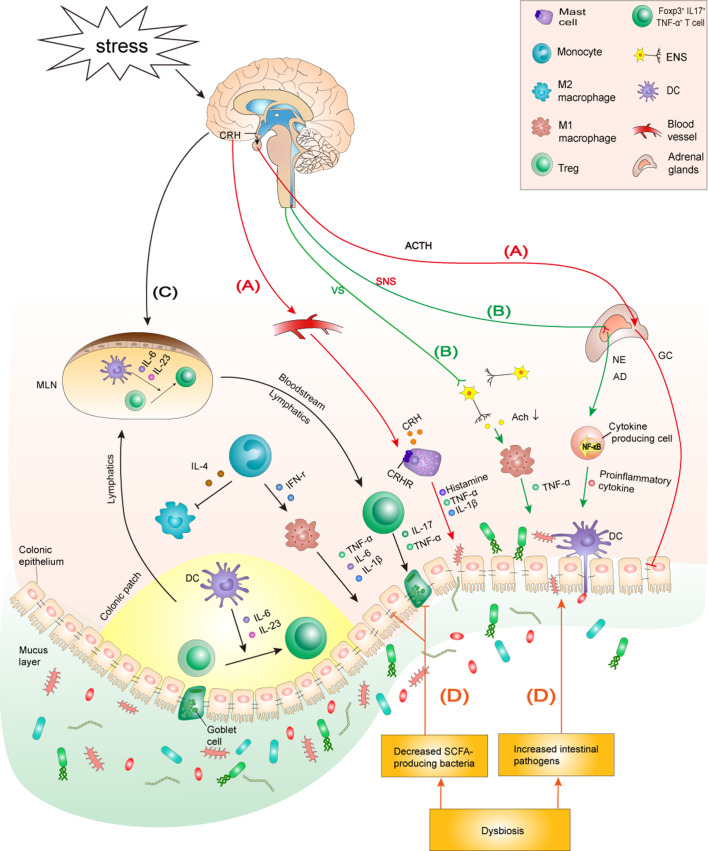
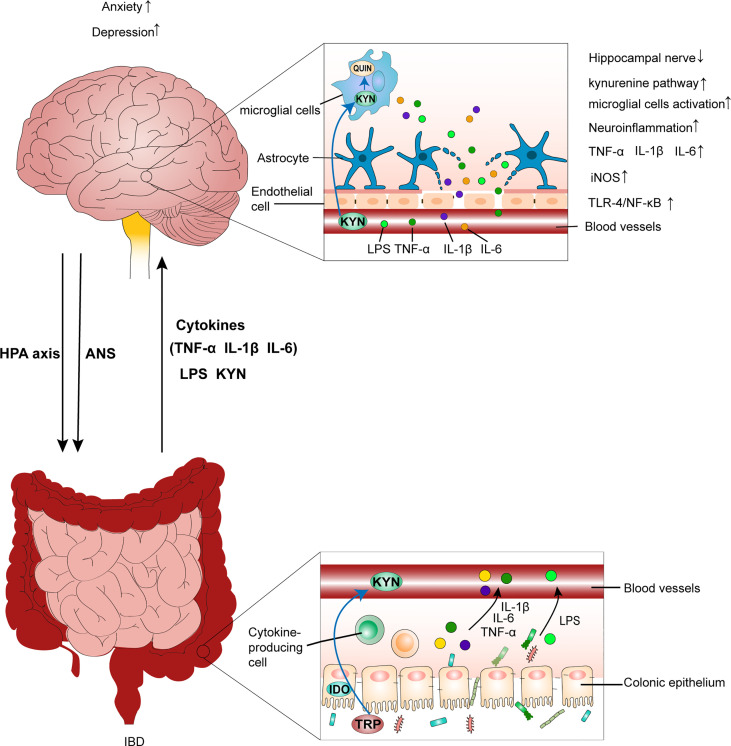
Verification
Claims the paper makes
The claims and statistics of this paper haven’t been checked yet.
Run the check — free, no account needed. It reads the open-access text and checks the sources it cites.
Claims other papers make about this one
Each is checked against this paper’s own text: does it say what the citing paper says it does?
In the citing paper
“Stress is considered a trigger in patients with functional gastrointestinal disorders, such as IBS and functional dyspepsia, as well as IBDs like ulcerative colitis and Crohn’s disease (493).”
From Signalling cognition: The gut microbiota and hypothalamic-pituitary-adrenal axis (2023) · cites this paper as [493]
In the citing paper
“The gut–brain axis is a complex bidirectional communication system driven by neural, hormonal, metabolic, immunological, and microbial signals [77,78].”
From Association between Childhood Onset Inflammatory Bowel Disease and Psychiatric Comorbidities in Adulthood (2023) · cites this paper as [77]
Self-check
Percentages, sums and reported differences re-computed from the paper’s own numbers.
The self-check needs the paper’s full text.
Citations
Cites
Ng, S. C., Shi, H. Y., Hamidi, N., Underwood, F. E., Tang, W., Benchimol, E. I., Panaccione, R., Ghosh, S., Wu, J. C. Y., Chan, F. K. L., et al. (2017) · The Lancet · doi:10.1016/s0140-6736(17)32448-0 · Cited by 6,087
Cryan, J. F., O'Riordan, K. J., Cowan, C. S. M., Sandhu, K. V., Bastiaanssen, T. F. S., Boehme, M., Codagnone, M. G., Cussotto, S., Fulling, C., Golubeva, A. V., et al. (2019) · Physiological Reviews · doi:10.1152/physrev.00018.2018 · Cited by 5,286 · cited 1×
“In this context, increasing attention has been placed on the interactive regulatory mechanism of the brain and microbiota during disease progression (107, 108).”
BackgroundUngaro, R. C., Mehandru, S., Allen, P. B., Peyrin‐Biroulet, L., & Colombel, J. (2016) · The Lancet · doi:10.1016/s0140-6736(16)32126-2 · Cited by 3,659
Neural regulation of endocrine and autonomic stress responses
Ulrich-Lai, Y. M., & Herman, J. P. (2009) · Nature Reviews Neuroscience · doi:10.1038/nrn2647 · Cited by 3,318
Gut Microbiota Regulation of Tryptophan Metabolism in Health and Disease
Agus, A., Planchais, J., & Sokol, H. (2018) · Cell Host & Microbe · doi:10.1016/j.chom.2018.05.003 · Cited by 3,180
Hypothalamic-pituitary-adrenal axis, neuroendocrine factors and stress
Tsigos, C., & Chrousos, G. P. (2002) · Journal of Psychosomatic Research · doi:10.1016/s0022-3999(02)00429-4 · Cited by 2,822 · cited 1×
“ACTH itself stimulates the secretion of adrenal glucocorticoids (GCs) by the zona fasciculata of the adrenal cortex, such as cortisol in humans and corticosterone in rodents (28, 30, 31).”
BackgroundSudo, N., Chida, Y., Aiba, Y., Sonoda, J., Oyama, N., Yu, X., Kubo, C., & Koga, Y. (2004) · The Journal of Physiology · doi:10.1113/jphysiol.2004.063388 · Cited by 2,735
The gut microbiota–brain axis in behaviour and brain disorders
Morais, L. H., Schreiber, H. L., & Mazmanian, S. K. (2021) · Nature Reviews Microbiology · doi:10.1038/s41579-020-00460-0 · Cited by 2,149
Gut microbiota-derived metabolites as key actors in inflammatory bowel disease
Lavelle, A., & Sokol, H. (2020) · Nature Reviews Gastroenterology & Hepatology · doi:10.1038/s41575-019-0258-z · Cited by 2,015
Immunopathogenesis of IBD: current state of the art
de Souza, H. S. P., & Fiocchi, C. (2016) · Nature Reviews Gastroenterology & Hepatology · doi:10.1038/nrgastro.2015.186 · Cited by 1,551
Cited by
Sorted by citations
Signalling cognition: The gut microbiota and hypothalamic-pituitary-adrenal axis
Rusch, J. A., Layden, B. T., & Dugas, L. R. (2023) · Frontiers in Endocrinology · doi:10.3389/fendo.2023.1130689 · Cited by 415
Microbiota–neuroepithelial signalling across the gut–brain axis
Ohara, T. E., & Hsiao, E. Y. (2025) · Nature Reviews Microbiology · doi:10.1038/s41579-024-01136-9 · Cited by 147
Zhang, X., Zhang, F., Li, Y., Fan, N., Zhao, K., Zhang, A., Kang, J., Yan, L., Xue, X., & Jiang, X. (2024) · Journal of Translational Medicine · doi:10.1186/s12967-024-05168-w · Cited by 100
Sic, A., Cvetkovic, K., Manchanda, E., & Knezevic, N. N. (2024) · Diseases · doi:10.3390/diseases12090220 · Cited by 65
Interactions Between Antidepressants and Intestinal Microbiota
Xu, F., Xie, Q., Kuang, W., & Dong, Z. (2023) · Neurotherapeutics · doi:10.1007/s13311-023-01362-8 · Cited by 59
Metadata
- Authors
- Ge, L., Liu, S., Li, S., Yang, J., Hu, G., Xu, C., & Song, W.
- Affiliations
- Shandong Provincial QianFoShan Hospital (CN)
- Shandong First Medical University (CN)
- Corresponding author
- Song, Wengang
- Venue
- Frontiers in Immunology
- Publisher
- Frontiers Media SA
- Published
- 2022-10-06
- Volume
- 13
- Pages
- 1016578-1016578
- ISSN
- 1664-3224 (ISSN-L)
- PMC
- PMC9583867
- OpenAlex
- W4303184202
- Cited by
- 187
- References
- 225
- Citations by year
- 2026: 58 · 2025: 74 · 2024: 42 · 2023: 12 · 2022: 1
- FWCI
- 4.98
- Type
- journal article
- Language
- en
- Open access
- gold
- doi.org
- Licence
- Locations
- Frontiers in Immunology (publishedVersion, cc-by)
- PubMed Central (publishedVersion, cc-by)
- PubMed (publishedVersion)
- DOAJ (DOAJ: Directory of Open Access Journals) (submittedVersion, cc-by-sa)
- Funders
- National Natural Science Foundation of China
- Natural Science Foundation of Shandong Province
- Topics
- Health Sciences › Medicine › Gastroenterology › Inflammatory Bowel Disease
- Life Sciences › Neuroscience › Biological Psychiatry › Tryptophan and brain disorders
- Life Sciences › Biochemistry, Genetics and Molecular Biology › Molecular Biology › Gut microbiota and health
- Keywords
- inflammatory bowel disease, psychological stress, psychoneuroimmunology, gut-brain axis, ulcerative colitis, Crohn's disease, anxiety, depression, immunomodulation, gut microbiota, neuroinflammation, psychotherapy, antidepressants, recurrence
- MeSH terms
- Antidepressive Agents, Brain, Chronic Disease, Humans, Psychoneuroimmunology, Stress, Psychological, Inflammatory Bowel Diseases
About these checks
Registry, retraction, Cites and statistics results are computed, not judged, with one exception: a printed reference that no index lists is read once by a model before it counts as a citation error. Claims are extracted by a model and kept only when their quote appears verbatim in the text; each cited source is then checked, with a model’s help, for whether it says what the claim relies on. Those verdicts can be wrong — read the claim’s quote and the cited source before relying on one.
Statistics and arithmetic are recomputed, not judged.
Confidence bands are shown only for fields calibrated on our annotated test set. None is calibrated yet, so no band is shown.
What counts as a claim ›How we measure confidence ›How we check this ›
Are you an author, or do you see a problem with this page? Request a review
