

Cholangiokines: undervalued modulators in the hepatic microenvironment
Open accessThe DOI matches its Crossref record; 226 of the 229 references it cites were found in a registry or an index.
Abstract
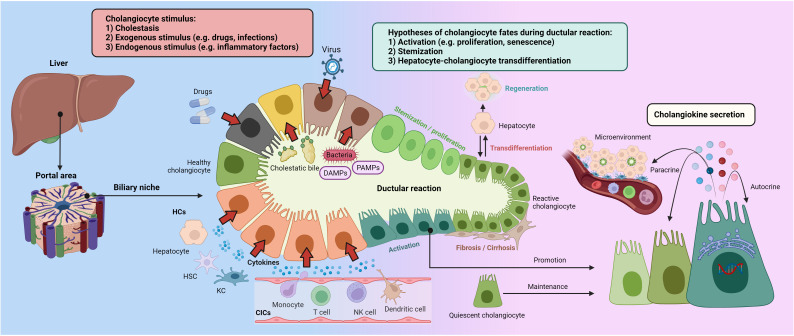
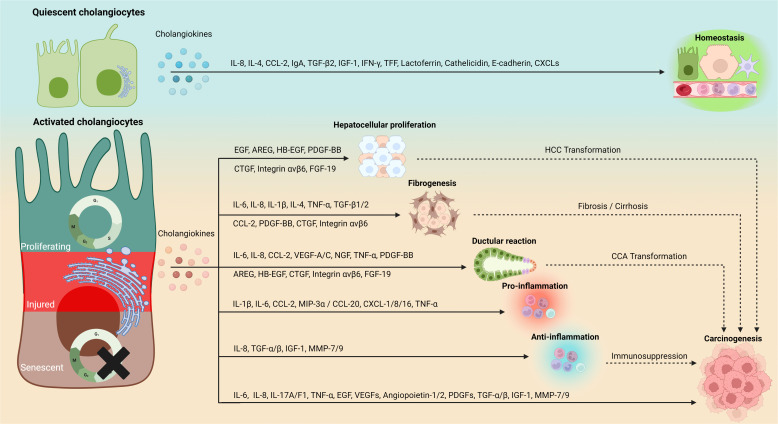
The biliary epithelial cells, also known as cholangiocytes, line the intra- and extrahepatic bile ducts, forming a barrier between intra- and extra-ductal environments. Cholangiocytes are mostly known to modulate bile composition and transportation. In hepatobiliary diseases, bile duct injury leads to drastic alterations in cholangiocyte phenotypes and their release of soluble mediators, which can vary depending on the original insult and cellular states (quiescence, senescence, or proliferation). The cholangiocyte-secreted cytokines (also termed cholangiokines) drive ductular cell proliferation, portal inflammation and fibrosis, and carcinogenesis. Hence, despite the previous consensus that cholangiocytes are bystanders in liver diseases, their diverse secretome plays critical roles in modulating the intrahepatic microenvironment. This review summarizes recent insights into the cholangiokines under both physiological and pathological conditions, especially as they occur during liver injury-regeneration, inflammation, fibrosis and malignant transformation processes.
Overview
The claims and statistics of this paper haven’t been checked yet.
Free: it reads the open-access text and checks the first 5 claims that cite a source we can check. Create a free account to check every claim.
Integrity signals
Registry
Cites
Statistics
Figures
Verification
Claims the paper makes
The claims and statistics of this paper haven’t been checked yet.
Free: it reads the open-access text and checks the first 5 claims that cite a source we can check. Create a free account to check every claim.
Claims other papers make about this one
Each is checked against this paper’s own text: does it say what the citing paper says it does?
The source backs part of the claim, not all of it — or backs it for a different population, condition or comparison.
In the citing paper
“Moreover, their microanatomic niche predisposes BECs to interact with many other cell types, including immune cells, and renders the periductular area a common site of inflammation [155–157].”
From Inflammation and immunity in liver homeostasis and disease: a nexus of hepatocytes, nonparenchymal cells and immune cells (2025) · doi:10.1038/s41423-025-01313-7 · cites this paper as [156]
Experimental — accuracy not yet measuredThe cited source says what the claim attributes to it.
In the citing paper
“Biliary epithelial cells (BECs) and their derivatives, often referred to as ductular cells in liver diseases, play a key role in many liver diseases, as the transport of bile to the intestine is a central liver function that needs to be preserved to avoid toxic effects on the liver.”
From Inflammation and immunity in liver homeostasis and disease: a nexus of hepatocytes, nonparenchymal cells and immune cells (2025) · doi:10.1038/s41423-025-01313-7 · cites this paper as [156]
Self-check
Percentages, sums and reported differences re-computed from the paper’s own numbers.
The self-check needs the paper’s full text.
Citations
Cites
The serial cultivation of human diploid cell strains
Hayflick, L., & Moorhead, P. S. (1961) · Experimental Cell Research · doi:10.1016/0014-4827(61)90192-6 · Cited by 8,508
IL-23 drives a pathogenic T cell population that induces autoimmune inflammation
Langrish, C. L., Chen, Y., Blumenschein, W. M., Mattson, J., Basham, B., Sedgwick, J. D., McClanahan, T., Kastelein, R. A., & Cua, D. J. (2005) · The Journal of Experimental Medicine · doi:10.1084/jem.20041257 · Cited by 4,099
Hallmarks of Cellular Senescence
Hernandez-Segura, A., Nehme, J., & Demaria, M. (2018) · Trends in Cell Biology · doi:10.1016/j.tcb.2018.02.001 · Cited by 2,605
Oncogene-induced senescence is part of the tumorigenesis barrier imposed by DNA damage checkpoints
Bartkova, J., Rezaei, N., Liontos, M., Karakaidos, P., Kletsas, D., Issaeva, N., Vassiliou, L.-V. F., Kolettas, E., Niforou, K., Zoumpourlis, V. C., et al. (2006) · Nature · doi:10.1038/nature05268 · Cited by 1,986
IL‐6: Regulator of Treg/Th17 balance
Kimura, A., & Kishimoto, T. (2010) · European Journal of Immunology · doi:10.1002/eji.201040391 · Cited by 1,595
Liver regeneration: from myth to mechanism
Taub, R. (2004) · Nature Reviews Molecular Cell Biology · doi:10.1038/nrm1489 · Cited by 1,567
Single cell RNA sequencing of human liver reveals distinct intrahepatic macrophage populations
MacParland, S. A., Liu, J. C., Ma, X.-Z., Innes, B. T., Bartczak, A. M., Gage, B. K., Manuel, J., Khuu, N., Echeverri, J., Linares, I., et al. (2018) · Nature Communications · doi:10.1038/s41467-018-06318-7 · Cited by 1,552
Imai, T., Hieshima, K., Haskell, C., Baba, M., Nagira, M., Nishimura, M., Kakizaki, M., Takagi, S., Nomiyama, H., Schall, T. J., et al. (1997) · Cell · doi:10.1016/s0092-8674(00)80438-9 · Cited by 1,445
Liver Macrophages in Tissue Homeostasis and Disease
Krenkel, O., & Tacke, F. (2017) · Nature Reviews Immunology · doi:10.1038/nri.2017.11 · Cited by 1,424 · cited 1×
“Although hepatocytes and Kupffer cells are generally responsible for the clearance of bacterial products in the liver (51, 52), cholangiocytes can also play auxiliary roles in this process, especially regarding the response to intraductal stimuli.”
BackgroundSelf-citationMichalopoulos, G. K. (2007) · Journal of Cellular Physiology · doi:10.1002/jcp.21172 · Cited by 1,384
Cited by
(2025) · doi:10.1038/s41423-025-01313-7 · Cited by 97
“In reference to “ cholangio-kines ” , the BEC secretome is versatile, and we have just started to explore its potential for shaping portal in fl ammation [156].”
Self-citationCentral role for cholangiocyte pathobiology in cholestatic liver diseases
Jalan-Sakrikar, N., Guicciardi, M. E., O’Hara, S. P., Azad, A., LaRusso, N. F., Gores, G. J., & Huebert, R. C. (2025) · Hepatology · doi:10.1097/hep.0000000000001093 · Cited by 38
The impact of aging on liver health and the development of liver diseases
Williams, S. N., & Ding, W. (2025) · Hepatology Communications · doi:10.1097/hc9.0000000000000808 · Cited by 35
“[29] As the name implies, LSECs are specialized cells that line the hepatic sinusoids and are fenestrated to allow for blood filtration.”
Xiao, M.-H., Wu, S., Liang, P., Ma, D., Zhang, J., Chen, H., Zhong, Z., Liu, J., Jiang, H., Feng, X., et al. (2024) · EBioMedicine · doi:10.1016/j.ebiom.2024.105138 · Cited by 28
Microenvironmental control of the ductular reaction: balancing repair and disease progression
Sorrentino, G. (2025) · Cell Death and Disease · doi:10.1038/s41419-025-07590-4 · Cited by 28
“Cholangio-kines secretion is in fl uenced by different factors such as tissue in fl ammation, infection, and metabolic dysregulation and actively maintain the portal area ’ s microenvironment contributing to immune response and in fl ammation [81].”
Liu, H., Yin, G., Franco Leonardi, B., Lan, T., Ait Ahmed, Y., Berger, H., Kohlhepp, M. S., Amiridze, N., Martagón Calderón, N., Frau, C., et al. (2025) · Gut · doi:10.1136/gutjnl-2024-334425 · Cited by 23
Self-citationCellular heterogeneity and plasticity during NAFLD progression
Park, H., Choi, J., Kim, H.-M., Yang, D.-Y., An, T. H., Lee, E., Han, B., Lee, S. C., Kim, W. K., Bae, K., et al. (2023) · Frontiers in Molecular Biosciences · doi:10.3389/fmolb.2023.1221669 · Cited by 24
“Liver mesenchymal cells are also activated by these inflammatory signals from the bile duct and are attracted to the bile duct (Cai et al., 2023).”
BackgroundShao, X., Xu, H., Kim, H., ljaz, S., Beier, F., Jankowski, V., Lellig, M., Vankann, L., Werner, J. N., Chen, L., et al. (2024) · Cell Death Discovery · doi:10.1038/s41420-024-02131-y · Cited by 16
“Senescent cells obtain a senescence-associated secretory phenotype (SASP) and secrete numerous proin fl ammatory and pro fi - brotic cytokines that can adversely affect neighboring healthy cells [4].”
Cellular interactions in self-directed immune-mediated liver diseases
Bozward, A. G., Davies, S. P., Morris, S. M., Kayani, K., & Oo, Y. H. (2025) · Journal of Hepatology · doi:10.1016/j.jhep.2025.01.002 · Cited by 17
Lou, C., Lan, T., Xu, S., Hu, X., Li, J., Xiang, Z., Lin, S., Fan, X., Chen, J., & Xu, X. (2025) · Gut · doi:10.1136/gutjnl-2025-334763 · Cited by 20
“15 91 Furthermore, although the primary effect of B cells focused on secreting high-affinity and specific antibodies to neutralise pathogens and participating in humoral immunity, B cells have also been demonstrated to participate in liver fibrosis through crosstalk with HSCs. 129 130…”
Innate immunity of bile and cholangiocytes in primary biliary cholangitis
Chen, R., Sun, Y., Hu, Y., & Tai, W. (2025) · Frontiers in Immunology · doi:10.3389/fimmu.2025.1655287 · Cited by 14
Chu, H., Li, Y., Yang, H., Liu, Y., Zheng, R., Zhang, X., Wang, X., Zhao, J., Zhang, Y., Wang, Q., et al. (2024) · Liver International · doi:10.1111/liv.16157 · Cited by 12
Samuvel, D. J., Lemasters, J. J., Chou, C. J., & Zhong, Z. (2024) · Frontiers in Pharmacology · doi:10.3389/fphar.2024.1386238 · Cited by 11
Wang, W., Lian, H., Liang, Y., Ye, Y., Tam, P. K. H., & Chen, Y. (2024) · Cells · doi:10.3390/cells13231997 · Cited by 13
“For example, the cholangiocyte-secreted cytokines (also termed cholangiokines) drive ductular cell proliferation, portal inflammation and fibrosis, and carcinogenesis by modulating the intrahepatic microenvironment [21].”
Sequence of events leading to primary biliary cholangitis
Lenci, I., Carnì, P., Milana, M., Bicaj, A., Signorello, A., & Baiocchi, L. (2023) · World Journal of Gastroenterology · doi:10.3748/wjg.v29.i37.5305 · Cited by 9
“Moreover, endogenous (inflammatory) or exogenous stimuli (bacterial, toxic, drug-induced, and others) altering the ductal microenvironment can change cholangiocyte secretory response[33].”
An Integrated Pathogenetic Model of Primary Biliary Cholangitis
Kouroumalis, E., Tsomidis, I., & Voumvouraki, A. (2025) · Livers · doi:10.3390/livers5020015 · Cited by 7
“Quiescence-maintaining cholangiokines support liver homeostasis, whereas cholangiokines secreted by BECs after senescence or injury mediate fibrogenesis, ductular reaction, and inflammation, finally leading to carcinogenesis [323].”
Diagnosis of Cholangiocarcinoma: The New Biological and Technological Horizons
Selvaggi, F., Lopetuso, L. R., Pizzi, A. D., Melchiorre, E., Murgiano, M., Taraschi, A. L., Cotellese, R., Diana, M., Vivarelli, M., Mocchegiani, F., et al. (2025) · Diagnostics · doi:10.3390/diagnostics15081011 · Cited by 7
“Cytokines secreted by cholangiocytes drive ductal cell proliferation, inflammation, portal fibrosis and carcinogenesis [34].”
Fagoonee, S., Bolontrade, M. F., Defilippi, P., & Weiskirchen, R. (2025) · Cells · doi:10.3390/cells14161274 · Cited by 6
“Once activated, cholangiocytes exhibit a unique secretory profile that significantly impacts their local microenvironment by facilitating the recruitment of immune cells and promoting the migration and activation of mesenchymal cells [14].”
Cunanan, C. J., Sanders, A. B., Gallant, K. C., Seedor, R. S., & Hartsough, E. J. (2025) · Cancer and Metastasis Reviews · doi:10.1007/s10555-025-10298-8 · Cited by 5
“Cholangiocytes can become activated upon liver injury or disease and secrete cytokines and chemokines termed cholangiokines [39].”
RAGE is a key regulator of ductular reaction-mediated fibrosis during cholestasis
Lam, W.-L. M., Gabernet, G., Poth, T., Sator‐Schmitt, M., Oquendo, M. B., Kast, B., Lohr, S., Ponti, A. D., Weiß, L., Schneider, M., et al. (2025) · EMBO Reports · doi:10.1038/s44319-024-00356-7 · Cited by 4
“Again, we observed a higher expression of Acta2 and Col1a1 in HSCs treated with either rTGFB1 or conditioned medium from RAGE WT BECs, but not RAGE KO BECs (Fig.”
InfluentialAnfuso, B., Velnati, S., Selvestrel, D., Garlant, C., Ferracci, E., Baj, G., Parisse, P., Overi, D., Bertolio, R., Bulla, R., et al. (2025) · Cell Reports · doi:10.1016/j.celrep.2025.116681 · Cited by 3
Purinergic signaling and cholangiocyte regeneration: a new frontier in ischemic liver injury
Nwaduru, C., Anyagwa, O., Fenlon, M., Buff, M., Selim, M., Botha, J., Kastenberg, Z., & Zimmerman, M. (2026) · Frontiers in Transplantation · doi:10.3389/frtra.2025.1731982 · Cited by 3
“Factors like IL-8, found elevated in the bile of PSC patients play crucial role in this scenario (39, 44).”
Du, X., Zhang, S., Liu, S., Gao, Y., Wang, Z., Dong, N., Song, S., Hui, Q., Wang, Z., Ma, Y., et al. (2025) · Chemico-Biological Interactions · doi:10.1016/j.cbi.2025.111738 · Cited by 2
Olson, K. E., Krishnan, A., Splinter, P. L., Wixom, A. Q., Guicciardi, M. E., Jalan‐Sakrikar, N., Azad, A. I., LaRusso, N. F., & Gores, G. J. (2025) · American Journal of Physiology-Gastrointestinal and Liver Physiology · doi:10.1152/ajpgi.00243.2025 · Cited by 2
Ghosh, S., Devereaux, M. W., Anderson, A. L., Anderson, C. C., D’Alessandro, A., Orlicky, D. J., & Sokol, R. J. (2026) · Cellular and Molecular Gastroenterology and Hepatology · doi:10.1016/j.jcmgh.2026.101731 · Cited by 2
“4,7,14 Thus, restoring hepatic immune balance, reducing oxidative stress, and modulating nuclear receptor signaling are potential strategies for mitigating cholangiopathies.”
Lee, S., Ren, L., Li, W., Paranjpe, A., Zhou, P., Potter, A., Huppert, S. S., & Shin, S. (2025) · Hepatology Communications · doi:10.1097/hc9.0000000000000745 · Cited by 2
“These data indicate that HPCs express high levels of many reactive cholangiocyte markers [36 – 38] in at least one comparison.”
Gonçalves, J. D. O., Mafra, C. A. M., de Castro, I., Cogliati, B., Teodoro, W. R., Bando, S. Y., Serafini, S., Moreira‐Filho, C. A., Tannuri, U., & Tannuri, A. C. A. (2025) · Pediatric Research · doi:10.1038/s41390-025-04272-x · Cited by 3
Du, X., Gao, Y., Song, S., Hui, Q., Wang, Z., Ji, M., Li, M., Duan, S., Liu, S., Wang, Z., et al. (2025) · Cell Death and Disease · doi:10.1038/s41419-025-08043-8 · Cited by 1
“This process disrupts the liver microenvironment, leading to liver in fl ammation and fi brosis [31].”
Xu, M., Huang, Y., Jiang, K., Zhang, L., Huang, W., Shen, J., Lei, J., Yan, H., Sun, X., & Wu, Z. Z. (2026) · Liver International · doi:10.1111/liv.70698 · Cited by 1
“Increasing evidence suggests that cholangiocytes are not merely passive targets of injury but function as active participants in the hepatic microenvironment by secreting cytokines, growth factors, and extracellular matrix-modifying molecules [5–7].”
Dysregulation of sphingolipid metabolism in liver fibrosis
Wu, N., Song, M., Zhang, F., Aseem, S. O., Hylemon, P. B., & Zhou, H. (2024) · Metabolism and Target Organ Damage · doi:10.20517/mtod.2024.38 · Cited by 3
Vartak, N., Damle‐Vartak, A., Jörs, S., Günther, G., Lam, M., Sator‐Schmitt, M., Poth, T., Hofmann, U., Kovacevic, J., Ringelhan, M., et al. (2024) · Research Square · doi:10.21203/rs.3.rs-4337701/v1
Gonçalves, J. D. O. (2024) · Digital Library of Theses and Dissertations (Universidade de São Paulo) · doi:10.11606/t.5.2024.tde-04092024-150229
Immunology of Autoimmune Liver Diseases
Kayani, K., Bozward, A. G., Davies, S. P., Jeyaraj, R., Asif, A., & Oo, Y. H. (2025) · Elsevier eBooks · doi:10.1016/b978-0-12-824465-4.00173-3
When getting reactive becomes the nORM: the emerging roles of proinflammatory cholangiokines
He, Y., & Kostallari, E. (2025) · Gut · doi:10.1136/gutjnl-2025-335426
Gao, R., Yuan, R., Wu, G., Wang, Y., Guo, M., & Liu, X. (2025) · International Journal of Pharmacology · doi:10.31083/ijp44188
“The MyD88-dependent signaling pathway downstream of TLR4 can activate NF-κ B, inducing the migration of tumor cells, a phenomenon verified in various cancers [38].”
Zhang, W., Wei, A., & Xie, G. (2026) · Medicine · doi:10.1097/md.0000000000047519
Breaking the metabolo-immune cycle in primary biliary cholangitis for therapeutic benefit
Yan, S., Wang, H., Du, S., Li, Y., Yang, D., Xu, M., & Jin, Q. (2026) · Frontiers in Immunology · doi:10.3389/fimmu.2026.1766177
The biliary tree: A new frontier in mucosal immunology?
Guo, Y., Chouik, Y., Hao, Y., Kohlhepp, M. S., & Guillot, A. (2026) · Mucosal Immunology · doi:10.1016/j.mucimm.2026.04.006
Self-citationGonçalves, J. D. O., Mafra, C. A. M., de Castro, I., Cogliati, B., Bando, S. Y., Teodoro, W. R., Serafini, S., Ferreira, L. F., Moreira‐Filho, C. A., Tannuri, U., et al. (2026) · Scientific Reports · doi:10.1038/s41598-026-50023-1
Cholangiocyte RUNX1 Orchestrates Fibrogenic and Inflammatory Signaling to Drive Biliary FibrosisPreprint
Aseem, S. O., Wang, J., Younis, A. M., Nakib, D., Way, G. W., Carter, C., Zhao, D., Tai, Y., Wang, X., Gurley, E., et al. (2026) · bioRxiv (Cold Spring Harbor Laboratory) · doi:10.64898/2026.05.20.726667
Gambella, A., & Pinon, M. (2026) · Frontiers in Gastroenterology · doi:10.3389/fgstr.2026.1874974
Liu, H., Zhang, M., & Tacke, F. (2026) · Drug Design Development and Therapy · doi:10.2147/dddt.s543657
Self-citationOrchestrated cell death pathways in cholangiopathies
Guicciardi, M. E., Pistorio, V., Soret, P., Steunou, V., Gores, G. J., & Gautheron, J. (2026) · Gut · doi:10.1136/gutjnl-2026-339264
Khurram, N. A., Miller, A., Varshney, N., Barwad, A., Sharma, C. B., Stanton, K., Baroudi, I., Davis, K., & Zhang, P. J. L. (2026) · Annals of Diagnostic Pathology · doi:10.1016/j.anndiagpath.2026.152729
Stem cells for hepatic regeneration: Evaluating mechanisms, sources, and clinical outcomes
Dastmalchi, N., Rahbarghazi, R., Barzegari, A., Safaralizadeh, R., Mansoori, B., Khojasteh, S. M. B., & Hajiasgharzadeh, K. (2026) · Biochemistry and Biophysics Reports · doi:10.1016/j.bbrep.2026.102858
Metadata
- Authors
- Cai, X., Tacke, F., Guillot, A., & Liu, H.
- Affiliations
- Charité – Universitätsmedizin Berlin (DE)
- Stiftung Charité (DE)
- Changzhou No.2 People's Hospital (CN)
- Corresponding author
- Guillot, Adrien
- Liu, Hanyang
- Venue
- Frontiers in Immunology
- Publisher
- Frontiers Media SA
- Published
- 2023-05-16
- Volume
- 14
- Pages
- 1192840-1192840
- ISSN
- 1664-3224 (ISSN-L)
- PMC
- PMC10229055
- OpenAlex
- W4376954999
- Cited by
- 40
- References
- 229
- Citations by year
- 2026: 9 · 2025: 21 · 2024: 8 · 2023: 2
- FWCI
- 1.73
- Type
- journal article
- Language
- en
- Open access
- gold
- doi.org
- Licence
- Locations
- Frontiers in Immunology (publishedVersion, cc-by)
- PubMed Central (publishedVersion, cc-by)
- PubMed (publishedVersion)
- DOAJ (DOAJ: Directory of Open Access Journals) (submittedVersion, cc-by-sa)
- Funders
- Deutsche Forschungsgemeinschaft (DFG SFB/TRR 296, CRC1382, 403224013)
- Deutsche Gesellschaft für Erziehungswissenschaft (BMBF DEEP-HCC consortium)
- Changzhou Science and Technology Bureau (CJ20220142)
- Topics
- Health Sciences › Medicine › Hepatology › Liver physiology and pathology
- Health Sciences › Medicine › Hepatology › Liver Diseases and Immunity
- Health Sciences › Medicine › Surgery › Cholangiocarcinoma and Gallbladder Cancer Studies
- Keywords
- cholangiocytes, cytokines, bile duct injury, liver fibrosis, ductular reaction, liver regeneration, liver inflammation, hepatocarcinogenesis, cellular senescence, biliary tract
- MeSH terms
- Bile Ducts, Epithelial Cells, Fibrosis, Humans, Inflammation, Liver
About these checks
Registry, retraction, Cites and statistics results are computed, not judged, with one exception: a printed reference that no index lists is read once by a model before it counts as a citation error. Claims are extracted by a model and kept only when their quote appears verbatim in the text; each cited source is then checked, with a model’s help, for whether it says what the claim relies on. Those verdicts can be wrong — read the claim’s quote and the cited source before relying on one.
Statistics and arithmetic are recomputed, not judged.
Confidence bands are shown only for fields calibrated on our annotated test set. None is calibrated yet, so no band is shown.
What counts as a claim ›How we measure confidence ›How we check this ›
Are you an author, or do you see a problem with this page? Request a review
Data sources
Bibliographic data: Semantic Scholar, OpenAlex, Crossref.
Contains information from the Semantic Scholar Academic Graph Datasets, made available under the ODC Attribution License (ODC-BY 1.0).
Semantic Scholar’s data is described in: Kinney, R., et al. (2023). The Semantic Scholar Open Data Platform. arXiv:2301.10140.
