

The DOI matches its Crossref record; 139 of the 139 references it cites were found in a registry or an index.
Serotonin-prefrontal cortical circuitry in anxiety and depression phenotypes: pivotal role of pre- and post-synaptic 5-HT1A receptor expression
Open accessAbstract
Decreased serotonergic activity has been implicated in anxiety and major depression, and antidepressants directly or indirectly increase the long-term activity of the serotonin system. A key component of serotonin circuitry is the 5-HT1A autoreceptor, which functions as the major somatodendritic autoreceptor to negatively regulate the "gain" of the serotonin system. In addition, 5-HT1A heteroreceptors are abundantly expressed post-synaptically in the prefrontal cortex (PFC), amygdala, and hippocampus to mediate serotonin actions on fear, anxiety, stress, and cognition. Importantly, in the PFC 5-HT1A heteroreceptors are expressed on at least two antagonist neuronal populations: excitatory pyramidal neurons and inhibitory interneurons. Rodent models implicate the 5-HT1A receptor in anxiety- and depression-like phenotypes with distinct roles for pre- and post-synaptic 5-HT1A receptors. In this review, we present a model of serotonin-PFC circuitry that integrates evidence from mouse genetic models of anxiety and depression involving knockout, suppression, over-expression, or mutation of genes of the serotonin system including 5-HT1A receptors. The model postulates that behavioral phenotype shifts as serotonin activity increases from none (depressed/aggressive not anxious) to low (anxious/depressed) to high (anxious, not depressed). We identify a set of conserved transcription factors including Deaf1, Freud-1/CC2D1A, Freud-2/CC2D1B and glucocorticoid receptors that may confer deleterious regional changes in 5-HT1A receptors in depression, and how future treatments could target these mechanisms. Further studies to specifically test the roles and regulation of pyramidal vs. interneuronal populations of 5-HT receptors are needed better understand the role of serotonin in anxiety and depression and to devise more effective targeted therapeutic approaches.
Overview
The claims and statistics of this paper haven’t been checked yet.
Run the check — free, no account needed. It reads the open-access text and checks the sources it cites.
Integrity signals
Registry
Cites
Statistics
Figures
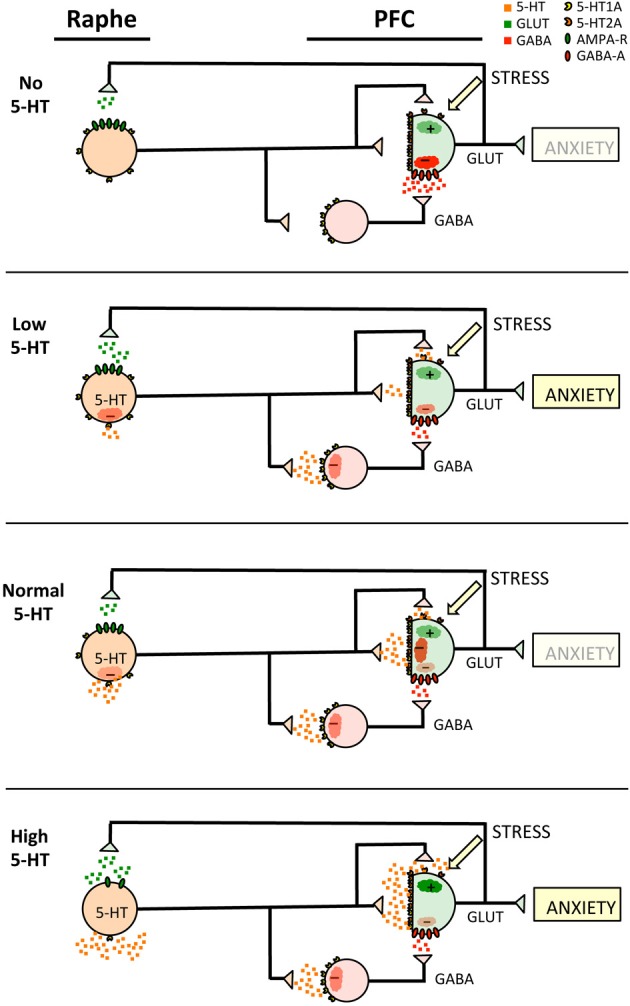
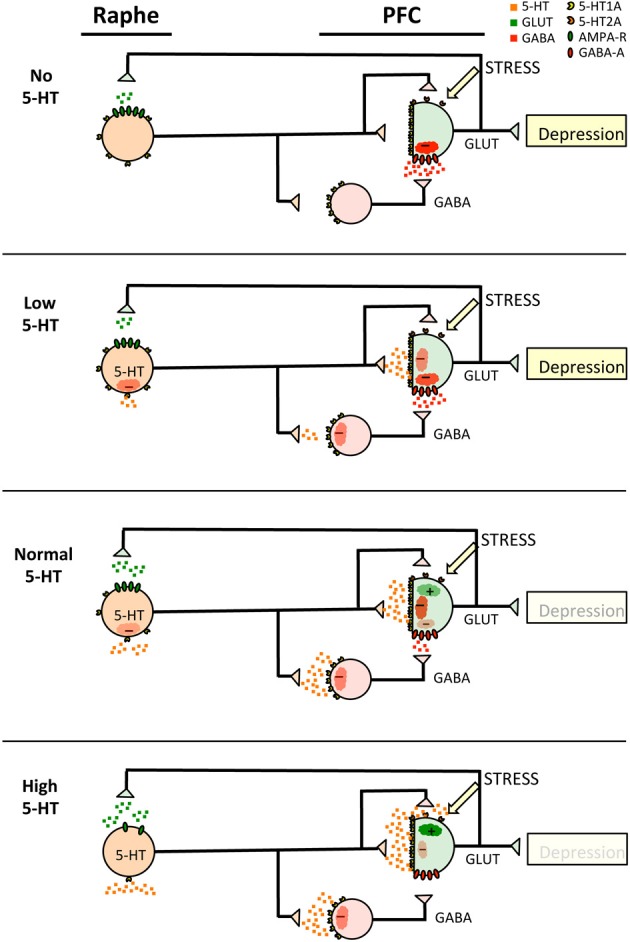
Verification
Claims the paper makes
The claims and statistics of this paper haven’t been checked yet.
Run the check — free, no account needed. It reads the open-access text and checks the sources it cites.
Claims other papers make about this one
Each is checked against this paper’s own text: does it say what the citing paper says it does?
The cited source says what the claim attributes to it.
In the citing paper
“Up-regulated serotonin 1A receptors may result from a 5-HT1A gene promoter polymorphism that causes overexpression of autoreceptors as a result of less binding of inhibitory transcription factors in serotonin neurons (120, 121).”
From A brain-centric model of suicidal behavior (2020) · cites this paper as [120]
Self-check
Percentages, sums and reported differences re-computed from the paper’s own numbers.
The self-check needs the paper’s full text.
Citations
Cites
Whiteford, H. A., Degenhardt, L., Rehm, J., Baxter, A. J., Ferrari, A. J., Erskine, H. E., Charlson, F. J., Norman, R. E., Flaxman, A. D., Johns, N., et al. (2013) · The Lancet · doi:10.1016/s0140-6736(13)61611-6 · Cited by 6,006
Depression: a new animal model sensitive to antidepressant treatments
PORSOLT, R. D., LE PICHON, M., & JALFRE, M. (1977) · Nature · doi:10.1038/266730a0 · Cited by 4,451
Requirement of hippocampal neurogenesis for the behavioral effects of antidepressants
Santarelli, L., Saxe, M., Gross, C., Surget, A., Battaglia, F., Dulawa, S., Weisstaub, N., Lee, J., Duman, R., Arancio, O., et al. (2003) · Science · doi:10.1126/science.1083328 · Cited by 4,321
Trivedi, M. H., Rush, A. J., Wisniewski, S. R., Nierenberg, A. A., Warden, D., Ritz, L., Norquist, G., Howland, R. H., Lebowitz, B., McGrath, P. J., et al. (2006) · American Journal of Psychiatry · doi:10.1176/appi.ajp.163.1.28 · Cited by 3,879
A review of central 5-HT receptors and their function
Barnes, N. M., & Sharp, T. (1999) · Neuropharmacology · doi:10.1016/s0028-3908(99)00010-6 · Cited by 3,211
The molecular neurobiology of depression
Krishnan, V., & Nestler, E. J. (2008) · Nature · doi:10.1038/nature07455 · Cited by 2,889
The use of a plus-maze to measure anxiety in the mouse
Lister, R. G. (1987) · Psychopharmacology · doi:10.1007/bf00177912 · Cited by 2,617
Synthesis of Serotonin by a Second Tryptophan Hydroxylase Isoform
Walther, D. J., Peter, J., Bashammakh, S., Hörtnagl, H., Voits, M., Fink, H., & Bäder, M. (2003) · Science · doi:10.1126/science.1078197 · Cited by 1,576
Caspi, A., Hariri, A. R., Holmes, A., Uher, R., & Moffitt, T. E. (2010) · American Journal of Psychiatry · doi:10.1176/appi.ajp.2010.09101452 · Cited by 1,346
Targeting abnormal neural circuits in mood and anxiety disorders: from the laboratory to the clinic
Ressler, K. J., & Mayberg, H. S. (2007) · Nature Neuroscience · doi:10.1038/nn1944 · Cited by 1,007
Research works printed but not linked: 1
- Newman-Tancredi, 2012, Gene polymorphism at serotonin 5-HT1A receptors: moving towards personalized medicine for psychosis and mood deficits, 337
Cited by
Sorted by citations
Anatomically defined and functionally distinct dorsal raphe serotonin sub-systems
Ren, J., Friedmann, D., Xiong, J., Liu, C. D., Ferguson, B. R., Weerakkody, T., DeLoach, K. E., Ran, C., Pun, A., Sun, Y., et al. (2018) · Cell · doi:10.1016/j.cell.2018.07.043 · Cited by 498
Neuroplasticity Underlying the Comorbidity of Pain and Depression
Doan, L., Manders, T. R., & Wang, J. (2015) · Neural Plasticity · doi:10.1155/2015/504691 · Cited by 304
Barnes, N. M., Ahern, G. P., Bécamel, C., Bockaert, J., Camilleri, M., Chaumont‐Dubel, S., Claeysen, S., Cunningham, K. A., Fone, K. C. F., Gershon, M. D., et al. (2020) · Pharmacological Reviews · doi:10.1124/pr.118.015552 · Cited by 274
Liu, Y., Zhao, J., & Guo, W. (2018) · Frontiers in Psychology · doi:10.3389/fpsyg.2018.02201 · Cited by 268
A brain-centric model of suicidal behavior
Mann, J. J., & Rizk, M. M. (2020) · American Journal of Psychiatry · doi:10.1176/appi.ajp.2020.20081224 · Cited by 214
Metadata
- Authors
- Albert, P. R., Vahid-Ansari, F., & Luckhart, C.
- Affiliations
- University of Ottawa (CA)
- Corresponding author
- Albert, Paul R.
- Venue
- Frontiers in Behavioral Neuroscience
- Publisher
- Frontiers Media SA
- Published
- 2014-06-06
- Volume
- 8
- Pages
- 199-199
- ISSN
- 1662-5153 (ISSN-L)
- PMC
- PMC4047678
- OpenAlex
- W2092933199
- Cited by
- 321
- References
- 139
- Citations by year
- 2026: 27 · 2025: 31 · 2024: 27 · 2023: 24 · 2022: 24 · 2021: 21 · 2020: 24 · 2019: 27 · 2018: 30 · 2017: 33 · 2016: 19 · 2015: 26 · 2014: 8
- FWCI
- 3.27
- Type
- journal article
- Language
- en
- Open access
- gold
- doi.org
- Licence
- cc-by
- Locations
- Frontiers in Behavioral Neuroscience (publishedVersion, cc-by)
- Europe PMC (PubMed Central) (publishedVersion, cc-by)
- PubMed Central (publishedVersion, cc-by)
- PubMed (publishedVersion)
- DOAJ (DOAJ: Directory of Open Access Journals) (submittedVersion, cc-by-sa)
- Funders
- Canadian Institutes of Health Research (123426_1, 115098_1)
- Topics
- Life Sciences › Neuroscience › Cellular and Molecular Neuroscience › Neurotransmitter Receptor Influence on Behavior
- Health Sciences › Medicine › Pharmacology (medical) › Treatment of Major Depression
- Life Sciences › Neuroscience › Cellular and Molecular Neuroscience › Neuroscience and Neuropharmacology Research
- Keywords
- serotonin, 5-HT1A receptor, prefrontal cortex, anxiety, depression, autoreceptors, heteroreceptors, pyramidal neurons, interneurons, DEAF1, glucocorticoid receptor, genetic mouse models, antidepressant targets
About these checks
Registry, retraction, Cites and statistics results are computed, not judged, with one exception: a printed reference that no index lists is read once by a model before it counts as a citation error. Claims are extracted by a model and kept only when their quote appears verbatim in the text; each cited source is then checked, with a model’s help, for whether it says what the claim relies on. Those verdicts can be wrong — read the claim’s quote and the cited source before relying on one.
Statistics and arithmetic are recomputed, not judged.
Confidence bands are shown only for fields calibrated on our annotated test set. None is calibrated yet, so no band is shown.
What counts as a claim ›How we measure confidence ›How we check this ›
Are you an author, or do you see a problem with this page? Request a review
