

The DOI matches its Crossref record; 137 of the 137 references it cites were found in a registry or an index.
Gut to Brain Dysbiosis: Mechanisms Linking Western Diet Consumption, the Microbiome, and Cognitive Impairment
Open accessAbstract
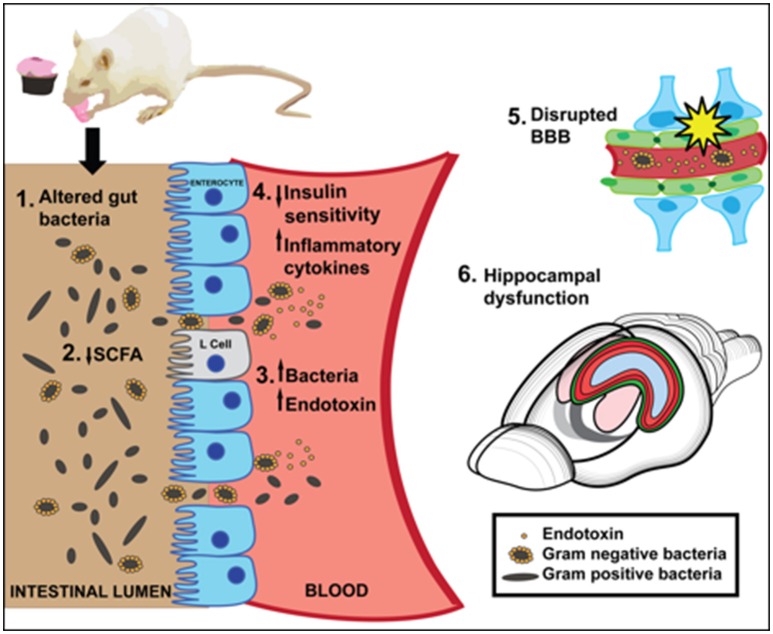
Consumption of a Western Diet (WD) that is high in saturated fat and added sugars negatively impacts cognitive function, particularly mnemonic processes that rely on the integrity of the hippocampus. Emerging evidence suggests that the gut microbiome influences cognitive function via the gut-brain axis, and that WD factors significantly alter the proportions of commensal bacteria in the gastrointestinal tract. Here we review mechanisms through which consuming a WD negatively impacts neurocognitive function, with a particular focus on recent evidence linking the gut microbiome with dietary- and metabolic-associated hippocampal impairment. We highlight evidence linking gut bacteria to altered intestinal permeability and blood brain barrier integrity, thus making the brain more vulnerable to the influx of deleterious substances from the circulation. WD consumption also increases production of endotoxin by commensal bacteria, which may promote neuroinflammation and cognitive dysfunction. Recent findings also show that diet-induced alterations in gut microbiota impair peripheral insulin sensitivity, which is associated with hippocampal neuronal derrangements and associated mnemonic deficits. In some cases treatment with specific probiotics or prebiotics can prevent or reverse some of the deleterious impact of WD consumption on neuropsychological outcomes, indicating that targeting the microbiome may be a successful strategy for combating dietary- and metabolic-associated cognitive impairment.
Overview
The claims and statistics of this paper haven’t been checked yet.
Run the check — free, no account needed. It reads the open-access text and checks the sources it cites.
Integrity signals
Registry
Cites
Statistics
Figures
Verification
Claims the paper makes
The claims and statistics of this paper haven’t been checked yet.
Run the check — free, no account needed. It reads the open-access text and checks the sources it cites.
Claims other papers make about this one
Each is checked against this paper’s own text: does it say what the citing paper says it does?
In the citing paper
“Indeed, the inflammatory effects of a diet high in calories and saturated fat have been proposed as one mechanism through which the Western diet may have detrimental effects on brain health, including cognitive decline, hippocampal dysfunction, and damage to the blood-brain barrier.15”
From Food and mood: How do diet and nutrition affect mental wellbeing? (2020) · cites this paper as [15]
In the citing paper
“On the other hand, high calorie meals rich in saturated fat appear to stimulate immune activation.13 15”
From Food and mood: How do diet and nutrition affect mental wellbeing? (2020) · cites this paper as [15]
In the citing paper
“Conversely, the consumption of a diet high in fibres, polyphenols, and unsaturated fatty acids (as found in a Mediterranean diet) can promote gut microbial taxa which can metabolise these food sources into anti-inflammatory metabolites,15 28 such as short chain fatty acids, while lowering the production of secondary bile acids and p-cresol.”
From Food and mood: How do diet and nutrition affect mental wellbeing? (2020) · cites this paper as [15]
In the citing paper
“In addition to genetic factors and exposure to antibiotics, diet is a potentially modifiable determinant of the diversity, relative abundance, and functionality of the gut microbiome throughout life.”
From Food and mood: How do diet and nutrition affect mental wellbeing? (2020) · cites this paper as [15]
In the citing paper
“Such a decrease in the function of the gut barrier is sometimes referred to as a “leaky gut” and has been linked to an “unhealthy” gut microbiome resulting from a diet low in fibre and high in saturated fats, refined sugars, and artificial sweeteners.15 23 27”
From Food and mood: How do diet and nutrition affect mental wellbeing? (2020) · cites this paper as [15]
In the citing paper
“For instance, the neurocognitive effects of the Western diet, and the possible mediating role of low grade systemic immune activation (as discussed above) may result from a compromised mucus layer with or without increased epithelial permeability.”
From Food and mood: How do diet and nutrition affect mental wellbeing? (2020) · cites this paper as [15]
In the citing paper
“Decreased levels of BDNF were found in subjects consuming diets with high sugar and fat [222, 223].”
From Brain-Derived Neurotrophic Factor in Brain Disorders: Focus on Neuroinflammation (2019) · cites this paper as [223]
Self-check
Percentages, sums and reported differences re-computed from the paper’s own numbers.
The self-check needs the paper’s full text.
Citations
Cites
1 retracted
Tsukumo, D. M. L., Carvalho-Filho, M. A., Carvalheira, J. B. C., Prada, P. O., Hirabara, S. M., Schenka, A. A., Araújo, E. P., Vassallo, J., Curi, R., Velloso, L. A., et al. (2007) · Diabetes · doi:10.2337/db06-1595 · Cited by 826
RetractedDiet rapidly and reproducibly alters the human gut microbiome
David, L. A., Maurice, C. F., Carmody, R. N., Gootenberg, D. B., Button, J. E., Wolfe, B. E., Ling, A. V., Devlin, A. S., Varma, Y., Fischbach, M. A., et al. (2014) · Nature · doi:10.1038/nature12820 · Cited by 10,100
Changes of Intestinal Functions in Liver Cirrhosis
Fukui, H., & Wiest, R. (2016) · Inflammatory Intestinal Diseases · doi:10.1159/000444436 · Cited by 6,820
Metabolic Endotoxemia Initiates Obesity and Insulin Resistance
Cani, P. D., Amar, J., Iglesias, M. A., Poggi, M., Knauf, C., Bastelica, D., Neyrinck, A. M., Fava, F., Tuohy, K. M., Chabo, C., et al. (2007) · Diabetes · doi:10.2337/db06-1491 · Cited by 6,638
Host-Bacterial Mutualism in the Human Intestine
Bäckhed, F., Ley, R. E., Sonnenburg, J. L., Peterson, D. A., & Gordon, J. I. (2005) · Science · doi:10.1126/science.1104816 · Cited by 5,277
Cani, P. D., Bibiloni, R., Knauf, C., Waget, A., Neyrinck, A. M., Delzenne, N. M., & Burcelin, R. (2008) · Diabetes · doi:10.2337/db07-1403 · Cited by 4,819
Hearing loss and cognitive decline in older adults
Lin, F. R., Yaffe, K., Xia, J., Xue, Q.-L., Harris, T. B., Purchase-Helzner, E., Satterfield, S., Ayonayon, H. N., Ferrucci, L., Simonsick, E. M., et al. (2013) · JAMA Internal Medicine · doi:10.1001/jamainternmed.2013.1868 · Cited by 4,017
Intestinal mucosal barrier function in health and disease
Turner, J. R. (2009) · Nature reviews. Immunology · doi:10.1038/nri2653 · Cited by 3,952
Gut Microbiota from Twins Discordant for Obesity Modulate Metabolism in Mice
Ridaura, V. K., Faith, J. J., Rey, F. E., Cheng, J., Duncan, A. E., Kau, A. L., Griffin, N. W., Lombard, V., Henrissat, B., Bain, J. R., et al. (2013) · Science · doi:10.1126/science.1241214 · Cited by 3,788
Hsiao, E. Y., McBride, S. W., Hsien, S., Sharon, G., Hyde, E. R., McCue, T., Codelli, J. A., Chow, J., Reisman, S. E., Petrosino, J. F., et al. (2013) · Cell · doi:10.1016/j.cell.2013.11.024 · Cited by 3,283
Cited by
Sorted by citations
Global Impacts of Western Diet and Its Effects on Metabolism and Health: A Narrative Review
Clemente‐Suárez, V. J., Beltrán-Velasco, A. I., Redondo-Flórez, L., Martín-Rodríguez, A., & Tornero-Aguilera, J. F. (2023) · Nutrients · doi:10.3390/nu15122749 · Cited by 933
Brain-Derived Neurotrophic Factor in Brain Disorders: Focus on Neuroinflammation
Lima Giacobbo, B., Doorduin, J., Klein, H. C., Dierckx, R. A. J. O., Bromberg, E., & de Vries, E. F. J. (2019) · Molecular Neurobiology · doi:10.1007/s12035-018-1283-6 · Cited by 750
Microbiome, probiotics and neurodegenerative diseases: deciphering the gut brain axis
Westfall, S., Lomis, N., Kahouli, I., Dia, S. Y., Singh, S. P., & Prakash, S. (2017) · Cellular and Molecular Life Sciences · doi:10.1007/s00018-017-2550-9 · Cited by 570
Food and mood: How do diet and nutrition affect mental wellbeing?
Firth, J., Gangwisch, J. E., Borsini, A., Wootton, R. E., & Mayer, E. A. (2020) · BMJ · doi:10.1136/bmj.m2382 · Cited by 475
Nutritional psychiatry: Towards improving mental health by what you eat
Adan, R. A. H., van der Beek, E. M., Buitelaar, J. K., Cryan, J. F., Hebebrand, J., Higgs, S., Schellekens, H., & Dickson, S. L. (2019) · European Neuropsychopharmacology · doi:10.1016/j.euroneuro.2019.10.011 · Cited by 454
Metadata
- Authors
- Noble, E. E., Hsu, T. M., & Kanoski, S. E.
- Affiliations
- University of Southern California (US)
- Corresponding author
- Kanoski, Scott E.
- Venue
- Frontiers in Behavioral Neuroscience
- Publisher
- Frontiers Media SA
- Published
- 2017-01-30
- Volume
- 11
- Pages
- 9-9
- ISSN
- 1662-5153 (ISSN-L)
- PMC
- PMC5277010
- OpenAlex
- W2574256641
- Cited by
- 333
- References
- 137
- Citations by year
- 2026: 26 · 2025: 30 · 2024: 36 · 2023: 60 · 2022: 37 · 2021: 38 · 2020: 42 · 2019: 26 · 2018: 27 · 2017: 11
- FWCI
- 2.71
- Type
- journal article
- Language
- en
- Open access
- gold
- doi.org
- Licence
- cc-by
- Locations
- Frontiers in Behavioral Neuroscience (publishedVersion, cc-by)
- PubMed Central (publishedVersion, cc-by)
- PubMed (publishedVersion)
- Funders
- National Institute of Diabetes and Digestive and Kidney Diseases (DK104897)
- Topics
- Life Sciences › Biochemistry, Genetics and Molecular Biology › Molecular Biology › Gut microbiota and health
- Health Sciences › Medicine › Public Health, Environmental and Occupational Health › Nutritional Studies and Diet
- Health Sciences › Medicine › Gastroenterology › Gastrointestinal motility and disorders
- Keywords
- Western diet, gut microbiota, gut-brain axis, cognitive impairment, hippocampus, memory impairment, intestinal permeability, blood-brain barrier, endotoxin, neuroinflammation, insulin sensitivity, probiotics, prebiotics, dietary fat, added sugars
About these checks
Registry, retraction, Cites and statistics results are computed, not judged, with one exception: a printed reference that no index lists is read once by a model before it counts as a citation error. Claims are extracted by a model and kept only when their quote appears verbatim in the text; each cited source is then checked, with a model’s help, for whether it says what the claim relies on. Those verdicts can be wrong — read the claim’s quote and the cited source before relying on one.
Statistics and arithmetic are recomputed, not judged.
Confidence bands are shown only for fields calibrated on our annotated test set. None is calibrated yet, so no band is shown.
What counts as a claim ›How we measure confidence ›How we check this ›
Are you an author, or do you see a problem with this page? Request a review
