

FOCUS: object-centric world models for robotic manipulation
Open accessThe DOI matches its Crossref record; 58 of the 99 references it cites were found in a registry or an index; none of the 3 sources its claims cite is checked for support yet.
Abstract
Understanding the world in terms of objects and the possible interactions with them is an important cognitive ability. However, current world models adopted in reinforcement learning typically lack this structure and represent the world state in a global latent vector. To address this, we propose FOCUS, a model-based agent that learns an object-centric world model. This novel representation also enables the design of an object-centric exploration mechanism, which encourages the agent to interact with objects and discover useful interactions. We benchmark FOCUS in several robotic manipulation settings, where we found that our method can be used to improve manipulation skills. The object-centric world model leads to more accurate predictions of the objects in the scene and it enables more efficient learning. The object-centric exploration strategy fosters interactions with the objects in the environment, such as reaching, moving, and rotating them, and it allows fast adaptation of the agent to sparse reward reinforcement learning tasks. Using a Franka Emika robot arm, we also showcase how FOCUS proves useful in real-world applications. Website: focus-manipulation.github.io.
Overview
CoChat Summary
TL;DR
FOCUS is a model-based RL agent that learns an object-centric world model and an object-focused exploration reward for robotic manipulation. Across simulated and real-world manipulation settings, the paper reports better object interaction, stronger sparse-reward adaptation, and improved object prediction than flat world-model baselines.
Key findings
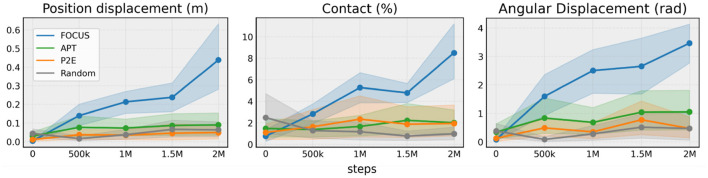
- In exploration on 10 tasks from ManiSkill2, robosuite, and Metaworld, FOCUS “interacts with objects much more assiduously” than Plan2Explore, Active Pre-training, and Random; the paper reports that FOCUS’s exploration performance “consistently increas[es] over time.”
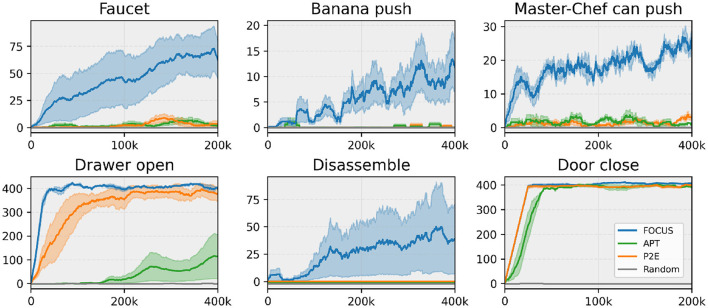
- In sparse-reward fine-tuning after 2M environment steps of exploration, FOCUS shows the “most significant progress across all tasks,” and the paper says it found rewarding interactions early enough that fine-tuning “starts increasing almost immediately in all tasks.”
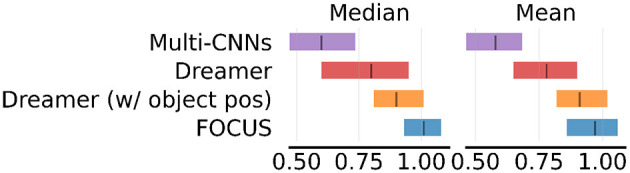
- On 6 dense-reward tasks, FOCUS obtains the highest median and mean performance compared with Dreamer, Dreamer (w/ object pos), and Multi-CNNs, supporting the claim that object-centric world models improve manipulation performance.
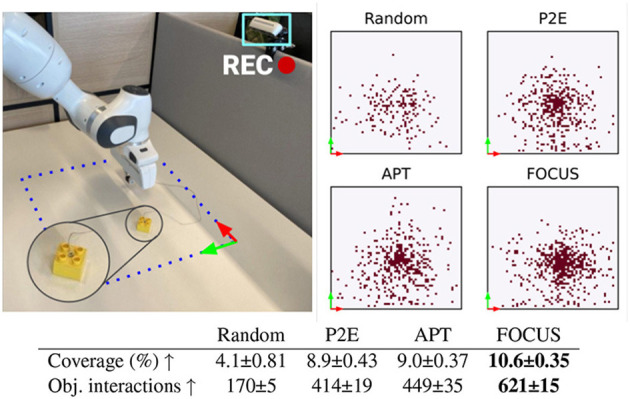
- In the real-world Franka Emika setup, after 50k random-interaction pretraining and 10k fine-tuning steps, FOCUS has the highest interaction score with the object and the highest coverage of object positions in the workspace.
Methods
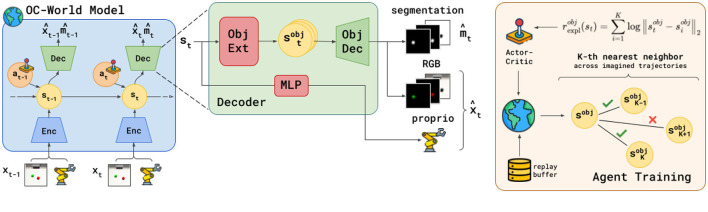
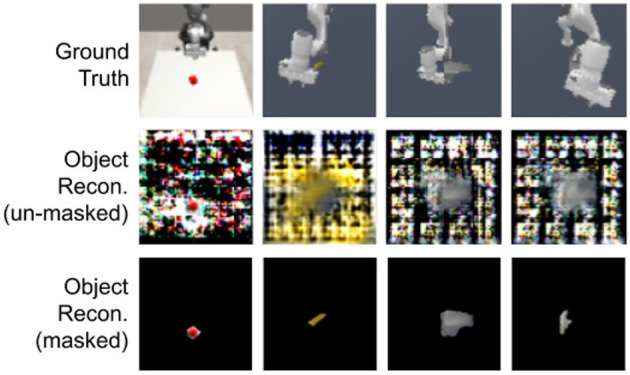
- FOCUS combines a Dreamer-style recurrent state-space world model with object-centric components: an object latent extractor and an object decoder that reconstruct per-object masks and masked RGB observations.
- Exploration is driven by maximizing entropy over the object latent representation, estimated with a K-NN particle-based estimator using K = 30 nearest neighbors.
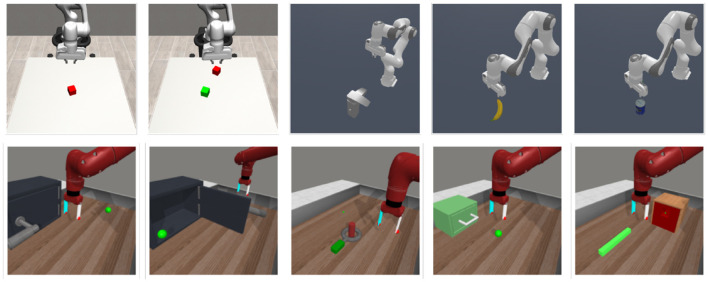
- Experiments span 10 sparse-reward tasks from ManiSkill2, robosuite, and Metaworld; 6 dense-reward tasks; and a real-world Franka Emika tabletop pushing setup. For segmentation, the paper uses fastSAM and XMem tracking when masks are not provided.
Limitations
- The paper states that FOCUS requires a “consistent amount of training steps” to learn a robust world model, and that this makes full deployment in a complex real-world environment challenging; it notes FOCUS only begins to show an edge after 500k explorative steps.
- The paper states that scalability is its “primary limitation” for scenes with more than 2 objects of interest, because each object requires an additional output map for segmentation weights and RGB channels, increasing compute and memory use.
- Evident from the text: the method depends on segmentation masks (from simulation or from fastSAM/XMem in real settings), so its performance and applicability are tied to the quality and availability of object segmentation.
Model-written summary. Check it against the paper before relying on it.
Integrity signals
Registry
Cites
Statistics
Figures
Verification
Claims the paper makes
0 Valid · 0 Not valid · 3 Not checked · 18 Own results and interpretations
A result the paper reports from its own data — it cites no other source for it, so there is none to check. The quote shows it is in the paper.
In the paper
“Indeed, FOCUS starts to show an edge over the other methods after 500 K explorative steps.”
plainstates an association- Asserted: passes — The authors put it forward as true.
- Checkable: passes — It can be checked against evidence.
- Load-bearing: unclear — It is unclear whether the paper’s conclusions depend on it.
- Based: passes — The paper gives a reason why it holds.
A result the paper states — it cites no source for it, so there is none to check. The quote shows it is in the paper.
In the paper
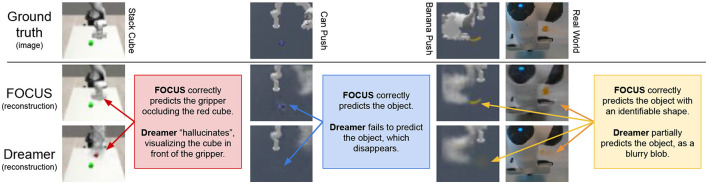
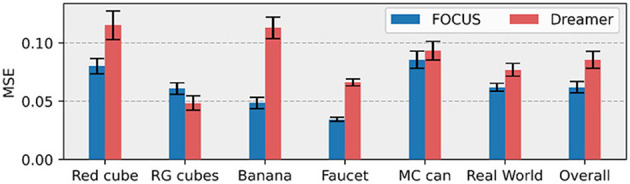
“In general, the implicit segmentation knowledge makes it for more dynamically consistent reconstructions when compared to Dreamer.”
plainstates a cause- Asserted: passes — The authors put it forward as true.
- Checkable: passes — It can be checked against evidence.
- Load-bearing: passes — The paper’s conclusions depend on it.
- Based: passes — The paper gives a reason why it holds.
A result the paper reports from its own data — it cites no other source for it, so there is none to check. The quote shows it is in the paper.
In the paper
“we observe that Plan2Explore and APT were able to consistently find rewarding interactions only in a few tasks (Drawer Open, Door Close), where they perform well and similarly to FOCUS.”
plain- Asserted: passes — The authors put it forward as true.
- Checkable: passes — It can be checked against evidence.
- Load-bearing: passes — The paper’s conclusions depend on it.
- Based: passes — The paper gives a reason why it holds.
A result the paper reports from its own data — it cites no other source for it, so there is none to check. The quote shows it is in the paper.
In the paper
“To confirm what was seen during the simulation experiments, FOCUS has the highest interaction score with the object.”
plain- Asserted: passes — The authors put it forward as true.
- Checkable: passes — It can be checked against evidence.
- Load-bearing: passes — The paper’s conclusions depend on it.
- Based: passes — The paper gives a reason why it holds.
A result the paper reports from its own data — it cites no other source for it, so there is none to check. The quote shows it is in the paper.
In the paper
“The results show that FOCUS is the method that makes the most significant progress across all tasks.”
plainstates a cause- Asserted: passes — The authors put it forward as true.
- Checkable: passes — It can be checked against evidence.
- Load-bearing: passes — The paper’s conclusions depend on it.
- Based: passes — The paper gives a reason why it holds.
5 more claims
Create a free account to see all 21 claims and to verify the 3 references still open.
- It may state two separate claims as one. 7
- The quote only partly states this claim. 3
- Probably not a substantial claim. 1
Self-check
Percentages, sums and reported differences re-computed from the paper’s own numbers.
Each contradiction between two passages listed here was confirmed by an independent check.
Rated minor: it would not touch a result — a value no result rests on, a p-value that stays on the same side of the significance level, or a conflict that is clerical, resolved elsewhere in the paper, or outside its own findings.
In the paper
“(4) m t ^ = softmax ( l t 1 , . . . , l t N )”
“(5) L obj = - log p ( m t ^ ) ︸ mask - log ∑ obj = 0 N m t obj p θ ( x ^ t obj | s t obj ) ︸ masked reconstruction”
Citations
Cites
Kirillov, A., Mintun, E., Ravi, N., Mao, H., Rolland, C., Gustafson, L., Xiao, T., Whitehead, S., Berg, A. C., Lo, W.-Y., et al. (2023) · 2023 IEEE/CVF International Conference on Computer Vision (ICCV) · doi:10.1109/iccv51070.2023.00371 · Cited by 11,953
Proceedings of the 24th international conference on Machine learning
(2007) · doi:10.1145/1273496 · Cited by 11,630
Proximal Policy Optimization Algorithms
Schulman, J., Wolski, F., Dhariwal, P., Radford, A., & Klimov, O. (2017) · arXiv · doi:10.48550/arxiv.1707.06347 · Cited by 10,625
Soft actor-critic Off-policy maximum entropy deep reinforcement learning with a stochastic actor
Haarnoja, T., Zhou, A., Abbeel, P., & Levine, S. (2018) · arXiv · doi:10.48550/arxiv.1801.01290 · Cited by 5,594 · cited 2×
“Among RL algorithms, model-based approaches aspire to provide greater data efficiency, compared to the model-free counterparts (Fujimoto et al., 2018; Haarnoja et al., 2018).”
Addressing Function Approximation Error in Actor-Critic Methods
Fujimoto, S., van Hoof, H., & Meger, D. (2018) · arXiv · doi:10.48550/arxiv.1802.09477 · Cited by 3,650 · cited 2×
“Among RL algorithms, model-based approaches aspire to provide greater data efficiency, compared to the model-free counterparts (Fujimoto et al., 2018; Haarnoja et al., 2018).”
Curiosity-Driven Exploration by Self-Supervised Prediction
Pathak, D., Agrawal, P., Efros, A. A., & Darrell, T. (2017) · 2017 IEEE Conference on Computer Vision and Pattern Recognition Workshops (CVPRW) · doi:10.1109/cvprw.2017.70 · Cited by 1,815 · cited 1×
“Inspired by artificial curiosity theories (Schmidhuber, 1991; Oudeyer et al., 2007), several works have designed exploration strategies for RL (Pathak et al., 2017; Mazzaglia et al., 2022; Rajeswar et al., 2021).”
End-to-End Training of Deep Visuomotor Policies
Levine, S., Finn, C., Darrell, T. J., & Abbeel, P. (2015) · arXiv (Cornell University) · doi:10.48550/arxiv.1504.00702 · Cited by 1,344 · cited 1×
“In recent years, deep reinforcement learning (RL) has shown to be a promising approach for dealing with complex manipulation scenarios (Levine et al., 2016; OpenAI et al., 2019; Kalashnikov et al., 2018; Lu et al., 2021; Lee et al., 2021; Ferraro et al., 2022a).”
Concrete Problems in AI Safety
Amodei, D., Olah, C., Steinhardt, J., Christiano, P., Schulman, J., & Mané, D. (2016) · arXiv · doi:10.48550/arxiv.1606.06565 · Cited by 1,314 · cited 1×
“Attempting to design dense reward functions easily leads to faulty reward designs (Amodei et al., 2016; Clark and Amodei, 2016; Krakovna et al., 2020; Popov et al., 2017).”
Mastering Atari, Go, chess and shogi by planning with a learned model
Schrittwieser, J., Antonoglou, I., Hubert, T., Simonyan, K., Sifre, L., Schmitt, S., Guez, A., Lockhart, E., Hassabis, D., Graepel, T., et al. (2020) · RePEc: Research Papers in Economics · Cited by 1,310
Mastering Atari, Go, chess and shogi by planning with a learned model
Schrittwieser, J., Antonoglou, I., Hubert, T., Simonyan, K., Sifre, L., Schmitt, S., Guez, A., Lockhart, E., Hassabis, D., Graepel, T., et al. (2020) · Nature · doi:10.1038/s41586-020-03051-4 · Cited by 1,214
Research works printed but not linked: 11
- Daniel, 2022, “Unsupervised image representation learning with deep latent particles,”, 4644
- Dittadi, 2021, Generalization and robustness implications in object-centric learning, arXiv [Preprint].
- Goodfellow I. Bengio Y. Courville A. Cambridge, MA MIT Press Deep Learning 2016
- Janner, 2019, “Reasoning about physical interactions with object-centric models,”, International Conference on Learning Representations
- Lu, 2021, “AW-Opt: learning robotic skills with imitation andreinforcement at scale,”, 5th Annual Conference on Robot Learning (CoRL
- Nakano, 2023, “Interaction-based disentanglement of entities for object-centric world models,”, The Eleventh International Conference on Learning Representations
- Pathak, 2019, Self-supervised exploration via disagreement, arXiv [Preprint].
- Popov, 2017, Data-efficient deep reinforcement learning for dexterous manipulation, arXiv [Preprint].
- Schmidhuber, 1991, “Curious model-building control systems,”, 1458
- Seo, 2021, State entropy maximization with random encoders for efficient exploration, arXiv [Preprint].
- Zhao, 2023, Fast segment anything, arXiv [Preprint].
Cited by
World Model-Based Perception for Visual Legged Locomotion
Lai, H., Cao, J., Xu, J., Wu, H., Lin, Y., Kong, T., Yu, Y. H., & Zhang, W. (2025) · Proceedings - IEEE International Conference on Robotics and Automation/Proceedings · doi:10.1109/icra55743.2025.11128762 · Cited by 51
World Models for Robotic Manipulation: A Survey
Wang, F., Wang, Z., Pei, G., Zhang, M., 梁燦錫, Hu, J., Li, Z., Wu, J., Han, N., Zhang, Z., et al. (2026) · SmartBot · doi:10.1002/smb2.70053 · Cited by 13
Wang, C., He, Q., Pei, J., Xia, L., Liu, J., Li, B., & Di, X. (2026) · Computer Vision and Image Understanding · doi:10.1016/j.cviu.2026.104828
Li, H., Lu, J., Huang, Z., Chen, Z., Li, B. Z., & Chen, X. (2026) · International Conference on Information Science, Electrical and Automation Engineering (ISEAE) · doi:10.1109/iseae69422.2026.11545100
OCC-MLLM-V2: Joint understanding and generation for occluded objects via multi-modal token learning
Wang, C., He, Q., Yang, Y., Pei, J., Xia, L., Liu, J., Li, B., & Di, X. (2026) · Journal of Visual Communication and Image Representation · doi:10.1016/j.jvcir.2026.104887
DiNBV-Grasp: Real-Time Distance-Aware Two-Stage Next-Best-View for Robotic Grasping
Xie, Z., Gong, J., Tan, X., Zhang, Z., Qu, Y., Ma, L., & Xie, Y. (2026) · Lecture notes in computer science · doi:10.1007/978-3-032-37026-6_37
Yang, Y., Feng, H., & Lu, B. (2026) · Sensors · doi:10.3390/s26185944
“Dreamer [3], DayDreamer [57], and iVideoGPT [66] illustrate this family across latent control, real robot learning, and interactive video prediction.”
Ng, W. C., Xie, Q., Lee, Y. K., Tee, W. H., Abdulrab, H. Q. A., Hii, T. C. S., & Ding, T. J. (2026) · Neurocomputing · doi:10.1016/j.neucom.2026.135279
Metadata
- Authors
- Ferraro, S., Mazzaglia, P., Verbelen, T., & Dhoedt, B.
- Affiliations
- Ghent University (BE)
- VERSES (United States) (US)
- Corresponding author
- Ferraro, Stefano
- Venue
- Frontiers in Neurorobotics
- Publisher
- Frontiers Media SA
- Published
- 2025-04-30
- Volume
- 19
- Pages
- 1585386-1585386
- ISSN
- 1662-5218 (ISSN-L)
- PMC
- PMC12075287
- OpenAlex
- W4409975538
- Cited by
- 9
- References
- 99
- Citations by year
- 2026: 8 · 2025: 1
- FWCI
- 3.61
- Type
- journal article
- Language
- en
- Open access
- gold
- doi.org
- Licence
- Locations
- Frontiers in Neurorobotics (publishedVersion, cc-by)
- PubMed Central (publishedVersion, cc-by)
- PubMed (publishedVersion)
- Ghent University Academic Bibliography (Ghent University) (submittedVersion, cc-by)
- DOAJ (DOAJ: Directory of Open Access Journals) (submittedVersion, cc-by-sa)
- Funders
- Fonds Wetenschappelijk Onderzoek
- Vlaamse regering
- Topics
- Physical Sciences › Computer Science › Artificial Intelligence › Reinforcement Learning in Robotics
- Physical Sciences › Engineering › Control and Systems Engineering › Robot Manipulation and Learning
- Physical Sciences › Computer Science › Artificial Intelligence › AI-based Problem Solving and Planning
- Keywords
- robotic manipulation, model-based reinforcement learning, object interaction
About these checks
Registry, retraction, Cites and statistics results are computed, not judged, with one exception: a printed reference that no index lists is read once by a model before it counts as a citation error. Claims are extracted by a model and kept only when their quote appears verbatim in the text; each cited source is then checked, with a model’s help, for whether it says what the claim relies on. Those verdicts can be wrong — read the claim’s quote and the cited source before relying on one.
A language model drew the claims from the paper on 2026-10-11, under version 3 of the claim definition (model deepseek-v4.1-flash, prompt extract-v3).
A second model labelled each claim on 2026-10-11 (model jev-1.13-20260917, definition revision gold-guideline-v0.2).
Statistics and arithmetic are recomputed, not judged.
Confidence bands are shown only for fields calibrated on our annotated test set. None is calibrated yet, so no band is shown.
What counts as a claim ›How we measure confidence ›How we check this ›
Are you an author, or do you see a problem with this page? Request a review
Data sources
Bibliographic data: Semantic Scholar, OpenAlex, Crossref.
Contains information from the Semantic Scholar Academic Graph Datasets, made available under the ODC Attribution License (ODC-BY 1.0).
Semantic Scholar’s data is described in: Kinney, R., et al. (2023). The Semantic Scholar Open Data Platform. arXiv:2301.10140.
