

The DOI matches its Crossref record; 86 of the 89 references it cites were found in a registry or an index.
CYFIP family proteins between autism and intellectual disability: links with Fragile X syndrome
Open accessAbstract
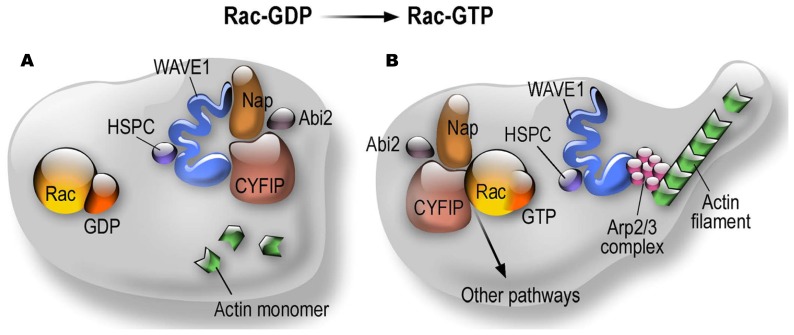
Intellectual disability (ID) and autism spectrum disorders (ASDs) have in common alterations in some brain circuits and brain abnormalities, such as synaptic transmission and dendritic spines morphology. Recent studies have indicated a differential expression for specific categories of genes as a cause for both types of disease, while an increasing number of genes is recognized to produce both disorders. An example is the Fragile X mental retardation gene 1 (FMR1), whose silencing causes the Fragile X syndrome, the most common form of ID and autism, also characterized by physical hallmarks. Fragile X mental retardation protein (FMRP), the protein encoded by FMR1, is an RNA-binding protein with an important role in translational control. Among the interactors of FMRP, CYFIP1/2 (cytoplasmic FMRP interacting protein) proteins are good candidates for ID and autism, on the bases of their genetic implication and functional properties, even if the precise functional significance of the CYFIP/FMRP interaction is not understood yet. CYFIP1 and CYFIP2 represent a link between Rac1, the WAVE (WAS protein family member) complex and FMRP, favoring the cross talk between actin polymerization and translational control.
Overview
The claims and statistics of this paper haven’t been checked yet.
Run the check — free, no account needed. It reads the open-access text and checks the sources it cites.
Integrity signals
Registry
Cites
Statistics
Figures
Verification
Claims the paper makes
The claims and statistics of this paper haven’t been checked yet.
Run the check — free, no account needed. It reads the open-access text and checks the sources it cites.
Claims other papers make about this one
Each is checked against this paper’s own text: does it say what the citing paper says it does?
The source backs part of the claim, not all of it — or backs it for a different population, condition or comparison.
In the citing paper
“Indeed, it is reported that reduction of Cyfip1 or fly Hspc300 affects the level of the other components of the WRC (Kunda et al., 2003; Schenck et al., 2004; Abekhoukh and Bardoni, 2014; Gautier et al., 2011; Qurashi et al., 2007; De Rubeis et al., 2013).”
From New insights into the regulatory function of CYFIP1 in the context of WAVE- and FMRP-containing complexes (2017) · cites this paper as Abekhoukh and Bardoni, 2014
Experimental — accuracy not yet measuredThe source backs part of the claim, not all of it — or backs it for a different population, condition or comparison.
In the citing paper
“while it is known that CYFIP1 interacts with many proteins (Rac, WRC members and membrane components) that are not known partners of FMRP (Abekhoukh and Bardoni, 2014).”
From New insights into the regulatory function of CYFIP1 in the context of WAVE- and FMRP-containing complexes (2017) · cites this paper as Abekhoukh and Bardoni, 2014
Experimental — accuracy not yet measuredThe cited source says what the claim attributes to it.
In the citing paper
“CYFIP1 and CYFIP2 are members of a family of proteins interacting with the Fragile X mental retardation protein (FMRP, encoded by FMR1) in mammals, as well as in the fly (Abekhoukh and Bardoni, 2014; Schenck et al., 2001, 2003).”
From New insights into the regulatory function of CYFIP1 in the context of WAVE- and FMRP-containing complexes (2017) · cites this paper as Abekhoukh and Bardoni, 2014
The cited source says what the claim attributes to it.
In the citing paper
“Owing to their high level of homology, CYFIP1 and CYFIP2 have been often considered as having the same function (Abekhoukh and Bardoni, 2014).”
From New insights into the regulatory function of CYFIP1 in the context of WAVE- and FMRP-containing complexes (2017) · cites this paper as Abekhoukh and Bardoni, 2014
The cited source says what the claim attributes to it.
In the citing paper
“These conclusions are consistent with the fact that FMRP is, indeed, not only involved in translation regulation (Maurin et al., 2014) and CYFIP1 is a component of complexes that do not contain FMRP (Abekhoukh and Bardoni, 2014; Chen et al., 2014).”
From New insights into the regulatory function of CYFIP1 in the context of WAVE- and FMRP-containing complexes (2017) · cites this paper as Abekhoukh and Bardoni, 2014
Self-check
Percentages, sums and reported differences re-computed from the paper’s own numbers.
The self-check needs the paper’s full text.
Citations
Cites
FMRP Stalls Ribosomal Translocation on mRNAs Linked to Synaptic Function and Autism
Darnell, J. C., Van Driesche, S. J., Zhang, C., Hung, K. Y. S., Mele, A., Fraser, C. E., Stone, E. F., Chen, C., Fak, J. J., Chi, S. W., et al. (2011) · Cell · doi:10.1016/j.cell.2011.06.013 · Cited by 2,072
Large recurrent microdeletions associated with schizophrenia.
GROUP, Stefansson, H., Rujescu, D., Cichon, S., Pietiläinen, O. P. H., Ingason, A., Steinberg, S., Fossdal, R., Sigurdsson, E., Sigmundsson, T., et al. (2008) · Nature · doi:10.1038/nature07229 · Cited by 1,745
De novo mutations in schizophrenia implicate synaptic networks
Fromer, M., Pocklington, A. J., Kavanagh, D. H., Williams, H. J., Dwyer, S., Gormley, P., Georgieva, L., Rees, E., Palta, P., Ruderfer, D. M., et al. (2014) · Nature · doi:10.1038/nature12929 · Cited by 1,617
A polygenic burden of rare disruptive mutations in schizophrenia
Purcell, S. M., Moran, J. L., Fromer, M., Ruderfer, D., Solovieff, N., Roussos, P., O’Dushlaine, C., Chambert, K., Bergen, S. E., Kähler, A., et al. (2014) · Nature · doi:10.1038/nature12975 · Cited by 1,385
Altered synaptic plasticity in a mouse model of fragile X mental retardation
Huber, K. M., Gallagher, S. M., Warren, S. T., & Bear, M. F. (2002) · Proceedings of the National Academy of Sciences · doi:10.1073/pnas.122205699 · Cited by 1,349
Brown, V., Jin, P., Ceman, S., Darnell, J. C., O'Donnell, W. T., Tenenbaum, S. A., Jin, X., Feng, Y., Wilkinson, K. D., Keene, J. D., et al. (2001) · Cell · doi:10.1016/s0092-8674(01)00568-2 · Cited by 1,109
Abnormal dendritic spines in fragile X knockout mice: Maturation and pruning deficits
Comery, T. A., Harris, J. B., Willems, P. J., Oostra, B. A., Irwin, S. A., Weiler, I. J., & Greenough, W. T. (1997) · Proceedings of the National Academy of Sciences · doi:10.1073/pnas.94.10.5401 · Cited by 1,046
Willsey, A. J., Sanders, S. J., Li, M., Dong, S., Tebbenkamp, A. T., Muhle, R. A., Reilly, S. K., Lin, L., Fertuzinhos, S., Miller, J. A., et al. (2013) · Cell · doi:10.1016/j.cell.2013.10.020 · Cited by 934
Mechanism of regulation of WAVE1-induced actin nucleation by Rac1 and Nck
Eden, S., Rohatgi, R., Podtelejnikov, A. V., Mann, M., & Kirschner, M. W. (2002) · Nature · doi:10.1038/nature00859 · Cited by 835
Gilman, S. R., Iossifov, I., Levy, D., Ronemus, M., Wigler, M., & Vitkup, D. (2011) · Neuron · doi:10.1016/j.neuron.2011.05.021 · Cited by 701
Research works printed but not linked: 3
- Bardoni, 2000, Fmr1 gene and fragile X syndrome., Am. J. Med. Genet., 97, 153, 10.1002/1096-8628(200022)97:2153::AID-AJMG73.0.CO;2-M · DOI
- Cassidy, 2000, Prader-Willi and Angelman syndromes: sister imprinted disorders., Am. J. Med. Genet., 97, 136, 10.1002/1096-8628(200022)97:2136::AID-AJMG53.0.CO;2-V · DOI
- Spranger, 2000, Interstitial deletion of 5q33.3q35.1 in a girl with mild mental retardation., Am. J. Med. Genet., 93, 107, 10.1002/1096-8628(20000717)93:2107::AID-AJMG53.0.CO;2-8 · DOI
Cited by
Sorted by citations
Items 101–110 of 110
Ahmed, T. S., Mahmood, K., Khattak, M. S. N. A., Noor, A., Liang, H., & Rahman, S. U. (2024) · Human Gene · doi:10.1016/j.humgen.2024.201301
Yotova, A. Y. (2024) · Publication Server of Goethe University Frankfurt am Main (Goethe University Frankfurt) · doi:10.21248/gups.85791
Neurodevelopmental Disorders and the Cyfip2 Gene: Linking Visual Acuity
Chaya, T., Ando, M., & Furukawa, T. (2024) · Springer eBooks · doi:10.1007/978-3-031-32035-4_68-1
Translational Pain Research: Dendritic Spines as Therapeutic Targets
Benson, C. A., Waxman, S. G., & Tan, A. M. (2025) · Springer eBooks · doi:10.1007/978-3-031-89307-0_23
Neurodevelopmental Disorders and the Cyfip2 Gene: Linking Visual Acuity
Chaya, T., Ando, M., & Furukawa, T. (2025) · Springer eBooks · doi:10.1007/978-3-031-73368-0_68
Kim, G. H., Zhang, Y., Kang, H. R., Lee, S.-H., Shin, J., Lee, C. H., Kang, H., Ma, R., Jin, C., Kim, Y., et al. (2020) · Figshare · doi:10.6084/m9.figshare.12947948
Dissecting the role of calcium signaling in Fragile X syndrome
Castagnola, S. (2019) · theses.fr (ABES) · doi:10.70675/3d35096bz79d0z46edz8a70zb783a8f60257
Pathophysiological consequences of a Fragile X missense mutation
Garcia, M. P. (2020) · theses.fr (ABES) · doi:10.70675/b8e86263z5926z4a83zbaf6z0f61bf2d15f9
Baldini, L. (2021) · theses.fr (ABES) · doi:10.70675/2bc16bcbz27cfz453czb929zfe82ebe5f9ae
Rôle de la phosphodiestérase 2A dans la physiopathologie du syndrome de l’X fragile
Delhaye, S. (2021) · theses.fr (ABES) · doi:10.70675/e0fac395z63d4z46a4z944aza4037215ca98
Metadata
- Authors
- Abekhoukh, S., & Bardoni, B.
- Affiliations
- Centre National de la Recherche Scientifique (FR)
- Corresponding author
- Bardoni, Barbara
- Venue
- Frontiers in Cellular Neuroscience
- Publisher
- Frontiers Media SA
- Published
- 2014-03-27
- Volume
- 8
- Pages
- 81-81
- ISSN
- 1662-5102 (ISSN-L)
- PMC
- PMC3973919
- OpenAlex
- W2123421954
- Cited by
- 110
- References
- 89
- Citations by year
- 2026: 1 · 2025: 6 · 2024: 9 · 2023: 16 · 2022: 5 · 2021: 11 · 2020: 12 · 2019: 10 · 2018: 14 · 2017: 8 · 2016: 9 · 2015: 8 · 2014: 1
- FWCI
- 1.15
- Type
- journal article
- Language
- en
- Open access
- gold
- doi.org
- Licence
- cc-by
- Locations
- Frontiers in Cellular Neuroscience (publishedVersion, cc-by)
- Europe PMC (PubMed Central) (publishedVersion, cc-by)
- PubMed Central (publishedVersion, cc-by)
- PubMed (publishedVersion)
- DOAJ (DOAJ: Directory of Open Access Journals) (submittedVersion, cc-by-sa)
- Funders
- Agence Nationale de la Recherche (ANR-11-LABX-0028)
- Institut National de la Santé et de la Recherche Médicale (ANR-11-LABX-0028-01)
- Fondation ARC pour la Recherche sur le Cancer (#ANR-11-LABX-0028-01)
- Centre National de la Recherche Scientifique (ANR-11-LABX-0028-01)
- Topics
- Life Sciences › Biochemistry, Genetics and Molecular Biology › Genetics › Genetics and Neurodevelopmental Disorders
- Life Sciences › Neuroscience › Cognitive Neuroscience › Autism Spectrum Disorder Research
- Life Sciences › Neuroscience › Cellular and Molecular Neuroscience › Neuroscience and Neuropharmacology Research
- Keywords
- CYFIP1, CYFIP2, FMRP, FMR1 gene, fragile X syndrome, autism spectrum disorder, intellectual disability, translational regulation, actin polymerization, WAVE complex, Rac1, synaptic transmission, dendritic spines
About these checks
Registry, retraction, Cites and statistics results are computed, not judged, with one exception: a printed reference that no index lists is read once by a model before it counts as a citation error. Claims are extracted by a model and kept only when their quote appears verbatim in the text; each cited source is then checked, with a model’s help, for whether it says what the claim relies on. Those verdicts can be wrong — read the claim’s quote and the cited source before relying on one.
Statistics and arithmetic are recomputed, not judged.
Confidence bands are shown only for fields calibrated on our annotated test set. None is calibrated yet, so no band is shown.
What counts as a claim ›How we measure confidence ›How we check this ›
Are you an author, or do you see a problem with this page? Request a review
