

The DOI matches its Crossref record; 346 of the 346 references it cites were found in a registry or an index.
Cellular and molecular mechanisms of immunomodulation in the brain through environmental enrichment
Open accessAbstract
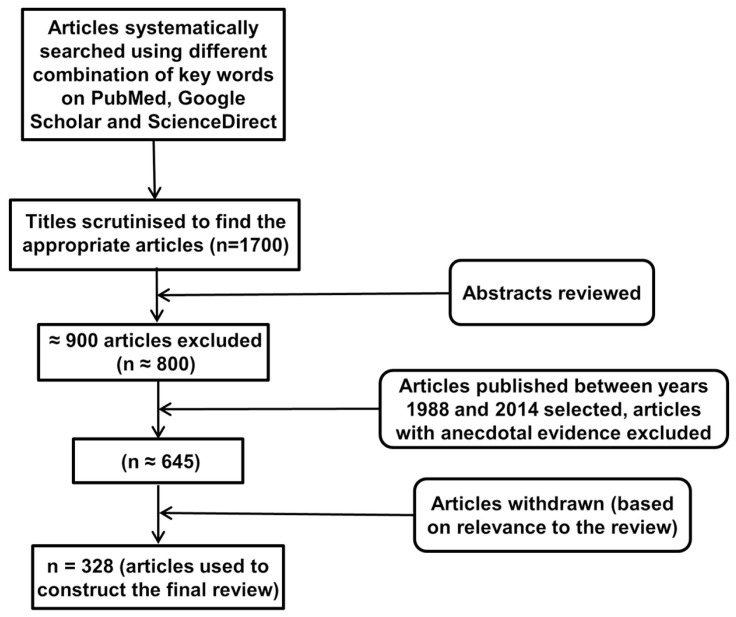
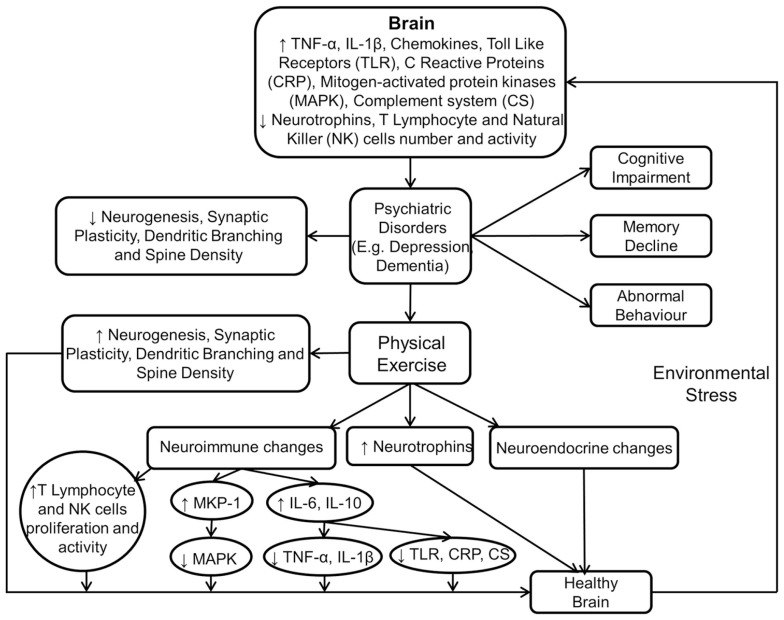
Recent studies on environmental enrichment (EE) have shown cytokines, cellular immune components [e.g., T lymphocytes, natural killer (NK) cells], and glial cells in causal relationship to EE in bringing out changes to neurobiology and behavior. The purpose of this review is to evaluate these neuroimmune mechanisms associated with neurobiological and behavioral changes in response to different EE methods. We systematically reviewed common research databases. After applying all inclusion and exclusion criteria, 328 articles remained for this review. Physical exercise (PE), a form of EE, elicits anti-inflammatory and neuromodulatory effects through interaction with several immune pathways including interleukin (IL)-6 secretion from muscle fibers, reduced expression of Toll-like receptors on monocytes and macrophages, reduced secretion of adipokines, modulation of hippocampal T cells, priming of microglia, and upregulation of mitogen-activated protein kinase phosphatase-1 in central nervous system. In contrast, immunomodulatory roles of other enrichment methods are not studied extensively. Nonetheless, studies showing reduction in the expression of IL-1β and tumor necrosis factor-α in response to enrichment with novel objects and accessories suggest anti-inflammatory effects of novel environment. Likewise, social enrichment, though considered a necessity for healthy behavior, results in immunosuppression in socially defeated animals. This has been attributed to reduction in T lymphocytes, NK cells and IL-10 in subordinate animals. EE through sensory stimuli has been investigated to a lesser extent and the effect on immune factors has not been evaluated yet. Discovery of this multidimensional relationship between immune system, brain functioning, and EE has paved a way toward formulating environ-immuno therapies for treating psychiatric illnesses with minimal use of pharmacotherapy. While the immunomodulatory role of PE has been evaluated extensively, more research is required to investigate neuroimmune changes associated with other enrichment methods.
Overview
The claims and statistics of this paper haven’t been checked yet.
Run the check — free, no account needed. It reads the open-access text and checks the sources it cites.
Integrity signals
Registry
Cites
Statistics
Figures
Verification
Claims the paper makes
The claims and statistics of this paper haven’t been checked yet.
Run the check — free, no account needed. It reads the open-access text and checks the sources it cites.
Claims other papers make about this one
Each is checked against this paper’s own text: does it say what the citing paper says it does?
In the citing paper
“Among those pathways, researchers showed that the inflammasome plays a role in depressive- and anxiety-like behaviors, and locomotor activity (57).”
From The gut-brain axis: how microbiota and host inflammasome influence brain physiology and pathology (2020) · cites this paper as [57]
Self-check
Percentages, sums and reported differences re-computed from the paper’s own numbers.
The self-check needs the paper’s full text.
Citations
Cites
Preferred Reporting Items for Systematic Reviews and Meta-Analyses: the PRISMA statement
Moher, D., Liberati, A., Tetzlaff, J., Altman, D. G., & for the PRISMA Group (2009) · BMJ · doi:10.1136/bmj.b2535 · Cited by 83,823
Preferred reporting items for systematic reviews and meta-analyses: the PRISMA Statement.
(2009) · PubMed Central · Cited by 44,859
Preferred reporting items for systematic reviews and meta-analyses: The PRISMA statement
Moher, D., Liberati, A., Tetzlaff, J., Altman, D. G., & the PRISMA Group* (2009) · Annals of Internal Medicine · doi:10.7326/0003-4819-151-4-200908180-00135 · Cited by 37,554
Liberati, A., Altman, D. G., Tetzlaff, J., Mulrow, C., Gøtzsche, P. C., Ioannidis, J. P. A., Clarke, M., Devereaux, P. J., Kleijnen, J., & Moher, D. (2009) · PLoS Medicine · doi:10.1371/journal.pmed.1000100 · Cited by 28,164
Preferred Reporting Items for Systematic Reviews and Meta-Analyses: The PRISMA Statement
Moher, D., Liberati, A., Tetzlaff, J., & Altman, D. G. (2009) · Journal of Clinical Epidemiology · doi:10.1016/j.jclinepi.2009.06.005 · Cited by 19,575
Liberati, A., Altman, D. G., Tetzlaff, J., Mulrow, C., Gøtzsche, P. C., Ioannidis, J. P. A., Clarke, M., Devereaux, P. J., Kleijnen, J., & Moher, D. (2009) · Annals of Internal Medicine · doi:10.7326/0003-4819-151-4-200908180-00136 · Cited by 10,349
Polazzi, E., Mengoni, I., Caprini, M., Peña‐Altamira, E., Kurtys, E., & Monti, B. (2012) · Neurosignals · doi:10.1159/000337115 · Cited by 9,023
Glutamate neurotoxicity and diseases of the nervous system
Choi, D. W. (1988) · Neuron · doi:10.1016/0896-6273(88)90162-6 · Cited by 8,188
Effects of stress throughout the lifespan on the brain, behaviour and cognition
Lupien, S. J., McEwen, B. S., Gunnar, M. R., & Heim, C. (2009) · Nature Reviews Neuroscience · doi:10.1038/nrn2639 · Cited by 6,256
Exercise training increases size of hippocampus and improves memory
Erickson, K. I., Voss, M. W., Prakash, R. S., Basak, C., Szabo, A., Chaddock, L., Kim, J. S., Heo, S., Alves, H., White, S. M., et al. (2011) · Proceedings of the National Academy of Sciences · doi:10.1073/pnas.1015950108 · Cited by 4,855
Research works printed but not linked: 4
- Fuglestad, 2008, “The role of nutrition in cognitive development,†in, Handbook in Developmental Cognitive Neuroscience, 623
- Haller, 2000, Anxiolytic effects of repeated victory in male Wistar rats., Aggressive Behavior, 26, 257, 10.1002/(SICI)1098-2337(2000)26:3257::AID-AB53.0.CO;2-7 · DOI
- Koletzko, 2003, Exercise and C-reactive protein., HEALTHY WEIGHT, 17
- Nakamura, 1999, Age-changes of brain synapses and synaptic plasticity in response to an enriched environment., J. Neurosci. Res., 56, 307, 10.1002/(SICI)1097-4547(19990501)56:3307::AID-JNR103.0.CO;2-3 · DOI
Cited by
Sorted by citations
Microglia in physiology and disease
Wolf, S. A., Boddeke, H. W. G. M., & Kettenmann, H. (2017) · Annual Review of Physiology · doi:10.1146/annurev-physiol-022516-034406 · Cited by 1,426
The gut-brain axis: how microbiota and host inflammasome influence brain physiology and pathology
Rutsch, A., Kantsjö, J. B., & Ronchi, F. (2020) · Frontiers in Immunology · doi:10.3389/fimmu.2020.604179 · Cited by 821
Wellman, C. L., Bangasser, D. A., Bollinger, J. L., Coutellier, L., Logrip, M. L., Moench, K. M., & Urban, K. R. (2018) · The Journal of Neuroscience · doi:10.1523/jneurosci.1673-18.2018 · Cited by 88
Regulation of astrocyte metabolism by mitochondrial translocator protein 18 kDa
Firth, W., Robb, J. L., Stewart, D., Pye, K. R., Bamford, R., Oguro‐Ando, A., Beall, C., & Ellacott, K. L. J. (2024) · Journal of Neurochemistry · doi:10.1111/jnc.16089 · Cited by 5
Metadata
- Authors
- Singhal, G., Jaehne, E. J., Corrigan, F., & Baune, B. T.
- Affiliations
- The University of Adelaide (AU)
- Corresponding author
- Baune, Bernhard T.
- Venue
- Frontiers in Cellular Neuroscience
- Publisher
- Frontiers Media SA
- Published
- 2014-04-03
- Volume
- 8
- Pages
- 97-97
- ISSN
- 1662-5102 (ISSN-L)
- PMC
- PMC3982075
- OpenAlex
- W2029961705
- Cited by
- 186
- References
- 346
- Citations by year
- 2026: 10 · 2025: 16 · 2024: 20 · 2023: 18 · 2022: 16 · 2021: 19 · 2020: 29 · 2019: 12 · 2018: 12 · 2017: 10 · 2016: 12 · 2015: 9 · 2014: 2
- FWCI
- 0.89
- Type
- journal article
- Language
- en
- Open access
- gold
- doi.org
- Licence
- cc-by
- Locations
- Frontiers in Cellular Neuroscience (publishedVersion, cc-by)
- Europe PMC (PubMed Central) (publishedVersion, cc-by)
- PubMed Central (publishedVersion, cc-by)
- PubMed (publishedVersion)
- Adelaide Research & Scholarship (AR&S) (University of Adelaide) (submittedVersion, cc-by)
- DOAJ (DOAJ: Directory of Open Access Journals) (submittedVersion, cc-by-sa)
- Minerva Access (University of Melbourne) (submittedVersion, cc-by)
- Funders
- Medical Research Council
- National Health and Medical Research Council (1043771)
- Topics
- Life Sciences › Neuroscience › Neurology › Neuroinflammation and Neurodegeneration Mechanisms
- Life Sciences › Neuroscience › Biological Psychiatry › Tryptophan and brain disorders
- Life Sciences › Neuroscience › Behavioral Neuroscience › Stress Responses and Cortisol
- Keywords
- environmental enrichment, neuroimmunomodulation, physical activity, cytokines, interleukin-6, Toll-like receptors, adipokines, microglia, T cells, natural killer cells, social defeat, sensory enrichment, IL-1β, TNF-α, IL-10, mental illness
About these checks
Registry, retraction, Cites and statistics results are computed, not judged, with one exception: a printed reference that no index lists is read once by a model before it counts as a citation error. Claims are extracted by a model and kept only when their quote appears verbatim in the text; each cited source is then checked, with a model’s help, for whether it says what the claim relies on. Those verdicts can be wrong — read the claim’s quote and the cited source before relying on one.
Statistics and arithmetic are recomputed, not judged.
Confidence bands are shown only for fields calibrated on our annotated test set. None is calibrated yet, so no band is shown.
What counts as a claim ›How we measure confidence ›How we check this ›
Are you an author, or do you see a problem with this page? Request a review
