

The DOI matches its Crossref record; 103 of the 103 references it cites were found in a registry or an index.
Regulation of cytoskeletal dynamics by redox signaling and oxidative stress: implications for neuronal development and trafficking
Open accessAbstract
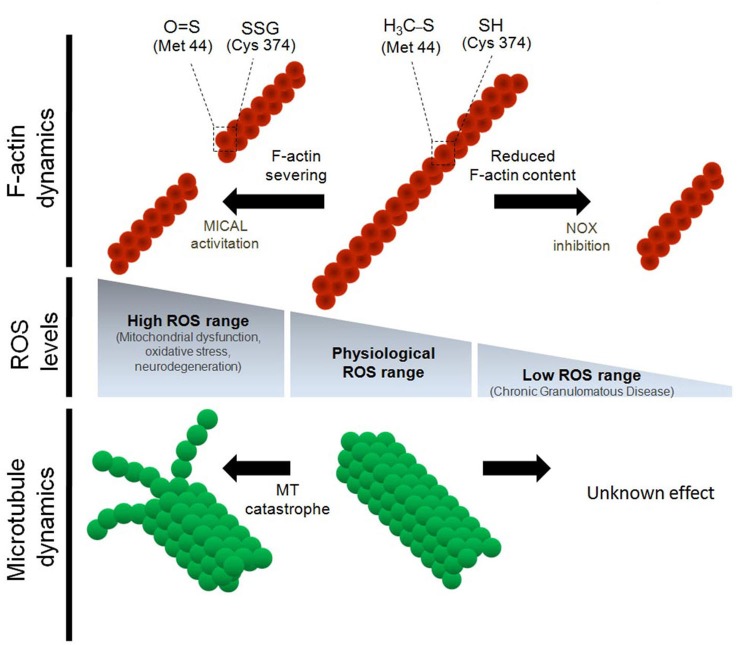
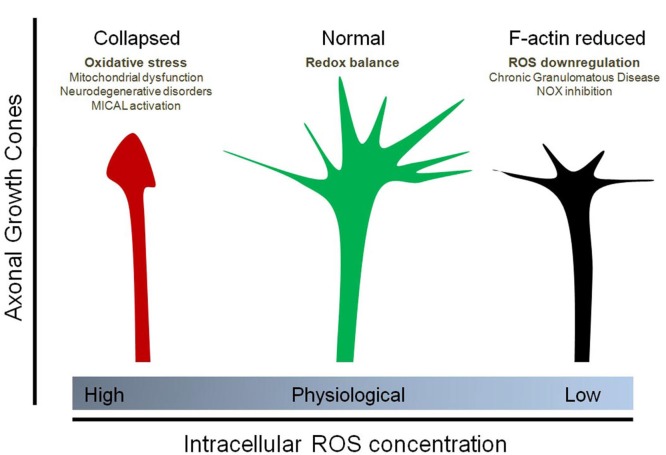
A proper balance between chemical reduction and oxidation (known as redox balance) is essential for normal cellular physiology. Deregulation in the production of oxidative species leads to DNA damage, lipid peroxidation and aberrant post-translational modification of proteins, which in most cases induces injury, cell death and disease. However, physiological concentrations of oxidative species are necessary to support important cell functions, such as chemotaxis, hormone synthesis, immune response, cytoskeletal remodeling, Ca(2+) homeostasis and others. Recent evidence suggests that redox balance regulates actin and microtubule dynamics in both physiological and pathological contexts. Microtubules and actin microfilaments contain certain amino acid residues that are susceptible to oxidation, which reduces the ability of microtubules to polymerize and causes severing of actin microfilaments in neuronal and non-neuronal cells. In contrast, inhibited production of reactive oxygen species (ROS; e.g., due to NOXs) leads to aberrant actin polymerization, decreases neurite outgrowth and affects the normal development and polarization of neurons. In this review, we summarize emerging evidence suggesting that both general and specific enzymatic sources of redox species exert diverse effects on cytoskeletal dynamics. Considering the intimate relationship between cytoskeletal dynamics and trafficking, we also discuss the potential effects of redox balance on intracellular transport via regulation of the components of the microtubule and actin cytoskeleton as well as cytoskeleton-associated proteins, which may directly impact localization of proteins and vesicles across the soma, dendrites and axon of neurons.
Overview
The claims and statistics of this paper haven’t been checked yet.
Run the check — free, no account needed. It reads the open-access text and checks the sources it cites.
Integrity signals
Registry
Cites
Statistics
Figures
Verification
Claims the paper makes
The claims and statistics of this paper haven’t been checked yet.
Run the check — free, no account needed. It reads the open-access text and checks the sources it cites.
Claims other papers make about this one
Each is checked against this paper’s own text: does it say what the citing paper says it does?
The source backs part of the claim, not all of it — or backs it for a different population, condition or comparison.
In the citing paper
“High blue light can cause ROS (produced by high-energy concentrations to induce NADPH oxidase) to regulate chloroplast light-avoiding movement by regulating the polymerization or depolymerization of actin filaments”
From The action of enhancing weak light capture via phototropic growth and chloroplast movement in plants (2022) · cites this paper as Wilson and González-Billault, 2015
Experimental — accuracy not yet measured
Self-check
Percentages, sums and reported differences re-computed from the paper’s own numbers.
The self-check needs the paper’s full text.
Citations
Cites
How mitochondria produce reactive oxygen species
Murphy, M. P. (2009) · Biochemical Journal · doi:10.1042/bj20081386 · Cited by 8,207
The NOX Family of ROS-Generating NADPH Oxidases: Physiology and Pathophysiology
Bedard, K., & Krause, K.-H. (2007) · Physiological Reviews · doi:10.1152/physrev.00044.2005 · Cited by 6,989
Oxidative stress: oxidants and antioxidants
Sies, H. (1997) · Experimental Physiology · doi:10.1113/expphysiol.1997.sp004024 · Cited by 4,577
ROS as signalling molecules: Mechanisms that generate specificity in ROS homeostasis
D'Autréaux, B., & Toledano, M. B. (2007) · Nature Reviews Molecular Cell Biology · doi:10.1038/nrm2256 · Cited by 3,642
Dynamic instability of microtubule growth
Mitchison, T., & Kirschner, M. (1984) · Nature · doi:10.1038/312237a0 · Cited by 3,337
NOX enzymes and the biology of reactive oxygen
Lambeth, J. D. (2004) · Nature Reviews Immunology · doi:10.1038/nri1312 · Cited by 3,125
Reactive Oxygen Species and the Central Nervous System
Halliwell, B. (1992) · Journal of Neurochemistry · doi:10.1111/j.1471-4159.1992.tb10990.x · Cited by 2,947
H 2 O 2 , a Necessary Evil for Cell Signaling
Rhee, S. G. (2006) · Science · doi:10.1126/science.1130481 · Cited by 2,160
Oxidative stress in neurodegeneration: Cause or consequence?
Andersen, J. K. (2004) · Nature Medicine · doi:10.1038/nrn1434 · Cited by 1,869
Refined structure of αβ-tubulin at 3.5 Å resolution 1 1Edited by I. A. Wilson
Löwe, J., Li, H., Downing, K. H., & Nogales, E. (2001) · Journal of Molecular Biology · doi:10.1006/jmbi.2001.5077 · Cited by 1,169
Cited by
Sorted by citations
Reactive oxygen species (ROS) as pleiotropic physiological signalling agents
Sies, H., & Jones, D. P. (2020) · Nature Reviews Molecular Cell Biology · doi:10.1038/s41580-020-0230-3 · Cited by 5,335
Mitocytosis, a migrasome-mediated mitochondrial quality-control process
Jiao, H., Jiang, D., Hu, X., Du, W., Ji, L., Yang, Y., Li, X., Sho, T., Wang, X., Li, Y., et al. (2021) · Cell · doi:10.1016/j.cell.2021.04.027 · Cited by 569
Short Overview of ROS as Cell Function Regulators and Their Implications in Therapy Concepts
Milković, L., Gašparović, A. Č., Cindrić, M., Mouthuy, P., & Žarković, N. (2019) · Cells · doi:10.3390/cells8080793 · Cited by 330
The biological pathways of Alzheimer disease: a review
Calabrò, M., Rinaldi, C., Santoro, G., & Crisafulli, C. (2020) · AIMS neuroscience · doi:10.3934/neuroscience.2021005 · Cited by 287
Magnetic field effects in biology from the perspective of the radical pair mechanism
Zadeh-Haghighi, H., & Simon, C. (2022) · Journal of The Royal Society Interface · doi:10.1098/rsif.2022.0325 · Cited by 197
Metadata
- Authors
- Wilson, C., & González-Billault, C.
- Affiliations
- University of Chile (CL)
- Corresponding author
- González-Billault, Christian
- Venue
- Frontiers in Cellular Neuroscience
- Publisher
- Frontiers Media SA
- Published
- 2015-09-30
- Volume
- 9
- Pages
- 381-381
- ISSN
- 1662-5102 (ISSN-L)
- PMC
- PMC4588006
- OpenAlex
- W1850305390
- Cited by
- 238
- References
- 103
- Citations by year
- 2026: 23 · 2025: 19 · 2024: 12 · 2023: 14 · 2022: 32 · 2021: 32 · 2020: 35 · 2019: 22 · 2018: 16 · 2017: 14 · 2016: 16 · 2015: 2
- FWCI
- 1.55
- Type
- journal article
- Language
- en
- Open access
- gold
- doi.org
- Licence
- cc-by
- Locations
- Frontiers in Cellular Neuroscience (publishedVersion, cc-by)
- Europe PMC (PubMed Central) (publishedVersion, cc-by)
- PubMed Central (publishedVersion, cc-by)
- PubMed (publishedVersion)
- Americanae (AECID Library) (submittedVersion, cc-by-nc-nd)
- DOAJ (DOAJ: Directory of Open Access Journals) (submittedVersion, cc-by-sa)
- LA Referencia (Red Federada de Repositorios Institucionales de Publicaciones Científicas) (submittedVersion, cc-by-nc-nd)
- Universidad de Chile (submittedVersion, cc-by-nc-nd)
- Funders
- Comisión Nacional de Investigación Científica y Tecnológica (ACT1114, 21120221)
- Fondo Nacional de Desarrollo Científico y Tecnológico (1140325)
- Topics
- Life Sciences › Biochemistry, Genetics and Molecular Biology › Molecular Biology › Redox biology and oxidative stress
- Life Sciences › Biochemistry, Genetics and Molecular Biology › Cell Biology › Microtubule and mitosis dynamics
- Life Sciences › Biochemistry, Genetics and Molecular Biology › Cell Biology › Cellular Mechanics and Interactions
- Keywords
- redox signaling, oxidative stress, redox homeostasis, cytoskeletal dynamics, actin dynamics, microtubule dynamics, reactive oxygen species, neuronal development, neuronal polarity, neurite outgrowth, intracellular trafficking, axonal transport, protein oxidation, nitric oxide synthase
About these checks
Registry, retraction, Cites and statistics results are computed, not judged, with one exception: a printed reference that no index lists is read once by a model before it counts as a citation error. Claims are extracted by a model and kept only when their quote appears verbatim in the text; each cited source is then checked, with a model’s help, for whether it says what the claim relies on. Those verdicts can be wrong — read the claim’s quote and the cited source before relying on one.
Statistics and arithmetic are recomputed, not judged.
Confidence bands are shown only for fields calibrated on our annotated test set. None is calibrated yet, so no band is shown.
What counts as a claim ›How we measure confidence ›How we check this ›
Are you an author, or do you see a problem with this page? Request a review
