

The DOI matches its Crossref record; 138 of the 138 references it cites were found in a registry or an index.
Neurologic Alterations Due to Respiratory Virus Infections
Open accessAbstract
Central Nervous System (CNS) infections are one of the most critical problems in public health, as frequently patients exhibit neurologic sequelae. Usually, CNS pathologies are caused by known neurotropic viruses such as measles virus (MV), herpes virus and human immunodeficiency virus (HIV), among others. However, nowadays respiratory viruses have placed themselves as relevant agents responsible for CNS pathologies. Among these neuropathological viruses are the human respiratory syncytial virus (hRSV), the influenza virus (IV), the coronavirus (CoV) and the human metapneumovirus (hMPV). These viral agents are leading causes of acute respiratory infections every year affecting mainly children under 5 years old and also the elderly. Up to date, several reports have described the association between respiratory viral infections with neurological symptoms. The most frequent clinical manifestations described in these patients are febrile or afebrile seizures, status epilepticus, encephalopathies and encephalitis. All these viruses have been found in cerebrospinal fluid (CSF), which suggests that all these pathogens, once in the lungs, can spread throughout the body and eventually reach the CNS. The current knowledge about the mechanisms and routes used by these neuro-invasive viruses remains scarce. In this review article, we describe the most recent findings associated to neurologic complications, along with data about the possible invasion routes of these viruses in humans and their various effects on the CNS, as studied in animal models.
Overview
The claims and statistics of this paper haven’t been checked yet.
Run the check — free, no account needed. It reads the open-access text and checks the sources it cites.
Integrity signals
Registry
Cites
Statistics
Figures
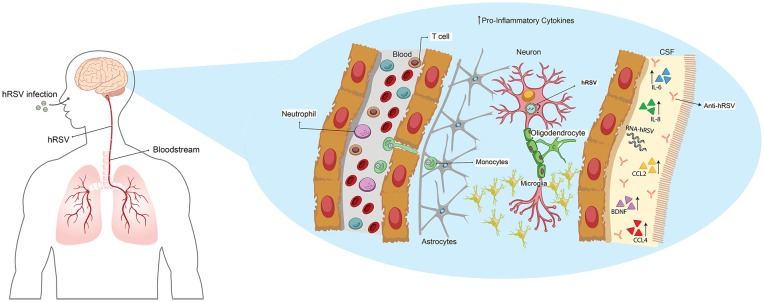
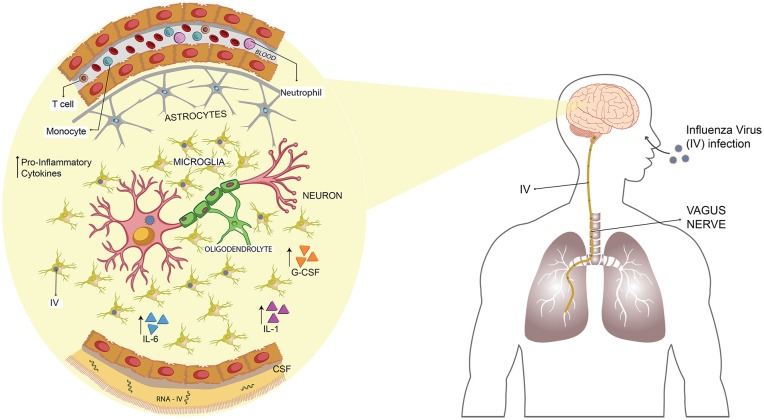
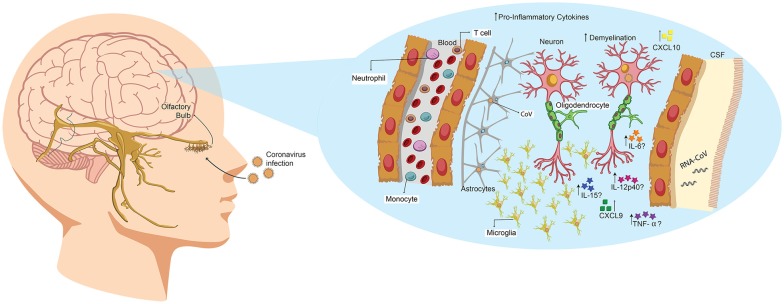
Verification
Claims the paper makes
The claims and statistics of this paper haven’t been checked yet.
Run the check — free, no account needed. It reads the open-access text and checks the sources it cites.
Claims other papers make about this one
Each is checked against this paper’s own text: does it say what the citing paper says it does?
In the citing paper
“Respiratory viral diseases are associated with both acute and long-lasting psychopathological consequences in the survivors (Bohmwald et al., 2018).”
From Anxiety and depression in COVID-19 survivors: role of inflammatory and clinical predictors (2020) · cites this paper as Bohmwald et al., 2018
In the citing paper
“For example, after CoV infects nasal cells, it can reach the entire brain and cerebrospinal fluid through the olfactory nerve and olfactory bulb within 7 days and cause inflammation and demyelinating reaction.”
From Nervous system involvement after infection with COVID-19 and other coronaviruses (2020) · cites this paper as Bohmwald et al., 2018
In the citing paper
“However, removal of the olfactory bulb in the mice, resulted in a restricted invasion of CoV into the CNS (Bohmwald et al., 2018).”
From Nervous system involvement after infection with COVID-19 and other coronaviruses (2020) · cites this paper as Bohmwald et al., 2018
In the citing paper
“Additionally, experiments have confirmed that primary glial cells cultured in vitro secrete a large amount of inflammatory factors such as IL-6, IL-12, IL-15, and TNF-α after being infected with CoV (Bohmwald et al., 2018).”
From Nervous system involvement after infection with COVID-19 and other coronaviruses (2020) · cites this paper as Bohmwald et al., 2018
In the citing paper
“Many viruses, including coronaviruses, have been shown to propagate from the nasal epithelium past the cribriform plate to infect the OB; this form of central infection has been suggested to mediate olfactory deficits, even in the absence of lasting OE damage (60-65).”
From Non-neuronal expression of SARS-CoV-2 entry genes in the olfactory system suggests mechanisms underlying COVID-19-associated anosmia (2020) · cites this paper as [60]
Self-check
Percentages, sums and reported differences re-computed from the paper’s own numbers.
The self-check needs the paper’s full text.
Citations
Cites
A newly discovered human pneumovirus isolated from young children with respiratory tract disease
van den Hoogen, B. G., de Jong, J. C., Groen, J., Kuiken, T., de Groot, R., Fouchier, R. A. M., & Osterhaus, A. D. M. E. (2001) · Nature Medicine · doi:10.1038/89098 · Cited by 2,186
Classification and Nomenclature of Viruses
Fenner, F. J., Bachmann, P., Gibbs, E. P. J., Murphy, F. A., Studdert, M. J., & WHITE, D. O. (1987) · Elsevier eBooks · doi:10.1016/b978-0-12-253055-5.50006-2 · Cited by 1,326
The biology of influenza viruses
Bouvier, N. M., & Palese, P. (2008) · Vaccine · doi:10.1016/j.vaccine.2008.07.039 · Cited by 1,199
Ding, Y., He, L., Zhang, Q., Huang, Z., Che, X., Hou, J., Wang, H., Shen, H., Qiu, L., Li, Z., et al. (2004) · The Journal of Pathology · doi:10.1002/path.1560 · Cited by 1,082
King, A. M. Q., Lefkowitz, E. J., Mushegian, A. R., Adams, M. J., Dutilh, B. E., Gorbalenya, A. E., Balázs Harrach, B., Harrison, R. L., Junglen, S., Knowles, N. J., et al. (2018) · Archives of Virology · doi:10.1007/s00705-018-3847-1 · Cited by 1,078
Nidovirales: Evolving the largest RNA virus genome
Gorbalenya, A. E., Enjuanes, L., Ziebuhr, J., & Snijder, E. J. (2006) · Virus Research · doi:10.1016/j.virusres.2006.01.017 · Cited by 938
Respiratory Viral Infections in Infants: Causes, Clinical Symptoms, Virology, and Immunology
Tregoning, J. S., & Schwarze, J. (2010) · Clinical Microbiology Reviews · doi:10.1128/cmr.00032-09 · Cited by 768
Gaunt, E. R., Hardie, A., Claas, E. C. J., Peter Simmonds, K., & Templeton, K. E. (2010) · Journal of Clinical Microbiology · doi:10.1128/jcm.00636-10 · Cited by 699
Transmission routes of respiratory viruses among humans
Kutter, J. S., Spronken, M. I., Fraaij, P. L., Fouchier, R. A., & Herfst, S. (2018) · Current Opinion in Virology · doi:10.1016/j.coviro.2018.01.001 · Cited by 611 · cited 1×
“The transmission of these viruses is mainly by contact with fomites or suspension droplets (Kutter et al., 2018) .”
BackgroundVirus Infections in the Nervous System
Koyuncu, O. O., Hogue, I. B., & Enquist, L. W. (2013) · Cell Host & Microbe · doi:10.1016/j.chom.2013.03.010 · Cited by 594
Research works printed but not linked: 1
- Swanson, Chapter 2. Portals of viral entry into the central nervous system, 23
Cited by
Sorted by citations
Rogers, J. P., Chesney, E., Oliver, D., Pollak, T. A., McGuire, P., Fusar-Poli, P., Zandi, M. S., Lewis, G., & David, A. S. (2020) · The Lancet Psychiatry · doi:10.1016/s2215-0366(20)30203-0 · Cited by 2,407
Nervous system involvement after infection with COVID-19 and other coronaviruses
Wu, Y., Xu, X., Chen, Z., Duan, J., Hashimoto, K., Yang, L., Liu, C., & Yang, C. (2020) · Brain, Behavior, and Immunity · doi:10.1016/j.bbi.2020.03.031 · Cited by 2,046
Anxiety and depression in COVID-19 survivors: role of inflammatory and clinical predictors
Mazza, M. G., De Lorenzo, R., Conte, C., Poletti, S., Vai, B., Bollettini, I., Melloni, E. M. T., Furlan, R., Ciceri, F., Rovere-Querini, P., et al. (2020) · Brain, Behavior, and Immunity · doi:10.1016/j.bbi.2020.07.037 · Cited by 1,804
Brann, D. H., Tsukahara, T., Weinreb, C., Lipovsek, M., Van den Berge, K., Gong, B., Chance, R., Macaulay, I. C., Chou, H.-J., Fletcher, R. B., et al. (2020) · Science Advances · doi:10.1126/sciadv.abc5801 · Cited by 1,198
Desforges, M., Le Coupanec, A., Dubeau, P., Bourgouin, A., Lajoie, L., Dubé, M., & Talbot, P. J. (2019) · Viruses · doi:10.3390/v12010014 · Cited by 1,048
Metadata
- Authors
- Bohmwald, K., Gálvez, N. M. S., Ríos, M., & Kalergis, A. M.
- Affiliations
- Pontificia Universidad Católica de Chile (CL)
- Corresponding author
- Kalergis, Alexis M.
- Venue
- Frontiers in Cellular Neuroscience
- Publisher
- Frontiers Media SA
- Published
- 2018-10-26
- Volume
- 12
- Pages
- 386-386
- ISSN
- 1662-5102 (ISSN-L)
- PMC
- PMC6212673
- OpenAlex
- W2898372989
- Cited by
- 636
- References
- 138
- Citations by year
- 2026: 21 · 2025: 22 · 2024: 38 · 2023: 75 · 2022: 101 · 2021: 169 · 2020: 203 · 2019: 4
- FWCI
- 13.79
- Type
- journal article
- Language
- en
- Open access
- gold
- doi.org
- Locations
- Frontiers in Cellular Neuroscience (publishedVersion, cc-by)
- Europe PMC (PubMed Central) (publishedVersion, cc-by)
- PubMed Central (publishedVersion, cc-by)
- PubMed (publishedVersion)
- DOAJ (DOAJ: Directory of Open Access Journals) (submittedVersion, cc-by-sa)
- Funders
- Instituto Milenio en Inmunología e Inmunoterapia (P09/016-F, 3180570, 1150862)
- Topics
- Health Sciences › Medicine › Infectious Diseases › Infectious Encephalopathies and Encephalitis
- Health Sciences › Medicine › Epidemiology › Respiratory viral infections research
- Health Sciences › Medicine › Epidemiology › Virology and Viral Diseases
- Keywords
- respiratory viral infections, neurological complications, central nervous system infection, respiratory syncytial virus, influenza virus, coronavirus, human metapneumovirus, encephalitis, encephalopathy, status epilepticus, febrile seizures, cerebrospinal fluid, neurotropism, pediatric respiratory infection
About these checks
Registry, retraction, Cites and statistics results are computed, not judged, with one exception: a printed reference that no index lists is read once by a model before it counts as a citation error. Claims are extracted by a model and kept only when their quote appears verbatim in the text; each cited source is then checked, with a model’s help, for whether it says what the claim relies on. Those verdicts can be wrong — read the claim’s quote and the cited source before relying on one.
Statistics and arithmetic are recomputed, not judged.
Confidence bands are shown only for fields calibrated on our annotated test set. None is calibrated yet, so no band is shown.
What counts as a claim ›How we measure confidence ›How we check this ›
Are you an author, or do you see a problem with this page? Request a review
